5 Days of Manding Mastery
Presented by Matt Harrington
The “5 Days to Manding Mastery” course, created by Matt Harrington and presented by the Behaviorist Book Club, is a practical, research-informed training designed to help behavior analysts and practitioners enhance their understanding and implementation of mand training. The course addresses common challenges faced in early intervention and verbal behavior programs, particularly the tendency to implement mand training without adequate consideration of prerequisites, modality selection, or programming sequence. Over five sessions, participants explore foundational concepts such as prerequisite assessments, efficient prompting strategies, programming order, and generalization techniques. The course also introduces strategies for extending basic manding to more complex skills, such as manding for information and integrating functional communication training (FCT) to reduce problem behavior. It blends research findings with real-world clinical examples, offering a structured but flexible path to more effective, individualized communication programming.
Register free & watch nowCancel any time. Cert delivered to your inbox the moment you pass the quiz.
Learner ratings
from 159 learners
100% would recommend this CEU to other professionals in their field (138 responses)
“Informative materi”
— Falak N.“Great presentation with very informative articles”
— Rosario P.“I really enjoyed how he included studies and real life examples”
— Jocelyn C.
About this CEU
The “5 Days to Manding Mastery” course, created by Matt Harrington and presented by the Behaviorist Book Club, is a practical, research-informed training designed to help behavior analysts and practitioners enhance their understanding and implementation of mand training. The course addresses common challenges faced in early intervention and verbal behavior programs, particularly the tendency to implement mand training without adequate consideration of prerequisites, modality selection, or programming sequence. Over five sessions, participants explore foundational concepts such as prerequisite assessments, efficient prompting strategies, programming order, and generalization techniques. The course also introduces strategies for extending basic manding to more complex skills, such as manding for information and integrating functional communication training (FCT) to reduce problem behavior. It blends research findings with real-world clinical examples, offering a structured but flexible path to more effective, individualized communication programming.
From the talk
What was covered
Mand training that holds up: prerequisite checks, prompt delays, discriminated mands, caregiver coaching, and FCT schedule thinning.
- Probe imitation, echoic (copying sounds you hear), and matching before picking a mand modality. Low echoic scores predict stalled vocal mand training.
- Write a progressive prompt delay into the protocol with a flexible criterion, not a fixed number of days per step.
- Check for discriminated manding (requesting only when the want is really present). Give free access to one item and restrict the other, instead of leaning on vocal prompts.
- Teach manding and tacting at the same time rather than running one verbal operant at a time.
- Track five named mand targets, plus a spontaneous bucket and a contrived bucket. One broad mand percentage hides prompt dependency (leaning on the therapist's prompt instead of real want).
- Prep 15 to 30 different scenarios before you teach manding for information, because answering the question removes the motivation.
Run a Prerequisite Skills Check Before You Pick a Mand Modality
Mand training (teaching a learner to request things) often gets dropped into a program fast. Matt Harrington says he has done that himself. The first question is a simple one. Which modality (the form the request takes) fits this learner? The usual choices are vocal words, sign, and picture exchange. Picking one out of a hat can cost months.
Valentino and colleagues (2018) tested a brief prerequisite skills assessment. They probed three skills: motor imitation, echoic responses (copying sounds you hear), and matching. Each skill lines up with one modality. Motor imitation lines up with sign. Echoic lines up with vocal. Matching lines up with pictures. Then they taught all three modalities and watched which one was mastered first.
With three participants, the results were mixed. One learner scored high on matching only and mastered pictures first. That was a clean match. Another scored high on everything and mastered everything, which tells you little. A third did not line up at all. One finding did hold: echoic scores were low and vocal manding never showed up. If a learner cannot copy one and two syllable sounds, vocal mand training will likely stall.
You do not need a fifty session assessment for this. Brief probes during intake are enough. If you run the VB-MAPP (a verbal behavior skills assessment) or the ABLLS (a similar skills assessment), you are already gathering the data. The step most people skip is using those results to order the program instead of just filling in goals for insurance.
So what's lost when prerequisite skills aren't taken into account is a lot of time.
From the talk — Matt Harrington
Handling the Modality Talk With Families and the Rest of the Team
Your assessment will not always match what the family pictures. In Harrington's experience, many caregivers want a vocal mand no matter what. There is real emotion in that. They want their kid to come home and say mommy or daddy. Telling them pictures may be the faster route is a hard conversation.
It is also a conversation you should not have alone. Behavior analysts are not the only professionals who work on language. Speech and language pathologists, occupational therapists, teachers, and school psychologists all bring data you do not have. Harrington describes a school case. The learner had language skills, but also a lot of stereotypy (repeated behavior that keeps itself going). The speech pathologist offered insight he would have missed. The team moved from requiring a vocal mand to a picture exchange with an optional vocal mand attached.
Two things make this easier. First, have the frank sit down conversation early and say what you are seeing. Second, run two tracks at once. You can reinforce the picture exchange now while you build imitation, observational learning, and vocal imitation in the background. That keeps the vocal mand on the table as a later goal instead of a dropped one.
And I think it's really important to stay humble and listen and take advice from a lot of the other professionals in the room.
From the talk — Matt Harrington
The Basic Mand Arrangement and the Progressive Prompt Delay
Bowen and colleagues (2012) give a clean starting protocol. Sessions were naturalistic. Therapists capitalized on ongoing establishing operations (states that make an item worth wanting). A preference assessment picked the item. Teaching used a progressive prompt delay (waiting longer before you help) that moved from zero seconds to two seconds to six seconds. The study also compared adding the question what do you want against leaving it out. There was no difference. That fits the theory. The mand is controlled by deprivation and satiation (wanting something more, or less, based on recent access), not by the technician's question.
The mechanics matter more than the numbers. The learner walks to the juice and points. At a zero second delay, the therapist immediately models the sign, the learner copies it, and the juice is delivered. After a few correct responses in a row, the delay moves to two seconds, then six. Harrington runs this with a flexible criterion instead of three days per step. Three independent responses move the delay up. Errors move it back down. A whiteboard with tally dots keeps technicians on track.
Landa and colleagues (2022) answer the question that most protocols leave blank. What do you do when problem behavior happens first? They compared prompting right after the problem behavior, prompting as the reinforcer was removed, and delaying the prompt. Prompting immediately after problem behavior was not linked to more problem behavior in eight of eleven participants. It was linked to a decrease. The delay method sometimes produced an extinction burst (a spike when a response stops working).
One more piece belongs in the beginner arrangement: immediate access on an FR1 schedule (reinforce every single request). This is not the phase for thin or variable schedules. Build the skill first, then fade.
But the key is to have a flexible criteria that both goes up and goes down and having a tech who really understands and is able to keep track of that arrangement.
From the talk — Matt Harrington
Discriminated Manding: The Problem Hiding in Picture Card Programs
Vocal and sign mands sound and look different from each other. Say cracker and you get a cracker. Say water and you get water. Picture cards break that pattern. The response is the same motion every time: pick up a card and hand it over. Only the card changes. So learners often scroll, meaning they try card after card until something works. If that communication is replacing challenging behavior, the delay can set off an extinction burst.
A 2007 study tackled this by manipulating the establishing operation directly. Two previously taught cards sat in front of the learner. One item, a radio, was freely available and already playing. The other, Skittles, was visible but locked behind a request. Handing over the radio card shows the mand is not discriminated (matched to what the learner actually wants right now). Handing over the Skittle card shows it is. The manipulation worked for three of the four participants. For the fourth, the team added a vocal mand so discrimination would be easier.
Harrington's clinical warning is about prompts. A learner reaches for the tablet, the technician blocks and says say tablet please, and the learner repeats it. Later the learner reaches for a snack, gets blocked, and says tablet please again. That is echoing the last reinforced phrase, not requesting. Checking discrimination with an EO manipulation is faster and cleaner than adding more vocal prompts.
We don't just want kiddos echoing.
From the talk — Matt Harrington
Acquisition Efficiency: Teaching Order, Item Selection, and Data Setup
Efficiency here means how fast skills are acquired (learned to mastery). Behavior analysts tend to chase big visual effects on a graph. Harrington argues that five or ten percent is plenty. Across hundreds of verbal targets, that saved time compounds. It can mean fewer therapy hours, more time in the natural environment, and faster fading of services.
Programming order is one of the biggest levers and one of the least researched. A 2002 study compared two methods: teaching manding and tacting together, or tacting alone. It measured how fast tacts (labels for things) were learned. Teaching both operants together was the stronger method for both clients. That matches what Harrington sees in practice. Teaching one operant at a time makes each natural error a separate stall. Matrix training (teaching a set of item and skill combinations) is another efficiency tool worth reading about. So is multiple exemplar training (teaching with many varied examples).
For item selection, he starts with a free operant preference assessment (watch what the learner picks on their own). Technicians write down the top item every five minutes for about an hour. That gives roughly twenty data points. The top four or five items go into a quick MSWO assessment (items get removed once picked). That builds a hierarchy. Those items become the mand targets.
The data structure is where most programs go soft. One broad mand percentage gives you nothing to decide from. Instead, run five named targets, a sixth bucket for spontaneous mands, and a seventh for contrived or prompted mands. If targets sit at one hundred percent and spontaneous mands sit at zero, that gap is prompt dependency. Now you can see it and work on removing it.
Tracking that spontaneous manning has been a game changer for me just with an easy frequency setup.
From the talk — Matt Harrington
Manding for Information: Why Teaching Why Is So Hard
Valentino and a coauthor published a 2019 study on teaching the mand why to children with autism. They searched the literature first and found almost nothing on it. There are dozens of studies on simple mands for items. Complex mands for information get much less attention.
The analysis does not change when the mand gets complex. You still need a motivating state, a response, and a consequence that the response specifies. For goldfish, the consequence is goldfish. For who, the consequence is the answer. So you build a question mark into the room. A new person walks in. Someone wears a silly hat. Someone jumps up and down for no clear reason. The learner has a reason to ask.
Why is harder than what for one reason. Answering the question wipes out the motivation. Run the same scenario twice and the second ask is probably under the control of your materials, not curiosity. That is an undiscriminated mand again. The 2019 authors solved it without anything fancy. They wrote a long list of different scenarios and rotated through them. The learner manded when the question mark was present and did not when it was absent.
Harrington adds a story that reframes the work. He kept failing to teach why with silly hats and props. A person outside the field asked whether the kid actually cared. He did not. Rebuilding every scenario around the learner's special interest changed everything. Plan on two or three days of setup for a complex mand program.
And the key is to have a lot of different scenarios prepped.
From the talk — Matt Harrington
Caregiver Coaching That Produces Real Generalization
A mand that only works with the technician is not worth much. Generalization (using the skill in new places with new people) is the whole point. A 2022 Ferguson article gave Harrington a model he wishes he had earlier. It was fully telehealth, run during the pandemic, with caregivers in one country and trainers in another. The caregivers already had some ABA coursework or RBT (registered behavior technician) training, but lacked supervision.
The training itself was ordinary behavioral skills training (teach it, model it, have them practice, then give feedback). Caregivers recorded videos of themselves playing with their kids and promoting language. Fidelity (following the steps as written) came out strong. Harrington argues the real value is the strategy table. It defines the manding strategy step by step. Create motivation by withholding items or giving only a small amount. Add new pieces to play so more things are worth requesting. Watch for child initiation: reaching, pointing, or word approximations. Prompt with a short time delay (wait a few seconds before helping). Then reinforce the communication right away.
He flags one caveat. The published procedure required eye contact before prompting. He does not require it and does not recommend it. He looks at general attending behavior (whether the learner is actually focused on you) instead, such as whether the learner is busy with a competing item. Start this coaching in the first week, when families are still excited, not after the program is already built.
And the earlier you started, the more buy-in I think you're going to get from a caregiver because you start sessions, they're excited about sessions, they're excited about ABA.
From the talk — Matt Harrington
FCT and the Two Schedule Thinning Methods Clinicians Actually Use
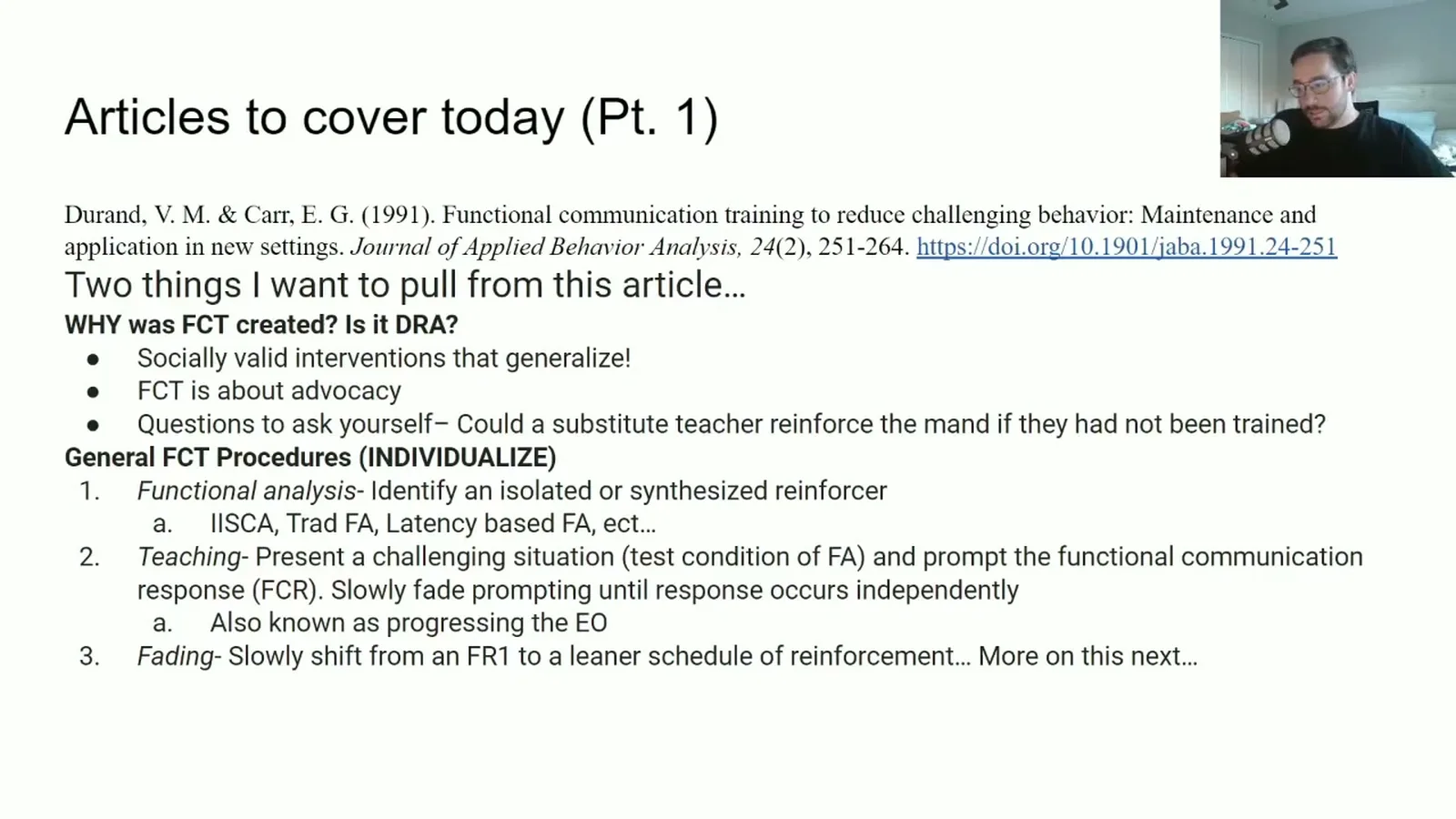
Functional communication training, or FCT (teaching a request that replaces problem behavior), rests on one behavioral principle. That principle is differential reinforcement of alternative behavior, or DRA (reinforcing a different response instead). So is it just DRA with a new name? Partly. DRA only requires that the replacement match the function. Clapping, waving, or touching your head would all count. FCT adds social validity (whether the behavior matters to everyday people) and generalization as design rules. The response has to travel.
Harrington's test question is sharp: could a substitute teacher reinforce this mand with no notes left behind? He once taught a learner to clap for a five minute break. Staff and classmates understood it. Then a substitute arrived and clapped back, and the day fell apart. That is why the research favors plain responses: break please, attention please, a tapped button, or a handed card.
The broad procedure runs in three stages. Confirm the function first with an assessment. Fast options work well now: latency based, trial based, brief, or a single session interview informed assessment. Then teach by progressing the motivating condition, reinforcing the communication response, and fading prompts with a time delay. Then thin the schedule from every single time to something natural.
Thinning is where most people get stuck. The first common method is a multiple schedule (two schedules that never run at once). A visual cue shows which one is active. Green side means every request is honored. Red side means requests get a not right now. Start red at five seconds, then ten, then thirty, and keep climbing. A ten minute timer and a whiteboard make this easy for technicians. The second method adds competing stimuli (items that hold the learner's attention) during the red periods. A competing stimulus assessment identifies them. Fading goes noticeably faster with them. But you then face a slow fade of the items themselves. In many home situations, Harrington argues you may not need to fade them at all.
And really, at the end of the day, functional communication training is about advocacy.
From the talk — Matt Harrington
Common questions
How do I choose between vocal, sign, and picture exchange for mand training?▾
Probe three prerequisite skills first: motor imitation, echoic responses, and matching. Motor imitation maps to sign, echoic maps to vocal, and matching maps to pictures. The strongest signal from the research is negative: if echoic skills are absent, vocal mand training will likely stall. Bring caregiver and team input into the final call, since an assessment result alone will not carry a hard conversation.
What is a progressive prompt delay in mand training?▾
It is a planned wait time between the learner's signal of interest and your prompt. You start at zero seconds with an immediate model, then stretch to two seconds, then six, as independent responses build. Harrington recommends a flexible criterion. Three independent responses move the delay up, and errors can move it back down. Tell your technicians the exact rule so the fading is not left to guesswork.
Why do learners scroll through picture cards, and how do I fix it?▾
Card exchanges all look the same. The response does not carry the specific request the way a spoken word does. That makes discrimination harder to build and easy to miss. Test it by giving free access to one item while restricting the other. If the learner hands you the card for the item they already have, the mand is not discriminated yet.
Should I teach manding and tacting at the same time or one at a time?▾
A 2002 study compared mand plus tact training against tact only training. Teaching both together was the superior method for both clients. Harrington's clinical experience matches it. Teaching one operant at a time makes each natural error into its own delay. More research is needed here, but the available evidence points toward teaching multiple verbal operants together.
What is the difference between FCT and DRA?▾
At the level of behavioral principle, FCT is DRA. The difference is in design intent. DRA only requires a function based alternative response, which could be any arbitrary behavior. FCT requires a response that generalizes, meaning new people in new settings can recognize and honor it without being coached.
How do I thin the schedule after FCT is working?▾
Two methods dominate practice. A multiple schedule uses a visual cue: a green side and a red side. It signals when requests will be honored. You start with very short extinction periods and stretch them slowly. The second method adds competing stimuli during the red periods. That speeds up thinning, though you may later need to fade those items too.
About the speaker
Matt Harrington is a behavior analyst. He calls himself a practitioner of the science first, and he focuses his learning, practice, and teaching on clinicians. He leads the Behaviorist Book Club, a podcast and ABA research library. His team has summarized more than 220 published articles there. He has worked in early intervention and verbal behavior settings for close to seven years. That work has included reducing problem behavior and teaching complex verbal behavior. He now works as a telehealth BCBA (a board certified behavior analyst working remotely). His RBTs (registered behavior technicians) work with clients in person.
This summary was generated from the recording’s transcript. Quotes are taken word for word from the talk.
What you'll learn
- 1By the end of this course, participants will be able to:
- 2Assess Prerequisites for Mand Training
- 3Identify key prerequisite skills (e.g., imitation, echoics, matching) that influence modality selection for manding.
- 4Discuss how caregiver input and client preferences should factor into modality decisions.
- 5Design Basic Mand Training Arrangements
- 6Set up naturalistic manding trials using progressive prompt delays.
- 7Describe the role of establishing operations (EOs) and how to capitalize on deprivation/satiation.
- 8Improve Acquisition Efficiency
- 9Analyze research comparing programming orders (e.g., mand-tact vs. tact-only training).
- 10Evaluate strategies such as EO manipulations and stimulus discrimination to improve response accuracy and generalization.
- 11Extend to Complex Mands and Generalization
- 12Differentiate between simple and complex mands, including manding for information.
- 13Implement caregiver training strategies to promote generalization outside of sessions.
- 14Integrate Functional Communication Training (FCT)
- 15Describe the relationship between FCT and mand training in problem behavior reduction.
- 16Identify prompting strategies and fading procedures for maintaining FCT while minimizing challenging behavior.
Concepts in this CEU
Related talks
Talks that cover the same concepts
Solving Clinical Challenges with Research
The Behaviorist Bookclub
Prediction and Probabilities: Three foundational equations to successful behavior reduction
The Behaviorist Bookclub

Delegating with Confidence: Training and Supervising RBTs to Support Assessments
Copper Consulting Group
Dunder Mifflin’s Guide to Training and Onboarding: Lessons from The Office
The Behaviorist Bookclub
Research to practice - extending past the pages
The Behaviorist Bookclub

Empowering Autonomy and Self-Management in ADHD Learners
The Behaviorist Bookclub
More from The Behaviorist Bookclub
Harm Reduction Within ABA Practice
The Behaviorist Bookclub
Supervising Beyond Technical Skills: Professionalism, Communication, and Clinical Judgment
The Behaviorist Bookclub
Reflective Supervision and Client Outcomes
The Behaviorist Bookclub
OpenCEU is supported by advertising from third-party sponsors. Sponsors are clearly labeled, have no influence over course content, instructors, or CEU decisions, and never appear on certificates. The BACB does not sponsor, approve, or endorse OpenCEU sponsors or their products.