Prediction and Probabilities: Three foundational equations to successful behavior reduction
Presented by Matt Harrington
This course, “Predictions and Probabilities: Three Foundational Equations to Successful Behavior Reduction,” explores the core principles of behavior analysis through the lens of three pivotal equations: contingency space analysis, the matching law, and the percentile schedule. Designed for behavior analysts seeking to enhance their clinical decision-making skills, the course emphasizes the importance of understanding foundational equations to predict and influence behavior change effectively. Participants will learn how to apply these equations to real-world scenarios, ensuring interventions are individualized and ethically sound. Through a combination of theoretical exploration and practical examples, the course aims to deepen participants' understanding of behavior reduction strategies and improve their ability to implement successful interventions.
Register free & watch nowCancel any time. Cert delivered to your inbox the moment you pass the quiz.
Learner ratings
from 37 learners
100% would recommend this CEU to other professionals in their field (17 responses)
“Great! Loved the contingency analysis, particularly for Behaviour Analysts that work within schools where it's hard to get very strong fidelity.”
— Kathryn T.“This was clear and informative presentation. The examples helped connect the concepts to practical behavior-analytic applications, and the content was relevant to clinical practice.”
— Monica B.“So much to digest in this one! Will happily be rewatching this to gain better understanding :-)”
— Melissa U.“I found this presentation valuable and relevant”
— Bridget M.“A lot of information in a short time. Thank you!”
— Sonya W.
About this CEU
This course, “Predictions and Probabilities: Three Foundational Equations to Successful Behavior Reduction,” explores the core principles of behavior analysis through the lens of three pivotal equations: contingency space analysis, the matching law, and the percentile schedule. Designed for behavior analysts seeking to enhance their clinical decision-making skills, the course emphasizes the importance of understanding foundational equations to predict and influence behavior change effectively. Participants will learn how to apply these equations to real-world scenarios, ensuring interventions are individualized and ethically sound. Through a combination of theoretical exploration and practical examples, the course aims to deepen participants' understanding of behavior reduction strategies and improve their ability to implement successful interventions.
From the talk
What was covered
Contingency strength, the matching law, and the percentile schedule: three equations that predict how a behavior reduction plan will go.
- Score a stream of behavior as A, B, and C events to estimate contingency strength from one observation.
- Score the same stream twice: once from severe behavior, once from the mand (a request, like asking for a break). Equal scores mean the plan is still a coin flip.
- Reinforce a precursor (the small behavior that comes first), then put it on extinction and prompt a mand instead. That gets FCT (functional communication training) sized splits without ever putting severe behavior on extinction.
- When fidelity is shaky, pick NCR (reinforcement given on a timer, not tied to behavior) over extinction. At 75% fidelity, extinction climbed back to about 0.27, while NCR barely moved.
- Use the matching law seesaw in caregiver training. Every setting that stops paying severe behavior raises mands on its own.
- Raise reinforcement density when a new technician runs the session, and lower it for a learner who acquires fast.
Three Equations, One Goal: Better Clinical Decisions
Behavior analysis is a building block science. Each new plan rests on the one below it. But in daily work, we chase new and custom plans. We forget the math that made the old ones work. This talk goes back to that math. It picks three equations and shows what each one predicts.
The three are contingency space analysis (how tight a link is), the matching law, and the percentile schedule. The matching law shows how behavior splits to match payoff. The percentile schedule is a rule for when to reinforce. Matt Harrington says to put the calculator away. You will not run these numbers in session. The point is to name what you already see.
Naming it is what lets you repeat it. You can say which variable moved and why behavior moved with it. Then you meet the next client. Some variables match. Some do not. Now you know what to change first.
He is clear about scope. This is the component intervention step of a case. The functional analysis (a test of why behavior happens) comes first. So do the FBA (the written assessment behind it) and the safety plan. He assumes that work is already done.
It boils down to clinical decision making.
From the talk — Matt Harrington
Ethical Guardrails That Force a Program Change
He starts with ethics, not theory. He uses three guardrails. Picture the bumpers at a bowling alley. A bad throw still stays in the lane. His three guardrails are these. Every plan stays informed and assented to throughout, meaning the client keeps saying yes. Every plan causes no further harm. And every plan builds resistant repertoires (skills that hold up under stress).
He pulled them from three places. Those are assent based care, trauma informed care, and the nonlinear contingency analysis, also called the constructional approach. They are not a list of banned tools. They are the edge of the lane. Most ABA plans can live inside them.
Here is the link to the math. Say you take over a case. The graph looks clean. But one part of the plan sits outside your guardrails. Now you have to change it. There is no flowchart in the research for that call. He looked for one. So you make the call, and the equations tell you what that call will do.
I firmly believe that within these guardrails, the vast majority of ABA interventions can live and thrive and create some absolutely fantastic outcomes.
From the talk — Matt Harrington
Contingency Space Analysis: Scoring A, B, and C Events
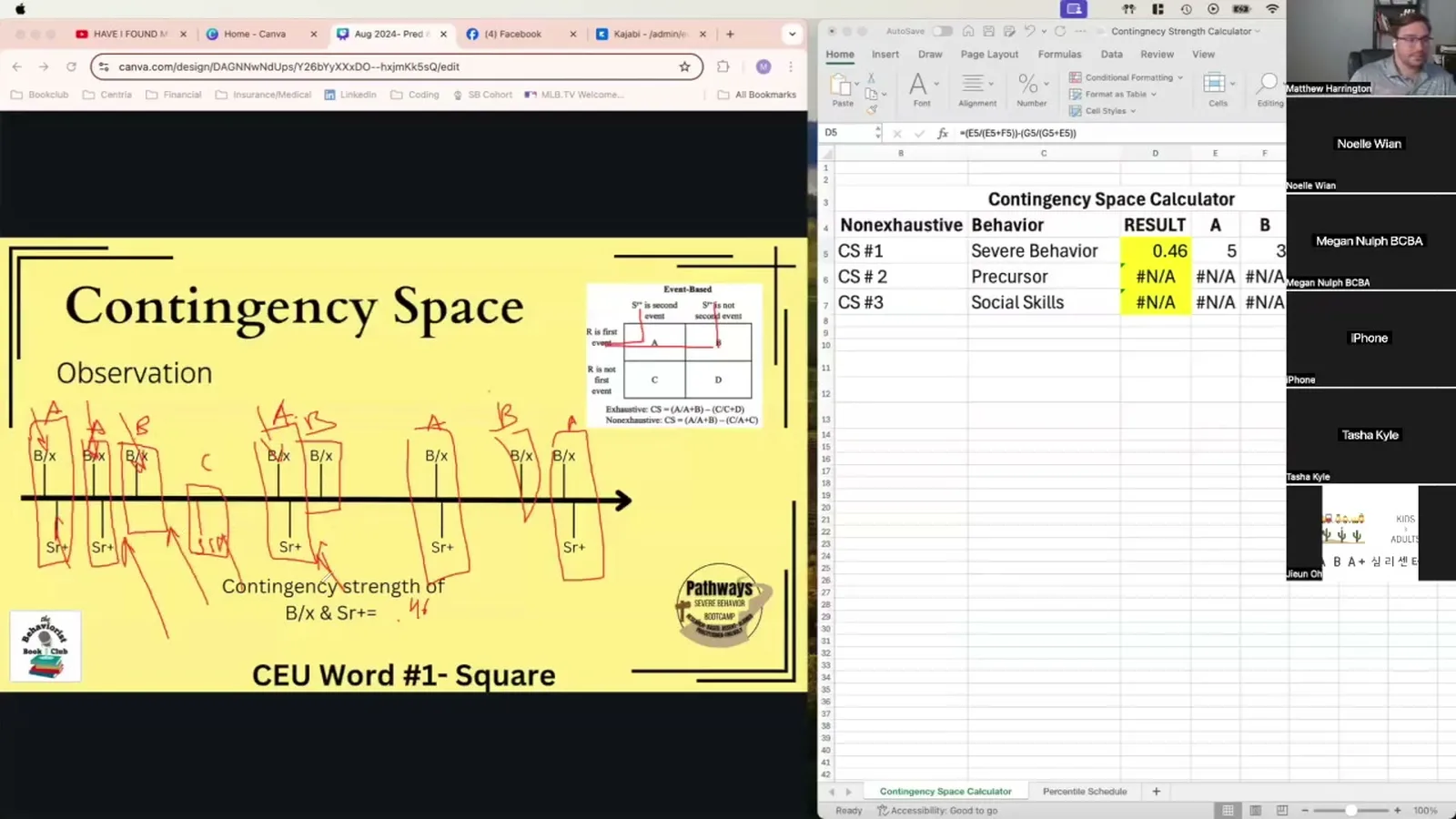
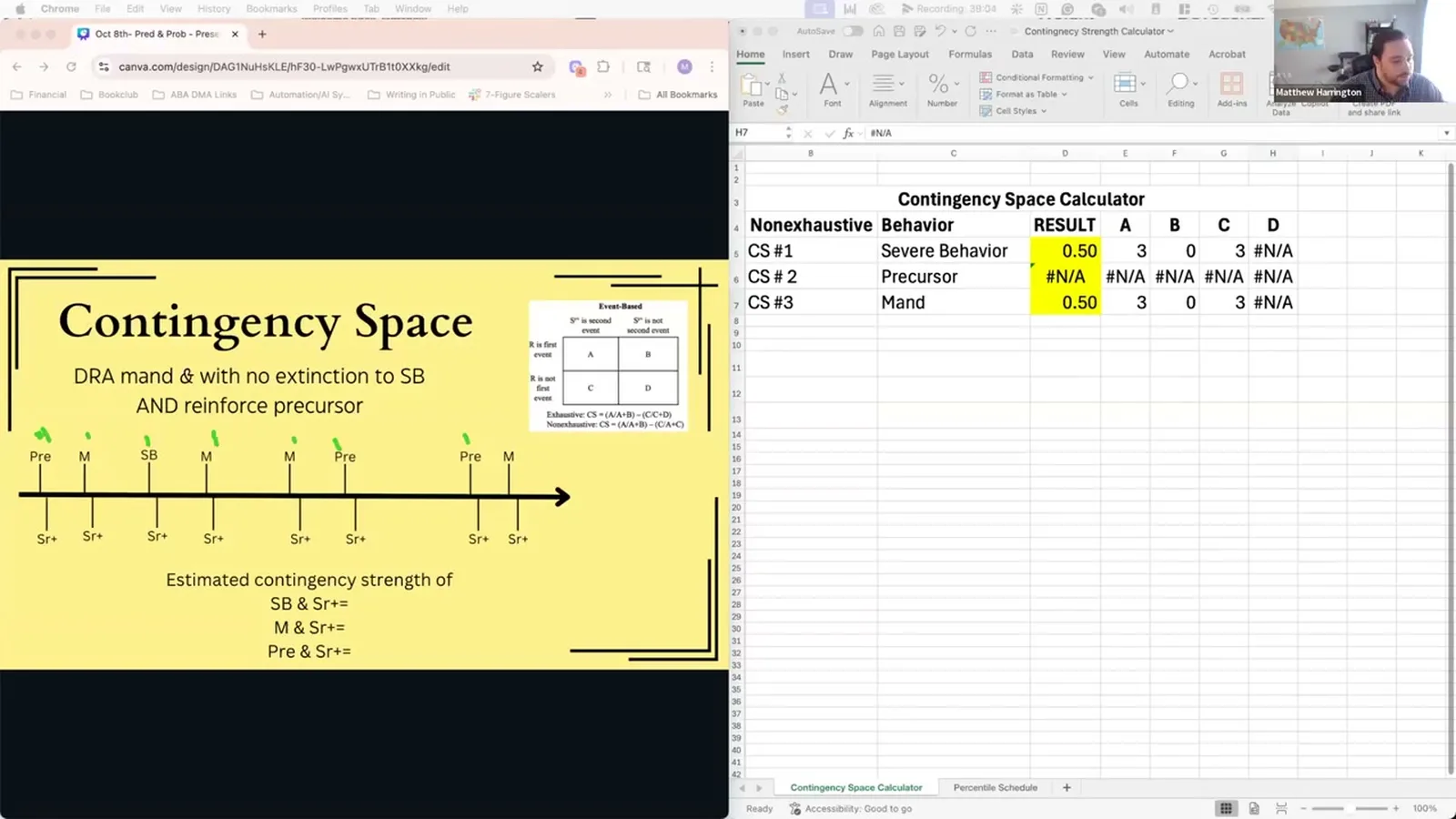
Contingency strength is the odds that behavior will produce the reinforcer (the payoff that follows). It runs from negative one to one. A score near one means the behavior pays off almost every time. Zero is a coin flip. Negative one means the payoff is more likely when the behavior does not happen. A test condition in a functional analysis sits at one. The source reading he names for this is Lloyd and colleagues, 2021.
The scoring is a square, not really an equation. Think of a Punnett square from high school. Behavior, then reinforcer, is an A. Behavior, then no reinforcer, is a B. No behavior, but a reinforcer, is a C. That C is what free, timed reinforcement looks like. Nothing at all is a D. Loosely, the score is one probability minus another.
He uses the event based, non exhaustive version (count each behavior-reinforcer pair and skip the empty gaps). That means you drop D. You cannot count empty space while you watch a session. Interval based scoring (splitting the session into timed chunks) is more exact, but it needs software. Event based is the version you can run from a chair in the room.
In his demo, a stream with five A events, three B events, and one C came out at 0.46. You would read that fast: this behavior gets paid more than it gets ignored. So expect some work ahead. History drives the number. A route you have walked 75 times sticks even after the store moves the shelves. A store you have never set foot in gets searching instead. Low strength means the learner is open to change.
The stronger the contingency strength is that the more robust and consistent the learning history.
From the talk — Matt Harrington
Getting FCT Results Without Putting Severe Behavior on Extinction
Then he runs one case through four steps. Step one is the observation above, at 0.46. Step two is to teach a mand (a request, like asking for a break). Nothing else changes. Now score the same stream twice.
Score it from the severe behavior first. Then score it again from the mand. He got 0.5 both ways. Equal scores mean a coin flip. The learner has two ways to get paid and no reason to pick one. That plan is not finished.
Step three adds a precursor (the small behavior that comes first). He reinforces that too. Now severe behavior shows up once and sits near 0.2. The precursor lands near 0.3 or 0.4. The mand lands near 0.4 or 0.5. For some clients, that is a fine place to stop.
Step four pushes further. Put the precursor on extinction (it stops paying off) and prompt the mand instead. Crossed arms and a frown become a break request, and the request gets paid. Now the mand runs near 0.7 or 0.8. Severe behavior sits near 0.1 or 0.2, and the precursor drops to zero. That is the same split FCT (functional communication training) makes. Severe behavior never went on extinction at all.
We've now achieved through a variety of different steps, completely individualized to this client, not a copy-paste intervention from a research paper, but completely individualized for this client, the same effects of FCT without ever putting the client on extinction.
From the talk — Matt Harrington
NCR vs Extinction When Fidelity Slips
Fidelity (how closely the plan gets run) is where this gets useful. Run extinction at full fidelity and every event is a B. The score cannot even be computed. Call it zero. The contingency is not weak. It is shattered.
Now slip a little. Three A events sneak in among eight B events. The score jumps to about 0.27. That is enough for the behavior to keep showing up. Extinction also teaches nothing new. That is why DRA (reinforce a better behavior instead) usually rides along with it.
NCR (free reinforcement on a timer) acts differently. You ignore the behavior and deliver on the clock. Most events score as B or C. Once in a while you get an A by accident, which is superstitious reinforcement. At 75% fidelity he scored it at negative 0.63, about 0.01 off the full fidelity score.
He also fielded a good question about DRO (pay for time with no behavior). DRO has extinction baked into it, so a burst is possible. NCR is the safer pick when the setting cannot take a burst, like head banging. His rule of thumb for a DRO interval is half the inter response time (the gap between two behaviors).
If you have a situation where fidelity is worrisome, a contingency strength perspective would absolutely argue that NCR is a better approach for that behavior reduction rather than extinction.
From the talk — Matt Harrington
The Matching Law as a Teeter-Totter for Caregiver Training
The matching law is a seesaw. On one side are the rates of two behaviors. On the other are the rates of payoff for each. Push one side and the other side moves. The reading he names here is Barrero and Vollmer, 2002.
Run extinction on severe behavior at full fidelity and the payoff on that side goes to zero. Mands rise. Run it at 60% and severe behavior still gets paid almost half the time. Mands barely move. That is a clean answer for why fidelity matters so much.
It also explains a plan that looks backward. Some treatments still pay off severe behavior to keep the session safe. That works when you load the other side hard: better quality, more of it, and less effort to ask. The seesaw tips toward the mand anyway.
His intake picture is worth stealing for caregiver training. At intake, severe behavior gets paid at home, at school, and in clinic. The mand gets paid nowhere, so its rate of payoff is zero. Teach the mand and effort drops. Add quality and clinic reinforcement and you land near 50/50. Train the caregivers and home joins in. The board tilts. Every setting that stops paying severe behavior raises mands, even with no change on the mand side.
Wherever the reinforcement is, that's where behavior is going to flow.
From the talk — Matt Harrington
The Percentile Schedule: K, M, and W in Plain Terms
Shaping (rewarding closer and closer tries) can feel like art. The percentile schedule turns it into a rule. The equation is K equals M plus one, times one minus W. The paper he names is Athens and colleagues, 2007, on shaping academic task engagement.
W is the density of reinforcement (how often a try gets paid). A high W near 0.8 is close to errorless (almost no wrong tries). It is slower, but safer for a learner who escalates at a miss. A low W near 0.1 moves fast and touches extinction far more. M is how many recent tries you look at before you decide. K is the rank the next try has to beat.
The example is easy to run. Set W at 0.5 and M at five, and K comes out at three. Take the last five sessions of attending. Sort them small to large. The next try has to beat the third value. Values of 1, 1, 1, 2, and 1 make the goal a 2. A 1 gets nothing. A 2 gets paid. Two more 2s move that third value to 2, so the goal becomes 3. The criterion walks up on its own.
It walks down too. If the learner is sick and the numbers drop, the sorted third value drops with them. The goal slides back to 2. He ties this to SBT (skills based treatment) work. Early CAB steps (the plan's skill steps) need a high density so progress stays slow and safe. Later steps can carry a lower one.
The percentile schedule automatically adjusts when things aren't going well.
From the talk — Matt Harrington
Using the Equations in a Real Supervision Session
He is honest about how this works in a real week. He has run the full spreadsheet during supervision, response by response. The data looked great. It was not worth the time for a BCBA with a dozen other cases.
A middle option is to plug in one number per day and score it then. The best option is to skip the sheet and know the effect cold. When you change a variable, you should be able to call the result before you change it.
One example lands hard. A technician who knows the client well can run a low reinforcement density. They read the precursors and drop demands at the right moment. A technician who has never met that client cannot do that. Raise the density for that session. Progress is slower and the session is much safer.
That is the whole message. You do not need a brand new package after one rough session. You need one small move: raise W, drop the payoff rate for severe behavior, or shift a contingency. Small changes move the odds, and the odds move behavior.
I want you to see how using these equations will help you predict intervention outcomes, and of course, be more prepared for changes in the future, rather than coming to copy-paste from a research paper down the line.
From the talk — Matt Harrington
Common questions
How do I read a contingency strength score?▾
The score runs from negative one to one. Near one means the behavior gets paid almost every time, like a test condition in a functional analysis. Zero is a coin flip, so the learner is open to change. Negative one means reinforcement is more likely when the behavior does not happen.
Is NCR really better than extinction when fidelity is poor?▾
In his scored examples, yes. Extinction at full fidelity scored about zero. With a few missed trials, it climbed back to about 0.27, which is enough for the behavior to return. NCR at 75% fidelity scored negative 0.63, roughly 0.01 off its full fidelity score. So when fidelity is a real worry, the contingency numbers favor NCR.
Do I have to calculate these equations during a session?▾
No. He says to put the calculator away and use the scoring as a teaching tool. The goal is to glance at a stream of behavior and estimate the strength within one or two observations. The real payoff is predicting what a change will do before you make it.
What do K, M, and W mean in the percentile schedule?▾
W is the density of reinforcement, or how often a try gets paid. M is the number of recent observations you sort before you decide. K is the rank value the next response must beat to earn reinforcement. He uses W and K most, since W sets the pace and K gives you a yes or no.
Why would a plan keep reinforcing severe behavior?▾
Sometimes the setting cannot take an extinction burst (a spike in behavior when reinforcement stops). Pulling the payoff is not safe there. The matching law says you can still tip the balance by loading the other side. Better quality, more reinforcement, and lower effort on the mand side raise mands even while severe behavior still gets paid.
About the speaker
Matt Harrington has worked in ABA for about 10 years, moving from direct care and RBT work up to BCBA and clinical director. He has practiced in telehealth, school, home, and hospital settings. He has run the Behaviorist Book Club for about three years, which has provided more than 2,000 CEUs to behavior analysts.
This summary was generated from the recording’s transcript and reviewed for accuracy. Quotes are taken word for word from the talk.
What you'll learn
- 1Learning Objectives
- 2By the end of this session, participants will be able to:
- 3Understand the foundational principles of behavior analysis and their application in behavior reduction strategies.
- 4Analyze and apply the contingency space analysis to assess contingency strength and predict behavior change outcomes.
- 5Utilize the matching law to evaluate reinforcement rates and make informed clinical decisions regarding behavior interventions.
- 6Implement the percentile schedule to quantify and guide the shaping process, enhancing the precision and effectiveness of interventions.
- 7Reflect on ethical considerations and individualization in behavior interventions, ensuring alignment with personal and professional guardrails.
Concepts in this CEU
Related talks
Talks that cover the same concepts
5 Days of Manding Mastery
The Behaviorist Bookclub
12 days of PFA & SBT
The Behaviorist Bookclub
Analyzing Assent and Taking Data
The Behaviorist Bookclub
The Math Behind Behavior Reduction
The Behaviorist Bookclub
Hey, Chillax Man! Understanding the Logic of Anxiety
The Behaviorist Bookclub
Solving Clinical Challenges with Research
The Behaviorist Bookclub
More from The Behaviorist Bookclub

Empowering Autonomy and Self-Management in ADHD Learners
The Behaviorist Bookclub
Shaping Behavior Change when ADHD is in the Picture
The Behaviorist Bookclub
From Hours to Competence: Assessing and Developing Supervisee Skills
The Behaviorist Bookclub
OpenCEU is supported by advertising from third-party sponsors. Sponsors are clearly labeled, have no influence over course content, instructors, or CEU decisions, and never appear on certificates. The BACB does not sponsor, approve, or endorse OpenCEU sponsors or their products.