Prompt Dependency in ABA: Why It Happens and How to Spot It
Prompt dependency is when a learner answers correctly after a prompt but not on their own. Learn what causes it, how to spot it in data, and what helps.
Key takeaway
Prompt dependency is when a learner gets a skill right after someone helps. On their own, without that help, they do not do it. A prompt is any extra help, like a hint, a gesture, or a hand guiding the learner.
Empowering Autonomy and Self-Management in ADHD Learners
Experts who cover this
5 recordings on openceu cover prompt dependency.
- Featured talk1 CEU
Empowering Autonomy and Self-Management in ADHD Learners
Nicole StewartThe Behaviorist Bookclub
Stewart identifies prompt dependency as a common risk of traditional ABA approaches with ADHD learners, where families over-rely on alarms, checklists, and…
- 1 PDU
Understanding ADHD: An RBT PDU Series | ADHD 101: Inattention, Hyperactivity & Impulsivity
Nicole StewartABA Made Ez
Reframed for ADHD: a client who needs step-by-step prompts for multi-step chains like getting dressed isn't failing to generalize — their brain hasn't yet been…
- 0.50 PDUs
Rad N Bad: Beyond the Blue Square — Demystifying Discrete Trial Training, Stimulus Control, and Generalization for RBTs
Sean Yocum & Michael CarreroHickory Learning Group
Named as a key con of DTT when prompts, reinforcer-driven trials, and adult-led structure aren't faded: the learner completes programs to get the reward rather…
- 2.50 CEUs
5 Days of Manding Mastery
Matt HarringtonThe Behaviorist Bookclub
Diagnosed via a data pattern: high percentages on targeted and contrived mands but zero spontaneous mands signals the response is still under the therapist's…
- 1 Supervision CEU
Article Club: Treatment Integrity Errors During Discrete Trial Instruction
Pauli Catanese & Sam MuellerAchieve Behavior Partners
Raised as a risk when prompting protocols aren't clearly written, with fading from the prompt to the natural stimulus discussed as the goal of a good prompting…



On this page · 9 sections▾
Prompt dependency is when a learner gets a skill right after someone helps. On their own, without that help, they do not do it. A prompt is any extra help, like a hint, a gesture, or a hand guiding the learner. The learner can clearly do the task. They just wait for the help before they start.
This is a common worry in ABA (applied behavior analysis), the science-based therapy used with many autistic learners. It also shows up at home and at school for kids with ADHD. Clinicians who speak on it agree on the basic problem. They differ on what causes it and where to look first. This page pulls together what they teach, plus what the research says about fixing it.
How structured teaching can build prompt dependency#
Sean Yocum names prompt dependency as one of the main downsides of discrete trial training. Discrete trial training, or DTT, is a teaching style built on short, repeated practice trials. The adult gives a cue, the learner responds, and the adult gives a reward.
Yocum is not against DTT. He says it lets a clinician "engineer" the learning setting. That way you can show a skill was truly taught, instead of hoping it shows up on its own. But the same features carry a risk. DTT is highly structured and usually led by an adult. Yocum calls it "prompt heavy" and "reinforcer driven," often with contrived rewards. Contrived means the reward is set up by the adult, not something that happens naturally.
I think you can risk building prompt dependency and compliance with just okay I'm going
From the talk — Sean Yocum
His point is that a child can learn to just get through the programs. The child finishes the work, then gets the prize. In his words, the learner could be completely prompt dependent and not dependent on actually learning the skill. "It just doesn't build independence," he says.
Staying too long in the teaching phase#
Michael Carrero, speaking in the same talk, adds a second cause. He looks at what happens after a skill is first taught. In real life, he notes, no one can strip every distraction from a room. There is no trained professional standing next to you, either. You might have no support at all. That gap makes prompt dependency a bigger problem over the long run.
we stay too long in the acquisition and maintenance phase of a skill and don't go into the generalization aspect of things
From the talk — Michael Carrero
Acquisition is the phase where a skill is first learned. Maintenance is keeping it strong over time. Generalization means using the skill in new places, with new people, and with new materials. Carrero argues teams often skip that last step, or reach it too late.
He gives a street-crossing example. A child only looks both ways when an adult says, "We're about to hit a crosswalk." Carrero says that is not true independence. The adult has become the SD, the cue that signals the behavior. The real issue, he says, is not working to reduce prompts soon enough, or at all. You can read more of this conversation in Rad N Bad: Beyond the Blue Square.
A data pattern that flags prompt dependency#
Matt Harrington offers a simple way to catch prompt dependency in your numbers. His example comes from teaching manding. A mand is a request the learner makes for something they want. He tracks three kinds of data side by side.
First, he tracks targeted mands, the requests being directly taught. Second, he tracks contrived mands, where the therapist sets up a chance to ask. Third, he counts spontaneous mands with an easy frequency count. Spontaneous means the learner asks with no setup and no prompt. To make room for this, he arranges items the learner cannot reach but could ask for.
Harrington calls tracking spontaneous mands "a game changer." It tells him whether the skill is spreading beyond teaching time.
Because if I get 100s in all my targets, 100s in my contrived manded data, but then zero in spontaneous manns, what does that tell me? Big prompt dependency.
From the talk — Matt Harrington
The takeaway is easy to use. Perfect scores during set-up trials do not prove independence. If the learner never asks on their own, the request is likely still tied to the therapist. Harrington says the dependence is likely on the therapist prompting and being present. That gap becomes the next goal to work on.
Prompt dependency at home: alarms, checklists, and reminders#
Nicole Stewart, BCBA, brings the topic out of the therapy room and into family life. She works with families of kids with ADHD. She sees prompt dependency there a lot.
We also see a lot of prompt dependencies.
From the talk — Nicole Stewart, BCBA
Stewart describes an over-reliance on systems, prompts, and social help from adults. Her example is getting ready for school. The child may be able to do it alone. But in practice, they need three alarms going off. They need a checklist. They need a parent asking, "What's next? Remember, it's 8:10." They need the whole setting arranged just right to succeed. Stewart says this is what creates the prompt dependency.
She ties it to how adults use rewards, too. When a child does not comply, she says, the first move is often to add a reward. Adults try to make the child want to do the task. Stewart warns this can backfire. She also notes that reinforcement thinning is hard. Thinning means slowly giving rewards less often, so the skill holds up without them. When thinning stalls, the child can stay tied to the extra supports.
When it only looks like prompt dependency#
In a separate talk, Nicole Stewart adds an important twist for ADHD learners. Some kids struggle with organizing tasks. That can make them seem prompt dependent for longer chains of skills. A skill chain is a task made of many small steps done in order.
We might see that like kids might be prompt. Dependent for longer chains of skills.
From the talk — Nicole Stewart
Think about packing a school bag or getting dressed. An adult may need to say, "Now get your computer, now get this, now get that." Stewart points out how many steps are hidden in getting dressed. The child has to ask, "Where do I start?" They even have to check the weather first. If organizing all of that is hard, the child may look prompt dependent.
it's not that you can't do it. it's that we haven't designed it for your brain.
From the talk — Nicole Stewart
This framing changes the next step. Instead of just pulling prompts away, the team can redesign the task itself. In the same talk, the hosts swap stories of moving items to where they get used. One keeps a toothbrush in the shower. Another keeps toothbrushes downstairs so no one has to go back up.
Where experts disagree#
The speakers agree that prompt dependency is real and common. Where they part ways is on the cause, and so on the fix.
Sean Yocum and Michael Carrero place the cause mostly in how teaching is run. In their view, structured, adult-led, reward-heavy trials can teach a child to wait for help. Carrero adds that teams linger in the teaching phase. For them, the answer is to cut prompts sooner and push for generalization earlier.
Nicole Stewart, in her ADHD 101 talk, pushes back on reading every case that way. She says some kids only appear prompt dependent. The real barrier may be organizing a long chain of steps. On her view, the task has not been built for how that child's brain works. Removing prompts faster would not fix that. Redesigning the task might.
Stewart's other talk sits closer to the middle. There, she puts some of the cause on adults and the home setup. Alarms, checklists, and repeated reminders can build the very dependence families want to avoid.
Matt Harrington's view is mostly about detection, not cause. His data pattern tells you prompt dependency is likely there. It does not, on its own, say which of these causes is at work.
Clear prompt protocols protect independence#
A group discussion led by Sam Mueller looked at errors staff make during discrete trial teaching. One participant said some skills were harder to prompt well. Examples were intraverbals, which are answers to spoken questions, and naming letter sounds. Picking the right answer from an array felt easier. The group traced the problem to not having a clear prompt protocol. A prompt protocol is the written plan for which prompts to use and when.
Avoiding prompt dependence.
From the talk — Sam Mueller
The group named this as a key reason to get prompting right. They also named the goal of any good prompting plan: fading from the prompt to the stimulus. That means moving control away from the helper's hint and onto the real-world cue. That process is called prompt fading.
When asked what they would change in practice, the group was specific. They wanted set outlines for procedures. They wanted procedural integrity checks with staff more often, since these checks are often skipped. Integrity checks confirm staff run the plan the way it was written. They also stressed adequate training before staff work with clients.
What the research says#
Studies on prompt dependency point to one clear lesson. No single fix works for every learner.
Gorgan and Kodak studied three children who answered correctly after a prompt but not on their own (Gorgan & Kodak, 2019). They compared three treatments: differential reinforcement, prompt fading, and an extended response interval. Differential reinforcement means giving a better reward for independent answers than for prompted ones. An extended response interval simply gives the learner more time to answer before any help. Results differed across children. The authors concluded the best treatment should be chosen through individual assessment.
A tutorial on assessment-based teaching lists variables that may drive prompt-dependent behavior (Kodak & Halbur, 2021). These include how rewards are arranged, whether a prompt is used, and what type of prompt it is. The tutorial notes differential reinforcement can help prevent prompt dependence. It can reward independent answers while giving prompted answers no reward, leaner rewards, or lower-quality rewards.
A systematic review adds a caution (Cividini-Motta, Livingston, & Efaw, 2024). It notes that in Gorgan and Kodak's study, differential reinforcement worked best for only one participant. The review calls for more research on what causes prompt-dependent responding.
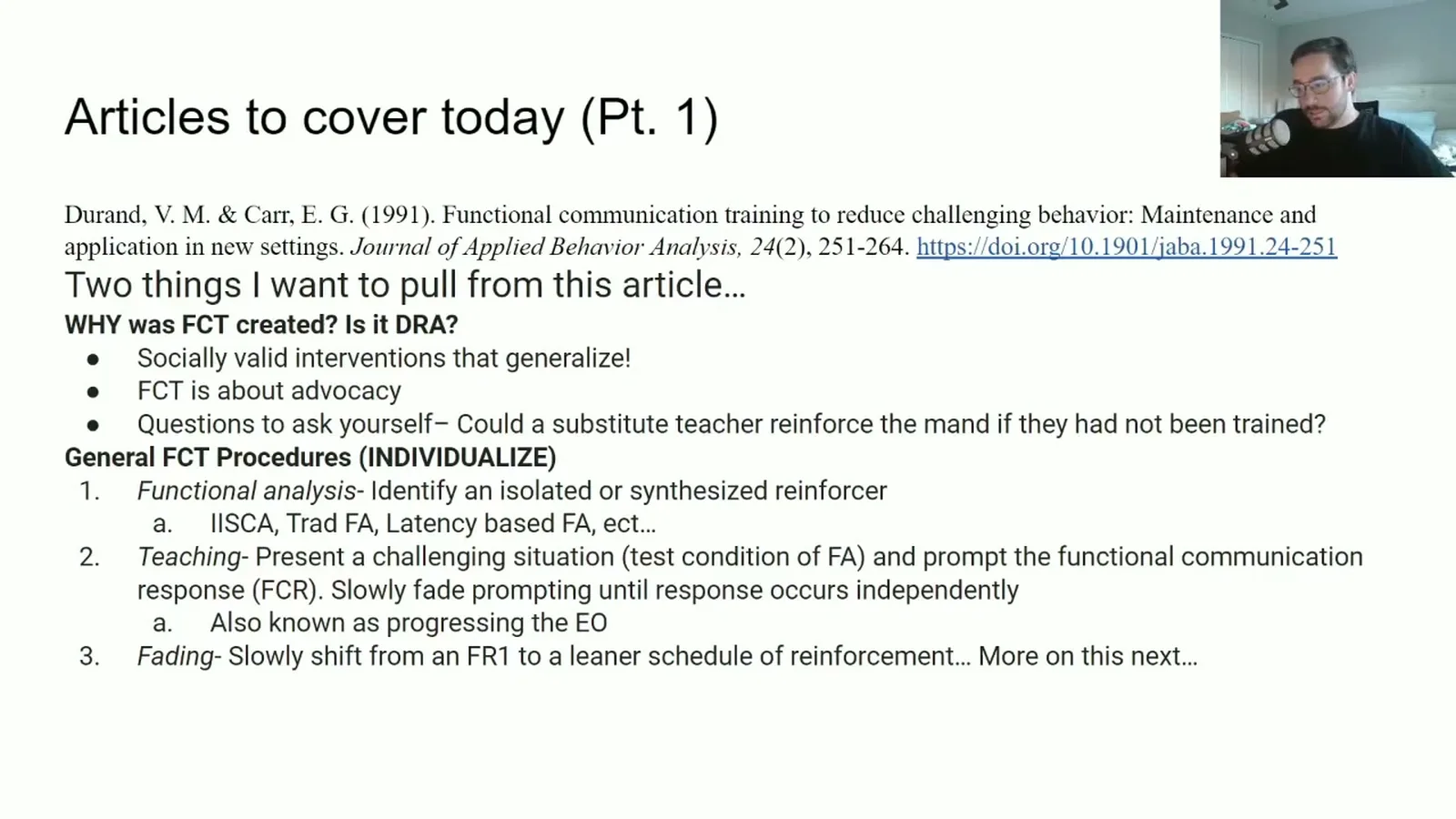
One newer case study treated prompt dependency during functional communication training (Weyman, Imler, & Kelly, 2024). Functional communication training teaches a person to ask for what they want instead of using challenging behavior. The learner was a 16-year-old autistic female. The study compared several treatments. Independent requests went up, and challenging behavior dropped to zero.
FAQ#
What is the difference between prompt dependency and prompt fading? Prompt dependency is the problem: a learner waits for help before responding. Prompt fading is one of the tools used to prevent or fix it. Fading slowly removes help until the natural cue alone gets the response.
How do I know if a learner is prompt dependent? Compare taught responses with spontaneous ones. Matt Harrington's red flag is high scores on taught and set-up trials but zero spontaneous responses. That pattern suggests the skill still depends on the adult being there.
Is a child with ADHD who needs reminders always prompt dependent? Not always. Nicole Stewart notes that trouble organizing long chains of steps can look like prompt dependency. In those cases, redesigning the task may help more than simply removing prompts.
Turn this topic into a CEU
You just studied this. Now get credit for it.
Watch Empowering Autonomy and Self-Management in ADHD Learners with Nicole Stewart, BCBA and earn 1 free BCBA CEU. Detailed certificate, delivered the moment you finish.