Matching Law in ABA: Behavior Follows Payoff
The matching law says behavior splits across choices in line with what each one pays. See how BCBAs use it in FCT, assent, and behavior reduction.
Key takeaway
The matching law says behavior spreads across choices in line with the payoff each choice gives. When two options are open, the one with the richer reinforcement gets more of the behavior.

Prediction and Probabilities: Three foundational equations to successful behavior reduction
Free learning path on this topic
Master PFA and SBT
Matt Harrington's 12-article walk through practical functional assessment and skill-based treatment, from Hanley's 2014 study to the enhanced choice model. Then assent, since SBT depends on it, and the ethical guardrails that keep behavior reduction defensible. Five CEUs, one of them ethics.
Experts who cover this
4 recordings on openceu cover matching law.
- Featured talk2 CEUs
Prediction and Probabilities: Three foundational equations to successful behavior reduction
Matt HarringtonThe Behaviorist Bookclub
Presented via Borrero and Vollmer (2002) as a simple 'teeter-totter' between the reinforcement rate for severe behavior versus an alternative like manding…
- 0.50 PDUs
Bite-Size Behavior Analysis: Differential Reinforcement
Anlara HoskinsCandid Contingencies, LLC
The matching law is named as the phenomenon explaining why behavior allocates toward whichever available option provides the best/most preferred outcome, while…
- 2.50 CEUs
5 Days of Manding Mastery
Matt HarringtonThe Behaviorist Bookclub
Invoked twice to explain why extinguishing challenging behavior while reinforcing the FCR shifts responding toward the reinforced alternative, and flagged as…
- 1 CEU
Assent: Don't just say Yes!-
Matt HarringtonThe Behaviorist Bookclub
Used to explain why clients move away from an intervention when the ratio of aversive to reinforcing elements is heavily skewed toward the aversive, framing…


On this page · 11 sections▾
The matching law says behavior spreads across choices in line with the payoff each choice gives. When two options are open, the one with the richer reinforcement gets more of the behavior.
That sounds simple. It is also the quiet engine behind most of what a BCBA does. This page shows how two OpenCEU instructors use the matching law in real clinical work.
What the matching law actually describes#
The matching law is a description of choice. It does not describe one behavior in isolation. It describes how behavior splits between two or more options that are both available.
Matt Harrington calls it a teeter-totter. Push reinforcement down on one side and behavior tips that way. In research terms this setup is a concurrent schedule, which just means two options running at the same time.
In his talk on behavior reduction, Matt frames the whole thing around choice. One behavior happens instead of another because the probability of reinforcement is higher for it. The matching law takes preference, aversion, and rule-governed history and boils them down to a rate comparison. Rule-governed history just means behavior shaped by rules a person has learned, not only by direct experience.
That is the part clinicians miss. You are never competing against a behavior. You are competing against a payoff. If the problem behavior pays better than the skill you are teaching, the skill loses. Not because the child is stubborn, but because the math is against you.
Behavior goes where reinforcement flows#
Most BCBAs have seen the slogan. Matt points out how common it has gotten, and he is not wrong about the laptop stickers.
How many of y'all have heard, behavior goes where reinforcement flows, right? I think it's like an Etsy saying now on like half of the stickers on BCBA's laptops. From the talk — Matt Harrington
The slogan is true. It is also incomplete. It tells you where behavior ends up but not why it got there. The matching law fills in the why. Behavior went there because the rate of reinforcement for that option was higher than the rate for the other option.
That shift matters for treatment planning. A slogan tells you to reinforce good behavior. The matching law tells you to measure both sides. You have to know what the problem behavior is earning before you can out-pay it.
Value and perception, not just raw rate#
Matt adds a piece that pure rate math leaves out. The organism has to value the reinforcer and has to perceive that the rate is there.
Whatever the organism values and perceives the rate of reinforcement being, that's where they're going. From the talk — Matt Harrington
He explains it with grocery delivery. One store is cheaper but slower. The other is pricier but faster. When money is tight he picks the cheap one. When his family just had a baby he picks the fast one.
Nothing about the stores changed. What changed was what he valued that week. The same is true for a client. A reinforcer that worked in March may be worth very little in June.
This is also why perception matters. If the child cannot tell that the new mand gets paid, the new mand will not win. Discriminability is part of the equation, not a side note.
Why teams reinforce the problem behavior on purpose#
Here is the piece that confuses new clinicians. In some models, like skill-based treatment, the team still reinforces severe behavior when it happens. Skill-based treatment is a model built around teaching communication and cooperation, not just managing behavior directly. The team gives in, keeps everyone safe, and stays inside their ethical guardrails.
That looks backward until you apply the matching law. You are not trying to make severe behavior pay zero. You are trying to make the mand pay much better.
The transcript below writes "man's" where Matt said "mands," which is just an auto-transcription slip.
The reason why that works when we're also reinforcing man's is because of the matching law. Because as we bump up the reinforcement for man's, then we also see the rate of man's go up as well. From the talk — Matt Harrington
Matt then layers on quality, quantity, and response effort. Make the mand easier and richer than the severe behavior. The ratio tips, mands flood the environment, and severe behavior drops out.
How FCT leans on the same principle#
 Advertisement
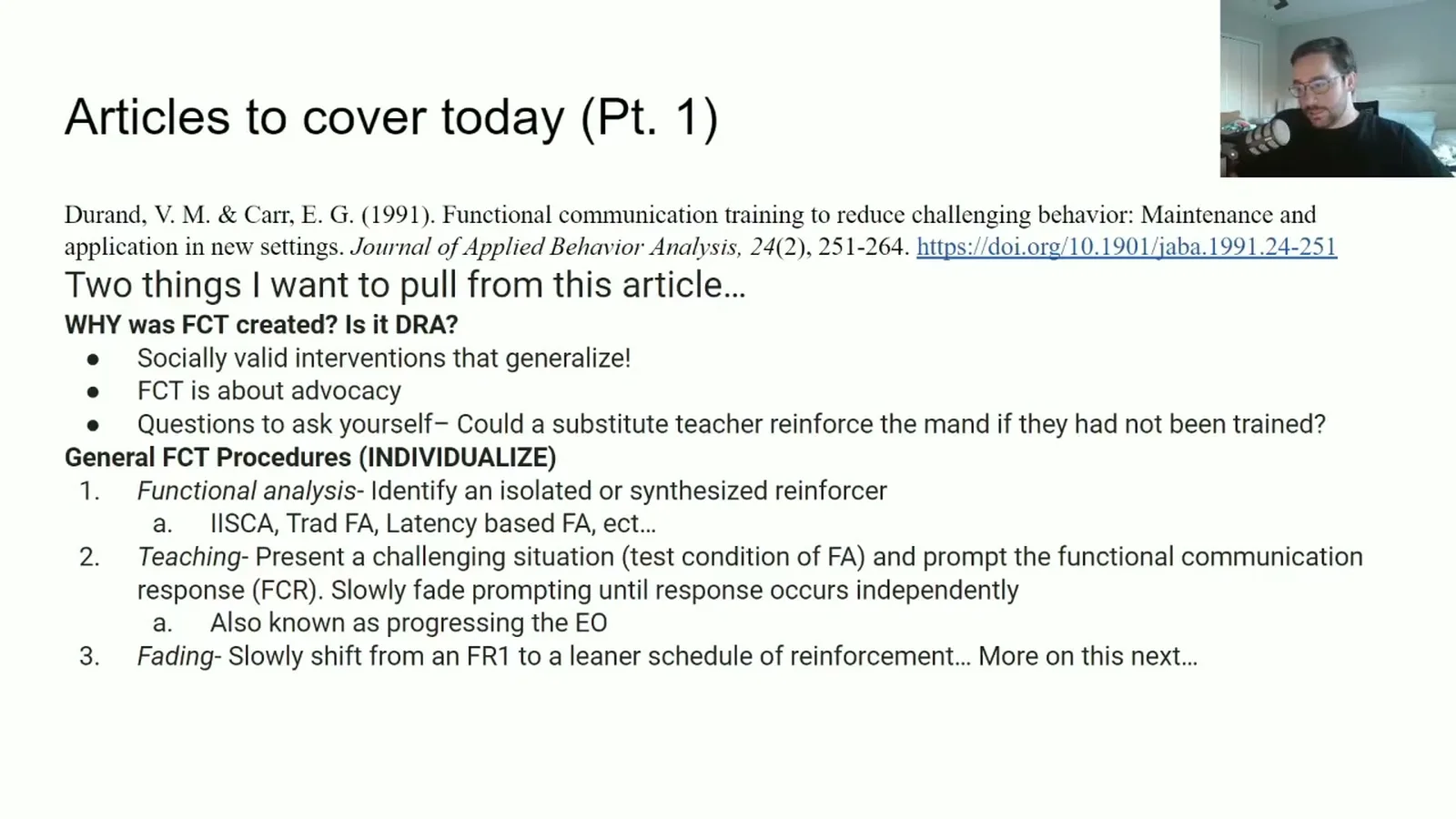
Functional communication training is differential reinforcement of alternative behavior with better packaging. The underlying process is the same one.
In his manding training, Matt describes the mechanism plainly. You reinforce the communication response, you thin or withhold reinforcement for the challenging behavior, and the allocation moves.
And because of the matching law, because of our extinction schedules that we've put into place, we're going to see the appropriate behavior increase and the challenging behavior decrease. From the talk — Matt Harrington
Take a common example. A child hits to escape desk work. You teach a break request. Now two responses lead to escape, and the break request is faster and safer to perform.
The hitting does not go away because you asked it to. It goes away because it became the worse deal. That is the matching law doing the work under the FCT label.
Reinforcement dimensions as an alternative to extinction#
Extinction is hard to run well. Caregivers miss trials. Bursts happen. Intermittent reinforcement sneaks in and makes the behavior tougher.
Matt flags a different lever for those situations. Instead of dropping the problem behavior to zero payoff, you change the size and quality of what each option delivers.
Athens and Balmer, 2010, as an analysis of the matching law and how you can modify quantities of reinforcement... to change the responding based on the matching law versus based on extinction. From the talk — Matt Harrington
This gives teams a safer dial to turn. A parent who cannot hold an extinction schedule can often deliver a bigger, better reinforcer for the appropriate response. The ratio still shifts.
It also protects treatment fidelity. A plan that depends on perfect extinction will break in a real home. A plan that depends on a richer alternative has more room for error.
Anlara Hoskins on response class and the best available deal#
Anlara Hoskins teaches the same law from the differential reinforcement angle. Her frame is the response class, which means a set of behaviors that all serve the same function.
She walks through a client with several ways to get an iPad. Some are unsafe. One is the topography the team wants. When the parameters are set right, that one option carries the best outcome.
this phenomenon, this concept, is something that we in behavior analysis call the matching law, which basically is just saying that the best benefit is going to convince whoever we're... referring to, that that behavior choice is the best option to choose From the talk — Anlara Hoskins
Her key point is the byproduct. You never have to target the other topographies directly. Boost the preferred one. The rest of the response class falls off on its own, because those options now pay less for the same function. Her short course Bite-Size Behavior Analysis: Differential Reinforcement unpacks that recipe in half an hour.
Assent withdrawal is behavior allocation#
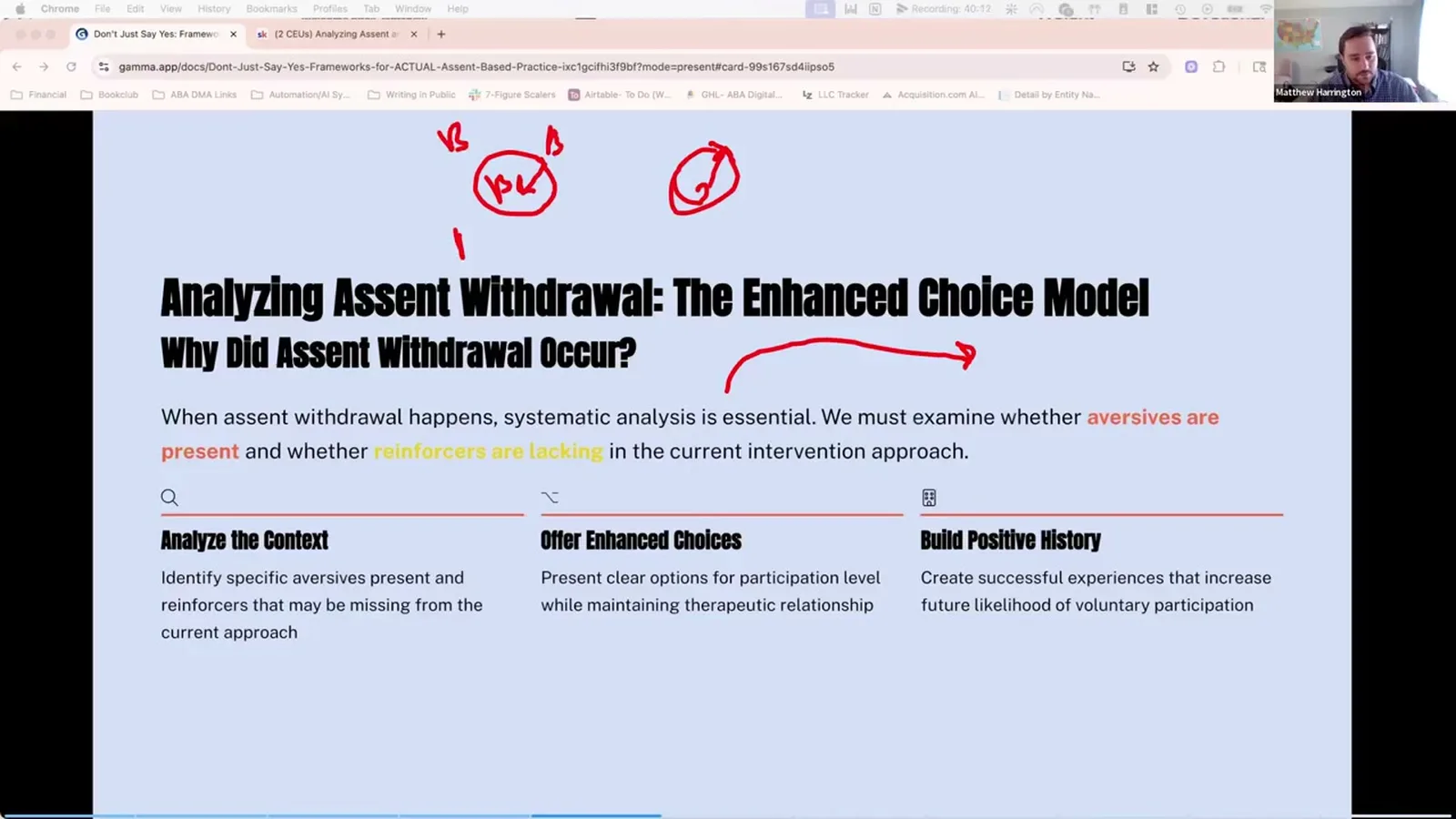
The matching law also explains why a client walks away from therapy. Matt uses a discrete trial example in his assent training. The table is boring, the seat is cold, the cards are dull, and the tablet only comes after ten correct answers.
based on what we know about the matching law, all of us would not be surprised when we have 10 bad things, and one good thing, that all of our behavior allocation is going to go to moving away from the aversive. From the talk — Matt Harrington
Read that as data, not defiance. The client is allocating behavior to the better option, which in that moment is leaving. The enhanced choice model formalizes this. A client can join the session or step into an assent withdrawal area with the same access to reinforcement and no demands.
If the therapy side is stacked with aversives, the withdrawal side wins. That is the law working exactly as predicted.
The bubble picture teams can actually use#
Matt keeps a visual version of this for caregiver and staff training. Picture two bubbles. One holds everything bad about the task. One holds everything good.
This simple bubble framework of pushing one bubble bigger and the other bubble smaller, it's essentially matching a lot of framework, but I like it because it's a little bit more visual. From the talk — Matt Harrington
The phrase "matching a lot" in that clip is the transcript mishearing "matching law." The idea holds. You have two moves. Shrink the bad side or grow the good side. Doing both at once is better than doing either alone.
He contrasts this with brute force. His team did not just put a kid on the bus for three months straight. They did not wait for exhaustion to get a fifty percent success rate. Instead they cut aversives and added value until the good bubble was bigger.
That framing is easy to hand to an RBT or a parent. It keeps the math honest without requiring anyone to fit an equation.
What the research says#
Researchers have tested this equation far outside the clinic, and it keeps holding up. One study fit the generalized matching equation to how parents deliver reinforcement at home before and after behavioral skills training. The relation between the child's response allocation and parent-delivered reinforcement matched well in both phases (Kronfli, Lloveras, & Vollmer, 2021, Behavioral Interventions). That gives teams a way to quantify whether caregiver training actually shifted the ratio.
The law also measures things we usually judge by eye. One team adapted the matching equation to study social time. They measured how children with autism allocate time near, or away from, an adult who starts social interaction. The equation accounted for a large share of the variance. It worked equally well for social and avoidant participants (Morris & Vollmer, 2022, Journal of Applied Behavior Analysis). Sociability became a number instead of a label.
Outside of clinical work, the equation describes skilled human choice under pressure. Researchers applied it to strike selection among UFC fighters. It described those picks well. The sport is fast-paced, with instant feedback from an opponent (Seniuk, Vu, & Nosik, 2020, Journal of Applied Behavior Analysis). Fighters allocate strikes toward what lands.
The basic science is still being refined. A recent lab study tested the matching equation's sensitivity term, which measures how closely behavior tracks the reinforcement ratio. Letting that term vary with the overall reinforcement rate improved the model's fit. It described switching between options better (Avellaneda & Shahan, 2025, Journal of the Experimental Analysis of Behavior). How easy the options are to tell apart, and how costly it is to switch, both matter.
FAQ#
What is the matching law in ABA? The matching law says behavior is split across available choices in proportion to the reinforcement each choice delivers. If one option pays twice as often, it tends to get about twice the behavior. BCBAs use it to explain why problem behavior persists and how to shift it.
How is the matching law used in treatment? It guides where you put your reinforcement. Teams make the appropriate response richer, faster, and easier than the problem behavior. That covers FCT, differential reinforcement, skill-based treatment, and caregiver training. The goal is always to change the ratio, not to scold the behavior.
Does the matching law only care about how often reinforcement happens? No. Rate is the starting point, but quality, quantity, delay, and response effort all count. Matt Harrington also notes that the person has to value the reinforcer and perceive that it is available. A great reinforcer nobody notices will not move behavior.
 Advertisement
Turn this topic into a CEU
You just studied this. Now get credit for it.
Watch Prediction and Probabilities: Three foundational equations to successful behavior reduction with Matt Harrington and earn 2 free BCBA CEUs. Detailed certificate, delivered the moment you finish.
Keep going with a free learning path
Master PFA and SBT
Matt Harrington's 12-article walk through practical functional assessment and skill-based treatment, from Hanley's 2014 study to the enhanced choice model. Then assent, since SBT depends on it, and the ethical guardrails that keep behavior reduction defensible. Five CEUs, one of them ethics.