Functional Communication Training: How FCT Works
Functional communication training teaches a person to ask for what their behavior used to get. Learn how BCBAs pick the response and make FCT last.
Key takeaway
Functional communication training, or FCT, teaches a person to ask for what their challenging behavior was already getting them. The behavior analyst finds the reason for the behavior first.
5 Days of Manding Mastery
Free learning path on this topic
Verbal Behavior: Beyond WH-Questions
Dana Pettus's three-part series on building generative verbal behavior. Why WH-question programs stall, how to establish speaker-listener repertoires, and how to scaffold advanced verbal skills like recall and simple inference. Three hours, three CEUs.
Experts who cover this
16 recordings on openceu cover functional communication training.
- Featured talk2.50 CEUs
5 Days of Manding Mastery
Matt HarringtonThe Behaviorist Bookclub
The day-5 centerpiece: FCT is framed not as a rebranded DRA but as a procedure built around social validity and generalization, so the replacement response…
- 1 CEU
Empowering Autonomy and Self-Management in ADHD Learners
Nicole StewartThe Behaviorist Bookclub
Stewart presents FCT as a way to give ADHD learners verbal behavior to communicate internal states, preferences, and needs, reducing coercive interactions and…
- 1 CEU
Reframing Behavior through an ADHD Lens
Nicole StewartThe Behaviorist Bookclub
Presented with a caution specific to ADHD: if an FBA identifies escape-maintained behavior driven by an unmet need for dopamine rather than by the demand…
- 2.50 CEUs
Solving Clinical Challenges with Research
Matthew HarringtonThe Behaviorist Bookclub
Harrington uses a stalled FCT case (a client whose FCRs work under a motor imitation prompt but who property-destructs once the prompt is faded) as the running…
- 1.50 CEUs
PDA Caregivers, Complex Profiles, Replacement Behaviors, and Being Trauma Informed
B. Kuerine GrayThe Behaviorist Bookclub
Gray argues that a rigid, single-topography FCR ('my way, my play') doesn't work for PDA profiles; clinicians should accept several functionally equivalent…
- 2 CEUs
Prediction and Probabilities: Three foundational equations to successful behavior reduction
Matt HarringtonThe Behaviorist Bookclub
FCT is described as producing such large effects because it drives severe behavior's contingency strength toward -1 while pushing the mand's toward +1. Matt…
- 3 CEUs
12 days of PFA & SBT
Matt HarringtonThe Behaviorist Bookclub
Used across the course as the treatment stage that follows the ISCA: teach the FCR tied to the synthesized reinforcer, then fade the differential-reinforcement…
- 1 CEU
The Math Behind Behavior Reduction
Matt HarringtonThe Behaviorist Bookclub
Used as the worked example of contingency strength: the mand is reinforced on an FR1 (contingency strength near 1) while severe behavior is placed on…
- 1 CEU
Shaping Behavior Change when ADHD is in the Picture
Nicole StewartThe Behaviorist Bookclub
Nicole described teaching adaptive ways for kids with ADHD to communicate internal states/needs (including through invented vocabulary, AAC, gestures, and sign…
- 1 CEU
From Research to the Applied Setting: Breaking Down the Three-Legged Stool of "Evidence Based Practice"
Dr. Jessica OsosCopper Consulting Group
Functional communication training is highlighted as a well-supported, evidence-based intervention for escape-maintained behavior, illustrated through a case…
- 1 CEU
Research to practice - extending past the pages
Matt HarringtonThe Behaviorist Bookclub
Used as a running example of how to translate a vague clinical struggle (a client stuck on a prompt) into a precise, then re-vague, search term that actually…
- 1 PDU
Navigating Communication with Clinicians
Anlara HoskinsCandid Contingencies, LLC
A worked scenario involves a BCBA prescribing a protocol addressing functional communication after a parent watched a video claiming an SLP said ABA shouldn't…
- 1 Supervision CEU
Teaching RBTs to Think Clinically: Training In-the-Moment Decision Making
Dr. Jessica Osos & Tauren KeelsCopper Consulting Group
Referenced briefly in a case anecdote about a child who would escalate/elope until the supervisor arrived; the goal of stepping back was for the child to start…
- 3.50 Ethics CEUs
Analyzing Assent and Taking Data
Matt HarringtonThe Behaviorist Bookclub
Referenced as the field's default pairing with escape extinction, and critiqued as an over-relied-on 'hammer' that some old-school analysts apply to every case…
- 1.50 CEUs
Hey, Chillax Man! Understanding the Logic of Anxiety
Dr. Clelia SigaudThe Behaviorist Bookclub
Part of the initial SBT protocol Matt used with M: teaching a functional communication response and tolerance of its denial before more steps were introduced.
- 1 CEU
Child Development Deep Dive: Early Childhood (2-5 year olds)
Kelly BrzakThe Behaviorist Bookclub
Mentioned as a sample early-childhood goal, splitting FCT trials across multiple family members and leaning on high-probability requests to build success with…




On this page · 17 sections▾
Functional communication training, or FCT, teaches a person to ask for what their challenging behavior was already getting them. The behavior analyst finds the reason for the behavior first. Then they teach a request that earns the same thing, faster and with less effort.
FCT shows up in almost every behavior plan in the field. This page pulls together how a dozen experts on OpenCEU actually run it. You will see where they agree, where they argue, and what the newest research says.
What functional communication training is#
Every behavior does something for the person doing it. That job is called the function. A child might hit to get out of worksheets. A teen might scream to get an adult to come over.
FCT swaps the behavior for a request that does the same job. Behavior analysts call that request a functional communication response, or FCR. An FCR can be a spoken word, a sign, a card, or a button on a speech device.
Matt Harrington walks through the classic version in his manding course. A functional analysis is a structured test that shows what a behavior is actually earning. You run one and learn that aggression gets the child out of desk work. Then you teach the child to ask for a break instead. The appropriate behavior goes up. The hard behavior goes down.
The idea sounds simple. The rest of this page is about all the places it gets hard.
Why FCT works so well#
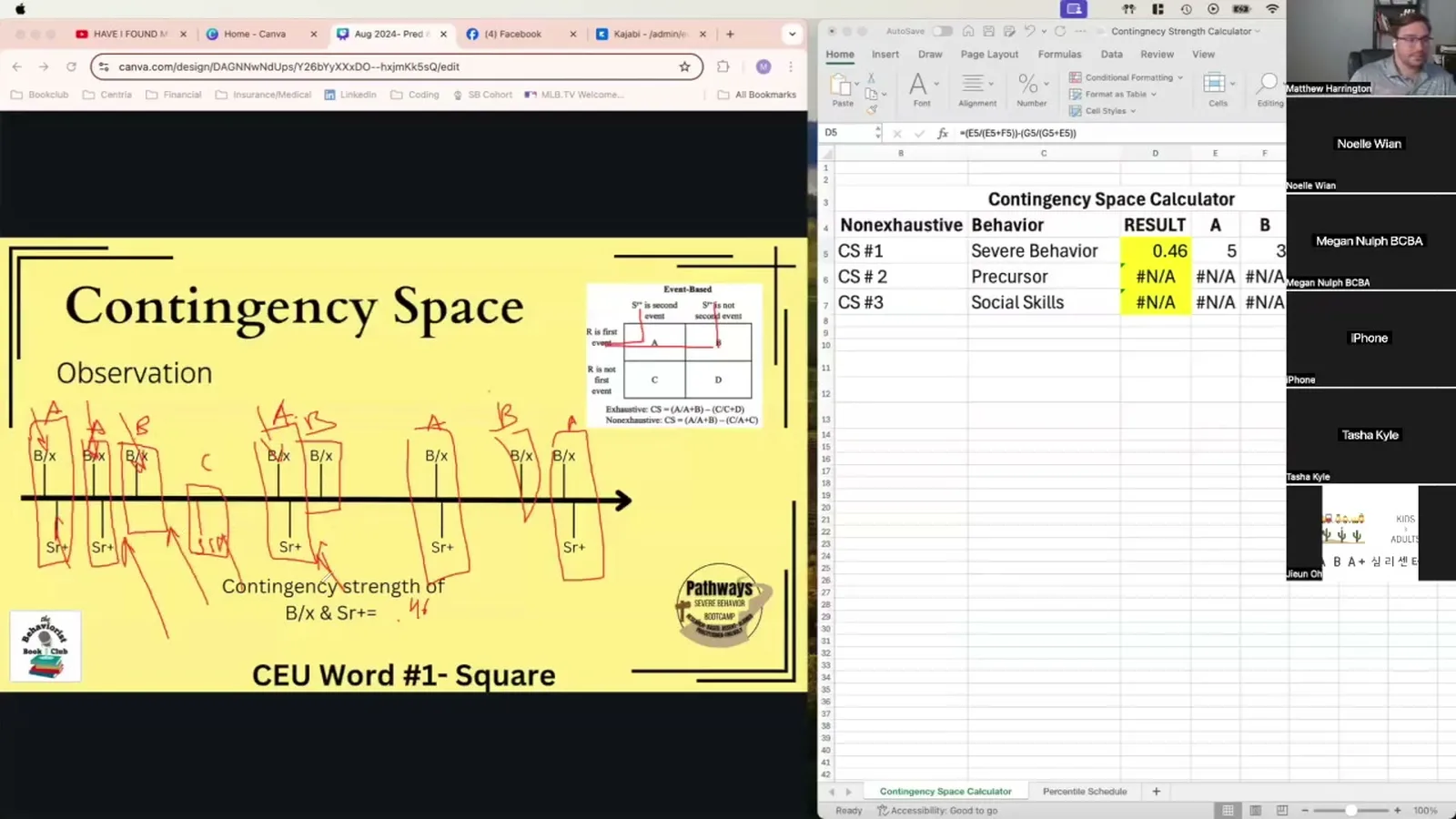
Matt Harrington explains the power of FCT using something he calls contingency strength. That is a plain measure of how reliably a behavior pays off.
When FCT is run the traditional way, the request pays off every single time. The severe behavior pays off never. So the learner is picking between a sure thing and a dead end.
At its core, FCT works because of the mand, and a super low contingency strength for the severe behavior. From the talk — Matt Harrington
That gap is the whole engine. Harrington argues it is not the prompts, the stimuli, or the errorless teaching that make FCT work. It is the size of the difference between the two options.
He makes a bigger claim in his behavior reduction course. No other tool in the field moves behavior that far.
FCT is the biggest intervention in behavior analysis. Like, I don't think it's arguably. I think it is. From the talk — Matt Harrington
This also gives you a troubleshooting tool. When FCT stalls, check whether the request really is the easier path for the learner right now.
FCT is more than differential reinforcement#
Teaching a replacement behavior that earns the same reinforcer is called differential reinforcement of alternative behavior, or DRA. On paper, FCT looks like DRA with a new name.
Matt Harrington says the two split apart on purpose. DRA only needs the new behavior to match the function. Any response counts as long as it earns the reinforcer.
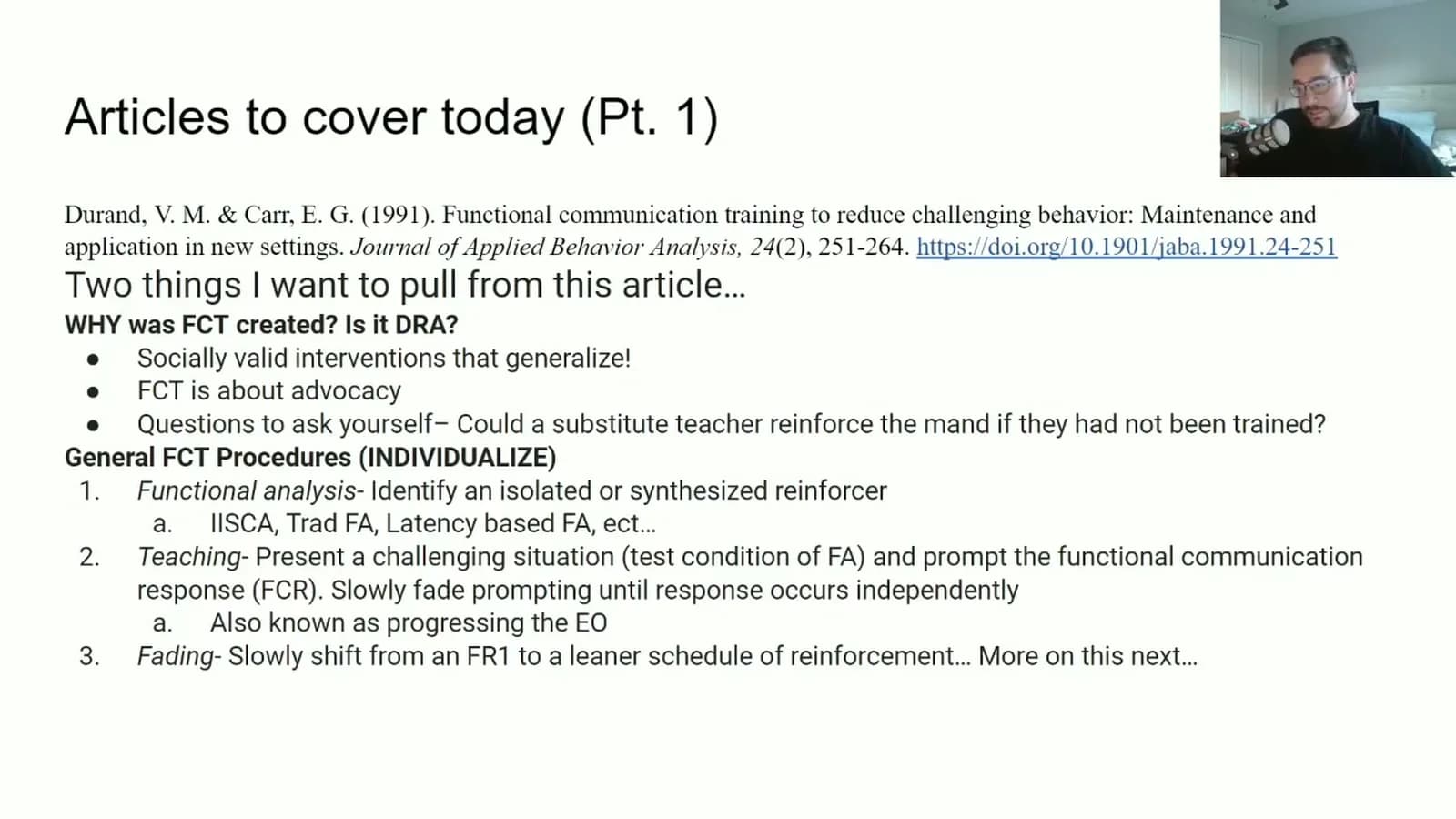
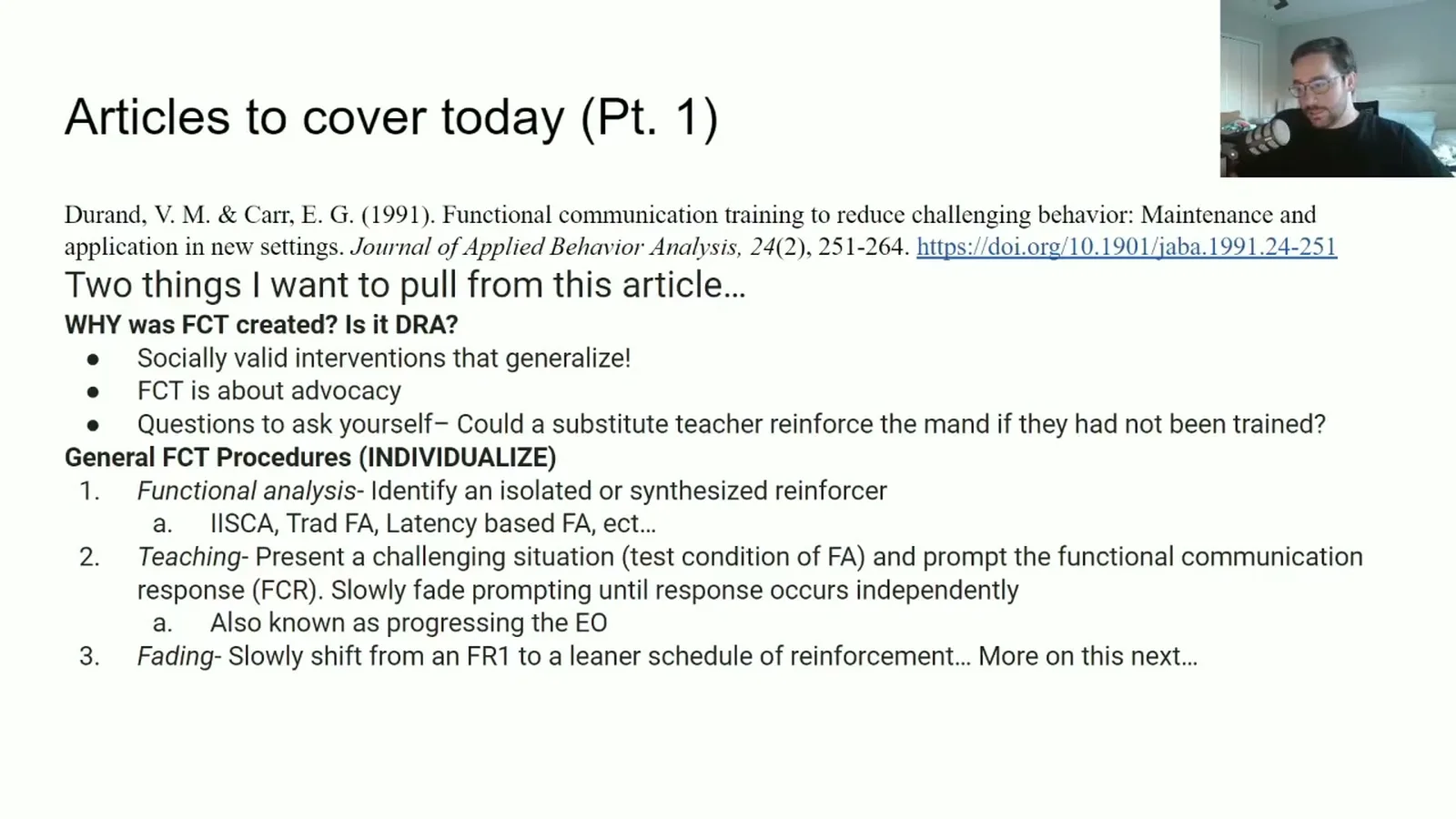
Functional communication training was really built with social validity and generalization in mind. From the talk — Matt Harrington
Social validity means the people in the person's life actually accept the plan. Generalization means the skill still works outside the therapy room.
We want this individual to be able to go into a completely new environment, utilize the skills that we taught them, and be able to communicate their wants and needs. From the talk — Matt Harrington
Harrington frames FCT as advocacy work. The point is that the learner does not need a staff member standing nearby to translate for them.
The substitute teacher test#
Harrington uses one question to check whether an FCR is truly ready for the world. He asks it every time he sets a communication target.
And I always try to ask myself, when I'm doing a functional communication training setup, could a substitute teacher reinforce this mand if they had no notes left for them by the primary education teacher? From the talk — Matt Harrington
He learned this the hard way. He taught a student a response that the class understood. The teacher knew it, the principal knew it, and even the other kids knew it.
Then a substitute showed up. Nobody had left notes. The response meant nothing to the new adult, so the student got no break and the plan fell apart for the day.
A talk on teaching RBTs to think clinically makes a close cousin of this point. One supervisor noticed a student would hold out until she walked in the room. Her presence had become part of the plan. Stepping back was the only way the student would start using his own communication.
Run the substitute teacher test before you write the goal, not after.
FCT rests on getting the function right#
FCT has a hidden requirement. You cannot teach a request that replaces a behavior until you know what the behavior was buying.
Functional communication training implicitly needs a function-based response, which means you need to accurately identify a function, which means you need to have some kind of functional behavior assessment and an accurate functional behavior assessment. From the talk — Matt Harrington
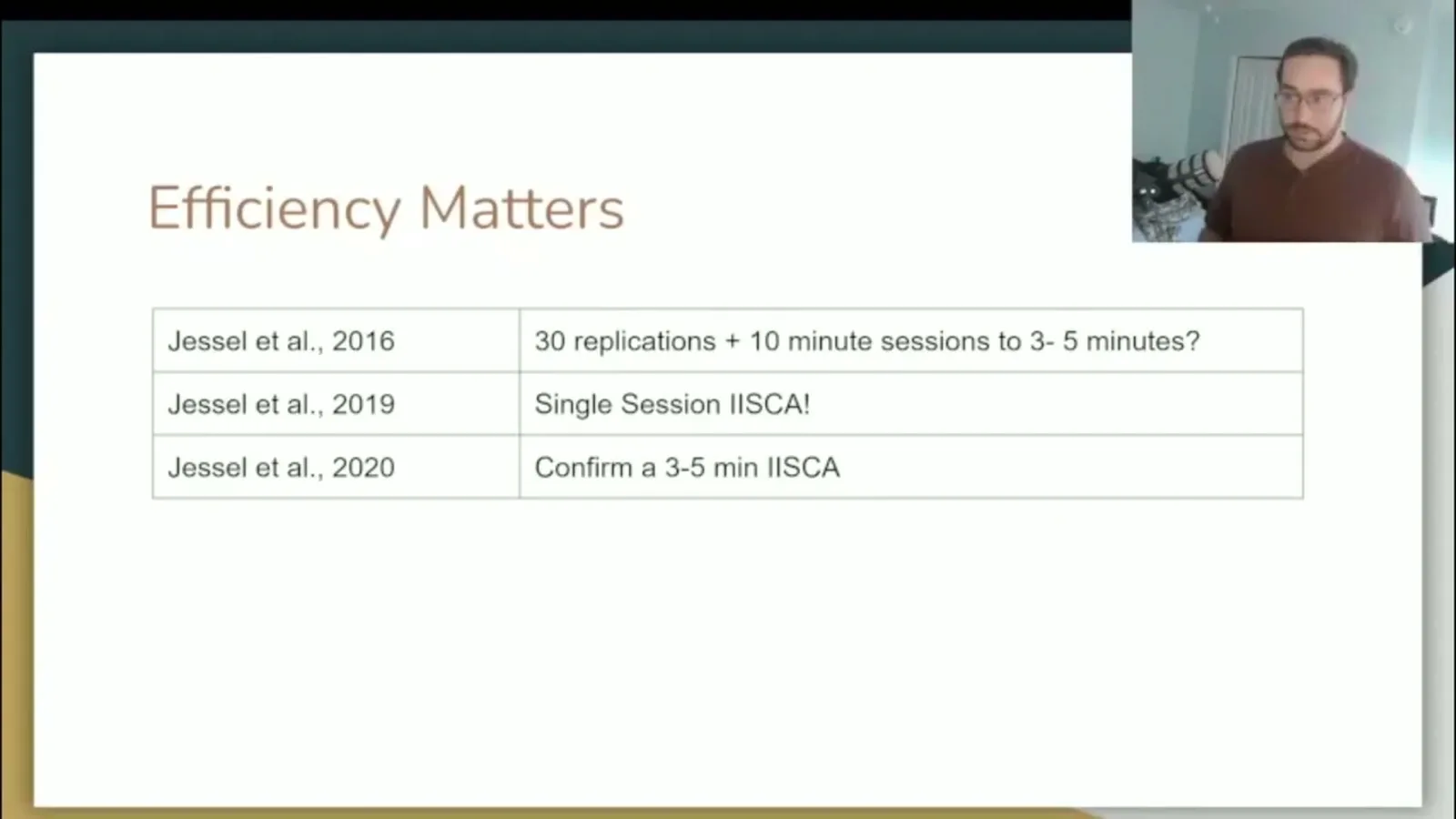
That is a real barrier in schools and homes. A full functional analysis is not always possible. Harrington points practitioners toward the research on shorter and modified assessment formats instead of skipping the step.
Dr. Jessica Osos walks a case the same way in her talk on evidence-based practice. An assessment showed that biting was maintained by escape from demands. She then went to the literature for escape-maintained behavior.
What she found was a pile of studies on functional communication training. Osos calls that a strong evidence base and a well-supported choice for escape-maintained behavior. The assessment picked the target, and the literature picked the tool.
Osos is careful about order. The evidence only points to FCT once the function is known. Matthew Harrington says the same thing when he builds search terms for a stuck case. FCT is his first thought for a replacement behavior, but the function drives which version he searches for.
Teach the request, then teach the "no"#
A request that always works is not a life skill. Sometimes the answer is no, or not yet. So most modern FCT packages teach a second step right after the FCR.
Matt Harrington covers this sequence in 12 days of PFA & SBT. It comes straight out of the practical functional assessment model.
then teach a functional communication response, the FCR... and then go through denial and tolerance training with shaping as a key teaching tool. From the talk — Matt Harrington
Shaping means you accept small steps and raise the bar slowly. You do not wait for the full skill before you reinforce.
One OpenCEU case study on anxiety shows the sequence in action. The team ran an assessment, taught an FCR, then taught the child to tolerate being told no. The child went from barely finishing one step to finishing them all in about six weeks.
Harrington stresses that the tolerance step is not a punishment step. It is a new skill with its own teaching plan.
What the request should earn#
Older FCT work assumed one reinforcer per behavior. Newer work often uses a synthesized reinforcer, which means several things delivered together.
Matt Harrington walks through a graph from Hanley and colleagues that tests this directly. The team taught the same child three versions of the same request.
So this is the equivalent of like the isolated FCR condition and you can see behavior did reduce and it was somewhat variable, and then they did FCT with escape and tangible. From the talk — Matt Harrington
When the request earned escape alone, behavior dropped but stayed bumpy. When it earned escape plus a toy, behavior dropped further. When it earned escape, the toy, and attention together, behavior mostly went away.
The lesson is not that every learner needs all three. The lesson is that a weak FCT result may mean your request is buying too little.
A school example: asking for more time#
 Advertisement
Lauren Weaver shared a school case that makes the whole sequence concrete. Her team stabilized the setting first, then moved into skill-based treatment with four target skills.
We taught Camden to say, please give me some more time when a teacher or adult told him it was time to do some work. From the talk — Lauren Weaver
Notice how ordinary that sentence is. Any adult in the building can understand it and honor it. That passes the substitute teacher test without any extra training.
Weaver's team also let the student pick his own response from a few good options. Choice was built into the teaching, not added later.
Once he mastered self-advocating for more time, we taught him to be okay when someone denied his request. From the talk — Lauren Weaver
He chose how he wanted to show that he was okay with a no. He picked a thumbs up, and sometimes a double thumbs up.
Where experts disagree: one response or many?#
Here is a real split in the field. It is about how many forms of the request you should teach and accept.
Dr. Shane Spiker was trained one way and changed his mind. He was taught that each request should match one specific motivating condition. So you teach one mand for breaks, one for snacks, and so on.
Then he read Ward and colleagues from 2020, and it changed how he thinks about prevention.
when you teach an omnibus man, like my way... it actually helps reduce the problem behavior. From the talk — Dr. Shane Spiker
An omnibus mand is one broad request that covers a lot of ground. Spiker points out that the effect held up even after teaching moved on.
the behavior, the problem behavior maintained at very low rates well after they stopped teaching the omnibus man and started teaching more specific man. From the talk — Dr. Shane Spiker
B. Kuerine Gray pushes back on the other side of that same broad response. She works with pathological demand avoidance profiles, where any demand can trigger refusal.
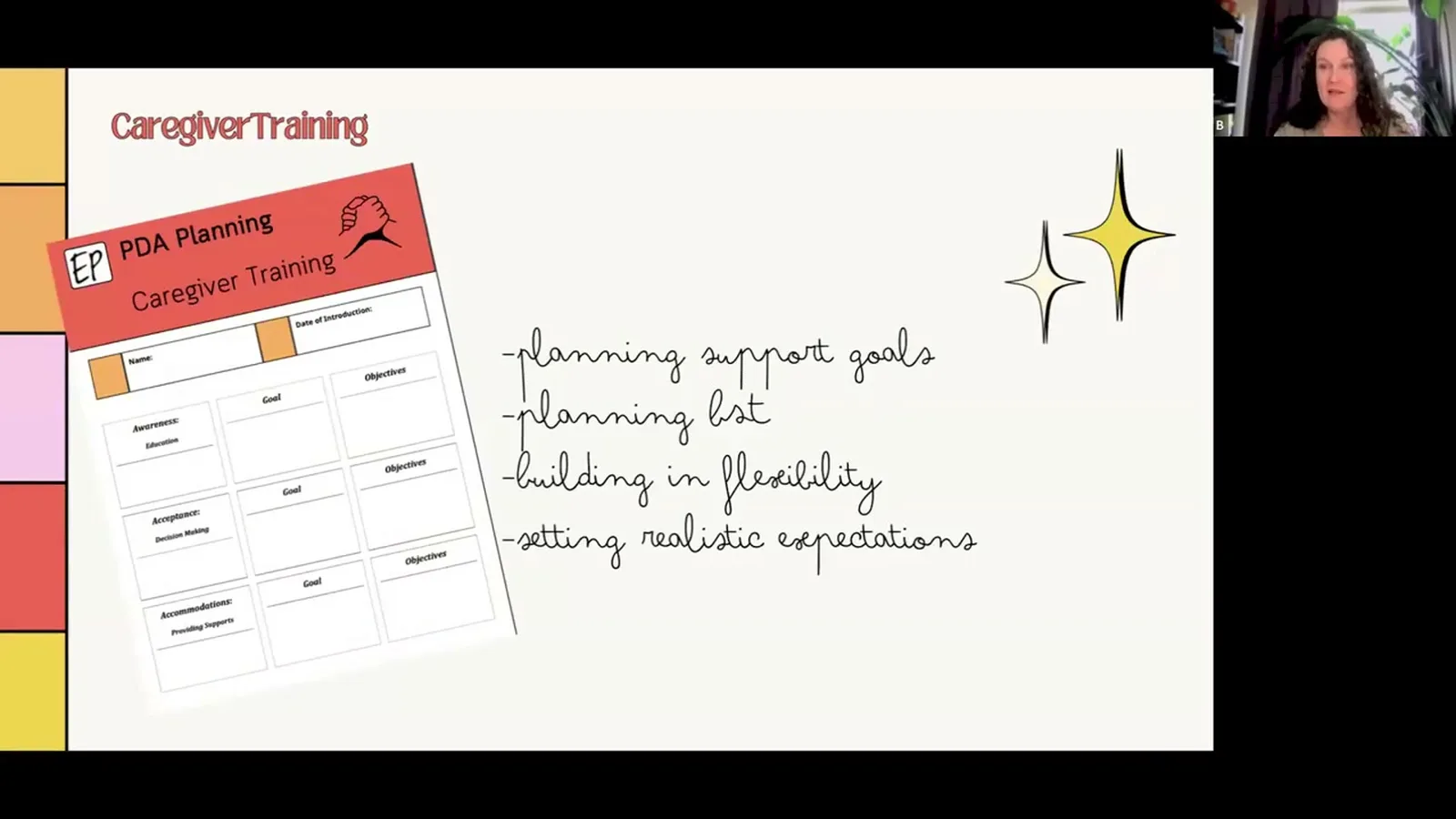
that programmed FCR that we are similar or we're used to with SBT is like my way, my play. I want to do things this way with individuals with PDA... it can be more appropriate to come up with several so that you're not expecting one specific rigid response From the talk — B. Kuerine Gray
Her concern is not the words. It is the rigidity. If you hold out for one exact phrase, you have just added another demand to the moment.
if you're understanding that the intent is an FCR that you count it as an FCR, because if you're saying like, Oh, well, you didn't say this... you're setting another demand instead of engaging in the intent of skills-based treatment From the talk — B. Kuerine Gray
So Spiker argues for one broad response that does a lot of work. Gray argues for several accepted responses that all count. Matt Harrington adds a third constraint, which is that whatever you accept must read clearly to a stranger. These three views can be reconciled in a single plan, but they pull in different directions on any given case.
The debate about pairing FCT with extinction#
Traditional FCT has two moving parts. You reinforce the request, and you stop reinforcing the challenging behavior. That second part is extinction.
Matt Harrington questions the automatic pairing. In his assent talk he describes a certain style of clinician who never varies the recipe.
We talk about that second style of old school behavior analyst who's used F.A. to F.C.T. to extinction for their entire career. And then they get faced with a case that is a circle and they're trying to hit it with a hammer. Their F.C.T. hammer. From the talk — Matt Harrington
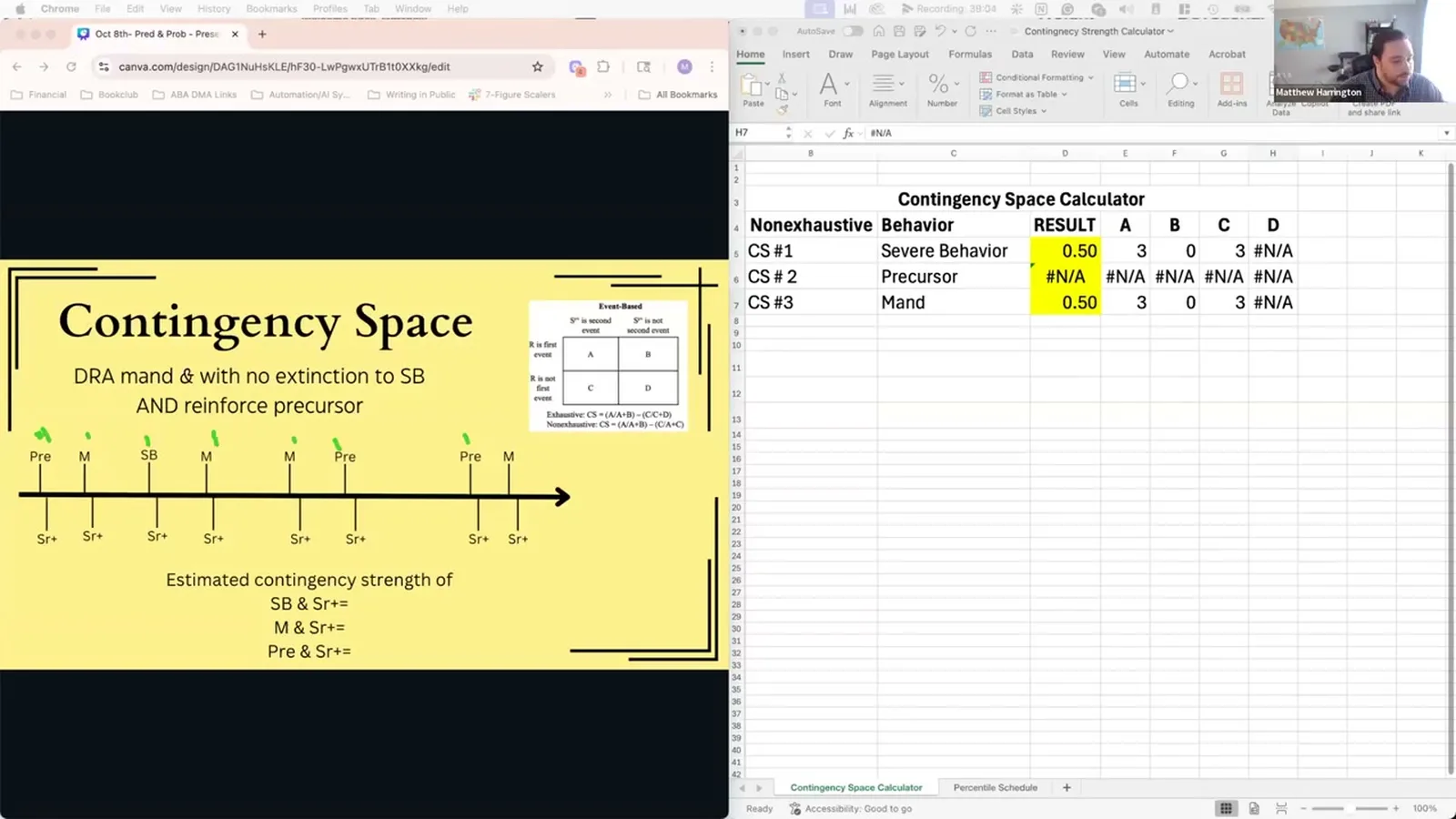
His alternative is not to drop FCT. It is to get the same gap in contingency strength another way. A precursor behavior is an earlier warning sign that tends to show up before the severe behavior itself. In one worked example he puts the precursor on extinction instead of the severe behavior, and reinforces the request heavily.
We've now achieved through a variety of different steps, completely individualized to this client, not a copy-paste intervention from a research paper, but completely individualized for this client, the same effects of FCT without ever putting the client on extinction. From the talk — Matt Harrington
Nicole Stewart raises a different worry about escape extinction. That means blocking the escape a behavior used to buy, instead of reinforcing it. For a learner with ADHD, blocking escape can feel like rejection even when it is meant neutrally. She warns that this can damage the relationship with the technician and lead to more harm, not less.
The disagreement is not about whether FCT works. It is about whether extinction is required to make it work, and at what cost.
FCT when ADHD is in the picture#
Nicole Stewart uses FCT constantly, and she frames it differently than the aggression-and-escape model.
We use functional communication training. So that's a really common one that we use. From the talk — Nicole Stewart, BCBA
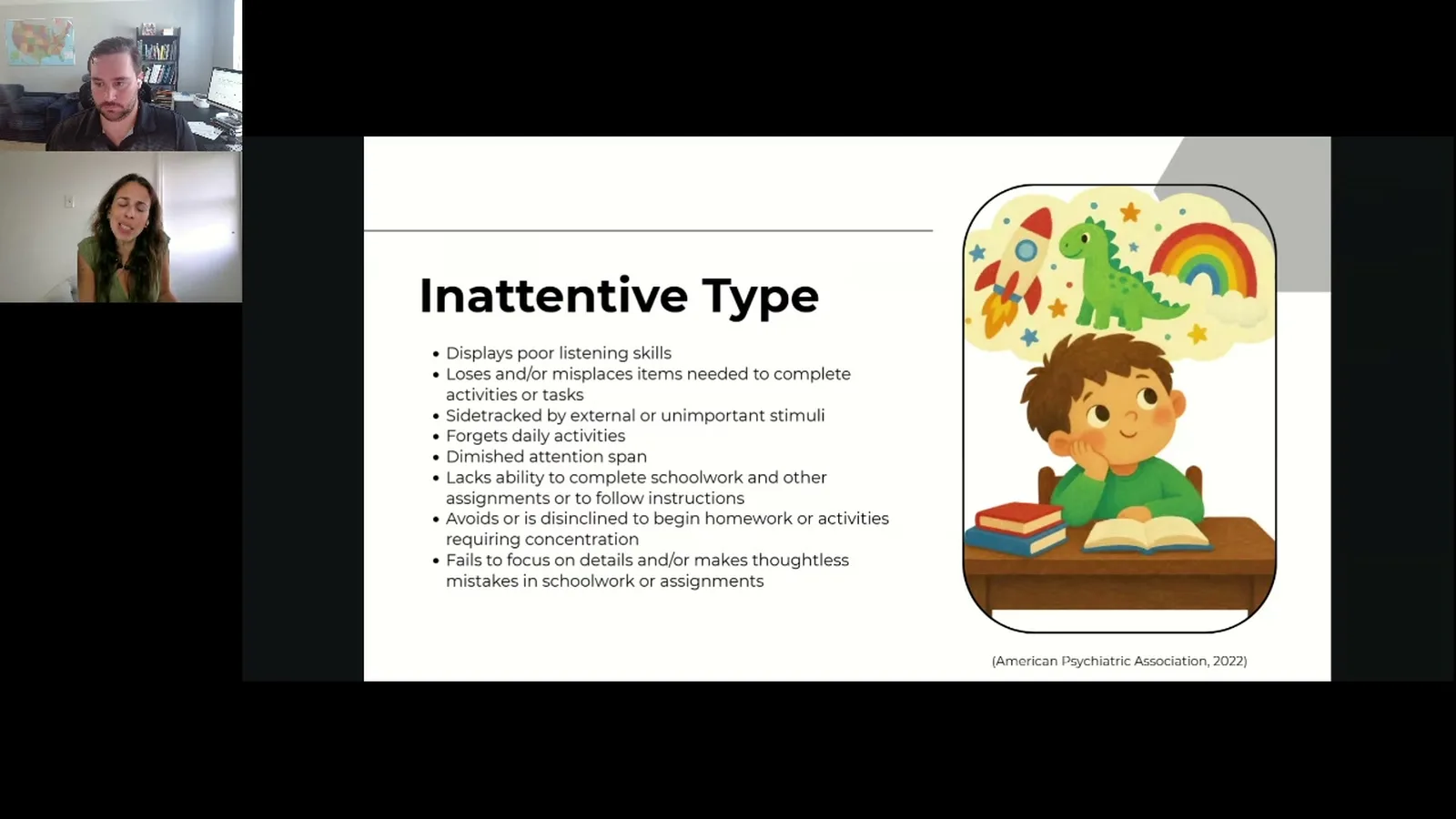
Her goal is to give a learner words for what is happening inside their body. Some traits do not go away. A learner who is inattentive will stay inattentive to some degree. So the skill is naming the state and asking for what helps.
Stewart calls this a key part of working with ADHD. It means teaching them to meet their underlying need in a more adaptive way.
She also gives the sharpest warning on this page. Say an assessment shows escape-maintained behavior during a boring task. The default move is to teach the learner to ask for a break.
Stewart says a break may be the wrong target. If the learner is escaping because the task gives them nothing to work with, a break gives them even less. The request has to replace the need for stimulation, not the demand itself.
That reframes the FCR. The better target may be asking to move, to go outside, or to chew gum while working. Stewart has used all three.
Choosing the form of the response#
The form of the FCR matters as much as the function behind it. Nicole Stewart lets learners help build it. One of her clients invented his own word for the buzzy feeling he got when he was bored.
For learners who do not speak, she uses speech devices, gestures, and sign language. Her measure of success is simple and human. Stewart says being able to communicate what is happening inside them has been life-changing for the kids she works with.
Dr. Jessica Osos adds the family's voice to the choice. In her case example, the parents wanted their child to learn sign and speech. She did not pick one and drop the other.
a modified functional communication approach really incorporating both sign and vocal prompts From the talk — Dr. Jessica Osos
She also embedded the teaching into the family's normal routines. There was no separate FCT session to schedule. That choice made the plan something the family could actually keep doing.
When FCT stalls, look at the prompt#
A huge share of stalled FCT cases are not really FCT problems. Matthew Harrington uses this exact case to teach clinical problem solving.
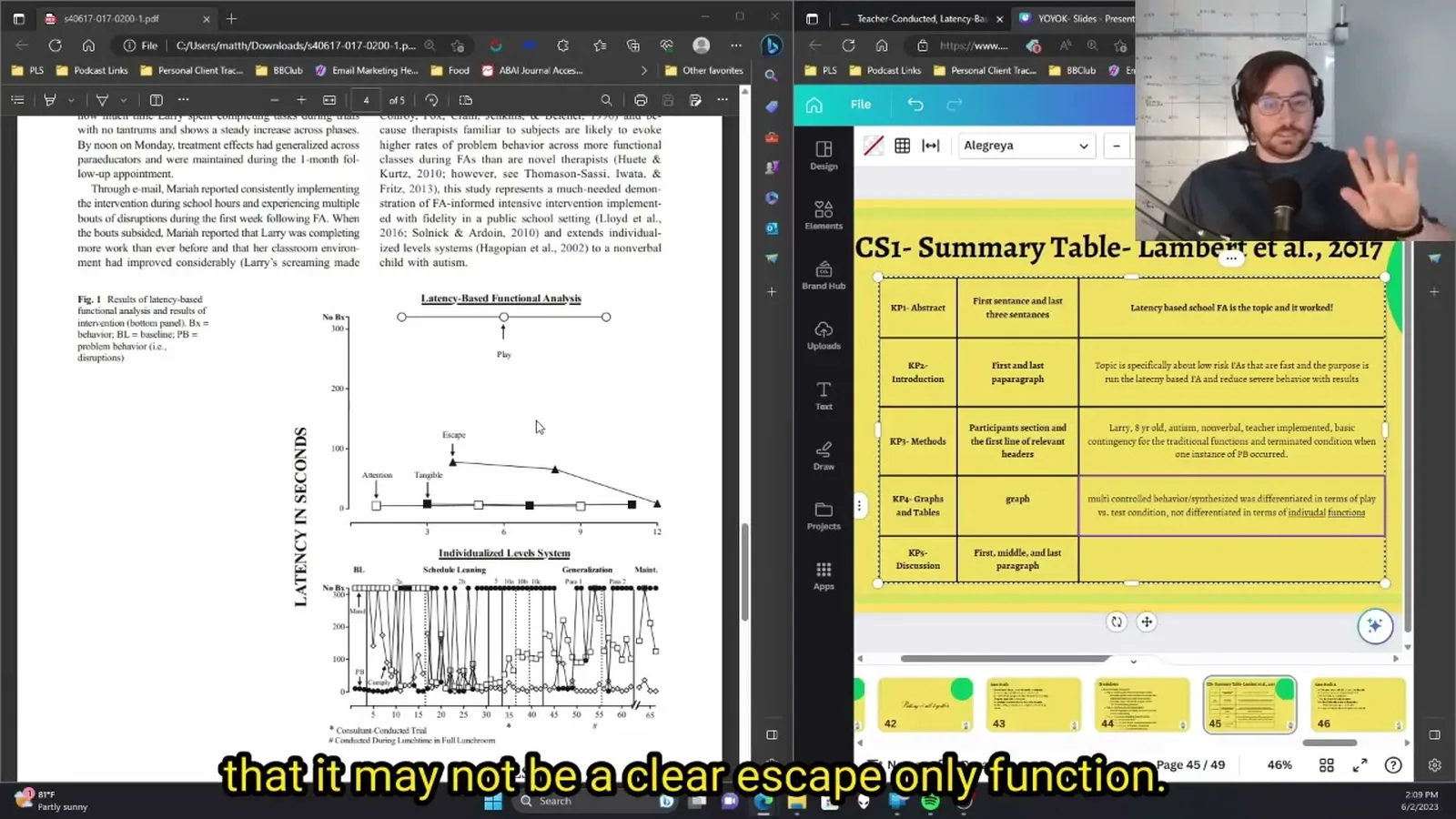
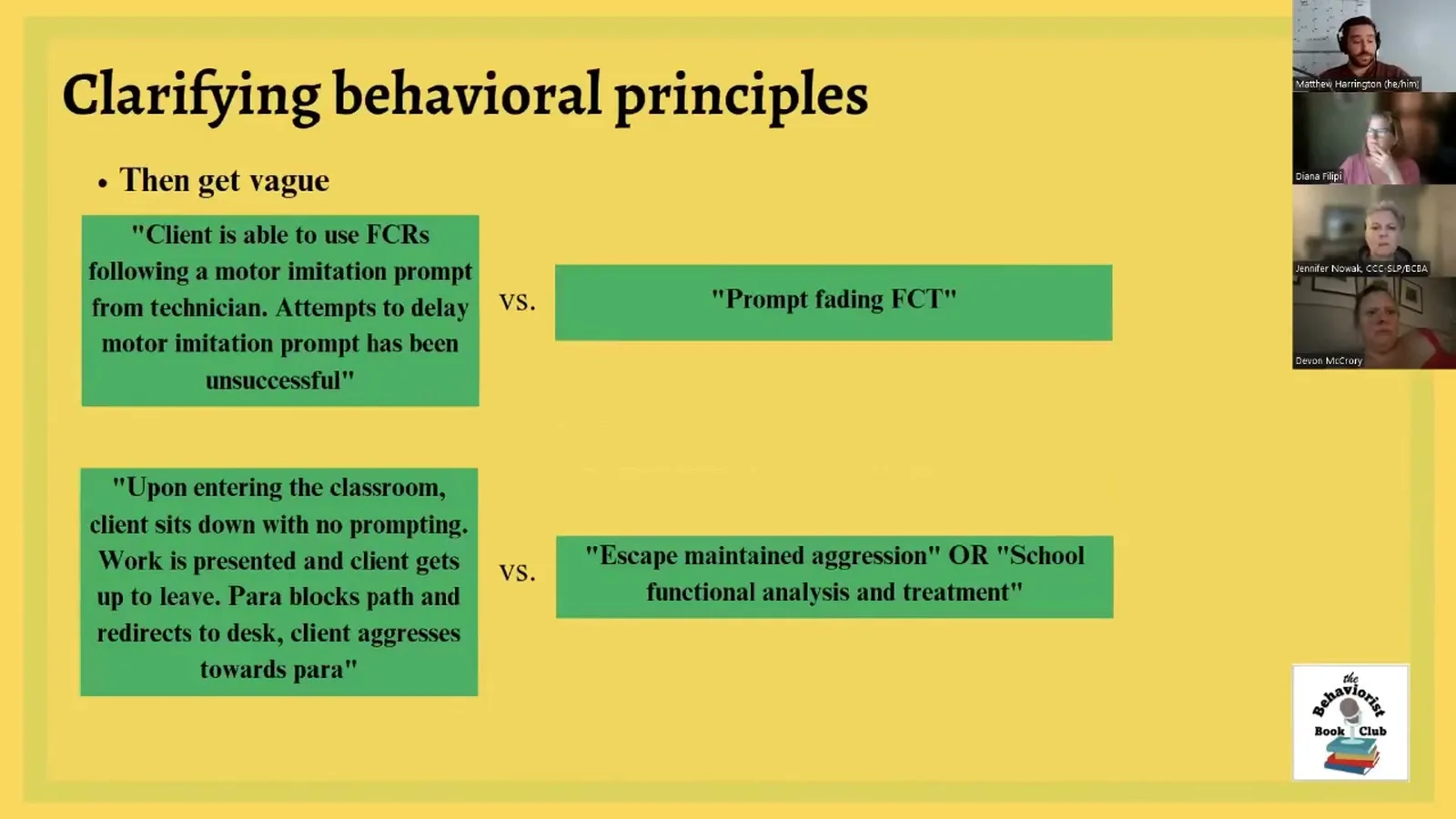
So the client is able to use FCRs following a motor imitation prompt, but whenever we try and delay that motor imitation prompt, it's been unsuccessful and property destruction is occurring. From the talk — Matthew Harrington
A motor imitation prompt just means the adult models the action so the learner can copy it.
Read that again. The request works. The learner can do it. What fails is the fade, which means the plan to remove the adult's help.
The core things that persist when you take out all the variables is that FCT isn't working, right? What does that mean that FCT isn't working? Well, FCT isn't working because the prompt is not triggering the behaviour. From the talk — Matthew Harrington
Harrington makes the same point in his research-to-practice talk. If you tell a colleague that the learner keeps getting stuck in FCT, they have nothing to work with. If you search that phrase, you get thousands of unrelated articles on verbal behavior.
The fix is to name the real problem. The research question here is about delaying motor imitation prompts, not about FCT at all. He recommends searching with short keywords and Boolean operators rather than full sentences.
He also warns against matching on every variable at once. A language assessment score matters a lot for a complex FCT plan. That same score matters very little when you are picking a functional analysis format.
Writing FCT goals that fit the learner#
A good FCR can still die inside a badly written goal. Nikki works in schools and sees this in individualized education programs.
We're not going to write a goal that says learner will tell us, excuse me, can I, can I please have my eraser back in, you know, by the end of the year when they, all they do right now is say no. From the talk — Nikki
Her point is about distance. A learner whose whole repertoire is one word is not getting to a full polite sentence in a year. Write the shaping steps as objectives instead.
Kelly Brzak shows what a reachable early-childhood goal looks like. She writes the goal around practice opportunities, not around perfect phrasing.
Client will complete a minimum of five FCT trials with two family members across five sessions. From the talk — Kelly Brzak
Brzak splits those trials across caregivers on purpose. It builds generalization into the goal itself. She also leans on easy, likely-to-succeed requests early so the adults get a win too.
Who should teach communication?#
Communication goals sit on a line between two professions. That line causes real conflict in clinics and schools.
Anlara Hoskins builds a training scenario around it. A behavior analyst is writing a communication protocol, and a parent has just seen a video making the opposite claim.
a SLP indicated that a BCBA or ABA therapy should not be addressing communication because that falls under the umbrella of speech and language therapy From the talk — Anlara Hoskins
Hoskins walks staff through the ethics codes that apply and a framework for raising the concern. Her answer is process, not territory. Name the problem clearly, go to the right person, and document it.
Nikki's answer is to remove the conflict before it starts.
If I'm writing a functional communication goal, I am going to work with the SLP. From the talk — Nikki
She notes the goal might live under the behavior section or the communication section of the plan. In her state, each specialist reports on their own goals. Deciding that early saves a fight later.
What the research says#
The evidence base for FCT is deep and still growing. A meta-analysis looked at 34 single-case studies with children aged two to eight. It found large effects for reducing challenging behavior. It also found moderate to large effects for increasing the replacement skill (Blair, Park, & Risse, 2025, Behavioral Sciences). The same review flagged low reporting of treatment fidelity and generalization, so quality of reporting still lags behind the results.
A review of six earlier reviews looked only at school settings. It found steady positive effects on challenging behavior. Results varied by setting, communication form, and who ran the plan (Corr, Rispoli, & Welker, 2025, Journal of Behavioral Education). That variability is why Harrington's substitute teacher test matters so much in schools.
One study speaks directly to the debate about teaching several forms. Researchers taught multiple response types for the same reinforcer, then placed preferred forms on extinction one at a time. Challenging behavior came back briefly but did not last. That suggests teaching more than one form makes treatment sturdier (Livingston, Loder-Lafferty, Tran, Melanson, Cengher, & Kwak, 2025, Behavioral Interventions).
Fading how often the request pays off is its own project. A study of schedule thinning found two of three participants held steady when a lean schedule was introduced right away. The third needed a slower climb instead (Ramirez, León, & Bacotti, 2025, Behavioral Interventions). Plan for both patterns, because you cannot tell which learner you have until you try.
FAQ#
What is functional communication training? Functional communication training teaches a person to request the thing their challenging behavior was already earning. You find the function first, then teach a request that earns the same result. The request gets reinforced, and the harder behavior usually drops.
Is FCT the same thing as DRA? Not quite. DRA only requires that the new behavior match the function. FCT adds two goals on top of that. The response has to be socially acceptable, and it has to work with new people in new places.
What do you do when FCT stops working? Check the prompt fade before you change the plan. Many stalled cases are prompt problems, not communication problems. Also check what the request earns, since a request that buys too little may not beat the old behavior.
 Advertisement
Turn this topic into a CEU
You just studied this. Now get credit for it.
Watch 5 Days of Manding Mastery with Matt Harrington and earn 2.5 free BCBA CEUs. Detailed certificate, delivered the moment you finish.
Keep going with a free learning path
Verbal Behavior: Beyond WH-Questions
Dana Pettus's three-part series on building generative verbal behavior. Why WH-question programs stall, how to establish speaker-listener repertoires, and how to scaffold advanced verbal skills like recall and simple inference. Three hours, three CEUs.
Want the primary literature? Read the Functional Communication Training research roundup on our sister site, Behaviorist Book Club.