Research to practice - extending past the pages
Presented by Matt Harrington
In the world of Applied Behavior Analysis, why does it often feel like none of the research being published really applies to us as clinicians? A key skill for clinicians to develop is the ability to understand behavioral principles and extract information about those principles from research articles, ultimately learning something that will positively impact the client they are serving. However, while graduate programs do focus on reading research, very little time is spent actually applying what is learned to the clinical world. In this talk, Matt Harrington will introduce three case studies in which the clinical pathway was influenced—but not controlled—by published research. Each case study will begin with a discussion of the research article that inspired the clinical decision, followed by a description of the necessary modifications made to ensure the successful application of the intervention. Time will also be spent discussing and modeling the clinical decision-making process to ensure attendees can independently engage in these skills outside of the conference environment.
Register free & watch nowCancel any time. Cert delivered to your inbox the moment you pass the quiz.
Learner ratings
from 27 learners
100% would recommend this CEU to other professionals in their field (21 responses)
About this CEU
In the world of Applied Behavior Analysis, why does it often feel like none of the research being published really applies to us as clinicians? A key skill for clinicians to develop is the ability to understand behavioral principles and extract information about those principles from research articles, ultimately learning something that will positively impact the client they are serving. However, while graduate programs do focus on reading research, very little time is spent actually applying what is learned to the clinical world. In this talk, Matt Harrington will introduce three case studies in which the clinical pathway was influenced—but not controlled—by published research. Each case study will begin with a discussion of the research article that inspired the clinical decision, followed by a description of the necessary modifications made to ensure the successful application of the intervention. Time will also be spent discussing and modeling the clinical decision-making process to ensure attendees can independently engage in these skills outside of the conference environment.
From the talk
What was covered
A behavior analyst's three step method for turning a messy clinical problem into a research paper you can actually use.
- Add detail to the case before you search, because the real hinge point is almost always narrower than the referral question.
- Translate that hinge into the broad words a journal would use, and keep client demographics out of the search box.
- Use keywords instead of full sentences, with capitalized Boolean operators like AND, OR, and NOT to narrow your results fast.
- Read the methods for boundaries: prerequisite skills, staff ratios, resources, and who actually ran the sessions.
- Rule out data integrity and fidelity before you decide the intervention itself failed.
- Expect to combine several papers, since one article will rarely match your setting well enough on its own.
Why published research feels like it never fits your caseload
A fieldwork student once asked the speaker for help. Their client's behavior was serious. Staff safety was at stake. They had about thirty minutes before the next session. They opened Google and typed a full sentence in the box. It read like a note to a friend. No one had taught them how to search. No one had shown them search terms or Boolean operators (search words like AND and OR). No one had taught them how to find the crux of a case.
Weeks later a fellow BCBA (a board certified behavior analyst) asked about toothbrushing. A learner was stuck. Was there a paper on it? The speaker knew of a shaping study (building a skill in small steps) on tolerating dentist visits. The colleague said that was about the dentist chair. It was not toothbrushing. The colleague was not against using research. They just could not lift the principle out and move it.
Both moments point at the same gap in master's training. Programs pour on research like a fire hose. The speaker read about eight papers a week in their program. All of them sat in Canvas, ready to download. Finding them took no problem solving at all. The written work was pros, cons, and summaries. None of it was about using the paper on a real kid.
It wasn't that she didn't know that we needed to use research.
From the talk — Matt Harrington
Step 1: get specific before you get vague
The finding framework has three steps. First, name the behavioral principles at play. Second, name the demographics that matter. Third, search with terms that make sense. Speed is the point. A four hour search that dead ends is a loss.
Step one feels backwards. To find the real problem, add detail first. Look at the room and the motivation. Look at the skills the learner has. Look at the ones they do not have yet. Look at the contingencies (what happens right after the behavior). Look at the learning history. Then look at what is not happening. Borrow from nonlinear contingency analysis (the study of behavior that does not occur). Some other behavior is being held down by its own ABC (antecedent, behavior, consequence chain).
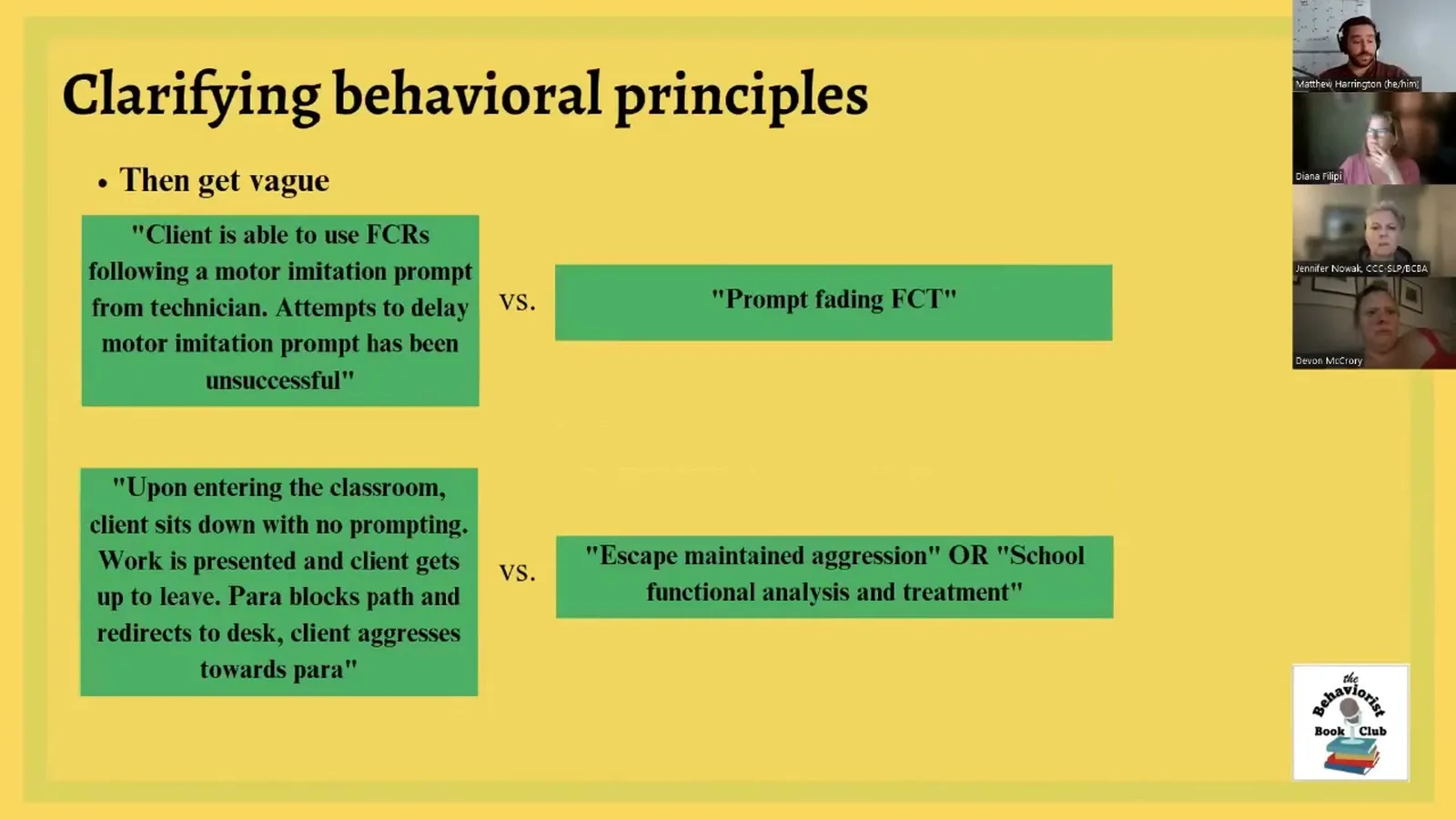
Here is the gap in action. "They keep getting stuck in FCT (teaching a request that gets the same payoff)" helps no one. Type that into Google Scholar and you drown in verbal behavior papers. Now get specific. The learner requests after a motor imitation prompt (you show the move to copy). Delaying that prompt has failed every time. So the search is not about FCT at all. It is about delaying a motor imitation prompt.
"Client engaged in aggression" fails the same way. Walk the chain instead. The client enters the room. They sit down. Work is put in front of them. They get up to leave. Staff block the path and redirect. Aggression follows. Now you can see real targets. Maybe staff are running extinction (no longer paying off the behavior) in a room that cannot hold the burst. Maybe the issue is how long they can tolerate the work.
So get really specific before you get vague.
From the talk — Matt Harrington
Step 2: turn the hinge point into a vague search term
Once you find the hinge, go back to vague. Journals write for everyone, so they use broad words. Your search has to meet them there. This is not the same as starting vague. You are being broad about a problem you already pinned down.
The imitation case becomes prompt fading (slowly taking the help away). Add functional communication training if you want it tighter. The classroom case becomes escape maintained aggression (behavior that gets you out of work). It also becomes school functional analysis and treatment. The staff case becomes behavior skills training for classroom fidelity (staff running the plan as written). You go from a vague problem to a sharp one, then to a vague fix you can type.
Leave demographics out of the box for now. They come back when you read the papers. The speaker uses three tests for the right level of broad. Write it as if you cannot break HIPAA (the patient privacy law). Write it in Cooper book glossary terms. Or picture an old and fancy professor. How would that person hear your problem?
We're ignoring demographic variables at this point.
From the talk — Matt Harrington
Journal flavors, Boolean operators, and the two papers worth your time
Journals have flavors. JABA (the applied behavior analysis journal) runs more technical. The experimental analysis of behavior journal runs very technical. The speaker finds the verbal behavior journal more technical still. Behavior Analysis in Practice leans toward clinicians. Even that flips. A special issue on ACT (Acceptance and Commitment Therapy) brings in dense ideas like relational density (a dense technical concept).
Match the question to the specialty. Joint attention does show up in JABA. A deeper read of that verbal behavior may sit elsewhere. Staff who skip weekly cleaning tasks is an organizational behavior management question. Need an answer today? Go to the clinician focused journals. You have full access through the resources tab in your BACB account.
Use keywords, not sentences. Use Boolean operators in caps to steer the list. Prompting AND fading AND "functional communication training" beats prompt fading alone. Escape AND aggression AND intervention works well. "Functional analysis" AND school NOT home drops the clinic and hospital papers. You are cutting a response barrier: the time cost that stops you from searching at all.
A sharp search still returns a hundred papers. Two kinds earn your time. One tests the exact variable you care about, like a study comparing four prompt fading methods. The other just shows the answer working again and again. A long run of successful assessments is one example. If some of those cases ran in schools, read what they did there. Then find one good paper and mine its reference list.
It's about efficiency, getting the right information fast.
From the talk — Matt Harrington
Boundaries of treatment: what makes a good plan miss
Boundaries of treatment (limits on where a plan works) need more sunlight. ABA has grown fast. Insurance sends in two year olds and fifty five year olds. A plan does not stop being evidence based in the wrong room. It just stops doing what you built it to do.
Prerequisite skills come first. Teach PECS (a picture based way to ask) to a learner with no one to one matching and you stall. That is not a knock on PECS. The context was wrong for it. Other limits include cognitive differences, diagnoses, resources, and staff skill.
Resources decide more than most plans admit. Much of the speaker's grad training happened in a hospital setting. Each learner had two staff and a clinical supervisor. Nurses were on site all day. Meals and protective gear were covered. Great research comes out of settings like that. Send the same plan to a group home with five kids to one adult. Your NCR schedule (free attention on a timer) turns intermittent. Now it may pay off the wrong behavior.
Implementer skill is the limit people skip. Read who ran the sessions. A first author who ran every session is not your new technician. Feeding papers often say so in the last paragraph. When you read, match on what matters for your question. For an FCT paper, look at the manding scores, not the tacting ones.
We want similar, not exact.
From the talk — Matt Harrington
Parsimony: rule out the boring explanations first
Parsimony means you rule out simple causes first. You can do that by testing or by reasoning. Ask three things before you blame the plan. Is the data telling the story, or are you reacting to noise? Is the plan being run with fidelity when you are not there? Is there a motivation, skill, or values problem?
Ruling out does not mean weeks of testing. You see maybe twenty or thirty percent of sessions. You cannot pause a kid's life for a week of IOA (do two people score it the same). Rule it out on paper instead. Say the behavior is plain, has no covert form, and happens four times an hour. A technician with a clicker will score that well. That is why tight definitions and clean data systems pay for themselves.
Skip this step and you loop for months. The best procedure in any journal cannot fix a broken data system.
If you have no data integrity, your graph will never look beautiful.
From the talk — Matt Harrington
Case study: an SBT plan that had to survive a school placement change
A fourteen year old came in struggling with transitions. Not just the hard ones. Any change at all. The speaker ran an ISCA (an interview based functional analysis). Then they moved into skills based treatment (teaching tolerance and a clear request). The match was about principle, not looks. The problem hinged on waiting out a delay to reinforcement. SBT also builds in unpredictable schedules, which fit a kid whose routines set fast.
Early data looked like a textbook. Giving up reinforcement was choppy, then it shaped up. Moving to the activity shaped up the same way. Time in the task grew from five minutes to ten. Assent (the learner agreeing to go on) was honored the whole way. The constant no's dropped out. Then the district changed their placement. Weeks of prep for one school were gone. The first two mornings at the new school got nowhere.
Three weeks of IEP (the student's special education plan) meetings did not change the placement. So the speaker asked what had made the plan work. It was not the clinic. The paper behind it ran in an outpatient clinic too. That was never the active part. The active part was the kind of problem SBT handles well. So they ran SBT in the school and shaped it again, step by step. Today that kid moves through all of their classes on their own.
We've already done it twice and we can do it a third time.
From the talk — Matt Harrington
Case studies: stitching papers together, and church on Sunday
The second case was an eighteen year old who wanted a job. The client loved one cafe in town. A paper on assessing and teaching job skills gave six target skills. But it ran in an adult day program. That gap felt too wide. So the speaker pulled more papers. One on values, to make the work mean something to the client. Others showed that learners often prefer contingent reinforcement (a payoff you earn) over free access. Another covered renewal, or what happens when the team backs off.
No paper was about a cafe. Together, these pieces built a case plan. Pick a site that matches the client's values. Lean on real praise from a boss and coworkers. Teach the job skills that make that praise show up. Day one ran sixty minutes with no effect size to graph. No journal prints that graph. Later a session got canceled and the client's parent asked to take them alone. The client worked ninety minutes with no clinical staff there.
The third case was a three year old. Their family had stopped taking part in church and lost a support network. They ran and served at the back of the church and loved it. Going inside brought screaming and flopping. The paper chosen had destructive behavior in the title. That was not the point. The principle was the multiple schedule (a signal for when a payoff is on). In practice that meant extinction in one part and reinforcement in the other.
But screaming in church is not workable, and extinction on running would cause it. So a second paper came in. The Galbica paper on percentile schedules (math that sets each small step) sets the criterion. It keeps the odds of success near one hundred percent. That is the closest thing we have to micro shaping. It also heads off the extinction burst (a spike when the payoff stops). Minutes in the pew went from five to over twenty. The payoff was a wedding with the kids as ring bearers. That is social validity (change the family truly cares about).
There is no research article that talks about how to do vocational skills at a coffee shop.
From the talk — Matt Harrington
Common questions
How do I find a research article when nothing matches my client's exact situation?▾
Stop looking for your case and start looking for the principle under it. Get very specific about the chain of events first, so you can name the one variable that is stuck. Then get broad again and search that variable in journal language. A paper on a different behavior in a different setting can still carry the principle you need.
What are boundaries of treatment in ABA?▾
They are the limits that decide whether a good plan will actually work for your learner. Prerequisite skills, cognitive differences, diagnoses, available staff, and implementer competence all count. A plan built with two staff per learner and nurses on site may fall apart at a five to one ratio. The plan is still evidence based, but the context will not produce the effect.
How much can I change a published procedure and still call it evidence based?▾
Ask what was actually doing the work in the study. If the setting was not the active part, moving to a new setting is a fair change. If you strip out the part carrying the behavioral principle, you have gone too far. The talk moved a clinic based procedure into a school because the class of problem, not the room, was the match.
Which journal should I search first?▾
Match the journal to the flavor of your question. Technical and conceptual questions sit in the more technical journals. Staff performance questions belong in organizational behavior management. When you need an answer today, go to the clinician focused journals first.
How do BCBAs get access to these journals?▾
Certificants have access through the resources tab in their BACB (the board that certifies behavior analysts) account. That covers the journals named in this talk. Logging in once removes the access barrier for every journal covered here.
About the speaker
Matt Harrington is a BCBA (a board certified behavior analyst) and the director of clinical excellence at a local clinic. They founded The Behaviorist Book Club to ask why good research is not reaching the clients who need it, and they chose to stay a clinician so they could work on those barriers from the inside. Much of their graduate training happened in a hospital setting, and they describe their one real edge as curiosity.
This summary was generated from the recording’s transcript. Quotes are taken word for word from the talk.
What you'll learn
- 1Learning Objectives
- 2Learners will be able to identify how to view their clinical challenge through the lens of parsimony to determine the most likely variable that, when modified, will lead to a clinically significant change in behavior.
- 3Learners will be able to utilize the problem-solving framework presented to identify the behavioral principles present in their clinical scenario and determine how to find research related to their challenge.
- 4Learners will be able to define what “boundaries of intervention” means and how to identify individual boundaries of intervention for each client.
Concepts in this CEU
Related talks
Talks that cover the same concepts
Solving Clinical Challenges with Research
The Behaviorist Bookclub

Reflective Supervision and Client Outcomes
The Behaviorist Bookclub
Toward an Evidence-based Supervision Model: Training Students in Independent Fieldwork
Willow Mentorship & Consulting, LLC

From Research to the Applied Setting: Breaking Down the Three-Legged Stool of "Evidence Based Practice"
Copper Consulting Group
Prediction and Probabilities: Three foundational equations to successful behavior reduction
The Behaviorist Bookclub
5 Days of Manding Mastery
The Behaviorist Bookclub
More from The Behaviorist Bookclub
Harm Reduction Within ABA Practice
The Behaviorist Bookclub
Supervising Beyond Technical Skills: Professionalism, Communication, and Clinical Judgment
The Behaviorist Bookclub
When the Foundations Are Right: Unlocking Advanced Verbal Repertoires
The Behaviorist Bookclub
OpenCEU is supported by advertising from third-party sponsors. Sponsors are clearly labeled, have no influence over course content, instructors, or CEU decisions, and never appear on certificates. The BACB does not sponsor, approve, or endorse OpenCEU sponsors or their products.