Dunder Mifflin’s Guide to Training and Onboarding: Lessons from The Office
Presented by Mellanie Page
This CEU presentation tackles a central challenge in ABA organizations: how to train and supervise staff effectively from day one. Using humorous and relatable scenes from The Office, participants are guided through a series of training and supervision principles—from how to translate company values into behavioral expectations to how to structure engaging, retention-focused learning. Topics include BST, onboarding design, behaviorally defined expectations, staff motivation, and connection-building. Through structured discussion, participants will learn how to make training more meaningful, memorable, and mission-aligned—reducing burnout and increasing long-term effectiveness.
Register free & watch nowCancel any time. Cert delivered to your inbox the moment you pass the quiz.
Learner ratings
from 20 learners
100% would recommend this CEU to other professionals in their field (5 responses)
“.”
— Sheri W.“I love The Office, so the examples were applicable and relatable.”
— Lee D.“great presentation”
— Jaime O.“Excellent presentation!”
— Kally B.“Important very relevant. Using the model in the future.”
— Luis G.“Great presentation and very informative. I would love to see more.”
— Rene D.
About this CEU
This CEU presentation tackles a central challenge in ABA organizations: how to train and supervise staff effectively from day one. Using humorous and relatable scenes from The Office, participants are guided through a series of training and supervision principles—from how to translate company values into behavioral expectations to how to structure engaging, retention-focused learning. Topics include BST, onboarding design, behaviorally defined expectations, staff motivation, and connection-building. Through structured discussion, participants will learn how to make training more meaningful, memorable, and mission-aligned—reducing burnout and increasing long-term effectiveness.
From the talk
What was covered
Mellanie Page uses The Office to show how to define values as behaviors, cut jargon, shape staff training, and keep new RBTs (entry level ABA staff) from leaving.
- Write down the behaviors that prove each company value, then teach those behaviors during onboarding.
- Test every expectation with one question: how can I tell this happened?
- Swap jargon for modeling, practice, and feedback in a new hire's first weeks.
- Keep a skill in training only if it is high impact, used often, and it matters to the learner.
- Run a preference check on your staff and use options like recognition and social time, not just items.
- Build rapport with a new team member before you train the technical steps.
Onboarding Teaches Culture, So Define the Behaviors Behind Your Values
Onboarding is not just a skills checklist. It is a new hire's first taste of your company. In week one they learn what you care about. They also learn who you are as a supervisor. Page framed it as an introduction to the company and its values.
She pointed to the meta contingency (many small behaviors that build a culture). Single behaviors join into a network. That network makes acting a certain way stronger over time. In plain terms, it is your company culture. If nobody names the behaviors, the culture forms by accident.
When she asked the room for values, the chat filled fast. Kindness. Support. Growth. Collaboration. Then came the harder question. How much of that shows up in your actual training? Each value means something different to each person, so she ran the exercise both ways. Name a behavior, then find the value. Name a value, then list the behaviors.
For passion, her own examples were small and countable. Bring one new idea to supervision. Finish one piece of professional development. Show up to the meetings. For collaboration, the room got sharp. Attend a team meeting each week. Ask direct staff for input when building a treatment plan. Post updates in the group chat so everyone stays current. When a definition still feels fuzzy, use her test. How can I tell?
So the point here is to show values need to be complemented by defined behaviors.
From the talk — Mellanie Page
Cut the Jargon in Early RBT Training
Our field runs on acronyms. The people learning them are often brand new. Many RBTs (entry level ABA staff) come straight out of high school. For some, this is a first job. Big words on day one feel like a wall.
Page put it bluntly. Terms, concepts, and principles do not prepare a behavior tech to do the job. She pulled out the two action words: prepare and do. Big words do neither one. The science vocabulary still matters. It just does not have to come first.
What works instead came straight from the room. Model the skill. Give the person a turn. Give feedback. That is BST (show, practice, then give feedback), and it needs almost no vocabulary at all. Pair a technical word with a plain word, then give a real example. Over time the term gets layered onto a skill the person can already do.
The point here is we need to quit the jargon.
From the talk — Mellanie Page
Shape Staff Learning the Way You Shape Any Other Skill
Eagerness is the trap. We want to share all of it. So we hand new staff concepts, plans, and support strategies they cannot use yet. Page compared that to an initiation: a flood of policies, steps, and terms in week one.
Her fix is a thing we already teach. Shaping (build a skill in small steps) is not just for clients. We condition skills in staff too. So start where the learner really is. In her experience, that point is much earlier than most teams assume. She asked the room to rate their own shaping of training on a one to five scale. Most answers came back as twos and threes.
Two moves follow from that. First, build set times into training to hear barriers and questions. Lecture rolls on and the what if questions never get asked. What if my client walks away? What if there is a distraction? Second, go deep instead of broad. She was honest about her frustration with the broad 40 hour training. There is only so much time, and not every concept gets used in week one, or ever.
We can't possibly teach everything that we would eventually want them to know.
From the talk — Mellanie Page
Three Tests for Whether a Skill Belongs in Training
If you cannot teach everything, you need a filter. Page offered three.
First, high impact. Some skills ripple outward. Learn to pair (build rapport before asking for work) and you gain instructional control (getting a client to follow your lead). That control builds the relationship you need to teach. The same goes for reinforcing behavior and setting up the MO (making something worth working for). Her non example: hours of admin tasks. That is an area to trim.
Second, how often it comes up. Frequent skills create practice, and practice builds fluency (smooth, fast, correct work). Teach the thing a tech will use every single session, not the thing that shows up once a month.
Third, socially significant (it matters in real life). Her test is a sentence you have to finish out loud: you are learning this because. If you cannot finish it, cut it. She also wants the trainee to agree. If they do not see why it matters, you lose their reason to learn it. Her own non example was the long history of the science. Fun for us. Not day one material for a new tech.
If there's a skill that's not needed frequently, then it's likely not critical.
From the talk — Mellanie Page
Write Expectations That Leave No Room to Guess
Clear expectations are slow work, and they prevent most of the problems we blame on new staff. Page's checklist has five parts. Name who does the behavior, what the behavior is, and where it happens. Then add when it happens and how it should be done. Skip one and the directive falls apart.
Take the directive "report an incident right away." What counts as an incident? Who do you tell? Without that, a new tech pauses or tells the wrong person, and the response comes too late. Take "collect data." On which skills? How often? Why does it matter? Teams watch five teaching moments an hour go untracked and then wonder what went wrong.
Even "engage with your client" needs a definition. Do I follow their lead? Only when they are doing what I asked? All the time? She described policies and steps as clear definitions (exact, observable wording). They should also work as task analyses (a job broken into steps). And do not skip non examples. We tell people what to do and forget to show what not to do.
Most failures and shortcomings of new team members are due to lack of clear expectations.
From the talk — Mellanie Page
Link the Work to Outcomes, Then Assess What Motivates Your Staff
We fight hard for meaningful programs for clients. We rarely hold staff training to that same bar. Page's questions were direct. Is this training needed, or is it just habit? Do we tell trainees why each piece exists? Without a purpose, you have taught the steps and skipped the heart of the job.
That gap turns into turnover later. A tech knows they are doing the right thing. They cannot connect it to any outcome for a client or the company. The work is hard. Over time they fade, and then they go.
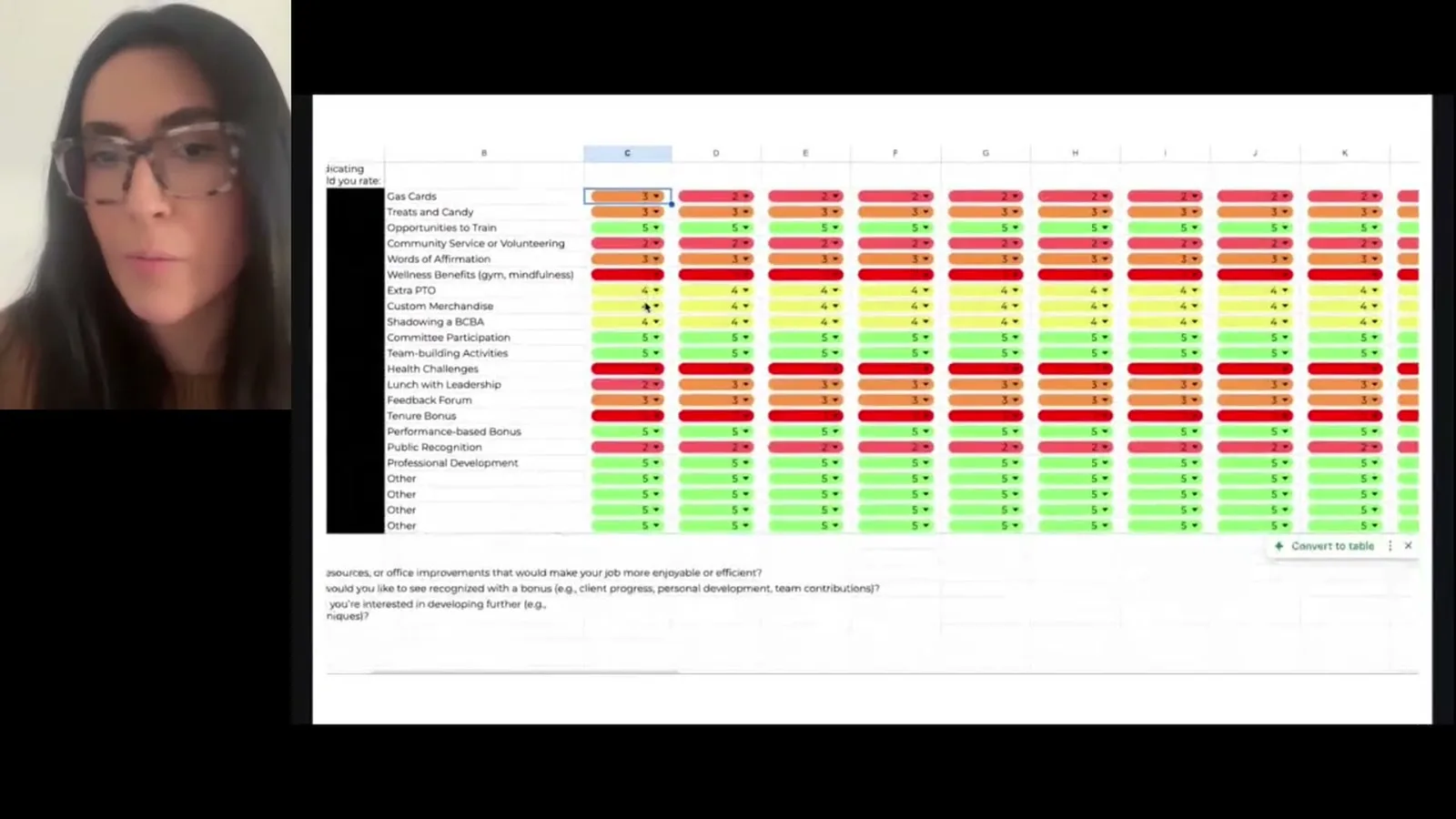
Motivation does not just appear because we want it to. People are reinforced by different things, so ask. She shared a simple tracker: team members across the top, items down the side, and a score for each one. Add your own options as you learn them.
Not every reinforcer has to be an item. Social time counts. Public credit counts. Lunch with a leader counts. If social contact is what lights someone up, invite them to a meeting they would enjoy. It does not have to be a meeting they are required to attend. You cannot match every preference on a team. You can still ask.
And as basic as this sounds, it's so important to assess preferences early and often and be clear about what reinforces team members.
From the talk — Mellanie Page
Engagement Techniques That Make Training Stick
Page shared a stat she came across. Attention span sat at 12 seconds in 2000 and 8 seconds by 2015. A goldfish holds nine. Meanwhile a 40 hour training runs 144,000 seconds. Attention drifts the whole way through it.
Retention follows the same line. Lecture style learning holds about 5 percent. Active participation pushes that toward 75 percent. So when a tech asks a basic question a week after training, they probably did hear the answer. It was never practiced and it was never reinforced.
The methods she and the room named are easy to run. Role play, even though people dread it, because it forces you to stay in the moment. Practice runs and real problem solving. Quiet time to reflect on what just happened, with a few guided questions. Stories and humor, since feelings make learning stick. Personal examples, which also show you who has not connected with the material yet. Student teaching: let trainees teach each other while you listen in. Games and friendly contests.
She also pushed learners to generalize a skill into new settings. Teach a token economy (earn points, trade them for rewards) in a classroom. Then ask how it would work in a grocery store with nothing to carry. That guided jump is derived relational responding (linking ideas nobody taught directly). She used the same idea for reinforcer variety. A child loves one animal toy. Ask what they like about it: is it soft, is it pretend play, is it animals? Then branch out into new options. Creativity can be trained.
Humor, I think, is a great way to make examples memorable.
From the talk — Mellanie Page
Connect First, Then Train: The Part Most Onboarding Skips
Her last clip was a sales scene. One character connects before he pitches. The other jumps straight to business. Page said we do the second thing in training all the time. We open with policy and steps and never learn who is in the room.
Connection here means real rapport. Who is this person? What matters to them? Supervisors put on the expert cap when being human would do more work. She pushed back on the memory excuse too. If you care about something, you tend to remember it. If a name or a detail keeps slipping, that is usually about what you are prioritizing, not about your memory.
The ideas from the room were simple and repeatable. Check in before and after a session. Ask about the person, not just the job. Name your own weak spots so the new tech can relax. Run daily debriefs and one on one time. Look for things you have in common. Share what makes you nervous. Build a pairing process for staff, not only for clients.
Her closing frame flips the usual script. We act like the trainee is selling us on why they belong here. In truth we are selling to them. We want them, and we want them to stay. That means sharing values as behaviors, setting clear expectations, and tying their role to the mission. It also means listening for barriers and building learning worth showing up for.
My big takeaway here is just before you sell, make sure you connect, right?
From the talk — Mellanie Page
Common questions
What should come first in RBT onboarding?▾
Page would start with values turned into real behaviors, plus a connection with the person you just hired. Onboarding is a new hire's first look at your culture. The behaviors you teach first are the ones you are saying matter most. Technical vocabulary can come later, layered onto skills the tech can already perform.
How do you turn a company value into something you can train?▾
Pick the value, then list behaviors that would prove it, written so anyone could see and count them. For passion, that might be bringing one new idea to supervision or finishing one piece of professional development. If a definition still feels vague, ask her test question: how can I tell? That question forces you down to the behavior you can teach and track.
How do I decide which skills to keep in a staff training?▾
Use three filters. Is the skill high impact, meaning it unlocks other skills like pairing does? Is it used often enough to build fluency? Can you finish the sentence you are learning this because, in a way the trainee agrees with? Skills that fail all three, like deep history of the science, can wait.
Why do new staff forget things they were clearly taught in training?▾
Usually because the training was lecture style. Retention for lecture sits around 5 percent, while active participation pushes it toward 75 percent. The information was delivered, but it was never practiced, reinforced, or tied to a real situation. Role play, teaching back, reflection, and stories all fix the same gap.
How do you motivate a new RBT beyond telling them the job is important?▾
Assess what actually reinforces them, and do it early. People differ, so a shared purpose alone will not carry everyone. Track preferences for each team member. Include options like social time, public credit, and time with leaders, not just items. Then link each expected behavior to an outcome so the daily work does not feel arbitrary.
About the speaker
Mellanie Page presents CEU (continuing education unit) sessions on staff training, supervision, and team culture in ABA (applied behavior analysis), using clips from The Office to make the principles land. This was her third run of this Office themed session, and she runs a free CEU each month. In this talk she drew on her time supervising in the clinical space, where she watched new techs get flooded with vocabulary instead of shaped toward the skills the job actually needs.
This summary was generated from the recording’s transcript and reviewed for accuracy. Quotes are taken word for word from the talk.
What you'll learn
- 1Learning Objectives
- 2By the end of this CEU, participants will be able to:
- 3Define key organizational values in observable and measurable terms to improve clarity and consistency during onboarding.
- 4Apply shaping and behavior skills training (BST) to structure learning experiences that match staff fluency levels and improve skill acquisition.
- 5Identify common pitfalls in training delivery, including excessive jargon, overloading, and unclear expectations, and propose solutions for improvement.
- 6Prioritize critical staff skills that have high impact, frequent application, and social significance in early intervention and ABA service delivery.
- 7Develop systems for providing clear, actionable expectations using behavioral language and job-relevant operational definitions.
- 8Incorporate learner engagement strategies such as role play, gamification, storytelling, and personal examples to increase participation and retention.
- 9Use preference assessments and feedback loops to motivate supervisees, improve team culture, and reduce early-stage staff turnover.
Concepts in this CEU
Related talks
Talks that cover the same concepts
5 Days of Manding Mastery
The Behaviorist Bookclub

Shaping Behavior Change when ADHD is in the Picture
The Behaviorist Bookclub
Toward an Evidence-based Supervision Model: Training Students in Independent Fieldwork
Willow Mentorship & Consulting, LLC
Reflective Supervision and Provider Outcomes in ABA
The Behaviorist Bookclub

Delegating with Confidence: Training and Supervising RBTs to Support Assessments
Copper Consulting Group

Cultural Considerations Across Teams, Systems & Practice
The Behaviorist Bookclub
More from The Behaviorist Bookclub
Empowering Autonomy and Self-Management in ADHD Learners
The Behaviorist Bookclub
From Hours to Competence: Assessing and Developing Supervisee Skills
The Behaviorist Bookclub
Getting the Right Answer Isn’t Enough: Establishing Speaker–Listener Repertoires for Complex Learning
The Behaviorist Bookclub
OpenCEU is supported by advertising from third-party sponsors. Sponsors are clearly labeled, have no influence over course content, instructors, or CEU decisions, and never appear on certificates. The BACB does not sponsor, approve, or endorse OpenCEU sponsors or their products.