Solving Clinical Challenges with Research
Presented by Matthew Harrington
You're Not On Your Own Kid: Solving Clinical Challenges with Research is a practical training course for behavior analysts seeking to bridge the gap between research and day-to-day clinical decision-making. Created and led by Matt Harrington, BCBA, the course introduces two proprietary frameworks—the Research Finding Framework and the Key Places Framework—that equip practitioners to identify relevant research efficiently and apply it meaningfully to clinical challenges. Designed for busy professionals, this course emphasizes speed, accuracy, and parsimony while maintaining respect for the complexity of applied settings. Through guided walkthroughs, case studies, and actionable tools, clinicians will learn how to systematically approach clinical problems, locate and evaluate literature quickly, and implement evidence-informed strategies without sacrificing their limited time.
Register free & watch nowCancel any time. Cert delivered to your inbox the moment you pass the quiz.
Learner ratings
from 126 learners
99% would recommend this CEU to other professionals in their field (107 responses)
“very good”
— Yongqiang M.“Very informative”
— Meredith C.
About this CEU
You're Not On Your Own Kid: Solving Clinical Challenges with Research is a practical training course for behavior analysts seeking to bridge the gap between research and day-to-day clinical decision-making. Created and led by Matt Harrington, BCBA, the course introduces two proprietary frameworks—the Research Finding Framework and the Key Places Framework—that equip practitioners to identify relevant research efficiently and apply it meaningfully to clinical challenges. Designed for busy professionals, this course emphasizes speed, accuracy, and parsimony while maintaining respect for the complexity of applied settings. Through guided walkthroughs, case studies, and actionable tools, clinicians will learn how to systematically approach clinical problems, locate and evaluate literature quickly, and implement evidence-informed strategies without sacrificing their limited time.
From the talk
What was covered
Matt Harrington teaches two frameworks. Turn a stuck case into a search term. Then read any ABA article in under 15 minutes.
- Say the stuck case out loud in full detail before you type a single search term.
- Turn that detailed story back into plain behavior terms, and leave the client details out of the search.
- Search inside one journal at a time, and start with Behavior Analysis in Practice for clinical questions.
- Capitalize AND, OR, and NOT to cut a long result list down in seconds.
- A paper has only five spots worth reading closely: the abstract edges and the first and last intro paragraphs. Then come the participant and method topic lines, the graphs, and three discussion paragraphs.
- Skim to pick which paper to read deeply, never to launch a new plan tomorrow.
Who These Two Frameworks Are Built For
Matt Harrington built both frameworks for one kind of reader. That reader is a supervising behavior analyst or a lead technician. They bill 30 to 40 hours a week of direct work or supervision. They move from parent training to supervision to a staff meeting. Then they go home to hug a kid before bed. The newest journal issue never makes that list.
He is honest about the trade he made. This is not a lit review method for a PhD student. It is not built for a deep dive into one topic. To go fast, the frameworks skip things on purpose. You will not weigh IOA (how closely two observers agree). You will not check treatment fidelity (how well staff follow a plan) on a first pass. A researcher would call those holes. He agrees, and he cut them anyway.
That trade only works if you know what you gave up. Speed is safe when you can name the cost. The rest of this page walks through both frameworks in order. First, how to find the research. Then, how to read it.
Everything in this training course is in service of one goal, answering your clinical question efficiently.
From the talk — Matthew Harrington
Step One: Get Painfully Specific About the Stuck Case
The Research Finding Framework has three steps. Clarify the behavioral principles at play. Clarify the demographics of the person in front of you. Then compare and pull research articles.
Step one starts with talking, not typing. Write out the whole situation, or ask a peer to interview you. Harrington likes to use a technician who does not know the case. Their questions go places yours will not. Then work a short list. Look at the immediate environment and the contingencies (what happens right before and after). Look at setting, staff, and schedule changes. Ask about motivation, and when the last preference assessment (a quick check of favorites) was run. Ask which skills are present but not showing up, and which are not there yet. Ask what happens right after the behavior, and what would have happened without it. Then look at learning history: past therapy, past trauma, past extinction (when asking stopped working).
He is clear that six bullets cannot hold a real case. It still beats answering nothing. A vague line like client engages in aggression gives you no direction at all. The specific version does. Client enters the room and sits with no prompt. Work is presented. Client gets up to leave. The para (classroom aide) blocks the path and redirects. Client aggresses toward the para. Now you can see real paths: a communication gap, free breaks that fade later, or an escape function (behavior that helps someone avoid a task).
However, behavioral principles stay the same and that's why we're starting with clarifying those behavioral principles.
From the talk — Matthew Harrington
Step Two: Go Vague on Purpose to Build the Search Term
Once you are specific, zoom back out. Take the piece you found and say it in plain behavior terms. Harrington's test is the Cooper book glossary. Picture a formal professor who never says encouragement and always says positive reinforcement through praise. Leave the client details out for this step. You add them back in step three.
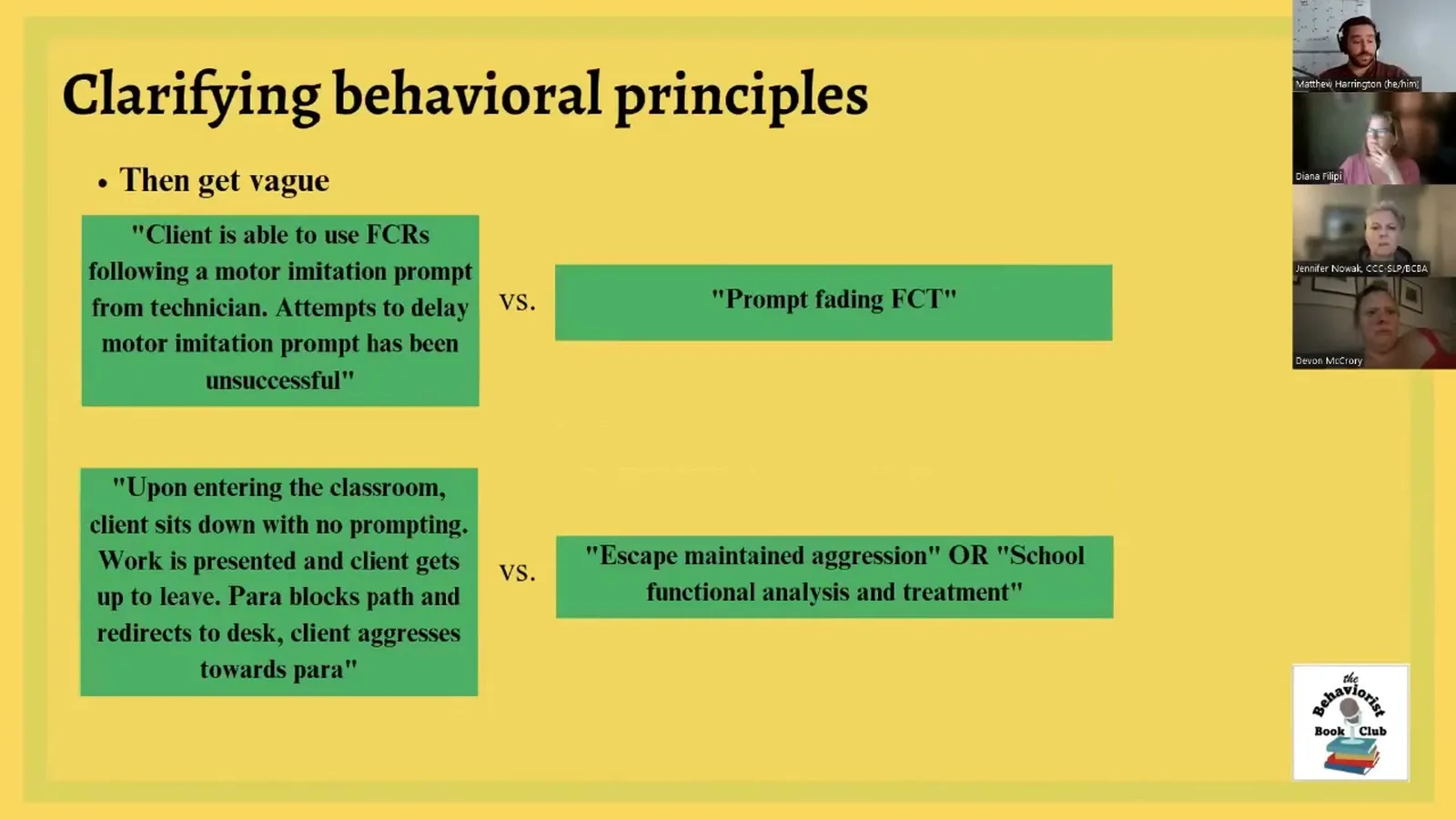
The first example started as a client stuck in functional communication training (teaching a better way to ask). Getting specific found the real hiccup. The client responds after a motor imitation prompt (copy what I do), but not when that prompt is delayed. So the search becomes prompt fading and functional communication training.
The aggression case ends in one of two searches. If your data point at escape maintained aggression (behavior that gets out of work), search that. If the function is still an open question, you need a functional analysis (a test of why behavior happens). Then the search is closer to school functional analysis and treatment. One messy story just became two clean search terms.
So once we get specific, we're then going to translate back into as vague terms as possible, zooming in on the challenge that we identified.
From the talk — Matthew Harrington
Step Three: Use Demographics as Boundaries, Not Filters
For years Harrington skipped demographics. His logic was simple: behavior is behavior, so what works for one group works for the next. He now calls that wrong. There is truth in it. It is just not nuanced, and it is not about the person in front of you.
What you are really hunting for are boundaries of treatment (the limits on where a plan still works). Which things, when present, change whether a plan works as written? Prerequisite skills matter (skills needed before a plan works). Some communication papers assume strong language scores. Resources matter. A general ed room might have 28 peers and two co-teachers. A special ed room might have six students, four paras, and one teacher. A clinic might have one to one staff instead. Home life matters. So does the skill of whoever runs the plan. A complex plan in a group home fails if you are not there to train it.
He also warns about what we assume the client feels. Say you run a DRO (reward for not doing the behavior) at one minute, with a break as the reward. The client never reaches one minute, so the timer keeps resetting. On paper you built a reward plan. What the client meets is extinction.
Research describes people in its own language. Skills show up as a VB-MAPP (a language and learning assessment) score or a speech test score. Cognitive differences show up as IQ or Vineland (a daily living skills measure) scores. Diagnoses are often bare ICD-10 labels (standard medical diagnosis codes) with no context. Setting hints are gold. A hospital room that is six by six and padded tells you the staffing was rich. A line saying the first author trained school staff tells you the plan had to stay simple. Then judge one variable at a time. A language score matters for complex communication work. It probably does not matter for picking a trial based or latency based functional analysis (timed to the first behavior). Rule articles in more than you rule them out, or you will search forever.
So keep in mind, demographic variables do matter, but I can't make sweeping generalizations about how and when they matter.
From the talk — Matthew Harrington
Pick One Journal, Then Actually Work the Search Bar
Harrington searches inside one journal at a time. It is less overwhelming, and every answer stays behavioral. If your question has a clear lean, go where that lean lives. Joint attention work (shared focus between two people) points to The Analysis of Verbal Behavior. Staff who miss weekly tasks point to the Journal of Organizational Behavior Management. Just know that some journals are dense. If the topic is new to you, start somewhere general and work up.
For clinical questions he starts with Behavior Analysis in Practice. The writing is clinical and quick to read, which is what speed needs. Three years ago he would have said go straight to the Journal of Applied Behavior Analysis. He still checks JABA when the first search comes up thin. Behavior Modification is another door.
Then there is the search bar itself. He points out that nobody taught him this in grad school, even though he read hundreds of papers there. Use keywords, not sentences. Use quote marks only when you want an exact string. Quotes match spaces, dashes, and your typos, so one misspelled word returns zero results. Boolean operators (search words like AND, OR, NOT) do the heavy lifting, and they are always capitalized. AND returns records holding both terms. NOT drops every record holding the second term. OR returns either one on its own.
His worked examples are easy to copy. Try prompting AND fading, plus the exact phrase functional communication training in quote marks. Escape maintained aggression is already a strong search on its own. Add AND intervention when you want more than an assessment paper. Pair an exact functional analysis phrase with AND school NOT home to pin the setting down. Expect two useful article types. One tests your exact variable, like a comparison of prompt fading methods, and those are rare. The other solves your question inside a bigger procedure, so read that method section. One last habit: when a paper lands, open its reference list and chase the names.
I used to think that these were kind of pointless, they're kind of finicky little things, but when it comes to finding articles really efficiently, they really do a great job.
From the talk — Matthew Harrington
The Five Key Places to Read in Any ABA Article
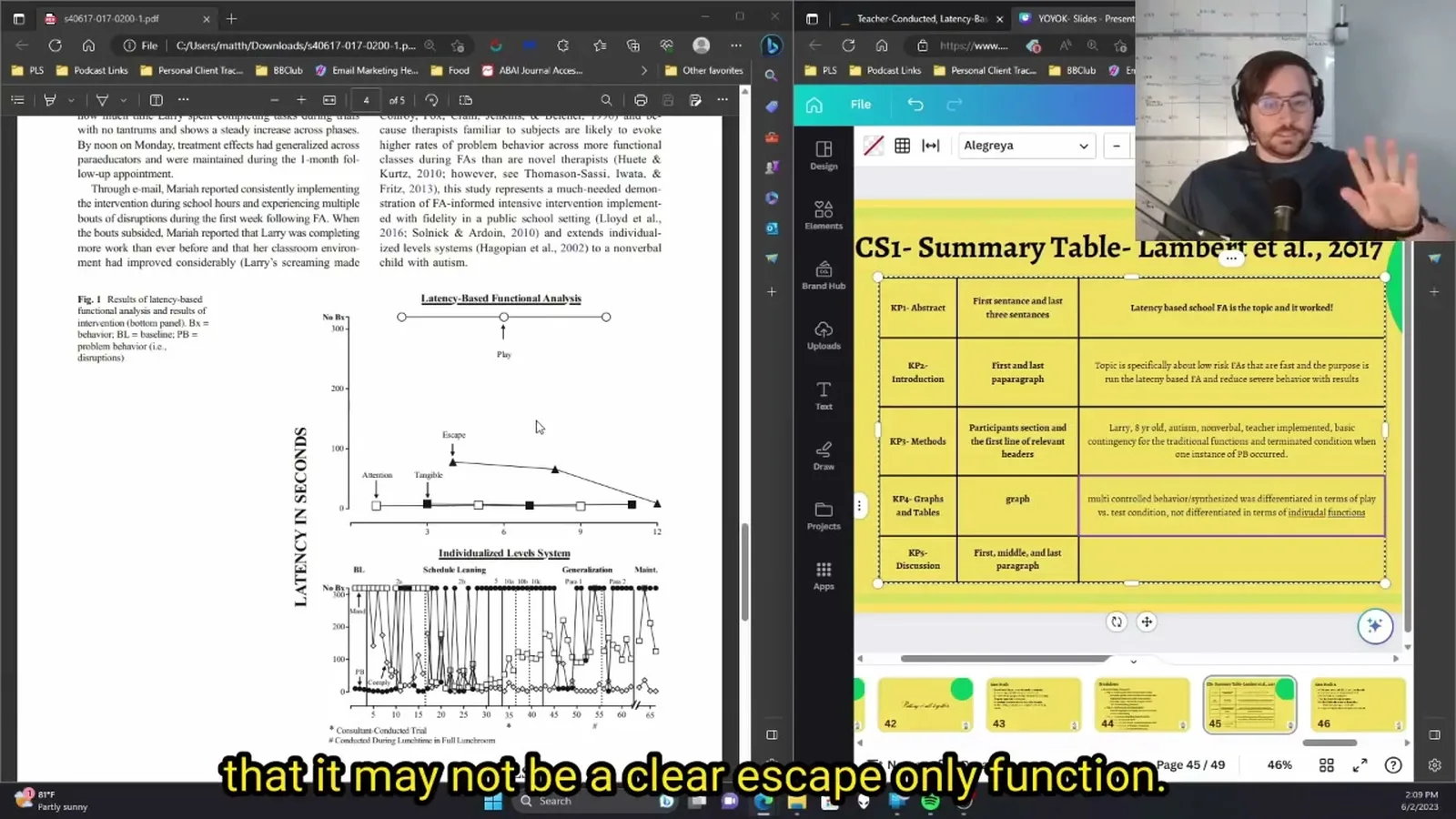
Now you have a pile of papers and no time. The Key Places Framework is a planned way to skim. There are five spots. Key place one is the abstract: the first sentence and the last three. Key place two is the introduction: the first paragraph and the last paragraph. Key place three is the participants section, plus the first line under each method heading. Key place four is every relevant graph and table, footnotes included. Key place five is the discussion: the first, middle, and last paragraph.
Each spot earns its place because papers are built like stories. The abstract is the teaser trailer, and it spoils the ending on purpose. Let it. If the result failed, you will read the method with sharper eyes. The first intro paragraph names the topic. The last one names the purpose, which is the question the whole paper answers. Methods are the training montage. Read just enough to understand the graphs. The graphs are the climax, and our field is very good at them. The discussion is the moral of the story. Its first paragraph gives plain language results. Its middle holds the limitations, which is why it is the hardest part to find. Its last paragraph is the big claim aimed straight at you.
What you skip is real. You skip the exact size of a stimulus card. You skip every condition description. On a first pass, if it was published, he treats the fidelity numbers as good enough. He makes one exception: dangerous behavior plus limitations that admit weak data. Fill a short summary table as you read. Topic, purpose, participants, methods, results, limitations, takeaway. At the end you decide in one glance whether to read deeper. You can also hand that page to a supervisee.
Without us, the practitioners, research has no purpose.
From the talk — Matthew Harrington
When to Skim and When to Sit Down and Read
Skim when the stakes are low and the goal is triage. Early lit review counts. Ten spare minutes before a session counts. Refreshing a method you already know counts, like pulling a recent trial based FA paper to review the steps.
Do not skim right before you launch a full plan built on that paper. Do not skim when the risk of error is high, like severe self injury. Do not skim to learn a topic you do not know yet. Behavioral feeding is his example. Skim one paper and you might pull out just one tool, like escape extinction (blocking the escape route). You would miss pages of warnings about when not to use it. That area also involves swallowing studies with speech language pathologists (therapists who treat speech and swallowing). If your background is thin, consult, hire help, or read the whole article.
He does not pretend skimming is free. You miss technical detail. You can hit a method that seems to come from nowhere, because you skipped the paragraph that set it up. Five years ago he argued that every line mattered. He also had hospital hours and grad school reading time. Both things can be true at once.
The key here is that skimming gives you the ability to make a highly informed decision.
From the talk — Matthew Harrington
Parsimony: Test the Boring Answer First
Parsimony (rule out simple answers first) is the cheapest tool in the talk. The Cooper definition asks you to rule out simple, logical explanations before you reach for complex ones. It is Occam's razor wearing a lab coat.
This is why step one uses that long list of variables. The list flushes out boring answers. Harrington tells on himself here. In a hospital setting, a plan fell apart and nobody could say why. Someone finally asked when the last preference assessment had been run. The answer was six months. New reinforcers went in (things the client will work for), and the plan worked again.
Here is the other classic. Behavior spikes, and you start redesigning the whole plan. Then you learn the client's main technician has been out of town for a week and a half. Things were fine before that. It still deserves your attention. It does not deserve a rebuild. Parsimony does not promise the simple answer is right. It tells you where to look first, and sometimes you can rule it out on paper without testing it.
Go to the simplest solution, examine it, test it out.
From the talk — Matthew Harrington
Common questions
How long does it really take to read a research article this way?▾
The claim is under 15 minutes, and Harrington says he has done it hundreds of times. In the final part of the talk he works two made up cases live on screen. The first article took him about 10 minutes, coughing fit included. The goal is not full understanding. It is a clear decision about whether to read deeper.
Which journal should I search first for a clinical question?▾
He starts with Behavior Analysis in Practice for most practitioner questions, because it is clinical and fast to read. If that comes up thin, he moves to the Journal of Applied Behavior Analysis. When the question has a clear lean, go to the journal that owns it instead.
Do Boolean operators have to be capitalized?▾
Yes. He notes that lowercase and behaves differently from AND in these search tools. AND asks for both terms in the same record. NOT removes records that hold the second term. OR gives you either term on its own, not both together.
What if the participants in the study do not match my client?▾
Do not throw the paper out on the first mismatch. Ask whether that difference touches the principle you care about. A language score may matter for complex communication work. It may not matter at all for the type of assessment you pick. He is blunt that ruling every paper out leaves you searching forever.
Can I use this to pick an intervention the same day?▾
Use it to choose what to read, not what to run. Skimming tells you which one or two papers deserve your full attention. Before you put a new plan in place, read those papers all the way through.
About the speaker
Matt Harrington is a board certified behavior analyst. He now works hybrid, splitting his week between clinic work, this business, and his two young kids. Before that, he spent almost two years as a fully telehealth behavior analyst. Earlier still, he worked as a clinical manager and carried his own caseload. He also worked on severe behavior units in a hospital setting. He runs The Behaviorist Book Club, which he describes as a passion project for teaching practitioners to use ABA research.
This summary was generated from the recording’s transcript. Quotes are taken word for word from the talk.
What you'll learn
- 1Learning Objectives
- 2By the end of this course, participants will be able to:
- 3Define the purpose of using research in clinical practice and distinguish between research use for practitioners versus researchers.
- 4Apply the Research Finding Framework to break down a clinical problem into behavioral principles, demographics, and search strategies.
- 5Use Boolean operators and targeted keywords to conduct efficient literature searches in behavior-analytic journals.
- 6Implement the Key Places Framework to quickly extract key information from research articles in under 15 minutes.
- 7Evaluate whether a research article is relevant and applicable to a specific client based on demographic and contextual variables.
- 8Differentiate when to skim versus fully read a research article based on the complexity, risk, and familiarity with the topic.
- 9Demonstrate how to integrate research findings into clinical problem-solving through real-world case examples.
Concepts in this CEU
Related talks
Talks that cover the same concepts
5 Days of Manding Mastery
The Behaviorist Bookclub
Research to practice - extending past the pages
The Behaviorist Bookclub
Prediction and Probabilities: Three foundational equations to successful behavior reduction
The Behaviorist Bookclub
12 days of PFA & SBT
The Behaviorist Bookclub

Delegating with Confidence: Training and Supervising RBTs to Support Assessments
Copper Consulting Group
Getting the Right Answer Isn’t Enough: Establishing Speaker–Listener Repertoires for Complex Learning
The Behaviorist Bookclub
More from The Behaviorist Bookclub

Harm Reduction Within ABA Practice
The Behaviorist Bookclub
Supervising Beyond Technical Skills: Professionalism, Communication, and Clinical Judgment
The Behaviorist Bookclub
Reflective Supervision and Client Outcomes
The Behaviorist Bookclub
OpenCEU is supported by advertising from third-party sponsors. Sponsors are clearly labeled, have no influence over course content, instructors, or CEU decisions, and never appear on certificates. The BACB does not sponsor, approve, or endorse OpenCEU sponsors or their products.