Percentile Schedules in ABA: Shaping by the Numbers
What a percentile schedule is and how it turns shaping into a clear rule. Learn the formula, the W value, and how BCBAs use it to reinforce progress.
Key takeaway
Shaping is how we build a new behavior in small steps. We reinforce closer and closer tries until the learner hits the goal. The hard part is knowing when to reinforce.
Prediction and Probabilities: Three foundational equations to successful behavior reduction
Free learning path on this topic
Master PFA and SBT
Matt Harrington's 12-article walk through practical functional assessment and skill-based treatment, from Hanley's 2014 study to the enhanced choice model. Then assent, since SBT depends on it, and the ethical guardrails that keep behavior reduction defensible. Five CEUs, one of them ethics.
Experts who cover this
3 recordings on openceu cover percentile schedule.
- Featured talk2 CEUs
Prediction and Probabilities: Three foundational equations to successful behavior reduction
Matt HarringtonThe Behaviorist Bookclub
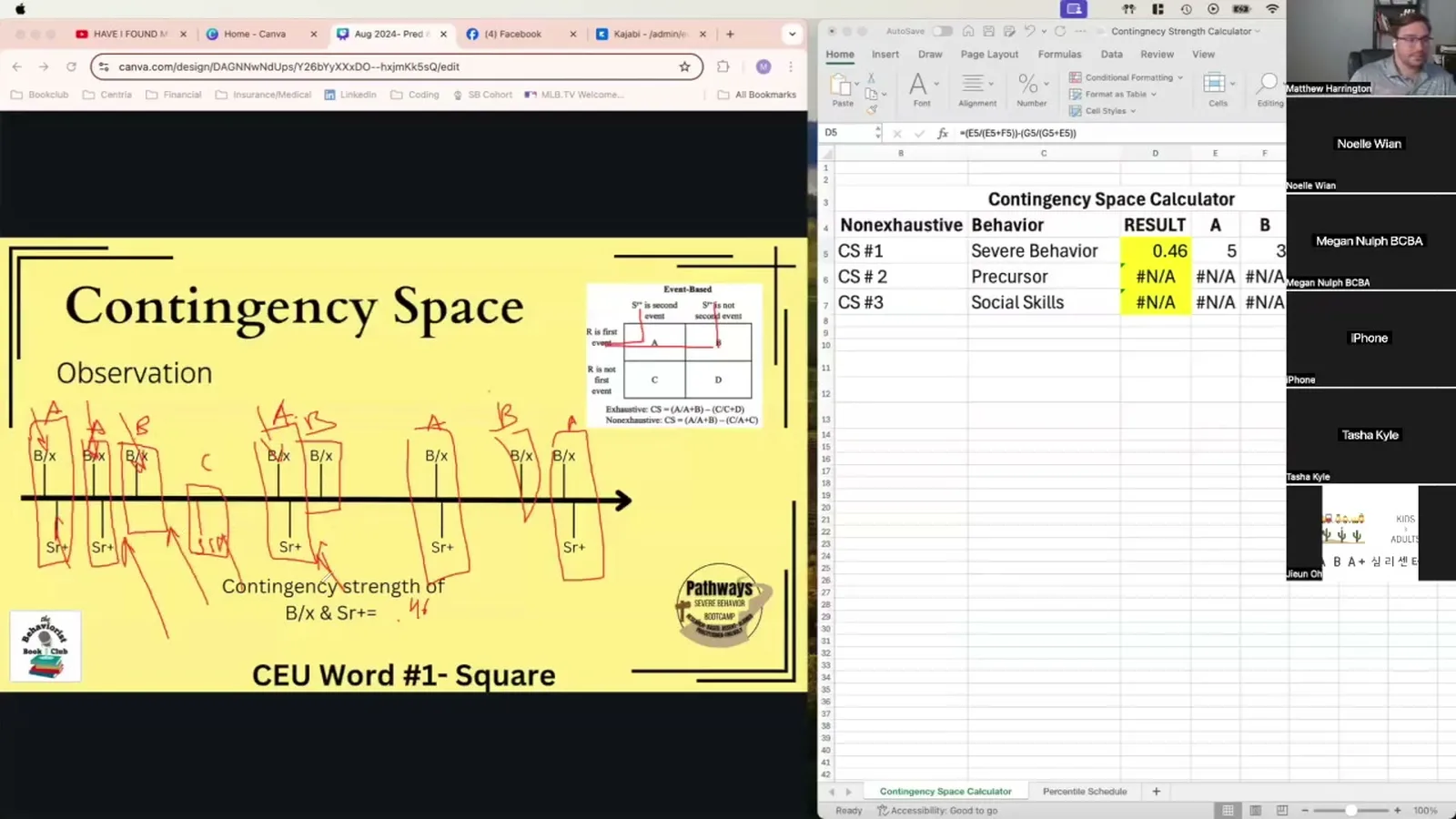
From Athens et al. (2007), the percentile schedule (K = M(1-W)) turns shaping decisions into an objective yes/no rule using a rolling window of the last M…
- 1 CEU
The Math Behind Behavior Reduction
Matt HarringtonThe Behaviorist Bookclub
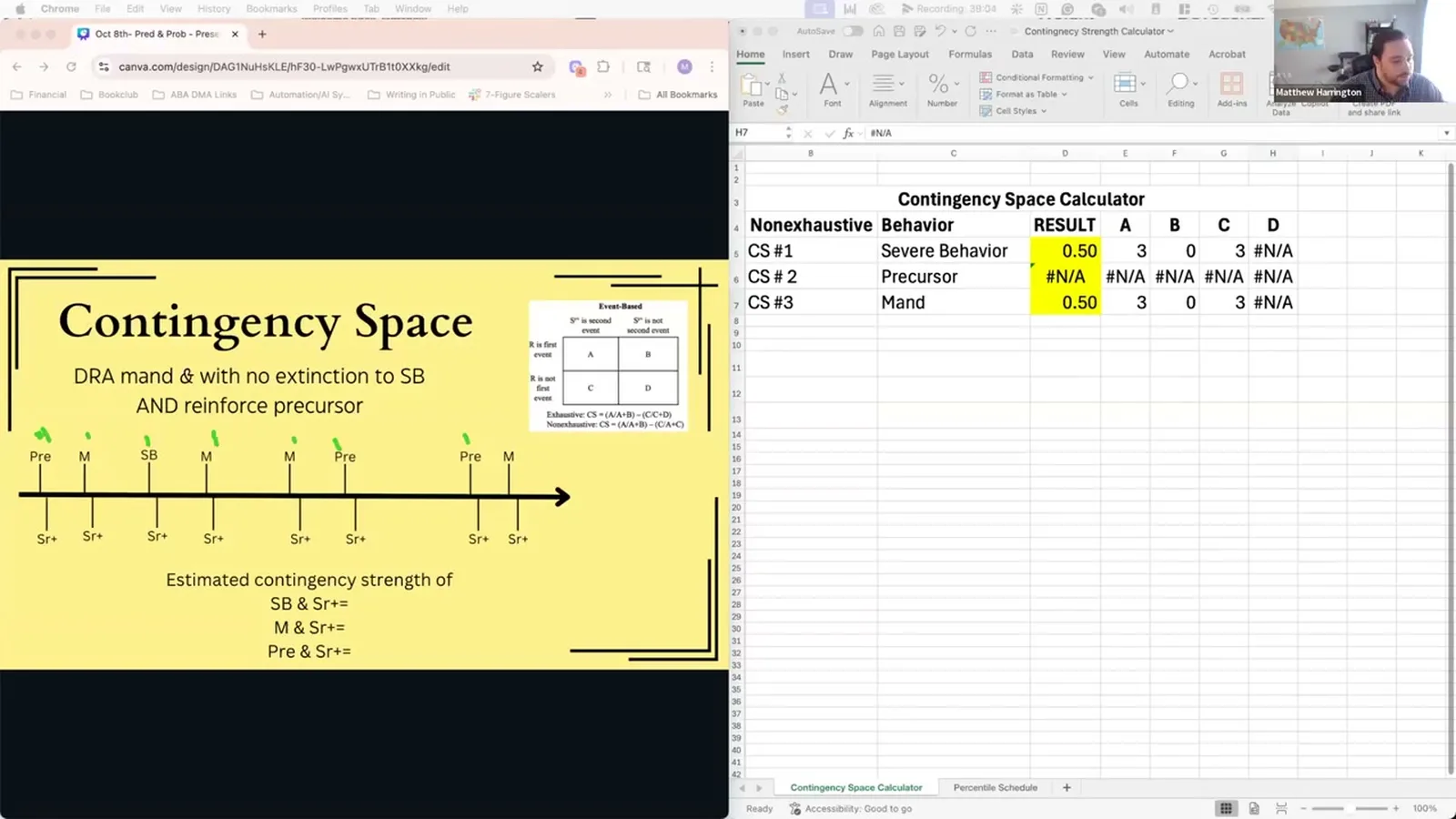
Presented as the equation that objectifies shaping decisions: K = M(1-W), where K is the criterion the next response must exceed, M is how many recent…
- 3 CEUs
12 days of PFA & SBT
Matt HarringtonThe Behaviorist Bookclub
Cited (Galbicka 1994) as the mathematically rigorous way to compute shaping step sizes, contrasted with the presenter's own more intuitive, flexible clinical…
On this page · 8 sections▾
Shaping is how we build a new behavior in small steps. We reinforce closer and closer tries until the learner hits the goal. The hard part is knowing when to reinforce. Do you reward this try, or hold out for a better one? That call often feels like a guess.
A percentile schedule turns that guess into a clear rule. It uses a simple formula to set a criterion for each try. The next response must beat that criterion to earn reinforcement. This gives BCBAs, RBTs, and teachers an objective way to shape. No more relying on gut feeling alone.
The problem it solves#
Matt Harrington describes the old way of shaping. You watch, you feel it out, and you decide in the moment. That works, but it is hard to explain or repeat.
It can feel like you're just going on your gut and you're, yes, reinforce that, no, hold back there. And it's hard to describe exactly why or what or where those decisions are coming from. The percentile schedule takes that wild amount of variability and pulls it into an equation, right? From the talk — Matt Harrington
That is the core idea. It takes a fuzzy art and makes it a math problem. The rule stays the same across staff and sessions. Two people can look at the same data and reinforce the same tries.
How the formula works#
The schedule uses a short formula to set the bar. Matt lays out each piece in plain terms.
K equals M plus one, one minus W. K is the response value that the next behavior must exceed. From the talk — Matt Harrington
So K is your target for the next try. The response has to beat K to earn a reward. The other two letters feed into that number. As Matt puts it, M is the number of recent observations you look back at. You keep a rolling window of the last M responses. Each new try gets ranked against that window. If it lands high enough, it beats K. Then the learner earns reinforcement for that try.
The W value and errorless learning#
The W value is where you make a choice. It sets how often the learner gets reinforced. Matt calls it the density of reinforcement. Think of it as the probability that a learner gets reinforced on a given try.
A high W means the learner wins most of the time. That keeps them happy and eager to keep going. Matt ties this directly to how errorless you want the process to be.
W really refers to how errorless you want this process to be. Do you want them to receive reinforcement most of the time? They love to be doing it. From the talk — Matt Harrington
You can set W low when you want to push for harder tries. You set it high when you want easy wins and steady effort. This is the dial you control for each learner.
Why it self-adjusts#
 Advertisement
One big strength is that the schedule moves with the learner. When tries improve, the bar rises on its own. When tries slip, the bar drops so the learner can still win. You do not have to redo the math by hand each time.
The percentile schedule automatically adjusts when things aren't going well. That's the beauty of this thing. It goes up and it goes down, and ultimately it's the only shaping process that's so hyper-individualized that you control every single variable specifically to your client. From the talk — Matt Harrington
This is why the tool feels so tailored. The window of recent tries reflects that one learner. The bar tracks their real progress, not a fixed goal. For a deeper walk through the equation, see The Math Behind Behavior Reduction.
The honest trade-off#
Matt is also frank about real-world use. The math is powerful, but it takes time to run. In a live session you may not have that time.
one of the coolest demonstrations of this is Galbicka, it talks about the percentile fading schedule and it's a way of mathematically determining all this, but as clinicians personally I don't have time to pull out my Excel spreadsheet and run a bunch of calculations when I'm about to shape a behavior. From the talk — Matt Harrington
So the schedule shines in planned programs and data-heavy work. In fast moments, many clinicians still shape by feel. Knowing the formula still sharpens that gut sense.
Putting it into practice#
Start by picking the behavior you want to shape. Choose a clear way to measure each try. It might be seconds of engagement or number of steps done. Then log those values in order as they happen.
Next, set your M and W values. A larger M gives a steadier, calmer bar. A higher W gives more frequent wins for the learner. Rank each new try against your recent window. If it beats the criterion, deliver reinforcement.
Review the data every few sessions. Watch how the bar moves as the learner grows. If wins get too rare, raise W to keep them motivated. This keeps the plan both objective and kind.
What the research says#
Studies show percentile schedules work as an objective shaping tool. One study used them to build academic fluency in a teen with developmental disabilities. The schedule improved fluency on two of three academic tasks (Using Percentile Schedules to Increase Academic Fluency).
Another study paired a percentile schedule with feedback to boost on-task behavior. On-task time rose from a mean of 32 percent to 68 percent (Kwak, Najdowski, & Danielyan, 2022). A separate report tested how far back to look. It found the formula worked best with a large window of about 20 observations (Shaping academic task engagement with percentile schedules). The method also reaches beyond the clinic. One study set step-count goals with a percentile schedule and raised daily steps (Batchelder, Devoto, & Washington, 2024).
FAQ#
What is a percentile schedule in ABA?
It is a rule for deciding when to reinforce during shaping. It sets a criterion each try must beat. This replaces gut-based choices with a clear, repeatable formula.
What does the W value mean?
W is the density of reinforcement. It sets how often the learner earns a reward. A high W gives frequent wins for near-errorless learning. A low W pushes for harder, better tries.
When should I use a percentile schedule?
Use it for planned shaping programs where you track data over time. It works well when you want objective, consistent criteria across staff. In fast live sessions, many clinicians still shape by feel.
 Advertisement
Turn this topic into a CEU
You just studied this. Now get credit for it.
Watch Prediction and Probabilities: Three foundational equations to successful behavior reduction with Matt Harrington and earn 2 free BCBA CEUs. Detailed certificate, delivered the moment you finish.
Keep going with a free learning path
Master PFA and SBT
Matt Harrington's 12-article walk through practical functional assessment and skill-based treatment, from Hanley's 2014 study to the enhanced choice model. Then assent, since SBT depends on it, and the ethical guardrails that keep behavior reduction defensible. Five CEUs, one of them ethics.