12 days of PFA & SBT
Presented by Matt Harrington
This training series, “12 Days of PFA and SBT,” offers a practical, research-based walkthrough of the foundational and advanced concepts of Practical Functional Assessment (PFA) and Skill-Based Treatment (SBT). Using key peer-reviewed articles, each session distills findings into practitioner-relevant insights and guides behavior analysts in tailoring these procedures to individual clients. Emphasis is placed on efficiency, social validity, individualized functional analyses, shaping procedures, and the integration of trauma-informed care. The course also showcases innovations such as the single-session IICA, the use of synthesized contingencies, and application with diverse populations.
Register free & watch nowCancel any time. Cert delivered to your inbox the moment you pass the quiz.
Learner ratings
from 76 learners
100% would recommend this CEU to other professionals in their field (40 responses)
“Great content and super informative, thank you so much!”
— Huhana M.
About this CEU
This training series, “12 Days of PFA and SBT,” offers a practical, research-based walkthrough of the foundational and advanced concepts of Practical Functional Assessment (PFA) and Skill-Based Treatment (SBT). Using key peer-reviewed articles, each session distills findings into practitioner-relevant insights and guides behavior analysts in tailoring these procedures to individual clients. Emphasis is placed on efficiency, social validity, individualized functional analyses, shaping procedures, and the integration of trauma-informed care. The course also showcases innovations such as the single-session IICA, the use of synthesized contingencies, and application with diverse populations.
From the talk
What was covered
Twelve PFA and SBT papers, distilled: synthesized reinforcers, three-minute ISCAs, shaping ladders, and trauma-assumed practice.
- Spend your assessment time on the interview first. A three-minute test only works if that conversation was strong.
- Program the full bundle of reinforcers rather than one piece, since the split version never outperformed it in these studies.
- Write test conditions that name real activities and real people instead of just attention or escape.
- When a shaping step stalls, drop back one rung after two or three sessions instead of six.
- Take affect data in session so a quiet session is not mistaken for a good one.
- Before you add a procedure, ask whether it could re-trigger a trauma response you do not know about.
Why Hanley and Colleagues 2014 Started With Social Validity
Day one of this series covers Hanley and colleagues 2014. The twelve papers all deal with practical functional assessment, or PFA (a guided, safer way to test). They also cover skill-based treatment, or SBT (teaching skills that replace hard behavior). Matt frames each one the same way. He gives the purpose, the methods, then the key point for working clinicians. He is blunt that this is not a how-to course. Other trainings teach the steps. This one teaches you how to bend the steps to fit a client.
The 2014 paper ran a functional analysis (a test of why behavior happens) using synthesized contingencies (two or more rewards together). Then it built treatment from what it found. Social validity (does the plan fit real life) drove every choice. Matt thinks the authors had seen clean lab results fall apart at home. Home is messy. Attention, escape, and toys all show up at the same moment there.
The graphs make the case. For one child, the bundled test showed a clear pattern. When the same rewards were split apart, the graph went flat. A flat graph gives you nothing to treat. Other children in the study split apart fast, sometimes inside five sessions. Matt's read is that the goal moved from clean data to workable treatment, and that shift shaped everything after it.
And I think that shift from differentiation to effective treatment actually influences a lot of the decisions that were made throughout this process.
From the talk — Matt Harrington
Does Every Piece of the Synthesized Reinforcer Matter?
Day two moves to a 2015 follow-up, and the question gets sharper. It is no longer whether the ISCA (a test built from parent reports) can find a function. It is whether that bundled function matters once you start treatment.
One child's test condition paired escape, toys, and attention, and it was clearly split from control. The interview had pointed to a strong attention piece, so the team also ran an attention-only test. That one was flat. No function showed up at all.
Treatment settled the rest. First the taught request, called a functional communication response or FCR (a taught way to ask), produced escape only. Behavior dropped some, but stayed bumpy. Next the FCR produced escape plus a toy, and behavior dropped further. Last the FCR produced all three, and behavior dropped out and stayed down.
That is a strong case for programming the whole bundle. It also saves you a step. You do not have to run a backwards component analysis on the function you just found.
It also tells us as clinicians that we can breathe a little easier and be a little more confident going immediately from an ISCA into treatment
From the talk — Matt Harrington
Precise Test Conditions Are the ISCA's Real Edge
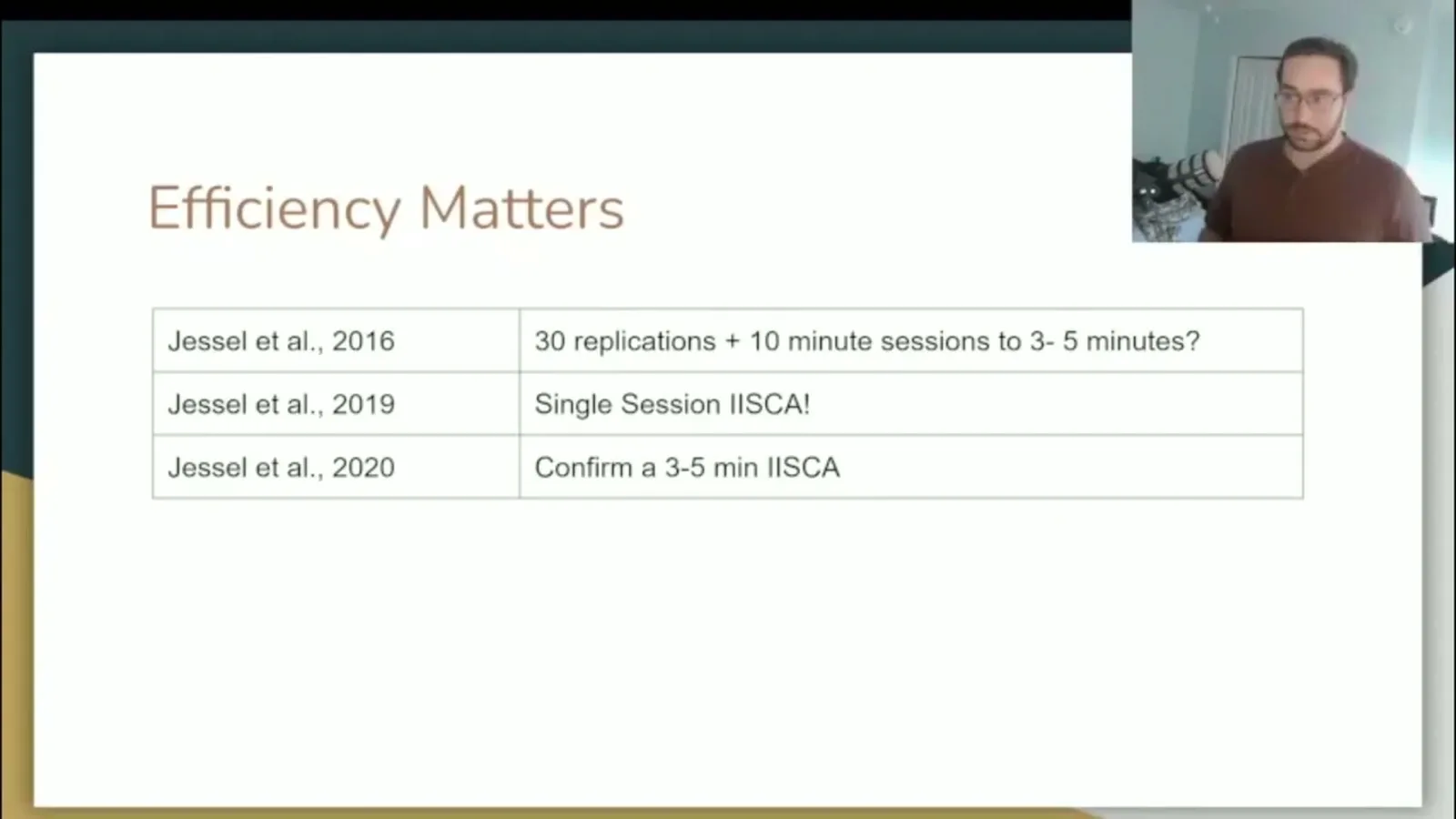
Day three covers a paper with 30 replications of the ISCA. The team also deleted everything but the first session and looked again. Matt trained on standard FA methods and still runs them today. What struck him was the speed. These graphs split apart much faster than he was used to seeing.
The test conditions are the part he wants you to notice. They are not simply attention or escape. They read like this: escape from teacher-directed work to child-directed play with dinosaurs. Escape from social interaction to access to daily snacks. Escape from transitions to a preferred conversation. Each one comes straight out of a real interview.
Day four adds Slaton and colleagues 2017. That study ran nine ISCAs, nine standard FAs, and a third analysis that also reinforced precursor behavior (small signs before big behavior). The ISCAs came out clean. Several standard FAs looked like a plate of spaghetti. Then the treatments were compared. A request that produced the full bundle cut behavior more than a request that produced one piece of it.
I don't think there was any instance of the synthesized component being less efficient than the isolated component
From the talk — Matt Harrington
The Caregiver Interview Is the Real Gate
This thread runs through the whole series. The ISCA is only as good as the interview behind it. A precise test condition comes from a precise conversation. Get that wrong and the graph tells you nothing. Matt calls this a boundary condition (a limit on where the method works) for the method.
He uses a personal check at the end of an interview. He asks himself if he is 99 percent sure of the function. If yes, he runs a short test to confirm it. If no, he goes back for more information, runs a longer observation, or starts with a broader standard FA.
He tells a story from his move into telehealth. He rushed the interview because he planned to run an ISCA right after. The test gave him zeros. The control gave him zeros. He stopped, apologized, and asked for one more hour the next day. He spent 57 of those 60 minutes listening to the family. Then he ran a single test condition and got a clean result.
if you don't have a really strong interview and a really strong observation your ISCA probably isn't going to look differentiated
From the talk — Matt Harrington
How Short Can an ISCA Get?
Day six covers a 2019 paper on the single-session ISCA. The trick is to look inside one test session. The child starts with the reward present. Then the reward is pulled. Behavior goes up. The reward comes back. That cycle repeats many times inside one session.
Score those as reinforcer-present and reinforcer-absent intervals (time with and without the reward). Now a single session holds many small tests and many small controls. In the real cases, absent intervals ran high and present intervals ran low. That is exactly what you want to see. Matt points out you can track this on a pad of paper. Software helps, but it is not required.
Day seven pushes on time again, in a case series of 26 functional analyses. The team took 10-minute sessions, re-scored them at five minutes, then at three. That is roughly 50 minutes of data, then 25, then 15. The graphs held up under a level check, a count of non-overlapping data (how much the phases overlap), and ratings from expert reviewers. Matt's warning is the useful part. You do not lose experimental control (proof the change caused the result) when you cut time. You lose watching time. A 10-minute session gives you 20 minutes with the child, and a three-minute session gives you six. If the interview was thin, buy that watching time back.
Day eleven is a short review from Metras and Jessel 2021. It maps the newer ISCA formats: latency-based (timing the first bit of behavior), trial-based (short tests spread through the day), and single-session. Matt leans on the latency form in telehealth work. It is far easier to coach a parent through in plain language.
the three minute ISCA session is definitely a reality for clinicians and it's actually not that difficult to conduct
From the talk — Matt Harrington
Shaping Is the Engine Under Skill-Based Treatment
Day five is the 2018 shaping paper, and it answers a question the other graphs skip. How do you get from a simple request to a complex one? The answer is a ladder, not a jump.
The rungs are clear. Step one is a sentence fragment, and no calm voice is needed yet. Step two adds an autoclitic frame (extra words wrapped around the ask), plus a calm voice. Step three adds an attention-getter like 'excuse me'. Step four adds a pause to wait for the adult to answer. Reinforcement moves up the ladder with the child.
The evocative context (the setup that triggers the ask) climbs at the same time. Early on, the adult touches a preferred item and gives a demand. Later, the adult removes the item, looks away, gives a demand, and stops granting requests. Both ladders move together in small steps.
The best part of the graph is a failure. At one rung the new response simply did not come, so nothing got reinforced. The team dropped back a step, rebuilt strong responding, and climbed again. Matt would have dropped back sooner, after two or three sessions rather than six. He wants the learner in reinforcement, not sitting in extinction (a behavior no longer paying off).
shaping as a process is something that's flexible enough to deal with the natural variability that comes in with clinical work
From the talk — Matt Harrington
Two Common Objections, Answered
The first objection is about the omnibus mand. A mand (an ask for something wanted) is a request, and an omnibus mand asks for everything at once. Many of us were taught to teach specific asks first and general asks later. So does starting broad block the specific ones?
Ward and colleagues 2021 tested it. They shaped the broad ask from a simple form up to a complex, two-part form. Then they taught an escape ask, a tangible ask, and an attention ask, one at a time. Each time a specific ask went in, it rose and the broad one fell. Problem behavior stayed low across the whole change.
The second objection is about who this work fits. Day eight covers a 2021 study on clients outside the usual age and diagnosis range. The participants spoke in full sentences and carried more than one diagnosis, including ADHD, depression, and anxiety. Both moved through the usual treatment path with solid results.
Matt is careful here. Two participants do not make an evidence-based standard. He asks you to look at the parts instead of the label. Functional communication training is differential reinforcement (rewarding one response, not another). Tolerance training is shaping and fading. Those parts already have decades of support across many kinds of learners.
one article is a long ways away from an evidence-based standard you have to meet very specific criteria for that to occur
From the talk — Matt Harrington
Trauma-Informed Care and the Enhanced Choice Model
Day nine is the one Matt would pick if you only read one. The 2022 article is not about PFA at all. It is a framework for your whole practice. Trauma-informed care (care shaped by past harm) rests on four pillars. Acknowledge trauma and its impact. Build safety and trust. Promote choice and shared governance. Emphasize skill building that actually moves a life forward. Safety often shows up as a safety signal (a cue that says nothing bad). Tell the child what happens first, second, and third. Matt compares it to a dentist who narrates the cleaning. The work does not change. The narration is what lowers the fear.
Applying it changes daily programming. Assent (the child agrees to take part) comes first, not last. You also screen out features that could set off a trauma response. Heavy physical prompting is a poor fit for a child with a history of physical abuse. Timeout is a poor fit for a child with a history of seclusion. Attention extinction is a poor fit for a child who has been left. You will often never know the history, which is why Matt prefers a stronger phrase.
He also wants affect data (how the child seems to feel) in the record. Check in every fifteen minutes or so and write it down. A session with no problem behavior and an unhappy child is still a bad session. His advice is small and concrete: pick one step you can take this week to make your procedures safer.
Day twelve closes with the enhanced choice model from 2021 (a version built around real choice). Physical guidance comes out of escape extinction, replaced by repeated vocal and gestural prompts. Pre-session role play and explanation go way up. Choice goes up too: where to work, what to work on, pen or marker or highlighter. The child can also move to a hangout space or end the visit for the day. The results bars show what happened. Most of each visit stayed in practice, hangout time was small, and one participant never left at all. Matt reads that as the whole point. Build in safety and choice early, and fewer people need the exit.
instead of trauma-informed we should really be thinking about trauma assumed care
From the talk — Matt Harrington
Common questions
What is the difference between an ISCA and a traditional functional analysis?▾
A traditional FA tests one reward at a time, like attention alone or escape alone. An ISCA tests a bundle of rewards drawn from the caregiver interview. In several of the studies covered here, the bundled test came out clean while the split test stayed flat.
How short can an ISCA session actually be?▾
One case series re-scored 10-minute sessions at five minutes and then at three, and the graphs stayed clearly split. So a three-minute session is realistic for most clinicians. What you give up is watching time with the child, not proof that your data means something.
Does teaching an omnibus mand block specific requests later?▾
Ward and colleagues 2021 shaped the broad ask up to a complex form, then taught escape, tangible, and attention asks one by one. Each specific ask rose while the broad one dropped off. Problem behavior stayed low through the whole transition.
Do PFA and SBT only work for young children with limited speech?▾
A 2021 study covered here worked with participants who spoke in full sentences and carried more than one diagnosis. That is one study rather than an evidence base, but the underlying parts like differential reinforcement and shaping have broad support.
What makes an interview strong enough to run a short ISCA?▾
Matt's personal test is whether he leaves the interview 99 percent sure of the function. If he is, he runs a short test to confirm it. If he is not, he goes back for more information or adds a direct observation before testing anything.
About the speaker
Matt Harrington is a practicing behavior analyst who carries a full caseload and has worked in hospital, clinic, and telehealth settings. He runs The Behaviorist Book Club and the ABA Research Library, where he breaks down research into points clinicians can use. He built this twelve-part series from the PFA and SBT articles that changed how he programs.
This summary was generated from the recording’s transcript and reviewed for accuracy. Quotes are taken word for word from the talk.
What you'll learn
- 1Learning Objectives
- 2By the end of this training, participants will be able to:
- 3Differentiate between synthesized and isolated functional analyses and describe the advantages and limitations of each in identifying relevant treatment functions.
- 4Describe the rationale and procedure for implementing Practical Functional Assessment (PFA) and identify key indicators of successful differentiation.
- 5Apply Skill-Based Treatment (SBT) principles, including shaping, FCR complexity, and tolerance training, using change-in-criterion designs.
- 6Analyze and interpret ISSCA data, including single-session and short-duration formats, for clinical decision-making.
- 7Design individualized, socially valid interventions by integrating caregiver input and adapting synthesized reinforcers.
- 8Apply trauma-informed care principles within the assessment and treatment process, ensuring client safety, choice, and assent.
- 9Evaluate the generalizability of PFA and SBT across verbal abilities, diagnoses (e.g., ADHD, anxiety, depression), and treatment contexts.
- 10Utilize data-informed decisions to maintain experimental control while enhancing clinical efficiency.
Concepts in this CEU
Related talks
Talks that cover the same concepts
Prediction and Probabilities: Three foundational equations to successful behavior reduction
The Behaviorist Bookclub
Analyzing Assent and Taking Data
The Behaviorist Bookclub
The Math Behind Behavior Reduction
The Behaviorist Bookclub
Solving Clinical Challenges with Research
The Behaviorist Bookclub
PDA Caregivers, Complex Profiles, Replacement Behaviors, and Being Trauma Informed
The Behaviorist Bookclub
Hey, Chillax Man! Understanding the Logic of Anxiety
The Behaviorist Bookclub
More from The Behaviorist Bookclub

Empowering Autonomy and Self-Management in ADHD Learners
The Behaviorist Bookclub
Shaping Behavior Change when ADHD is in the Picture
The Behaviorist Bookclub
From Hours to Competence: Assessing and Developing Supervisee Skills
The Behaviorist Bookclub
OpenCEU is supported by advertising from third-party sponsors. Sponsors are clearly labeled, have no influence over course content, instructors, or CEU decisions, and never appear on certificates. The BACB does not sponsor, approve, or endorse OpenCEU sponsors or their products.