Hey, Chillax Man! Understanding the Logic of Anxiety
Presented by Dr. Clelia Sigaud
This presentation explores the complexities of anxiety through a behavior analytic lens, highlighting the evolutionary basis of anxiety and its implications for intervention. Clelia Sigaud, PsyD, BCBA-D, discusses the principles underlying anxiety and differentiates between normal anxiety responses and anxiety disorders. The talk emphasizes the importance of understanding anxiety as a natural human experience that can become problematic when it leads to functional impairment. Key strategies for supporting individuals with anxiety, particularly children, are presented, focusing on empathy, confidence, and autonomy granting. The session also addresses the significance of scope of competence and scope of practice in anxiety interventions, advocating for evidence-based approaches such as exposure therapy and systematic desensitization. The presentation concludes with practical insights for behavior analysts working with clients experiencing anxiety.
Cancel any time. Cert delivered to your inbox the moment you pass the quiz.
Learner ratings
from 158 learners
99% would recommend this CEU to other professionals in their field (110 responses)
“Very informative.”
— Meredith C.“Very informative”
— Mitea L.“Great information on anxiety and evidence based practices:)”
— Michelle A.“Much lower level of learning than the first 3 parts”
— Julie M.
About this CEU
This presentation explores the complexities of anxiety through a behavior analytic lens, highlighting the evolutionary basis of anxiety and its implications for intervention. Clelia Sigaud, PsyD, BCBA-D, discusses the principles underlying anxiety and differentiates between normal anxiety responses and anxiety disorders. The talk emphasizes the importance of understanding anxiety as a natural human experience that can become problematic when it leads to functional impairment. Key strategies for supporting individuals with anxiety, particularly children, are presented, focusing on empathy, confidence, and autonomy granting. The session also addresses the significance of scope of competence and scope of practice in anxiety interventions, advocating for evidence-based approaches such as exposure therapy and systematic desensitization. The presentation concludes with practical insights for behavior analysts working with clients experiencing anxiety.
From the talk
What was covered
A behavior analytic look at anxiety: why the alarm is normal, where negative reinforcement lands on the anxiety wave, and how far your scope goes.
- Treat anxiety as fear plus worry, not as a function of behavior, and keep analyzing after the word comes up.
- Check two marks before calling worry a disorder: is it off for the age, and does it block daily life.
- Pair empathy with confidence in every response, then grant autonomy instead of smoothing the world for the person.
- Watch where escape lands on the anxiety wave, and reinforce at the low point rather than the peak.
- Build a fear ladder and hold each rung until it is boring before you move up.
- Run the scope test: if you cannot write a plan that is safe today and good years from now, refer out.
Fear Is the Alarm. Anxiety Is the Alarm Plus the Story.
Fear is a jolt in the here and now. Your body reads a threat and gets you moving. Worry is what humans add on top. Worry is the thinking part: the story about the threat. Fear plus worry is what we call anxiety. The story is the piece that travels. You can walk out of the scary room and still carry the whole thing with you.
Sigaud framed this as a trade our species made. We got smart. We got language. We got the power to solve problems in our heads before they ever happen. The bill came due as worry. A dog in a safe room is not scared, because nothing scary is there. A person in that same safe room can still feel scared of something that has not happened yet.
Our culture answers all of this with one note. Be fearless. Do not panic. Push through. Sigaud pushed back on the wording. A person with no fear at all is not a person who is thriving. Folks who show very little fear tend to struggle with safety and with other people. We call too much avoidance a problem. We call too little one as well. The alarm is supposed to be there.
But the human is potentially carrying this anxiety with him wherever he goes right.
From the talk — Dr. Clelia Sigaud
What Turns Normal Worry Into an Anxiety Disorder
Everybody has anxiety. That part is healthy, normal, and expected. Sigaud skipped the diagnostic manuals and named two marks that set a disorder apart. The first is that the worry has to be clearly outside what we expect for that age. A toddler who melts down when a parent walks out is right on schedule. That is not a disorder. That is a toddler.
The second mark is functional impairment (it gets in the way of daily life). The worry has to cost the person the life they and their people want to live. It blocks school, work, sleep, friendships, or care of the body. One mark alone is not enough. You need both.
Her plain version is the one to keep. A disorder is a pile of false alarms going off in the brain and the body. The alarm system itself is not broken. It is doing what it evolved to do. It just keeps firing when nothing is wrong. That framing changes the job in front of you. You are not repairing a faulty person. You are working on when the alarm goes off.
It is also worth saying out loud that this is very treatable. Sigaud cited evidence on this. About two thirds of children with a diagnosed anxiety disorder lost the diagnosis after 12 to 16 weeks of CBT (cognitive behavior therapy). Two thirds is not everyone, and there is more nuance than one dose for all. But unlike some things we work on, this is not a life sentence.
Basically, an anxiety disorder is a lot of false alarms going off in the brain and the body.
From the talk — Dr. Clelia Sigaud
The Behavior Analytic Read: Negative Reinforcement, Not a Function
Here is the core of it. What keeps anxious avoidance running is negative reinforcement (the bad feeling goes away). The aversive part (the piece that feels awful) is private. It is the buzz in the body and the loop in the head. Escape turns that down fast. The drop is the payoff. That is the deal the body has learned.
Sigaud drew a hard line around what this does not mean. We are not talking about arbitrary reinforcers (prizes handed out to shape a habit). Nobody is saying stop hyperventilating and I will give you a cookie. That would be silly, and she said so. The reinforcer here is relief, and relief is built in.
She also named a trap that shows up in case reviews all the time. A team works a problem, lands on the word anxiety, and then stops. Anxiety is not a function of behavior (the reason a behavior keeps paying off). It is not a catch all box either. It is a word for a set of conditions you can keep taking apart. Do not let it end the conversation.
The maintaining consequence when experiencing anxiety is negative reinforcement.
From the talk — Dr. Clelia Sigaud
Empathy and Confidence: The Two Part Response
Sigaud gave a simple script for anyone who supports an anxious person. Part one is empathy. Their experience is their reality. It may look small from where you stand. It is not small to them. It sounds like this: I can see that this is hard for you.
Part two is confidence. That is belief in what the person can do while the fear is still live. It sounds like this: I believe you can do this. Neither half stands alone. Empathy on its own slides into rescue. Confidence on its own lands as cold. You name the hard thing, then you back the person to face it.
Together those two build autonomy granting (helping them work through it themselves). The opposite is quietly smoothing the world so nothing is ever hard. Sigaud called that unhelpful, and she meant it for caregivers as much as for clinicians. You are not doing the task for them. You are standing next to them while they do it. When a clinical problem is in play, the caregivers and the trained clinician work as one team.
Autonomy granting means that we're empowering people to work through their problems with our support.
From the talk — Dr. Clelia Sigaud
The Anxiety Wave: Where You Reinforce Decides What You Teach
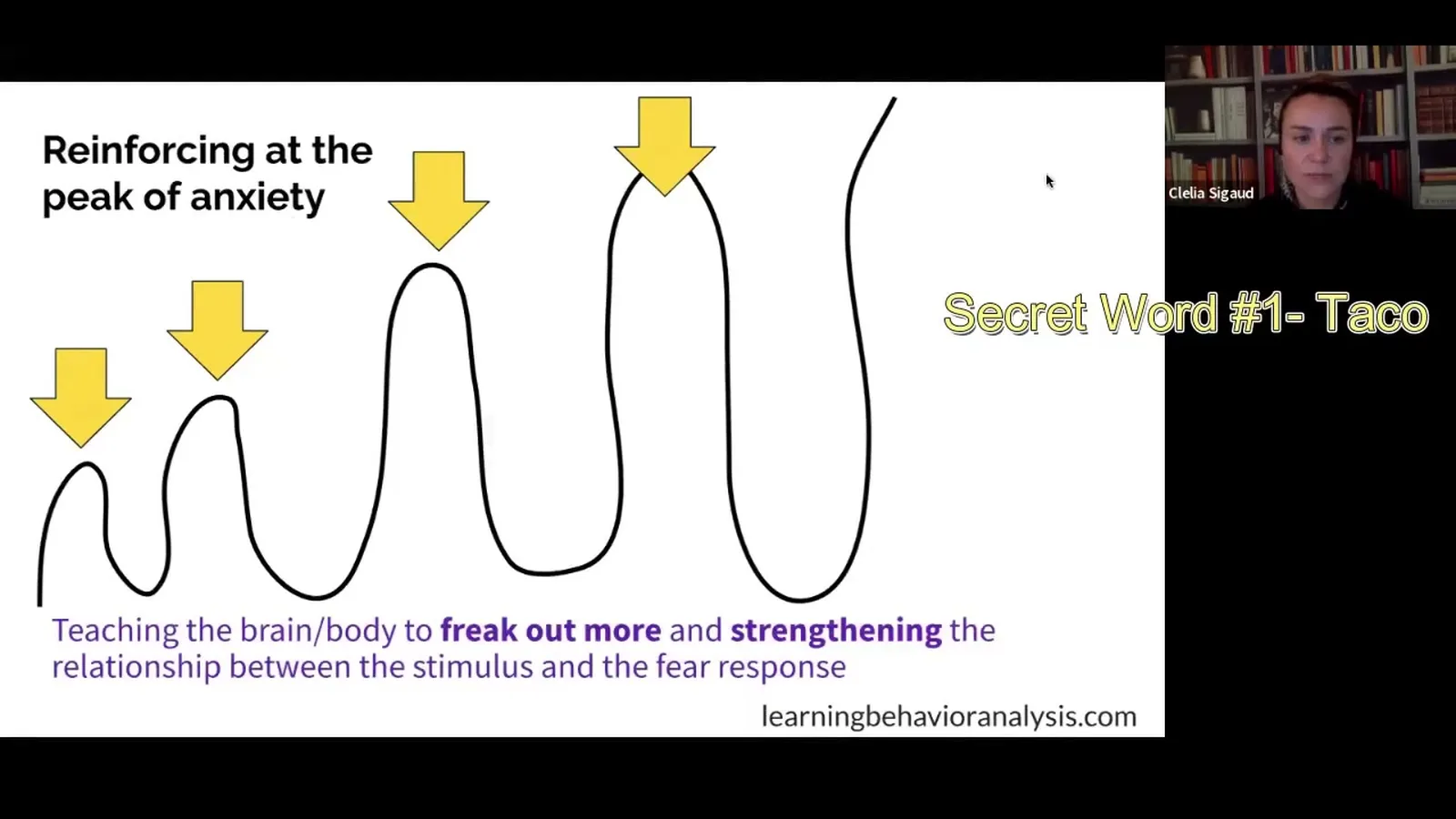
The body cannot hold peak fear forever. It is not built for that. If it could, the alarm would stop working, because the whole point is to be loud and short. So fear moves like a wave. It climbs, it tops out, and it comes back down on its own.
Now drop escape onto that wave. Escape at the peak teaches the brain that the peak is what works. The tie between the trigger and the fear gets stronger. The next wave runs higher. Nobody plans this. Real life shapes it up for us, because we are most desperate to get out when we feel worst.
Escape at the bottom teaches the other lesson. Relief shows up when things are calm. The tie between the trigger and the fear gets weaker over time. That is the whole logic of treatment in one picture. You are not deleting the wave. You are moving where the payoff lands on it.
So the part of the wave pattern that contacts reinforcement matters a lot.
From the talk — Dr. Clelia Sigaud
Flooding and Systematic Desensitization: Same Logic, Different Speed
Exposure based treatment (facing the feared thing on purpose) comes in two broad shapes. Flooding is the deep end. The person meets the worst version of the trigger and stays there until the body settles. It runs on pure extinction (escape is simply not on the table). It can work fast, sometimes in a single session.
The costs are real. Clients, families, and often the clinician will not agree to it. It can be seen as abusive. Staff can get paired with the awful feeling. Like any extinction plan, it falls apart without high fidelity (running it right every time). Sigaud was direct here: do not try this off the back of a short talk.
Systematic desensitization (small steps up a fear ladder) runs the same logic in slow motion. You build a hierarchy, from mildly annoying up to the worst thing the person can picture. You may teach and rehearse coping skills first. The person starts on the bottom rung. They move up only when the current rung stops pulling for escape.
Her bar for a finished step is the line worth stealing. A rung is done when it is boring. If a spider across the room now has the person hunting for something else to do, you move up. The processes doing the work are shaping (rewarding small steps toward the goal), forward chaining (building up one rung at a time), and a dose of extinction. She also flagged an open debate. A coping skill can turn into a private escape hatch, which leaves the raw feeling untouched for next time.
Basically, you want to desensitize each rung of the ladder until it's boring.
From the talk — Dr. Clelia Sigaud
A School Case: Assent Withdrawal Plus Contingent Escape
The second half of the session walked a real case from clinic to school. A teen had done well on a standard escape plan (teaching a better way to ask out of a demand). He went from refusing to step off a swing to joining table work for half an hour. Then he moved up to a much larger high school. On day one he would not get out of the car.
The team ran the old playbook harder first. A favorite person walking him in. A favorite food. Reinforcers for going through the door. None of it held. The pattern, seen later, was ugly and clean. Prompt, prompt, prompt. The fear climbs to the top. A big behavior lands. He gets out. They were paying the peak of the wave.
The rebuild had two pieces that sound alike and do very different jobs. Assent withdrawal (the client's no) was honored at any moment, with no prompting and no pulling. That told him he was driving. Contingent escape (a break earned right after trying) came right after a step forward. Step into the room, then go chill on purpose. That told him the team saw the effort and valued it.
Then they built the ladder. Drive up and stop for thirty seconds. Get out of the car. Walk the cafeteria. Sit in the hall. Sit outside the room. Step in. Progress was slow, and then it was not. Once the early rungs come clear, this work tends to speed up on its own. The run ended with him back in class, and the team worked with the school psychologist the whole way.
Scope of Practice and Scope of Competence in Anxiety Work
Scope of practice is what your whole profession is cleared to do. Scope of competence is what you as a person can do well. It comes from your coursework, your training, and your hours. That second circle is always the smaller one. No one is good at everything their field allows.
Working past your scope of practice is a legal problem and an honesty problem. Clients believe they are getting something you are not credentialed to give. Working past your scope of competence carries its own bill. You can hurt someone now. You can also keep them from care that would have worked. Poor work makes the whole field look poor.
The real danger zone is not knowing what you do not know. When you know almost nothing about an area, it looks simple. Anxiety looks simple. So a team reads anxious avoidance as plain refusal and puts a token board on it. That misses a large body of evidence, and the client pays for it. Writing anxiety meds or offering psychotherapy without the license to do it sits clean outside the line.
Sigaud gave three checks for competence. Coursework or training in the area. Someone competent watching you do the thing and signing off. Current knowledge, including the social issues around the work. Then she gave a field test. Can you write a plan that is safe and dignified today and still good for this person years from now? If you are stuck between dropping all demands and doing something that feels wrong, that is a signal. Refer out or get consultation.
Of course, our scope of competence will always be smaller than scope of practice.
From the talk — Dr. Clelia Sigaud
Common questions
Is anxiety a function of behavior?▾
No. Sigaud was clear that anxiety is not a function and not a catch all box either. It is a word for a set of conditions built from our history and our biology. The contingency you can still work with is negative reinforcement. Escape drops the bad feeling, and that drop is the payoff.
What makes anxiety a disorder instead of normal worry?▾
Two marks have to be there. The worry has to be clearly outside what we expect for that age, and it has to cause functional impairment. A toddler who cries when a caregiver leaves is right on schedule, so it is not a disorder. Worry that blocks school, sleep, or relationships is a different story.
Can a BCBA (a board certified behavior analyst) work on anxiety, or is that outside scope of practice?▾
Anxious avoidance that interferes with daily life can sit inside a behavior analyst's scope of practice, especially on a team. Writing recommendations about anxiety medication or offering psychotherapy without a mental health license does not. The harder question is scope of competence, which only you can answer for your own training.
What is the difference between flooding and systematic desensitization?▾
Flooding puts the person at the hardest level of the trigger and keeps them there until the body calms. It runs on pure extinction and can work in one session, but buy in and consent are real barriers. Systematic desensitization climbs a hierarchy one rung at a time. It moves up only when a rung stops pulling for escape. Both work the same underlying logic at very different speeds.
Why does giving a break at peak anxiety make things worse?▾
Fear rises and falls like a wave, because the body cannot hold peak fear forever. If escape arrives at the peak, you strengthen the tie between the trigger and the fear. The next wave runs higher. Relief delivered near the low point weakens that tie instead. Most of the time real life, not a plan, is what shapes the peak pattern up.
About the speaker
Dr. Clelia Sigaud is a psychologist and a BCBA-D (board certified at the doctoral level) whose clinical work is with children and adolescents. In this session she lays out the mechanism behind anxiety, the logic of exposure based treatment, and how scope of practice and scope of competence apply to anxious avoidance. She also runs learningbehavioranalysis.com, which hosts plain language breakdowns of the task list and test content outline items.
This summary was generated from the recording’s transcript. Quotes are taken word for word from the talk.
What you'll learn
- 1Learning Objectives
- 2State the behavior analytic principles underlying the mechanism of anxiety.
- 3Describe the logic of anxiety intervention using behavior analytic concepts.
- 4Explain how scope of competence and scope of practice apply to anxiety intervention.
Concepts in this CEU
Related talks
Talks that cover the same concepts
Prediction and Probabilities: Three foundational equations to successful behavior reduction
The Behaviorist Bookclub
Analyzing Assent and Taking Data
The Behaviorist Bookclub
12 days of PFA & SBT
The Behaviorist Bookclub

From Research to the Applied Setting: Breaking Down the Three-Legged Stool of "Evidence Based Practice"
Copper Consulting Group
PDA Caregivers, Complex Profiles, Replacement Behaviors, and Being Trauma Informed
The Behaviorist Bookclub
Research to practice - extending past the pages
The Behaviorist Bookclub
More from The Behaviorist Bookclub

Harm Reduction Within ABA Practice
The Behaviorist Bookclub
Supervising Beyond Technical Skills: Professionalism, Communication, and Clinical Judgment
The Behaviorist Bookclub
Reflective Supervision and Client Outcomes
The Behaviorist Bookclub
OpenCEU is supported by advertising from third-party sponsors. Sponsors are clearly labeled, have no influence over course content, instructors, or CEU decisions, and never appear on certificates. The BACB does not sponsor, approve, or endorse OpenCEU sponsors or their products.