Response Class Hierarchy in ABA, Explained Simply
A response class hierarchy is a set of behaviors that share one reinforcer, ranked by effort. Learn how BCBAs use it to shrink severe behavior safely.
Key takeaway
A response class hierarchy is a group of behaviors that share one reinforcer. The behaviors look different but do the same job. They are ranked by effort, from easy to hard.
Analyzing Assent and Taking Data
Experts who cover this
2 recordings on openceu cover response class hierarchy.
- Featured talk3.50 Ethics CEUs
Analyzing Assent and Taking Data
Matt HarringtonThe Behaviorist Bookclub
Defined as a set of responses ranked by effort that all produce the same functional reinforcer; the talk explains reinforcing an earlier, lower-effort member…
- 2 CEUs
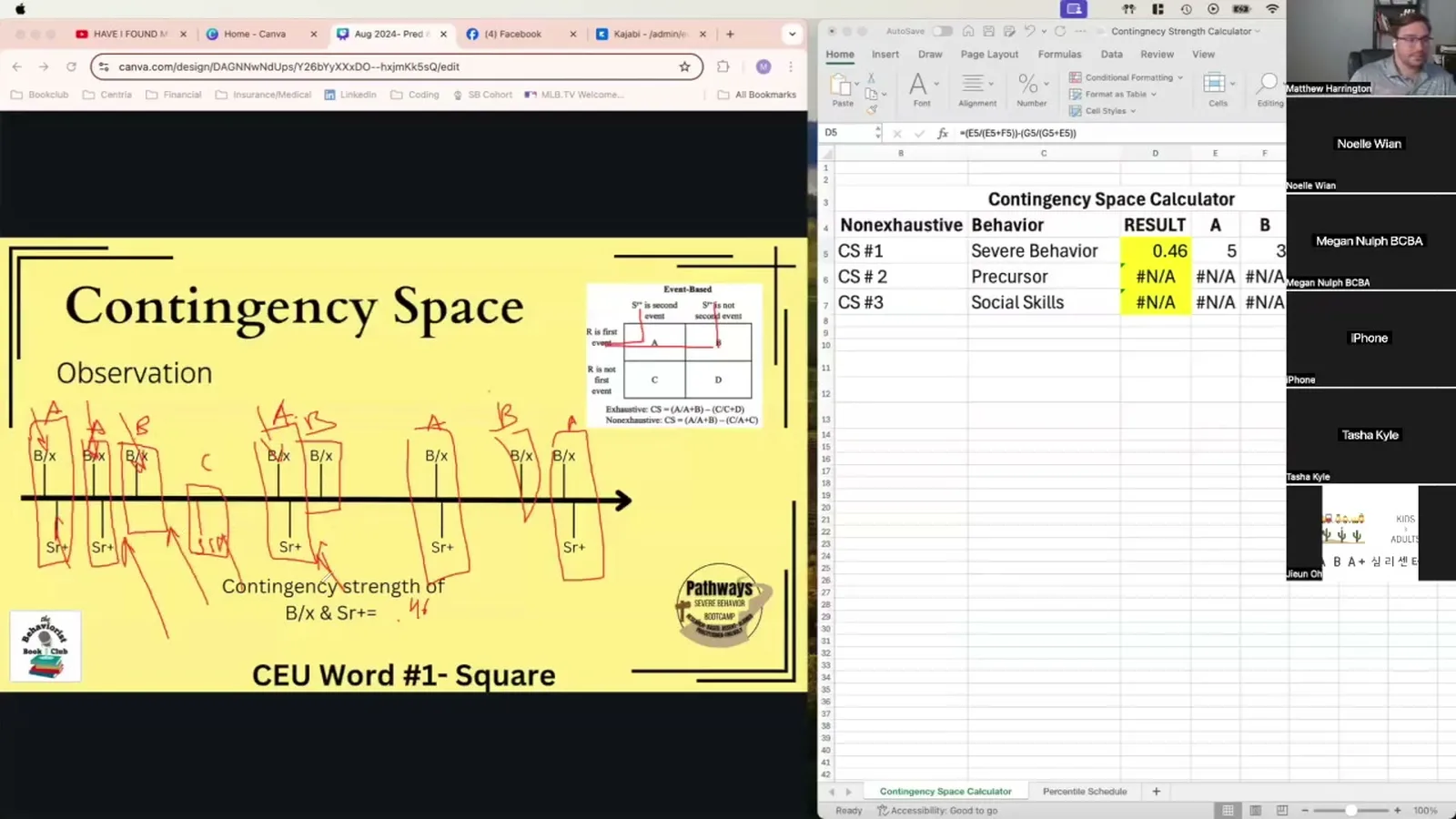
Prediction and Probabilities: Three foundational equations to successful behavior reduction
Matt HarringtonThe Behaviorist Bookclub
Introduced as an ordered set of topographically different behaviors that share the same reinforcer, used to identify a precursor behavior that can be…
On this page · 7 sections▾
A response class hierarchy is a group of behaviors that share one reinforcer. The behaviors look different but do the same job. They are ranked by effort, from easy to hard. The easy ones usually happen first.
This idea helps BCBAs and RBTs treat tough behavior more safely. You can target a small, early behavior instead of the big one. That choice can shrink severe behavior without harsh methods. It is a core tool for behavior reduction plans.
Think of it like a warning light on a dashboard. The small behavior is the light, and the severe behavior is the breakdown. If you act when the light comes on, you avoid the crash. The response class hierarchy tells you which light to watch.
What a response class hierarchy means#
Behaviors in one class all produce the same result. That result is the functional reinforcer. The topographies, or shapes, of the behaviors differ.
Response class hierarchy is simply the behaviors that occur prior to the more significant behaviors or, well, really, technically, it's a group of behaviors with the same reinforcers. From the talk — Matt Harrington
So the class might hold several steps in order. The order tends to follow effort and intensity.
So the response class hierarchy may be assent withdrawal, frowning, grunting, flipping a desk, hitting a teacher, right? An ordered sequence of behaviors, and the precursor would be assent withdrawal or frowning or something like that. From the talk — Matt Harrington
The first small behavior is the precursor. Assent withdrawal means the learner stops agreeing to take part. Frowning or grunting may come next. Hitting sits at the severe end of the same chain.
Ranked by effort, driven by one reinforcer#
The key is that effort sets the order. Low-effort behaviors show up first. As Matt notes, the responses are ranked by effort but all earn the same functional reinforcer. If those early behaviors get the reinforcer, the person rarely climbs higher.
This is why the hierarchy is so useful. You do not have to wait for the big behavior. You can respond at the bottom of the chain instead.
Using the precursor to reduce severe behavior#
 Advertisement
Here is the powerful move. You reinforce an earlier, lower-effort behavior. The person gets what they need before escalating. The severe behavior then has no reason to appear.
We've taken a socially significant behavior to decrease and we've decreased it, not by extinction, not by anything else, just by providing reinforcement for an earlier response class behavior in the response class hierarchy. From the talk — Matt Harrington
This works without extinction. Extinction means no longer reinforcing a behavior at all. That can be hard and can spike distress. Reinforcing the precursor avoids much of that risk.
Matt shows this same logic in a feeding case. Children learn a calm opt-out instead of crying or swiping.
That's the beauty of the response class hierarchy, right? Because we just described three topographies of behaviors. And within that functional response class hierarchy, only the bottom one is going to occur because it's going to get reinforced. From the talk — Matt Harrington
You can see this feeding example in Feeding Face Off. The wider math behind these plans appears in Prediction and Probabilities: Three foundational equations to successful behavior reduction.
Why this expands what you can work on#
Calming the severe behavior opens new doors. Skills that felt off-limits become possible again. The learner can rejoin harder tasks and settings.
These are all things that now get back on the table now that we're not seeing those severe instances of challenging behavior due to reinforcing the less severe instance of behavior. From the talk — Matt Harrington
So the hierarchy is not only about safety. It also grows the person's day. Less crisis means more chances to teach and connect.
This ties into assent-based care. Assent means the learner's willing agreement to take part. Assent withdrawal often sits at the bottom of the chain. When you honor that small signal, you may prevent a much bigger reaction.
That is the practical takeaway for teams. Watch for the early, low-effort behavior. Respond to it with respect and a real choice. You protect the learner and keep the day moving forward.
How clinicians spot a hierarchy#
You cannot assume a hierarchy exists. You test for it with careful assessment. A functional analysis shows what reinforcer drives a behavior. A functional analysis sets up conditions to reveal the behavior's cause.
Latency data adds another clue. Latency is the time before a behavior starts. If mild behavior almost always comes first, that hints at a chain. Then an extinction test can confirm the shared function.
This assessment step protects the whole plan. It tells you which small behavior to reinforce. It also stops you from targeting the wrong link. Good data here makes the later treatment far safer.
What the research says#
Studies confirm that mild and severe behaviors can share one class. In one extinction analysis, both belonged to the same response class. Mild behavior nearly always occurred before severe behavior. Latency data matched the hierarchy idea.
The concept guides real treatment plans. One study treated a 13-year-old whose four problem behaviors formed a hierarchy kept by access to items. Offering another option or a clear contingency prevented escalation. A recent case used a response class hierarchy analysis to treat self-induced vomiting linked to attention (Roth et al., 2025). The hierarchy also appears in skill-building, where a lag schedule helped a boy develop varied sign mands (Silbaugh & Falcomata, 2018).
FAQ#
What is a response class hierarchy in simple terms? It is a group of behaviors that all earn the same reinforcer. The behaviors are ranked by effort, from easy to hard. Easy behaviors tend to happen first. Severe ones sit at the top of the chain.
How is a response class hierarchy used in treatment? Clinicians reinforce an early, low-effort behavior in the chain. The person gets what they need before escalating. This can lower severe behavior without extinction. It makes plans safer and often calmer.
What is a precursor behavior? A precursor is the small behavior that comes before a bigger one. It shares the same function as the severe behavior. Examples include frowning, grunting, or pulling away. Spotting it early lets you respond before things escalate. Teaching a calm request in its place is often the safest plan.
 Advertisement
Turn this topic into a CEU
You just studied this. Now get credit for it.
Watch Analyzing Assent and Taking Data with Matt Harrington and earn 3.5 free BCBA CEUs. Detailed certificate, delivered the moment you finish.