Autoclitics: The Words That Frame What We Say
Autoclitics are the small words that qualify and frame verbal behavior. See how ABA experts teach autoclitic frames for questions, mands, and honest speech.
Key takeaway
An autoclitic is a small piece of language that shapes other language. It rides on top of a request or a label. It tells the listener how sure you are, what you want, or how the words fit together.
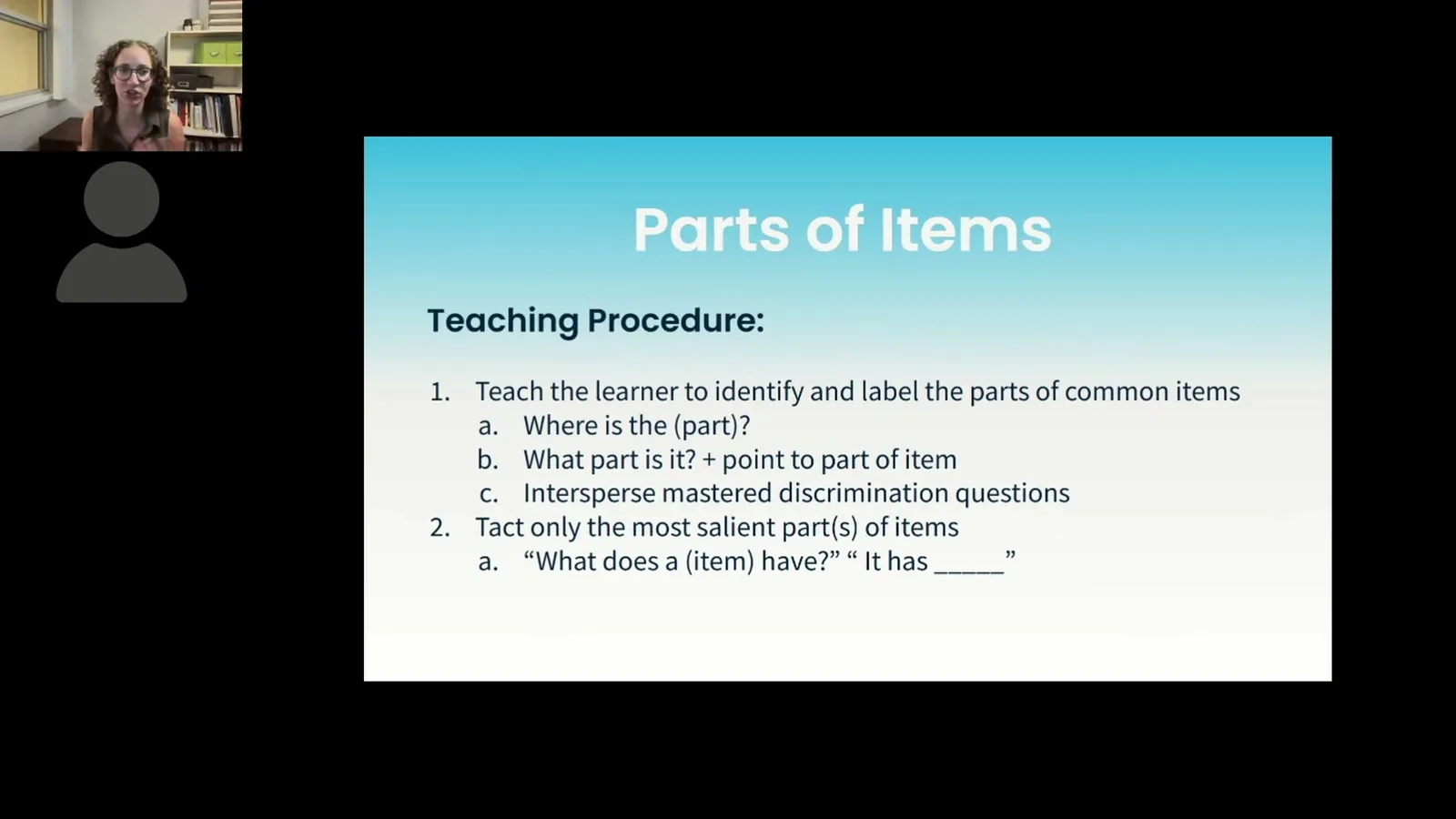
Teaching WH-Questions Isn’t Enough: Building True Conditional Discrimination
Experts who cover this
3 recordings on openceu cover autoclitic.
- Featured talk1 CEU
Teaching WH-Questions Isn’t Enough: Building True Conditional Discrimination
Dana PettusThe Behaviorist Bookclub
The talk's central teaching procedure: a fixed grammatical frame (e.g. 'what color, color___') that exerts interverbal control over a class of variable…
- 1 CEU
Getting the Right Answer Isn’t Enough: Establishing Speaker–Listener Repertoires for Complex Learning
Dana PettusThe Behaviorist Bookclub
Recapped from part one of the series: teaching learners to answer questions using a structured grammatical frame that echoes the question's form (e.g. 'what…
- 3 CEUs
12 days of PFA & SBT
Matt HarringtonThe Behaviorist Bookclub
The specific verbal-behavior term for the added phrasing ('may I have') that wraps the core mand as the FCR is shaped from a bare request into a full sentence.
On this page · 8 sections▾
An autoclitic is a small piece of language that shapes other language. It rides on top of a request or a label. It tells the listener how sure you are, what you want, or how the words fit together.
Skinner called these secondary verbal operants. An operant is simply a unit of learned behavior. Autoclitics matter because so much of real talk depends on them. "May I have the ball" says more than "ball." "It might be red" is not the same as "it is red." The talks below come from ABA (applied behavior analysis, the science of learning and behavior). Three speakers and several studies show how autoclitics work and how we teach them.
What an autoclitic actually does#
A mand is a request. A tact is naming something you see. Both are primary verbal behavior. An autoclitic is not primary. It depends on that first response and changes how the listener reacts.
Think of it as a frame around a picture. The picture is the core word. The frame tells you how to read it. Words like "may I," "I think," "not," and "like a" all do this job. They extend, negate, or soften what the speaker just said.
This is why one-word speech feels blunt. It carries the core message but drops the frame. Adding autoclitics is how a bare request grows into a full, polite sentence.
The autoclitic frame: a fixed part and a variable part#
Dana Pettus builds her whole teaching method on this idea. She works on WH-questions, the who, what, and where questions kids must answer. Her point is that teaching answers alone is not enough. Learners need the frame.
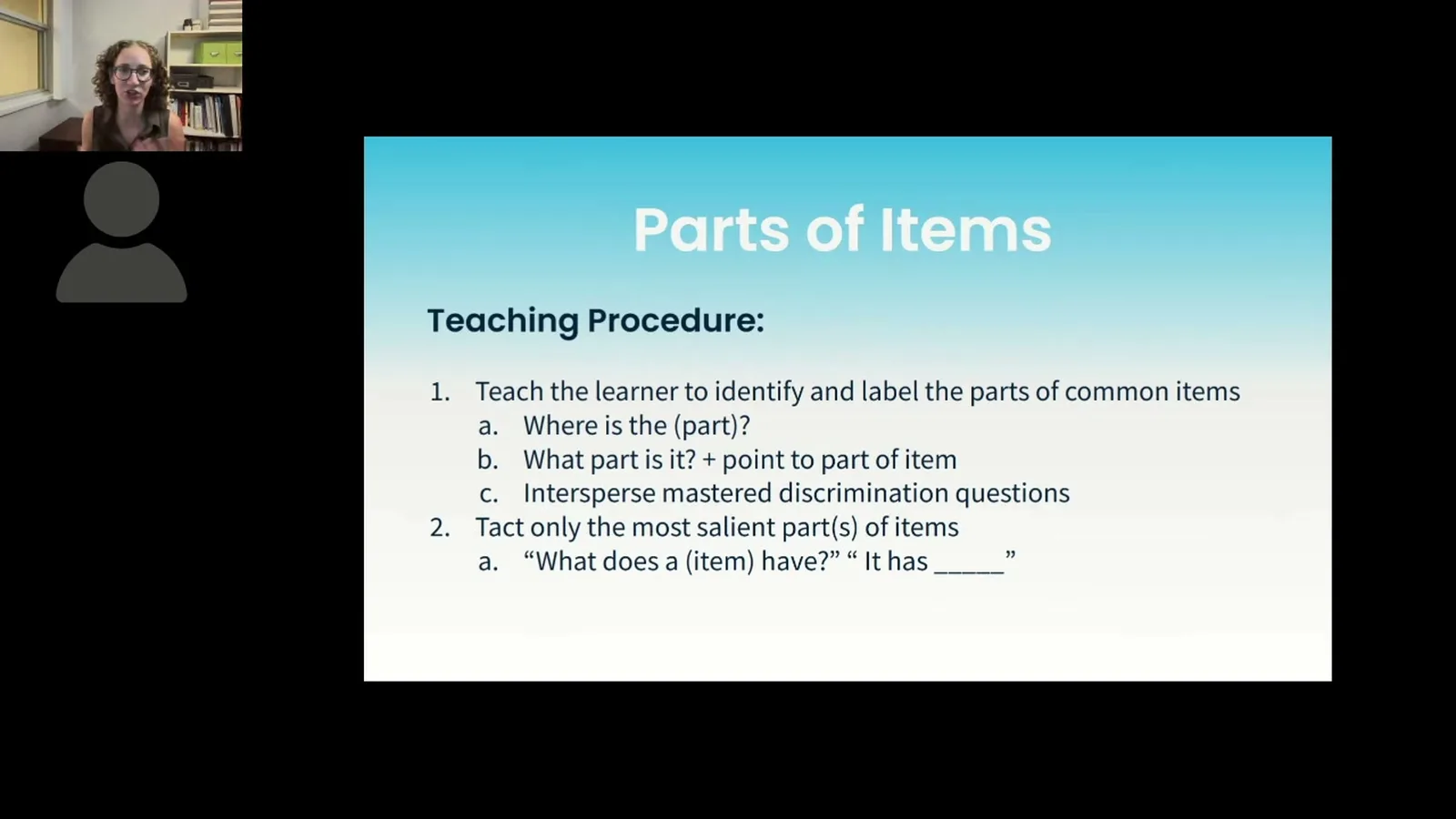
In her talk, Pettus defines an autoclitic frame as a verbal frame with two parts: one fixed, one variable. The fixed part stays the same, like "what color." The variable part changes, like "red" or "blue." When a child learns the frame, one slot can hold many answers. That is how a few taught frames unlock a large set of responses.
Pettus uses this control on purpose. The frame pulls the right answer into the open slot. She teaches it in three steps. First comes echoic practice, where the learner repeats the frame. Next comes autoclitic tacting, where the learner uses the frame to name things. Last come discrimination trials, mixed practice with different question types.
Pettus points out that the frame and its possible answers control each other. Teachers can use that link, she says, to help learners tell different questions apart.
Wrapping a bare request into a full sentence#
Matt Harrington shows the same structure inside skills-based treatment, an approach that builds new skills in small, planned steps. In his work on functional communication, a child learns a functional communication response. That is a taught, calm way to ask for what they want. It starts small and grows in steps.
The first request might be one word. Then a frame gets added around it. The core mand stays, but now it sounds like a real sentence.
In his talk, Harrington describes "may I have" as the autoclitic frame wrapped around the request. The next step up in complexity, he explains, adds a calm voice on top.
This is a clear picture of shaping, which means teaching a skill in small steps. The autoclitic frame is the next rung on the ladder. First the child asks. Then the child asks politely. Then the child asks politely in a calm voice.
Listening for autoclitics in therapy talk#
 Advertisement
Dr. Tom Szabo brings autoclitics into a different setting. He works in ACT (acceptance and commitment training), a therapy approach that builds flexible, values-based action. In that work, a clinician has to know when a client truly agrees.
A client might say "yes" out of habit or to please you. The real signal is in the qualifying words around the "yes." Those words are autoclitics. They reveal meaning that a flat answer hides.
You have to gently ask them what this meant and what this meant and what this meant and all those different things that people do, which in Skinner's Lexicon he would refer to these as autoclitics. These are ways of qualifying and quantifying and behaving with respect to your behavior.
From the talk — Dr. Tom Szabo
So autoclitics are not just a child-language topic. They are how any speaker marks doubt, strength, and honesty. A skilled listener tracks them to hear what a person really means.
Qualifying autoclitics and honest speech#
One family of autoclitics is called qualifying. These words assert, negate, or soften a claim. "I am sure" is strong. "It seems like" is weak. Both tell the listener how much to trust the message.
This repertoire is teachable. Owen and Rodriguez taught autistic children to say things like "like a" when a label only partly fit. The children learned to signal a weak match instead of stating a shaky guess as fact. That is a real honesty skill.
It also has ethical weight. The way a choice is framed can push people one way or the other. A checked box or an "opt out" line nudges behavior before a person even decides. Autoclitics are quiet, but they steer choices.
How autoclitic frames get taught and generalize#
The best news is that these frames spread. You do not have to teach every possible sentence. You teach a few good examples and the pattern generalizes.
The tool for this is multiple exemplar instruction. You teach the same frame across many words and settings. Then new, untaught uses start to show up on their own. Researchers have seen this with both autistic and typically developing children.
Extinction can help too. When an old behavior stops working, a learner tries new forms. A team can catch that moment and reinforce a mand with a full autoclitic frame. The bare request fades and the fuller, kinder request grows. For a deeper look at shaping communication in practice, see 12 days of PFA & SBT.
What the research says#
A 2023 paper argues that abstract tacts and autoclitic frames explain much of the generative side of language (Layng & Linnehan, 2023, Perspectives on Behavior Science). The authors show how stimulus control, the way cues in the setting guide behavior, can account for complex relational responding. No hidden mental variables are needed.
A 2024 study taught qualifying autoclitics to children with autism (Owen & Rodriguez, 2024, Journal of Applied Behavior Analysis). Using simultaneous teaching and multiple exemplars, the team saw the skill generalize to new labels and new sets.
A 2020 study used extinction-induced variability to grow mands with autoclitic frames (Cengher et al., 2020, The Analysis of Verbal Behavior). When simpler behaviors stopped paying off, richer, more appropriate requests took their place.
Frequently asked questions#
What is a simple example of an autoclitic?
Say a child wants a toy. "Ball" is the core request. "May I have the ball, please" adds autoclitics. The word "may" and the word "please" frame the request. They keep the same want but make it polite and clear for the listener.
What is the difference between an autoclitic and an autoclitic frame?
An autoclitic is a single framing word or phrase, like "not" or "I think." An autoclitic frame is a reusable structure with a fixed part and an open slot. "What color is the ___" is a frame. You can drop many answers into that one slot.
Why teach autoclitic frames instead of single answers?
Frames generalize. Teach a few examples of one frame and learners start using it with new words on their own. That is far more efficient than teaching each sentence one at a time. It also builds flexible, honest speech instead of memorized replies.
 Advertisement
Turn this topic into a CEU
You just studied this. Now get credit for it.
Watch Teaching WH-Questions Isn’t Enough: Building True Conditional Discrimination with Dana Pettus and earn 1 free BCBA CEU. Detailed certificate, delivered the moment you finish.