Client Assent in ABA: A Plain Guide
Client assent is a learner's ongoing yes to treatment. Learn what it looks like, how it differs from consent, and how to honor it in ABA.
Key takeaway
Client assent is a learner's ongoing "yes" to what is happening in a session. It is the willingness to take part, shown through what a person does and says.
Analyzing Assent and Taking Data
Experts who cover this
8 recordings on openceu cover client assent.
- Featured talk3.50 Ethics CEUs
Analyzing Assent and Taking Data
Matt HarringtonThe Behaviorist Bookclub
The whole course frames assent (a client's ongoing willingness to participate) as continuously observed rather than acquired once, and opens with three…
- 0.50 CEUs
Beyond Compliance: What Assent-Based ABA Looks Like in Real Life
Danielle VirnelsonDani Elle Mentorship and Consulting
The entire talk contrasts compliance-based ABA with assent-based ABA, defining assent as the learner's ongoing, observable agreement to participate and arguing…
- 1 CEU
Assent: Don't just say Yes!-
Matt HarringtonThe Behaviorist Bookclub
The talk distinguishes assent from consent, framing assent as a continuous dynamic agreement to an ongoing intervention rather than a single instance of…
- 1 Ethics CEU
Ethical Guardrails in Behavior Reduction
Matt HarringtonThe Behaviorist Bookclub
Matt Harrington explains assent as the BACB ethics-code construct that stands in for informed consent with individuals who can't legally consent, distinguishes…
- 1 CEU
genArete: Learner-Centered Skill Assessment
Mark MaladyThe Behaviorist Bookclub
Mark describes building assent into the Generate assessment through a 'pre-teach' framework applied before every pinpoint, so the learner has ongoing input…
- 1 Ethics CEU
Dunder Mifflin’s Guide to BCBA Ethics: Lessons from The Office
Mellanie PageThe Behaviorist Bookclub
Framed as a prerequisite before sharing information that could benefit a client, even when a clinician's ego wants to act on it immediately.
- 3 CEUs
12 days of PFA & SBT
Matt HarringtonThe Behaviorist Bookclub
Defined as the client actively opting into treatment rather than being assumed compliant, applied practically as opening the session-room door and waiting for…
- 1 CEU
Stronger Together: Care Collab
Matt HarringtonThe Behaviorist Bookclub
Framed as a marker of whether an intervention or collaboration strategy is truly working: if something is working, the learner is assenting to and enjoying it…


On this page · 9 sections▾
Client assent is a learner's ongoing "yes" to what is happening in a session. It is the willingness to take part, shown through what a person does and says. A client does not have to sign a form. They show you with their behavior.
Assent matters because the people we serve often cannot give legal consent. Many are young, and many have communication differences. That does not remove their right to a say. Assent is how we keep that say front and center, every minute of care.
Assent is not the same as consent#
Consent and assent get mixed up, but they do different jobs. Consent is the legal permission from an adult or guardian. Assent is the client's own willingness to join in.
Nikki, a school-based BCBA (board certified behavior analyst), draws the line clearly. Consent is "about permission and legal right to participate in services, research," or in her work, running an FBA (functional behavior assessment, a study of why a behavior happens). Assent is different. It is "about their behavior that tells us whether they're cool with it or not cool with it."
Matt Harrington makes the same split in his talk on ethical guardrails. Consent is a legal word for people who can legally agree. Assent stands in for consent when someone cannot legally give it. Both are needed. One does not replace the other.
You observe assent, you do not collect it once#
The biggest shift is timing. Assent is not a box you check at the start. It is something you watch the whole way through.
assent is not acquired once. It's observed continuously.
From the talk — Matt Harrington
This is the core idea across these talks. In his ethics work, Matt describes tracking assent across a full session. At any point, you know you still have a current "yes." A signed intake form from a parent does not tell you the child is willing right now. Only the child's behavior does that.
The ethics code backs this up. Matt cites the definition from the BACB (the board that certifies behavior analysts). Assent is "a vocal or non-vocal verbal behavior that can be taken to indicate a willingness to participate in research or behavioral services by individuals who cannot provide informed consent." The word there is willingness. And willingness can change from moment to moment.
What assent and its withdrawal look like#
If assent lives in behavior, you have to know the signs. The talks give clear, real examples.
Danielle Virnelson keeps the definition simple and useful. She defines assent as a learner's ongoing, observable agreement to take part in an activity or procedure.
Nicky Schneider walks through the signs on both sides. Vocal signs are easier to read. A student tells you no. Non-vocal signs take more skill. She lists turning away, crying, screaming, and falling to the floor as clear signs a learner is not assenting. Nikki adds a warm example of the opposite. She loves when a student takes your hand to show them what to do. That reach is a clear sign of assent.
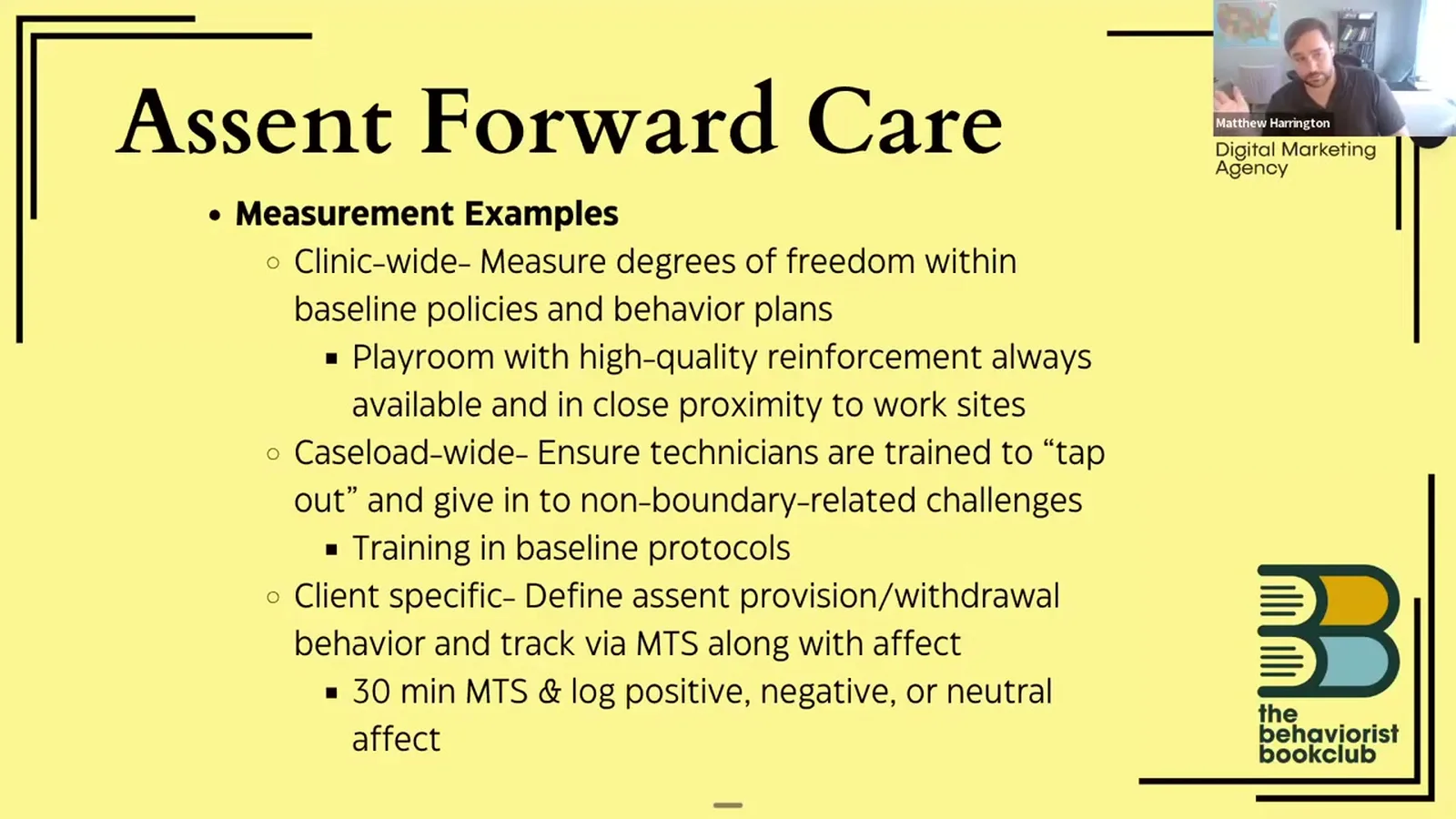
John Stavitz shows how this looks as a school-wide rule. In his universal protocol, a student could opt out of any part of his schedule. Any sign of reluctance or non-assent was taken seriously, and the non-preferred item was pulled right away.
Choice is the line you cannot cross#
 Advertisement
Why treat assent as a right instead of a nice extra? Because choice is what separates good care from harm.
as soon as you take choice away from people, then it goes from being a value to a rights violation.
From the talk — Brian Middleton
Brian Middleton frames the whole thing around one question. Can the person say no and have it honored? If they cannot say no, that is a rights violation. This is why assent is not optional. It is the practical test of whether someone still has a real choice.
Mellanie Page brings the same point to ethics and privacy. Even when we think we know what will help, we wait. In her words, we sometimes have to put our ego aside. We make sure we have both consent and assent before we act, even to share helpful information.
Building assent into assessment and treatment#
Assent is not only for the therapy chair. It can be built right into how we assess and plan.
Mark Malady describes doing this inside a skill assessment. Assent is built in through a "pre-teach" step used before each target. That means the learner has input all along, so the assessment is done with them, not to them. He also builds self-advocacy into the model as a milestone to reach.
Matt Harrington shows the same idea in practice-based care. He uses PFA and SBT (practical functional assessment and skill-based treatment, an assent-first approach to tough behavior). In that work, assent is prioritized from the first second. He opens the session-room door and waits. He assumes the client is not ready until they give enough social bids that show they want to move ahead. The client opts in. We do not assume they will.
Beyond compliance and toward dignity#
For a long time, ABA (applied behavior analysis) measured success by compliance. Assent-based care asks a better question. Is the person willing, and are they okay?
Danielle Virnelson is direct that this is not a step backward. Assent-based practice is "not... anti-ABA, it's actually high-quality ABA." She adds that the point is seeing clients as people, not just behavior. Mackenzie Sandler ties this to culture too. Good service gives people assent, consent, choice, and respect for who they are.
Matt Harrington sums up the spirit of it in his care collaboration talk. When something is working, the learner is usually enjoying it and wants it to keep going. As he puts it, the learner is always right and they vote with their feet. Assent is how we hear that vote.
Honoring a "no" without a free-for-all#
A fair worry comes up here. If we honor every no, does the child just do whatever they want? The talks answer this clearly. No.
Nicky Schneider says that honoring a withdrawal of assent does not mean letting a child do whatever they want.
It means honoring their distress and working to approach the challenge together.
From the talk — Nicky Schneider
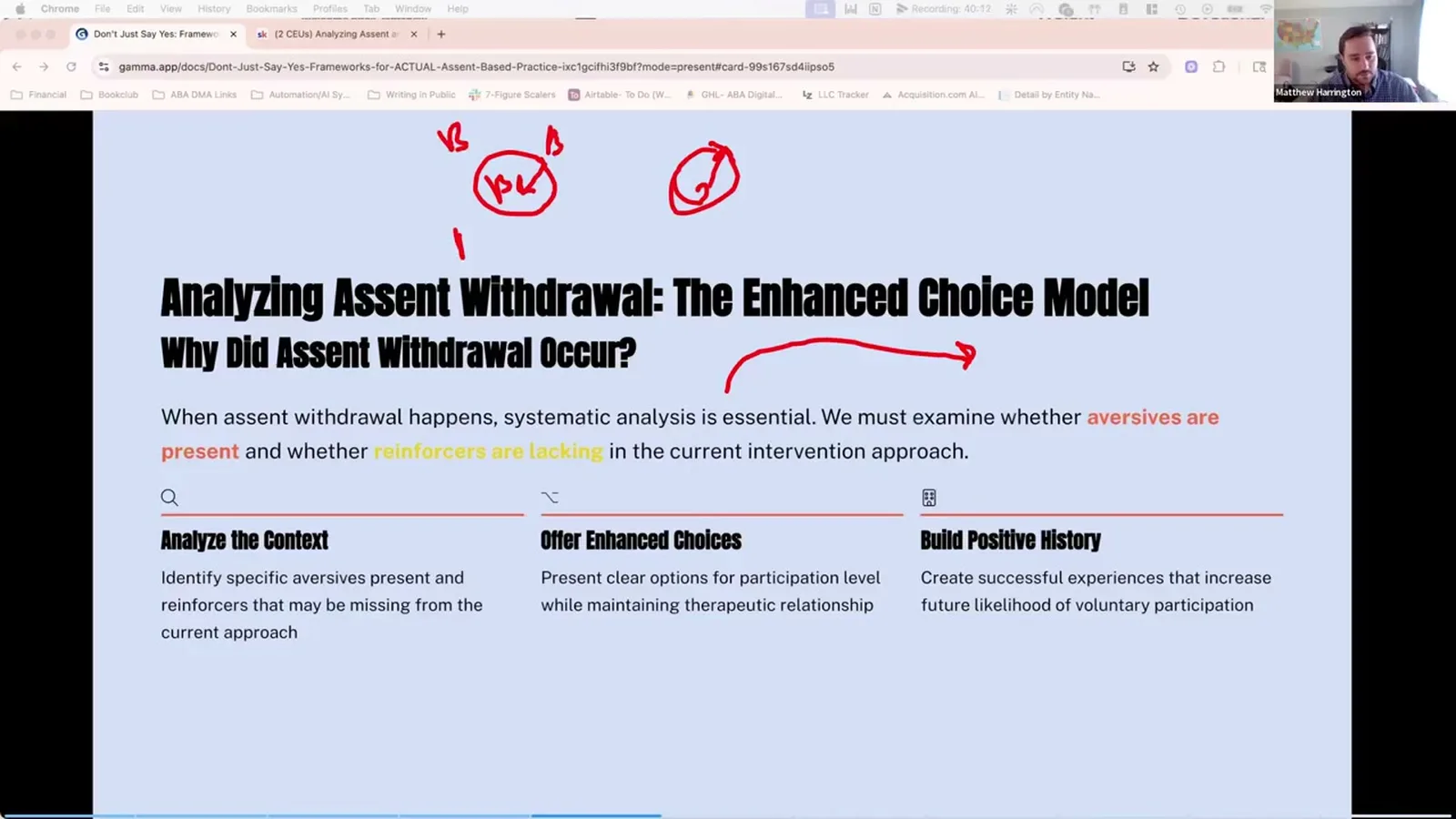
Matt Harrington makes the same point another way. Assent does not mean backing off and stopping. It means backing off and changing something. You notice the no, you adjust, and you find a path the learner can say yes to. The goal stays. The way you get there bends to keep the person willing.
What the research says#
The field is moving fast on assent, and the literature backs the practice.
Morris and colleagues (2024) offer six practical steps for adding assent to practice. These include arranging fair choices and picking good moments to check for assent. Their paper, "Toward a further understanding of assent," gives guidance a working clinician can use.
Flowers and Dawes (2023) argue that assent during treatment needs its own rules, separate from research. In "Dignity and Respect: Why Therapeutic Assent Matters," they note that clients with language differences may need their own assent methods.
Shpall and Kuhn (2026) tested whether BCBAs could be trained to spot and respond to assent withdrawal. With instruction, modeling, and feedback, every participant learned to identify withdrawal, adjust their plan, and embed ongoing assent checks.
Mead Jasperse and colleagues (2023) surveyed 123 researchers and found a gap. Many use assent methods, but those steps often go undescribed in published work. That points to a need for more training and shared resources.
Frequently asked questions#
What is the difference between consent and assent?
Consent is legal permission from a person who can give it, like an adult or guardian. Assent is the client's own willingness to take part, shown through behavior. You can hold a parent's consent and still lose the child's assent in the moment. You need both.
How do you know when a client is not assenting?
You watch behavior. Saying no is the easy sign. Harder signs include turning away, crying, moving away from the task, or falling to the floor. Any of these can mean the person is not willing right now. When you see them, you pause and change your approach.
Does honoring assent mean the client avoids all work?
No. Honoring a withdrawal is not the same as letting a child skip everything. It means you take their distress seriously and work with them toward the goal in a gentler way. The target stays in place. You adjust the path so the learner can stay willing.
For a deeper practice model, see Assent: Don't just say Yes!-, and for how assent fits into reducing harmful behavior, see Ethical Guardrails in Behavior Reduction.
 Advertisement
Turn this topic into a CEU
You just studied this. Now get credit for it.
Watch Analyzing Assent and Taking Data with Matt Harrington and earn 3.5 free BCBA CEUs. Detailed certificate, delivered the moment you finish.