Trauma-Informed Care in ABA: A Plain Guide
Trauma-informed care in ABA means planning for likely trauma, offering real choice, and avoiding harm. See how BCBAs apply it in daily practice.
Key takeaway
Trauma-informed care is a way of planning services that respects a person's past. It assumes the people we serve may carry hard experiences with them.
12 days of PFA & SBT
Experts who cover this
8 recordings on openceu cover trauma-informed care.
- Featured talk3 CEUs
12 days of PFA & SBT
Matt HarringtonThe Behaviorist Bookclub
Day 9's article (Rajaraman/Rogers 2022) laid out principles (acknowledge trauma, ensure safety/trust, promote choice, emphasize skill building) that the…
- 1 Ethics CEU
Ethical Guardrails in Behavior Reduction
Matt HarringtonThe Behaviorist Bookclub
Presented as one of three guardrail-adjacent frameworks: knowing a learner's trauma history and adjusting interventions accordingly to increase assent, built…
- 1 CEU
From Research to the Applied Setting: Breaking Down the Three-Legged Stool of "Evidence Based Practice"
Dr. Jessica OsosCopper Consulting Group
The talk addresses the trauma-informed and compassionate care movement in ABA, clarifying that standard procedures like prompting, reinforcement, and demand…
- 1.50 CEUs
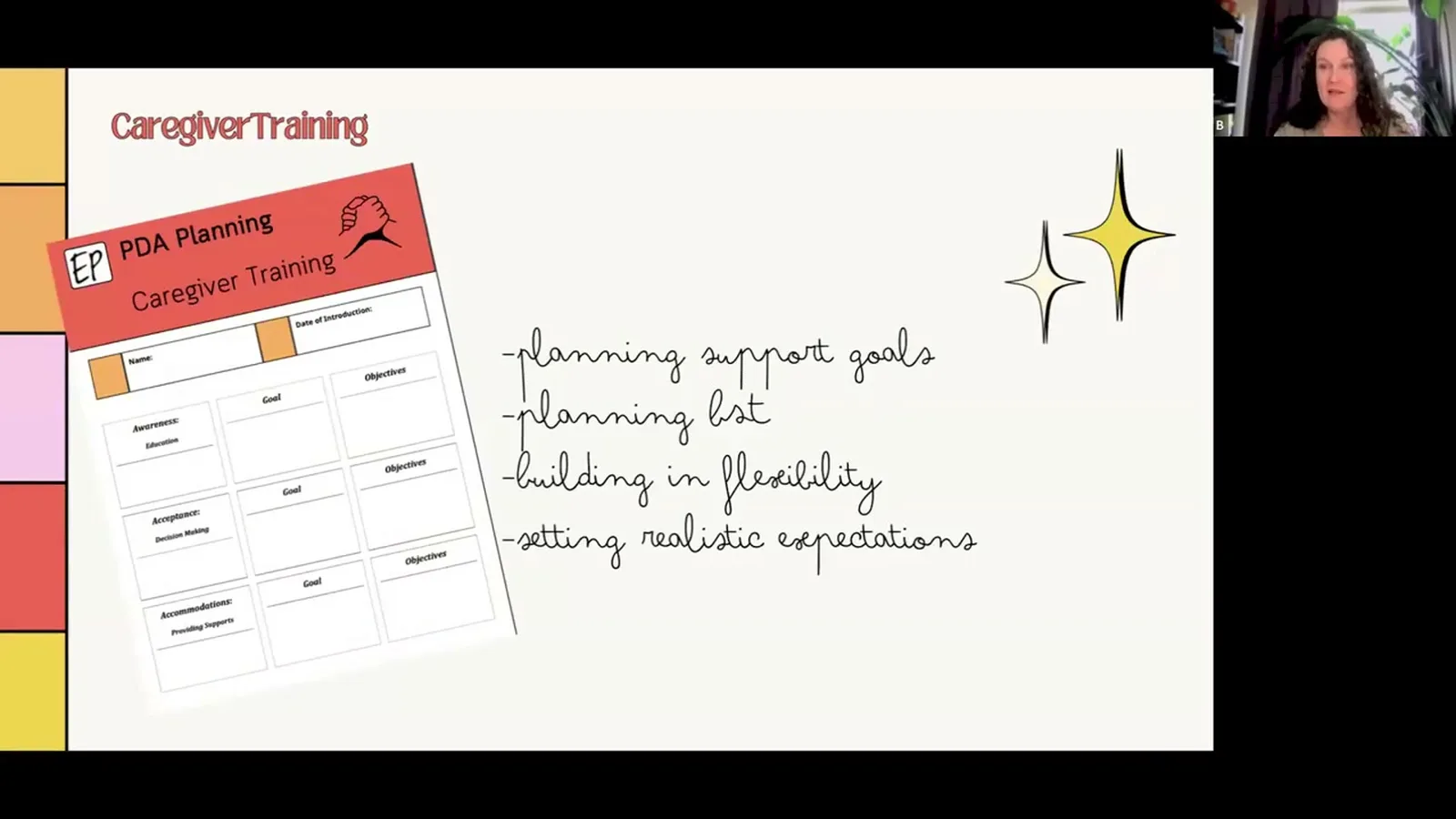
PDA Caregivers, Complex Profiles, Replacement Behaviors, and Being Trauma Informed
B. Kuerine GrayThe Behaviorist Bookclub
Gray closes with a call for clinicians to self-monitor their own triggers and reactions when working with PDA profiles, since power struggles or tone shifts…
- 0.50 CEUs
Beyond Compliance: What Assent-Based ABA Looks Like in Real Life
Danielle VirnelsonDani Elle Mentorship and Consulting
Named as one of the instructor's clinical interests and used to argue that even well-intentioned coercion during ABA sessions can have lasting effects on a…
- 3.50 Ethics CEUs
Analyzing Assent and Taking Data
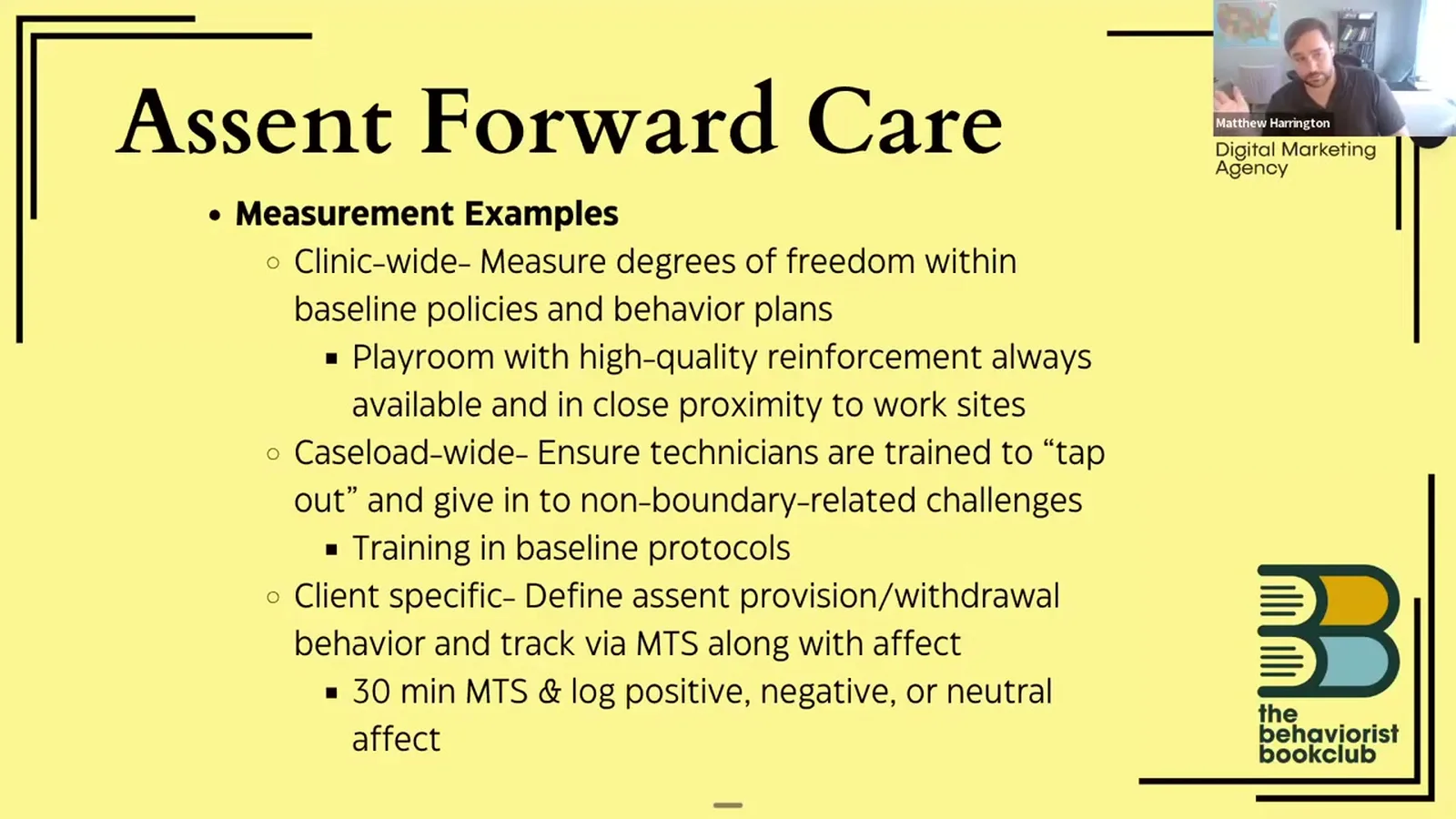
Matt HarringtonThe Behaviorist Bookclub
Framed as the recent shift that helped elevate assent as a topic in the field, and used to justify signaling an upcoming demand (visual schedule, warning cue)…
- 1.50 CEUs
Hey, Chillax Man! Understanding the Logic of Anxiety
Dr. Clelia SigaudThe Behaviorist Bookclub
One of Matt's three clinical guardrails; involves signaled transitions and awareness of how a client's trauma history shapes learned avoidance behavior.
- 1 Ethics CEU
Interdisciplinary Grief Support for People with Disabilities: Enhancing Outcomes Through BCBA-LPC Collaboration
Patricia LundThe Behaviorist Bookclub
In Q&A, Matt raises the tension in trauma-informed ABA practice between gathering sensitive history quickly and needing enough trust first, prompting Lisa's…


On this page · 8 sections▾
Trauma-informed care is a way of planning services that respects a person's past. It assumes the people we serve may carry hard experiences with them. So we work to build trust, offer choice, and avoid actions that could reopen old wounds.
This matters because trauma is common, not rare. Many of the clients a BCBA (a behavior analyst who plans care using ABA, short for applied behavior analysis) sees have lived through neglect, restraint, or loss. Their history shapes how they react to demands today. When we plan with that in mind, we lower fear and teach better.
What trauma-informed care means in ABA#
Across many talks, the definition stays simple and steady. It is not one procedure. It is a lens you hold over every choice you make.
Matt Harrington frames it as knowing the person in front of you. "Trauma-informed care means we know the history of that learner. We understand how to change our interventions, and we'll increase consumer participation." When you know the history, you adjust the plan. That is the whole idea.
Danielle Virnelson adds the ethics piece. She ties trauma-informed care to clinical decisions and to the harm that coercion can do. Even gentle pressure can teach a learner to fear the setting. So the lens is also a guardrail against harm we do not intend.
Trauma assumed care: plan as if trauma is present#
Several speakers push past "trauma-informed" to "trauma assumed." The reason is practical. You often do not know a person's full story. So you plan as if hard things happened.
Matt Harrington puts it plainly. He says we should assume that most people we serve carry some trauma placed on them. Dr. Shane Spiker teaches the same starting point from crisis work.
the trauma assumed care, the trauma informed care goes based on, it goes on the idea that everybody that we serve has been through every possible horrible thing.
From the talk — Dr. Shane Spiker
Spiker also reminds us we cannot manage another person's trauma. We can only avoid the things that re-trigger it. He once worked with a learner who could not stand the sight of him, because he looked like her abuser. That is a cue no data sheet would catch. Trauma assumed care keeps you ready for it.
Choice and signaling lower the threat#
A steady theme is giving people a heads up and a say. When a demand is coming, warn the person first. When a task is required, offer a choice inside it.
Matt Harrington describes signaling a hard moment before it lands. He notes this is part of trauma-informed care research, since a warning eases anxiety. It also builds trust and teaches a strong routine. Visual schedules, timers, body language, and simple warnings all work as the signal.
John Stavitz ties choice to safety in schools. He teaches that offering choices, especially before a needed demand, is a core piece of this work. He also argues that the field has debated words for too long.
There may be behavior analysts who want to do the right thing, but are tangled up fretting about the semantics and vocabulary of trauma... The time for these concerns to hold us back is past. The time has come for all of us to take trauma seriously and recommit to doing no harm.
From the talk — John Stavitz
The procedure is not the problem, the application is#
 Advertisement
A common worry is that certain ABA methods are "bad" by nature. The talks push back on that. What matters is how and when you use a method.
Matt Harrington makes this the sharpest point in Ethical Guardrails in Behavior Reduction. His four pillars come from Rajaraman and colleagues: acknowledge trauma, ensure safety and trust, promote choice, and build skills.
Procedures and interventions are not inherently trauma informed or trauma causing. The application of the procedures is what matters. An isolated single function functional analysis is not automatically more traumatic than a practical functional assessment with synthesized reinforcers.
From the talk — Matt Harrington
The same lens changed his own daily work. He used to lean on extinction (stop rewarding a behavior so it fades). Reading and re-checking pushed him away from it. He also warns that any physical management is likely to re-trigger trauma. So he now reaches for errorless learning (teaching that prevents mistakes) with clients who were once restrained for errors.
Dr. Jessica Osos brings needed balance from a research view. She clarifies that trauma has a strict clinical meaning. Typical ABA procedures like prompting hierarchies, reinforcement, and demand fading (slowly reducing how much support a task needs) do not meet the DSM-5 criteria for trauma. Real trauma involves life-threatening events or violence. The takeaway is not that ABA is safe by default. It is that misused procedures still carry risk, so care in the moment is what counts.
Providers watch their own triggers too#
Trauma-informed care looks inward, not just at the client. Your own reactions can escalate a hard moment.
B. Kuerine Gray asks clinicians to spot their own setting events, the conditions right before a moment that make a strong reaction more likely. She has seen providers slip into power struggles without noticing. That tone shift can retraumatize a person with a demand-avoidant profile.
we are responsible for being in control of our own histories and being able to change our own patterns of behavior to mitigate harm when working with others
From the talk — B. Kuerine Gray
This self-check shows up in Matt's guardrails too. He names "cause no further harm" as a rule he stands by. His programming reflects it, from signaled transitions to a read on each learner's history. You can see this applied with demand-avoidant clients in PDA Caregivers, Complex Profiles, Replacement Behaviors, and Being Trauma Informed.
Where trauma-informed care already lives in practice#
Some teams find they were doing this work before they had the name for it. That is a hopeful sign, not a gap.
Dr. Holly Gover shares this from her feeding team. Their shaping and choice steps were built on their own. Only later did a colleague point out how much of it matched trauma-informed care. She calls it a relief to learn ABA is not at odds with the framework.
There is still real tension in the day to day. Matt Harrington raises one honest problem from grief work. The field says to gather trauma history fast. But asking a stranger about their worst moments can break trust before you earn it. Rapport has to come first. Assent (a learner's willing yes) is the bridge, and it is a topic these talks return to often.
What the research says#
The research base is young but growing. A 2023 survey of BCBAs found most said trauma training was extremely important (Wheeler, Hixson, Hamrick, Lee, & Ratliff, 2023). Yet most also reported little to no training on trauma in their coursework, fieldwork, or continuing education. That gap is why pages and courses like this one exist.
A special issue helped set the direction. A 2024 review found the core values of trauma-informed care already fit ethical ABA, and worked to clear up common myths (Austin, Rajaraman, & Beaulieu, 2024).
The field also needs to test its own claims. A 2025 paper calls for study of both the benefits and the costs of this work (Austin, 2025). The point is honest. We should build an evidence base, not just a belief.
Frequently asked questions#
Is trauma-informed care the same as trauma assumed care?
They are close cousins. Trauma-informed care means you know a person's history and plan around it. Trauma assumed care goes one step further. You assume trauma may be there even when you have no record. Many speakers prefer the assumed version, because histories are often hidden or incomplete.
Does trauma-informed care mean I stop using standard ABA procedures?
No. The talks are clear that most common procedures do not cause trauma by themselves. Prompting, reinforcement, and demand fading are not harmful on their own. What matters is how you apply them. You avoid force, offer choice, and adjust for each learner's past. A method used with care can stay in your toolkit.
How do I use trauma-informed care if I do not know a client's history?
Start by assuming trauma could be present. Signal demands before they happen so nothing feels like an ambush. Offer choices, especially before a required task. Watch your own tone and avoid power struggles. Build trust first, then gather sensitive history slowly as the relationship allows.
 Advertisement
Turn this topic into a CEU
You just studied this. Now get credit for it.
Watch 12 days of PFA & SBT with Matt Harrington and earn 3 free BCBA CEUs. Detailed certificate, delivered the moment you finish.
Parent or caregiver? Find a vetted ABA provider near you on ProviderSpark.