Negative Reinforcement in ABA: How It Works
Negative reinforcement explained in plain terms. Why removing something can strengthen behavior, how it drives escape and anxiety, and how to use it well.
Key takeaway
Negative reinforcement is one of the most misread ideas in ABA. It does not mean punishment. It means a behavior gets stronger because something unwanted goes away.
Hey, Chillax Man! Understanding the Logic of Anxiety
Experts who cover this
2 recordings on openceu cover negative reinforcement.
- Featured talk1.50 CEUs
Hey, Chillax Man! Understanding the Logic of Anxiety
Dr. Clelia SigaudThe Behaviorist Bookclub
Sigaud explains that the maintaining consequence for anxious avoidance is negative reinforcement (removal of the aversive private event), and that whether you…
- 0.50 PDUs
Bite-Size Behavior Analysis: Behavior Analytic Definitions of Reinforcement & Punishment
Anlara HoskinsCandid Contingencies, LLC
Hoskins defines negative reinforcement as removing an aversive stimulus contingent on a behavior, which increases that behavior over time, using a…

On this page · 9 sections▾
Negative reinforcement is one of the most misread ideas in ABA. It does not mean punishment. It means a behavior gets stronger because something unwanted goes away. The word "negative" just means you take something away.
Think of taking aspirin for a headache. The pain fades, so you take aspirin again next time. That is negative reinforcement at work. This page draws on two OpenCEU talks to show how it shapes escape, avoidance, and even anxiety.
What negative reinforcement means#
The rule is simple. A behavior happens. Right after, something unpleasant is removed. Because of that, the behavior is more likely to happen again.
The removed thing is called an aversive stimulus. That just means something a person wants to avoid. It could be a hard task, a loud room, or a bad feeling inside.
So negative reinforcement always has two parts. There is a behavior, and there is relief that follows it. That relief is what makes the behavior grow.
It is not the same as punishment#
This is the point people get wrong. Reinforcement always makes behavior go up. Punishment makes behavior go down. The word "negative" fools people into thinking it weakens behavior.
Keep the two ideas apart. Negative reinforcement builds a behavior by taking away something bad. Punishment shrinks a behavior. Mixing them up leads to bad plans.
Escape and avoidance in daily sessions#
Dr. Megan DeLeon frames this as two different worlds a learner can live in. In one, the person wants to stay and connect. In the other, the person wants out.
In a positive reinforcement paradigm, someone is connected to the environment and people are seeking to stay engaged and present. In a negative reinforcement paradigm, someone is trying to get away from the environment and people to get back to a better set of circumstances for themselves. From the talk — Dr. Megan DeLeon
She warns about the old style of teaching. A demand goes up, the child bolts, and the escape gets reinforced. Over time, escape becomes the child's main move.
Learners who allocate most of their responding to negative reinforcement schedules are constantly trying to get away from aversive stimuli. From the talk — Dr. Megan DeLeon
DeLeon's point is about connection. If sessions feel aversive, the child learns to flee them. If sessions feel safe, the child stays and learns. You can hear her full take in The Heart of ABA Service Delivery: Creating Connected Relationships - Applied 2023.
Anxiety runs on negative reinforcement#
 Advertisement
Dr. Clelia Sigaud applies the same logic to anxiety. Anxiety is an unpleasant private event, which means a feeling inside the body. When a person avoids the scary thing, the fear drops. That drop is the reinforcer.
The maintaining consequence when experiencing anxiety is negative reinforcement. From the talk — Dr. Clelia Sigaud
So avoidance feels good in the moment. The bad feeling goes away fast. But the relief also teaches the brain to keep avoiding.
So basically, as a recap, the reinforcing consequence for anxiety is arousal reduction, negative reinforcement. From the talk — Dr. Clelia Sigaud
This is why anxiety can grow over time. Each escape makes the next escape more likely. The fear never gets a chance to fade on its own.
Timing changes everything#
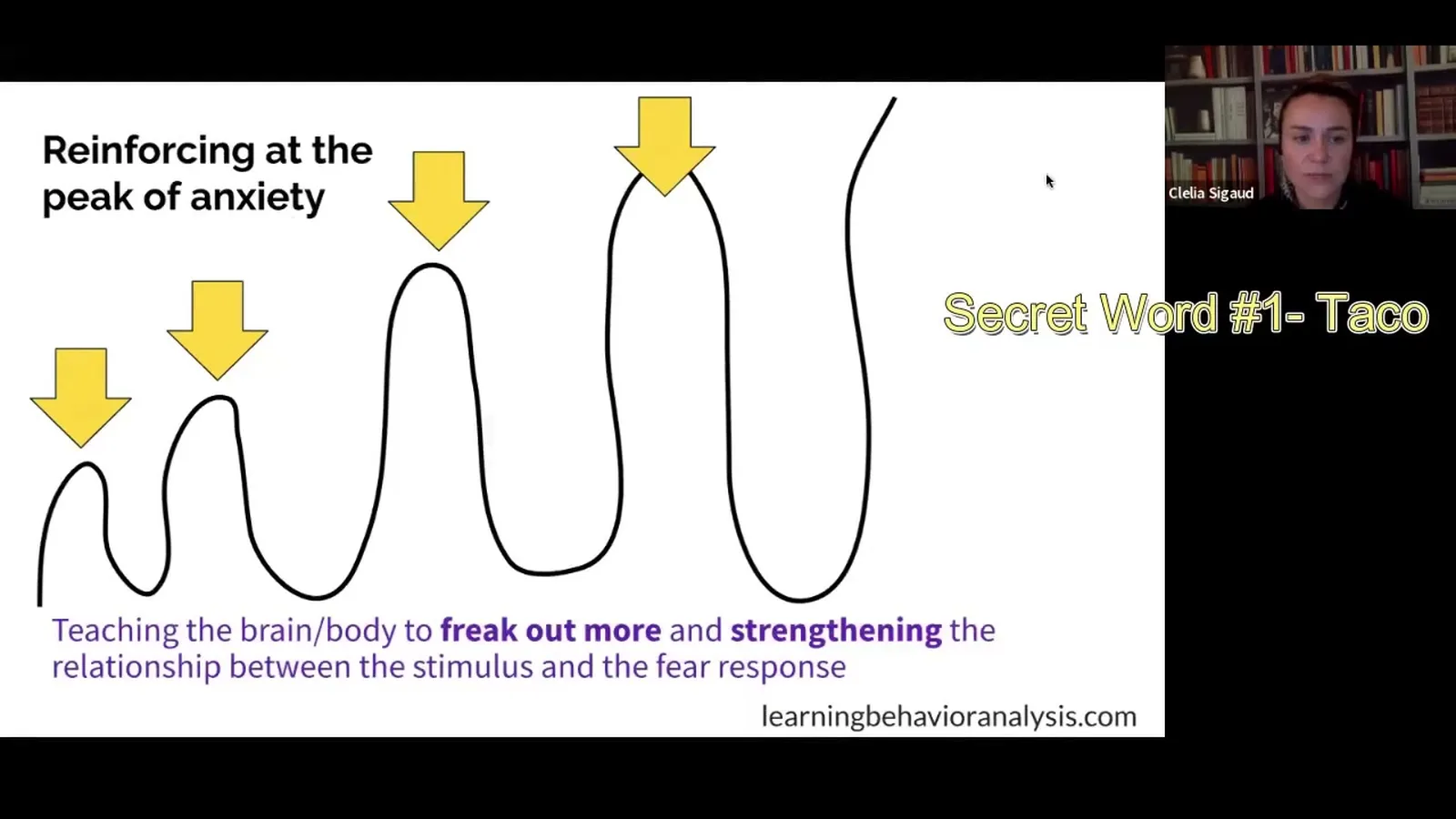
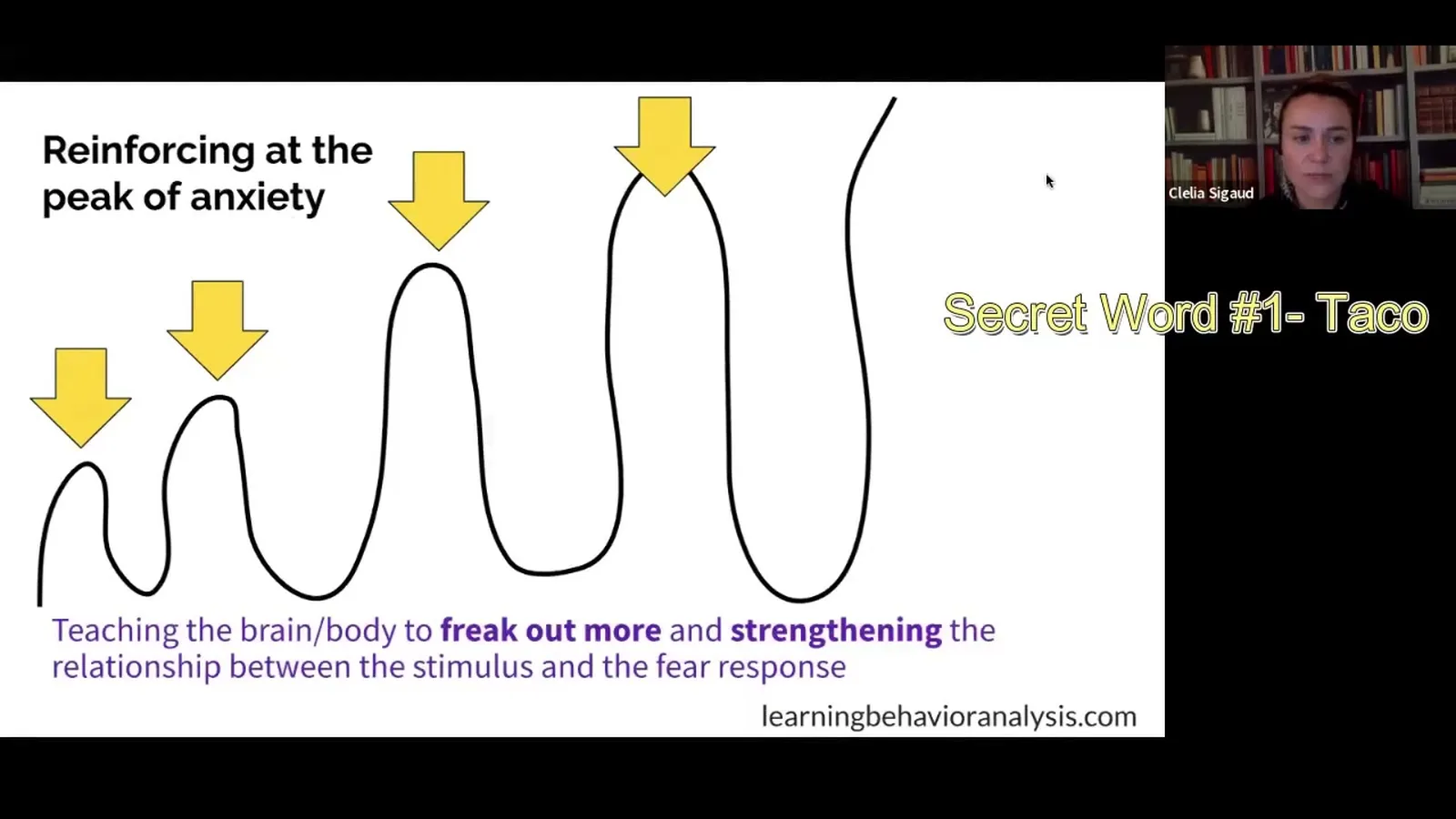
Sigaud shares a key tip about the "anxiety wave." Fear rises, peaks, and then falls if you wait. When relief comes matters a lot.
We want to reinforce at the bottom of the anxiety wave to make the anxiety lessen over time. From the talk — Dr. Clelia Sigaud
If a person escapes at the peak, avoidance gets stronger. If they stay until the fear drops, calm gets reinforced instead. Same tool, very different result.
Using negative reinforcement to teach#
Negative reinforcement is not always a trap. Used with care, it can build good skills. The trick is to reinforce the behavior you want.
Take a break as a reward, for example. A child finishes a small bit of work, then earns a short escape. Now escape is tied to doing the task, not to running away.
The same idea shows up in feeding and communication work. A child learns to ask for a break with words instead of screaming. The break still works as the reinforcer. But it now grows a helpful skill.
This is the heart of functional communication training. You find the escape the child wants. Then you teach a safe way to earn it. The unwanted behavior loses its job, so it fades.
Why the label matters in practice#
Getting the label right changes your whole plan. If you think escape is punishment, you may add more demands. That often makes the behavior worse, not better.
When you see the behavior as escape driven, you plan differently. You might soften the task, teach a break request, or build in choice. You work with the motivation instead of fighting it.
This is also why a functional assessment matters so much. You have to know what the behavior earns. Only then can you tell if negative reinforcement is at play. The right label points you to the right fix.
What the research says#
Studies show negative reinforcement can treat tough behavior when used on purpose. One study chained two escape-based treatments together for children whose behavior was kept going by escape. Functional communication training led to bigger drops in challenging behavior, and all participants preferred it (Ferris et al., 2026, Behavioral Sciences).
Researchers have also built tools to measure how aversive a task or interaction really is. One team used a latency assessment to rank forms of social contact. The ranking showed how much each person wanted to avoid each type (Slocum, Scheithauer, & Muething, 2022, Behavioral Interventions). Knowing what feels aversive helps a team plan better treatment.
Negative reinforcement can even grow independence. In one study, ending a meal was used as the reward for self-feeding. Six children with feeding disorders took part. They self-fed more when eating a bite let them end the meal (Haney, Ibañez, Kirkwood, & Piazza, 2023, Journal of Applied Behavior Analysis).
FAQ#
Is negative reinforcement good or bad? It is neither on its own. It is just a process. It can trap a child in escape, or it can teach useful skills. The outcome depends on what behavior you reinforce.
What is the difference between negative reinforcement and punishment? Reinforcement makes a behavior more likely. Punishment makes it less likely. Negative reinforcement removes something unpleasant to strengthen a behavior. Punishment weakens a behavior.
How does negative reinforcement relate to escape behavior? Escape behavior is often kept going by negative reinforcement. The child acts out, the demand goes away, and the escape gets stronger. Treatment teaches a better way to earn that same break.
 Advertisement
Turn this topic into a CEU
You just studied this. Now get credit for it.
Watch Hey, Chillax Man! Understanding the Logic of Anxiety with Dr. Clelia Sigaud and earn 1.5 free BCBA CEUs. Detailed certificate, delivered the moment you finish.