Better Sleep, Safer Behavior: Using Skill-Based Treatment To Tackle Sleep Challenges
Presented by Lindsay Anderson
Up to 80% of children diagnosed with ASD are estimated to have sleep problems, and these issues are often intertwined with behavioral concerns. This CEU will explore the bidirectional relationship between sleep and behavior, providing attendees with a clear understanding of common pediatric sleep challenges. Participants will gain insight into the role of BCBAs in addressing sleep within their professional scope of practice. Additionally, the presentation will highlight practical strategies for developing interventions to promote healthy sleep using the skill-based treatment (SBT) framework. Attendees will leave with actionable tools to support both behavior and sleep, enhancing overall child well-being.
Sign in to buy — $10One-time purchase, permanent access. Cert delivered to your inbox the moment you pass the quiz.
About this CEU
This CEU explores the two-way relationship between sleep and behavior, the BCBA’s role in addressing sleep within their scope of practice, and practical strategies for building interventions with the skill-based treatment (SBT) framework.
Abstract
Up to 80% of children diagnosed with ASD are estimated to have sleep problems, and these issues are often intertwined with behavioral concerns. This CEU will explore the bidirectional relationship between sleep and behavior, providing attendees with a clear understanding of common pediatric sleep challenges. Participants will gain insight into the role of BCBAs in addressing sleep within their professional scope of practice. Additionally, the presentation will highlight practical strategies for developing interventions to promote healthy sleep using the skill-based treatment (SBT) framework. Attendees will leave with actionable tools to support both behavior and sleep, enhancing overall child well-being.
Credits
1 CEU · 53 min
From the talk
What was covered
Up to 80% of autistic kids sleep poorly. How BCBAs can target bedtime skills during the day with skill-based treatment.
- Treat poor sleep as a condition that interferes with service delivery under ethics code 2.19.
- Rule out medical causes before any behavior plan, and send loud snoring or odd breathing to a doctor fast.
- Score a child's current sleep against five marks: satisfaction, timing, duration, efficiency, and daytime alertness.
- Target behavioral quietude instead of sleep itself, which keeps the work inside your scope.
- Skip extinction alone at bedtime when a burst could turn dangerous or parents cannot follow through.
- Teach bedtime skills during the day on skill-based treatment branches, then transfer every one to caregivers.
Why Sleep Loss Belongs in Your Treatment Plan
Poor sleep shows up in the body first. Tired kids get hurt more often. They face a higher risk of obesity, which brings other problems. Their immune system is weaker, so they get sick more and heal slower. Mood takes a hit too. Small events bring big reactions. Once a child is upset, calming down is hard. Behavior follows the same path. Cooperative behavior drops. Aggression goes up. School performance falls.
All of that lands in your sessions. Families cancel when a child was up all night. Other kids arrive asleep or doze through the hour. You spend the time keeping them awake instead of teaching. Tired kids are irritable and follow fewer instructions. Sleep also protects learning, especially REM sleep (the dream stage of sleep). Without it, kids hold on to less of what you taught. Your program can be solid and the child still forgets yesterday. Progress slows.
The ethics code gives this weight. Code 2.19 covers conditions that interfere with service delivery. Behavior analysts must actively find and address environmental conditions that block progress. They remove or reduce the condition, change the intervention, or bring in another professional. Interrupted sessions, trouble following directions, weak memory, and behavior problems all trace back to sleep loss.
So it really fits that we would want to treat lack of sleep as a condition interfering with service delivery.
From the talk — Lindsay Anderson
Why Autistic Children Have More Sleep Problems
Recent research puts sleep problems in up to 80% of children with autism. That is about two to three times the rate in typically developing children. Several reasons stack up. Autistic kids are more likely to also have anxiety and ADHD. Each one is tied to sleep problems on its own. Anxiety brings racing thoughts and high stress at bedtime. ADHD brings trouble keeping a schedule, medication side effects, and bursts of energy at the wrong hour.
Two medical conditions also show up more often. Obstructive sleep apnea (the throat blocks the airway) makes the brain wake the body all night to breathe again. It is twice as likely in autistic children. Higher rates of obesity, lower muscle tone, and oral motor apraxia (trouble moving the mouth muscles) all play a part. Restless leg syndrome (legs that need to keep moving) is common too. In one study, 39% of autistic children with chronic insomnia also met criteria for it. Iron deficiency often drives it, and most kids in that study were fully treated with iron supplements.
Two more pieces round out the picture. Studies show people with autism have lower melatonin (the hormone that times sleep). That can throw off the circadian rhythm (the body's daily sleep clock) and make falling and staying asleep harder. Studies also link sensory hyper reactivity (strong reactions to everyday sensations) to sleep problems, especially the avoiding kind. Think of the child who will not touch play dough or stand barefoot on grass. The theory is that their body overreacts in the bedroom too.
Poor child sleep spreads to parents. A study looked at over 300 parents of about two and a half year olds. Mothers whose sleep was shorter, later, and more variable had higher stress levels. Poor and insufficient sleep was tied to less observed positive parenting. Mothers who took longer to fall asleep reported more dysfunctional parenting. An exhausted, stressed parent has a hard time delivering the reinforcement your plan depends on.
And then this poor sleep in kids with autism is also going to have a ripple effect over to their parents' sleep, which will impact progress as well.
From the talk — Lindsay Anderson
The Research on Sleep and Behavior Runs Both Ways
Four studies in this talk map the link. Samola et al in 2014 followed preschoolers, then checked back four years later at school age. Children with persistent sleep problems carried a 16 times higher risk of psychosocial difficulties. That included aggression, social and attention problems, and anxious or depressed mood.
Dang et al in 2023 looked at a large sample of preschoolers. A history of sleep disturbance was tied to both emotional and behavioral difficulties. Cologne et al studied adolescents age 12 to 16. Trouble sleeping was tied to attention problems, anxiety, depression, and withdrawal. Teens who rated themselves as tired also showed more aggression.
Lew et al in 2021 adds the key piece. A sleep problem at age 6 predicted behavior problems at age 11, both inward and outward. The reverse held as well. A behavior problem at age 6 predicted a sleep problem at age 11. So the arrow points in both directions, and that changes how you plan.
So while a lack of sleep may be triggering challenging behaviors, it also may be that challenging behaviors are making it more difficult for the child to transition to bedtime and fall asleep.
From the talk — Lindsay Anderson
How To Screen for a Sleep Problem on Your Caseload
Parents often raise it first. They say the child takes too long to fall asleep, or does not sleep enough for their age. Some kids wake in the middle of the night or far too early. Others fight bedtime with crying, calling out, or coming out of the room over and over. Those behaviors usually get a parent to stay or push bedtime away. If a parent opens the door, go straight to your questions.
If no one has raised it, listen and watch. Staff comments carry data. Up all night again. Took forever to fall asleep. Cranky this morning. A parent may report a full eight hours, which is far too few for a young child. In session you might see a child who is drowsy, falls asleep, or arrives asleep. Watch for huge reactions to small events, frequent injuries, trouble concentrating, and frequent illness. Problem behavior with no clear function and progress that stalls for no clear reason both belong on this list.
Rule out medical causes before any behavior plan. Loud snoring or unusual breathing is a red flag for sleep apnea and needs a doctor soon. Reflux and constipation cause discomfort that wakes kids overnight. Seizures affect sleep quality. Asthma and allergies block the airway. Tooth pain and itchy skin conditions keep kids awake. Feeding problems can lead to vitamin gaps, like the iron deficiency behind restless legs. Autistic kids also take more medications, which change sleep. Point families to a qualified health care provider as step one.
Then measure the sleep itself. A 2014 study by Busey named five marks of healthy sleep. They are subjective satisfaction, appropriate timing, adequate duration, high efficiency, and sustained alertness while awake. Each one gives you a question. Ask a caregiver to rate the child's sleep from one to ten. Ask when the child usually sleeps, to see if timing is steady and overnight. Ask how much they sleep in a day and compare it to the published range for that age. Ask how long falling asleep takes, since 15 to 20 minutes is the target. Ask how hard the child is to wake and whether they stay alert all day.
So if these observations do have you suspecting a sleep issue, but parents haven't said anything yet, you'll just want to approach slowly and compassionately as many parents can feel judged on this topic.
From the talk — Lindsay Anderson
Is Sleep in a BCBA's Scope? Behavioral Quietude Is
Here is the honest answer. The act of sleeping is not in our scope. It is a biobehavioral state (a body state we cannot control). You cannot reinforce falling asleep. But getting ready to sleep is behavior, and behavior is our work.
That readiness has a name: behavioral quietude (a calm body resting in bed). It means a calm, regulated body that can lie in the sleep space on its own. Place it in the three-term contingency (antecedent, behavior, consequence). Sleep is the primary reinforcer. Behavioral quietude is the behavior. The antecedents are every skill you teach and every change you make to the environment. Those antecedents sit squarely inside our scope.
Framed that way, many sleep problems look like skill deficits. You shape and reinforce them like any other skill. One rule carries over too. You would not ask a child to use a brand new coping skill the moment their iPad breaks. Bedtime is that same kind of hard moment. The skill has to work in easy daytime practice first.
The act of being asleep itself is not in our scope.
From the talk — Lindsay Anderson
Why Extinction Alone Falls Short at Bedtime
Many of us were trained to use extinction (ending reinforcement for a behavior) at bedtime. Walk the child back to bed, every time, with no attention. That advice carries real problems, especially with intense interfering behavior.
Safety comes first. If an extinction burst could bring aggression or self-injury, the recommendation is neither safe nor ethical. Extinction also teaches nothing new. The child may end up staying in the room and still not sleeping better. That happens because behavioral quietude was never taught.
Then there is follow-through. Walking an upset child back to bed several times a night is brutal. The parent doing it is often sleep deprived too. Most families give in some of the time. The child sometimes gets into the parent's bed, and that patchy payoff makes leaving the room stronger than before.
Another problem with extinction alone is that it's not teaching any new skills.
From the talk — Lindsay Anderson
Skill-Based Treatment in Brief: HRE, the FA, and the Skill Sequence
Skill-based treatment (teaching skills in place of problem behavior) comes from Dr. Hanley. The goal is to treat problem behavior by teaching skills without having to see the severe behavior. It uses a synthesized reinforcement context (all suspected reinforcers at once) instead of one isolated reinforcer. This article is not a training in the model. Before you run it the first time, get real training through FTF Consulting courses and the PFA SBT Facebook group. This matters most if your learner has behavior that is dangerous to themselves or others.
The work starts with a caregiver interview inside the practical functional assessment (an interview that finds what drives behavior). Parents tell you what the child needs to be happy, relaxed, and engaged. They also name what is likely to set the behavior off. You build the context from favorite items and the specific attention the child likes. You leave out everything they dislike. Nothing else moves forward until that calm, engaged state is in place. Sometimes you try a few versions to get there.
Next comes the functional analysis (a short test of what drives behavior). After five minutes of happy, relaxed, and engaged, you present the trigger parents named. At the first precursor (a small warning sign before behavior), you reinforce right away. Say all done iPad, and the second the child whines, send them back to play. Return to that calm state, then repeat twice more to show control.
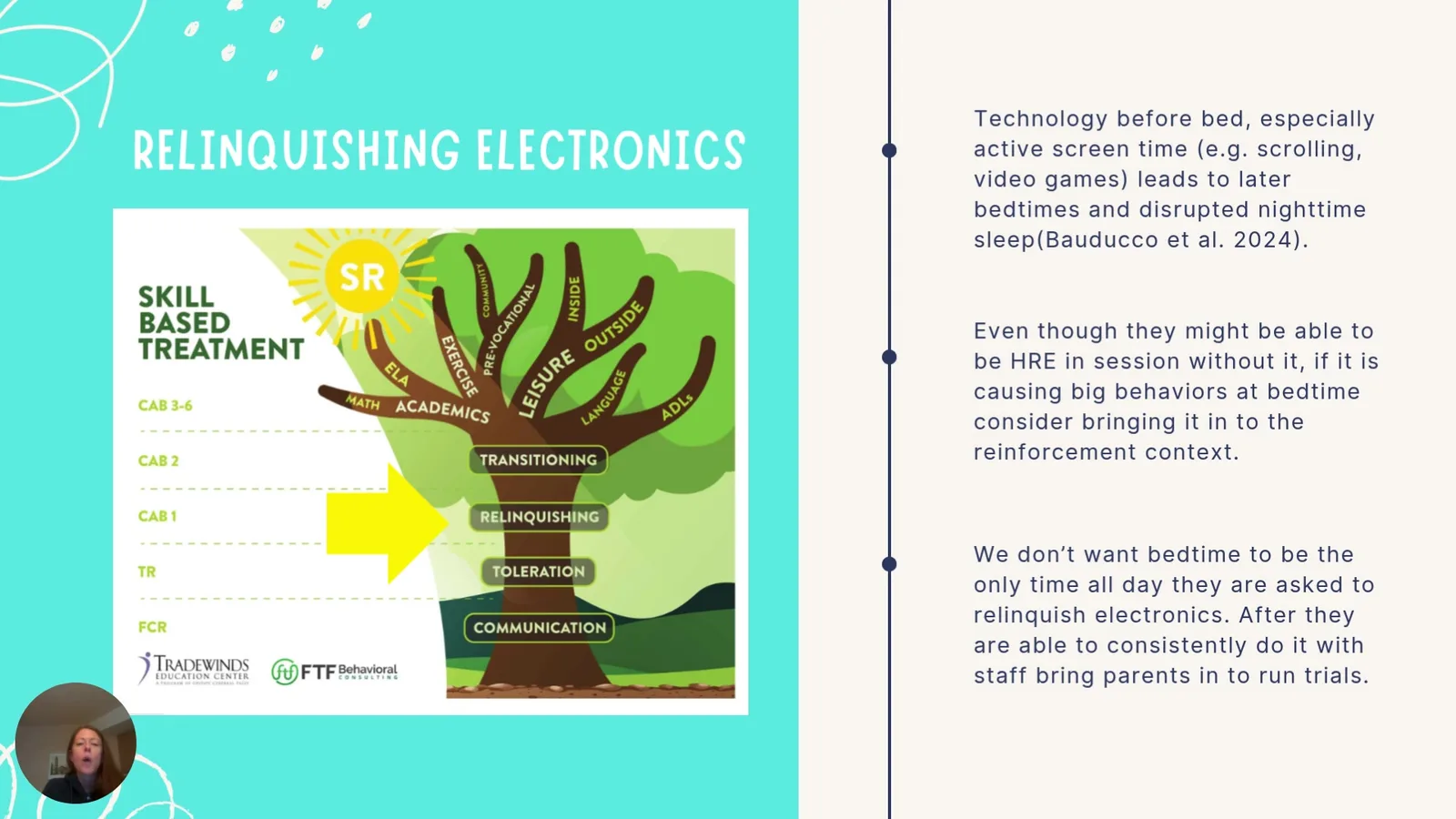
Teaching follows a set order. First the functional communication response (a simple way to ask), such as my way by voice, device, or picture. Then the tolerance response (calmly accepting a no), often a high five or fist bump. Then CAB 1, relinquishing reinforcers. CAB stands for contextually appropriate behavior (any response that fits the moment). CAB 2 is transitioning. CABs 3 through 6 build cooperation for longer and longer stretches. Every earlier step still pays off some of the time, even once the child is working at CAB 5.
And one of the most important parts is that happy, relaxed, and engaged needs to be achieved before any other steps can be taken.
From the talk — Lindsay Anderson
Five Bedtime Barriers You Can Program For During the Day
Five common bedtime problems map cleanly onto branches. A child who cannot calm their body or gets overstimulated. A child who cannot give up electronics. A child who cannot separate from a caregiver. A child who melts down moving through the routine. A child who is anxious about the bedroom or sleep. None of this is a standalone sleep treatment. Families still need a steady sleep schedule, a bedtime routine, and sometimes work on independent sleep.
Electronics sit on CAB 1, relinquishing reinforcers. If ending screen time ends in escalation, no calm body follows. Leaving the device in the room wrecks sleep too. Newer research points away from blue light as the main cause. Baduco in 2024 found teens with lower self-control were more likely to have tech hurt their sleep. Watching TV delayed sleep far less than video games, scrolling, or one more YouTube video. So bring the tablet into session on purpose. Run many calm handover trials with staff, then bring parents in to practice during the day.
For the routine itself, build a branch on CAB 2. Teach cooperation with hygiene tasks like toothbrushing and hand washing. Dr. Hanley recommends transitioning to the same place on every branch, so the child cannot predict the task. A visual schedule can ride along and then move to the family at home. For calm bodies, teach seated leisure skills: puzzles, Legos, coloring, or a Velcro matching folder with preferred characters. Save running and crashing for earlier in the day. Those games alert the sensory system and raise core temperature, and core temperature has to fall for sleep. Track how each child reacts, since one child's calming activity overstimulates another.
For separation, teach independent play first, then run the Be Right Back protocol by Emily Varon from Ready, Set, Sleep. The adult says I'll be right back, steps out for three to five seconds, and returns. Build up to one or two minutes on a varied, unpredictable schedule. Then try it while the child simply relaxes, which looks more like bedtime. For fear of the bedroom, use a pretend play branch. Put dinosaurs to bed, read them a story, and take turns pretending to sleep with loud fake snoring.
Write goals with the whole chain in them. You say all done tablet. The learner says my way. You say not right now. The learner gives a high five and drops the tablet in a bin. Then the learner walks to the table and works on a puzzle. CAB 3 might be one activity for 30 seconds. CAB 4 adds more activities. CAB 5 splits into short, medium, and long: one to three minutes, three to five, then five to ten. CAB 6 adds a challenge, like the adult stepping out. The full chain never runs on every trial. Last, hand all of it to caregivers in the clinic or the home. The natural environment is where sleep really changes.
Practicing these skills during the day will have an impact.
From the talk — Lindsay Anderson
Common questions
Is sleep within a BCBA's scope of practice?▾
Sleep itself is not. It is a biobehavioral state that we cannot control or reinforce directly. What is in scope is behavioral quietude, the calm, regulated body that can lie in the sleep space alone. Teaching those skills and changing the environment around them is ordinary behavior analytic work.
What should be ruled out before starting a behavioral sleep plan?▾
Start with a medical checklist and a referral. Loud snoring or unusual breathing is a high priority red flag for sleep apnea. Also ask about reflux, constipation, seizures, asthma, and allergies. Check for tooth pain, itchy skin conditions, feeding problems that cause vitamin gaps, and current medications. Recommend an evaluation by a qualified health care provider as the first step.
How do I know if a child's sleep is actually unhealthy?▾
Use the five marks from the 2014 Busey study: satisfaction, timing, duration, efficiency, and daytime alertness. Ask a caregiver to rate the child's sleep from one to ten. Ask when the child sleeps and how much they sleep each day. Ask how long falling asleep takes and how alert the child stays all day. Falling asleep inside 15 to 20 minutes and staying asleep is the target. Compare total hours to the published range for the child's age.
Why not just walk the child back to bed?▾
Extinction alone has three problems. It can trigger a burst that includes aggression or self-injury, which makes it unsafe to recommend. It teaches no new skill, so the child may stay in bed without sleeping better. And it is very hard for a tired parent to run. That often leads to patchy reinforcement that strengthens leaving the room.
Can bedtime skills really be taught in a daytime ABA session?▾
Yes, and that is the point. Children need to perform a skill in low pressure practice before you expect it at bedtime. During the day you can run relinquishing trials with a tablet, hygiene transitions, and calm seated play. You can also practice brief adult departures and bedtime pretend play. Then transfer every skill to caregivers so it works at home.
About the speaker
Lindsay Anderson has been a BCBA since 2016. A few years ago she earned a certification as a behavioral sleep practitioner and opened Restful Kids, with a mission of helping exhausted kids and families get the rest they deserve. She also holds a credential from FTF Consulting in the skill-based treatment process.
This summary was generated from the recording’s transcript. Quotes are taken word for word from the talk.
What you'll learn
- 1Learning Objective 1: Participants will be able to describe the bidirectional relationship between behavioral challenges and sleep difficulties in children. Learning Objective 2: Participants will be able to identify common sleep challenges and define the role of BCBAs within their scope of practice. Learning Objective 3: Participants will be able to develop interventions to promote better sleep within the skill-based treatment (SBT) framework.
Course materials
OpenCEU is supported by advertising from third-party sponsors. Sponsors are clearly labeled, have no influence over course content, instructors, or CEU decisions, and never appear on certificates. The BACB does not sponsor, approve, or endorse OpenCEU sponsors or their products.