Confessions of a New Behavior Analyst in Functional Analysis
Presented by Matt Harrington
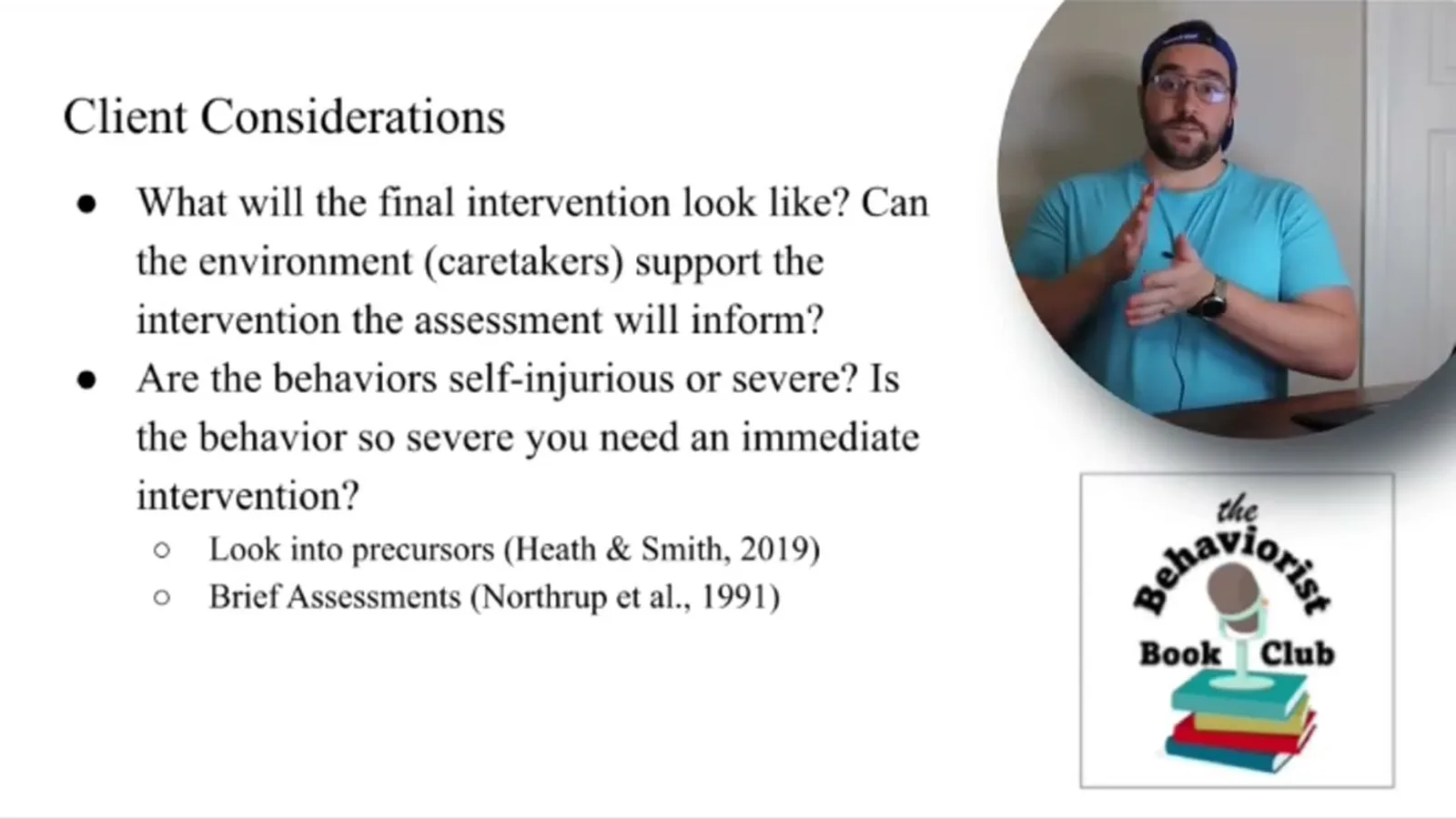
Learning Objectives By the end of this training, participants will be able to: Understand the distinctions between functional analysis methodology, procedures, and the term itself. Identify factors and barriers in clinical settings that impact the application of functional analysis. Explore various functional analysis formats, including latency, trial, ISCA, and precursor, and evaluate their strengths and weaknesses. Conduct high-quality caregiver interviews and comprehend how indirect and descriptive assessments influence experimental functional analysis. Develop the confidence to apply functional analysis methodologies, learn from mistakes, and continue education through research and additional training.
Register free & watch nowCancel any time. Cert delivered to your inbox the moment you pass the quiz.
Learner ratings
from 48 learners
100% would recommend this CEU to other professionals in their field (27 responses)
“He was relatable”
— Raiza G.“Great”
— Kaitlyn H.“Very slow paced and a bit confusing”
— Alicia M.
About this CEU
Learning Objectives By the end of this training, participants will be able to: Understand the distinctions between functional analysis methodology, procedures, and the term itself. Identify factors and barriers in clinical settings that impact the application of functional analysis. Explore various functional analysis formats, including latency, trial, ISCA, and precursor, and evaluate their strengths and weaknesses. Conduct high-quality caregiver interviews and comprehend how indirect and descriptive assessments influence experimental functional analysis. Develop the confidence to apply functional analysis methodologies, learn from mistakes, and continue education through research and additional training.
From the talk
What was covered
Five functional analysis mistakes from one analyst's first clinical year, and the fixes that worked.
- Budget at least 90 minutes for the caregiver interview, because a skipped interview often costs you a whole functional analysis (FA) session.
- Open broad with open-ended questions, then close with a short survey to test your hunches before you build conditions.
- Pick the FA format from your barriers. Weigh your own skill, the implementer's skill, the setting, and the behavior, not your preferred camp.
- Build conditions that match where the behavior really happens, or the treatment will fall apart when you generalize it.
- Stop the FA once the data is believable enough to guide treatment, instead of chasing a perfect graph.
- When results are undifferentiated, change one variable at a time and give the learner long enough to notice the change.
What a Functional Analysis Is, and What It Is Not
Matt Harrington opens by fixing the words we use. A functional analysis (a test of why behavior happens) is not one fixed recipe. It is not a set of steps carved in stone. He borrows a definition from Schlinger and Norman (2013). They call it a pretreatment clinical assessment. It changes antecedents (events that come before behavior). It also changes the likely reinforcers for problem behavior.
His own working version is shorter. An FA is a search for an if-then link. It needs at least one test condition and a control. That holds for latency-based formats (timing how long until behavior). It holds for trial-based formats (short paired trials in context). It holds for the traditional format and for the ISCA (a test that blends reinforcers). All of them count as FAs, and he uses the term for all of them.
Sort the larger process into three phases. First is the indirect assessment (the caregiver interview up front). Second is the descriptive assessment (watching behavior in real settings). Third is the FA itself. Each phase feeds the next one. The interview and the observation shape your conditions. Skip one and the last phase pays for it. That is the thread through all five mistakes in this course.
It's not the Ten Commandments of functional assessment.
From the talk — Matt Harrington
Mistake One: The Interview You Skip Costs You the Session
Harrington had a young client at his clinic. The caregiver did report pica (eating things that are not food) at intake. She also said it was fading at home. Nobody saw it in the clinic. So it did not look like a target worth picking. About four months later, the pica started showing up.
The team made the room safe first. They pulled anything smaller than a softball. They cleaned more. Then he ran an FA. He got consent, plus assent (the client's own okay to join). He pulled a stock four-condition FA off the shelf. He swapped ignore for attention because of the topography (what the behavior looks like). He added a tangible condition (a test using favorite items). Sessions ran five minutes. Program goals served as demands.
The data came back variable across the board. There were zeros in some sessions and high rates in toy play. That made an automatic function (behavior maintained by the behavior itself) look unlikely. Even the tech texted to ask if they were running it right. The answer came from the parents. The client had a new set of toy magnets at home. Those were the same magnets the FA rotated in and out. A 15-minute follow-up test confirmed the link. Saving 30 minutes cost him an hour and a half.
But I skipped the interview, and my functional analysis was crap because of it.
From the talk — Matt Harrington
Open-Ended and Closed-Ended Interviews: Use Both
Closed-ended tools are quick. Think of the FAST, the QABF, and the MAS (short, scored caregiver questionnaires). They run 10 to 15 set questions. They are easy to give and easy to score. They are also rigid. They carry little context about the setting. Open-ended tools go the other way. The open-ended functional assessment interview from Hanley and his team (2012) is the one most people use. It brings context. It builds a real bond with the caregiver. It also takes longer and asks more of your interview skills.
Both have a validity problem. Agreement with the FA sits near 50 to 60 percent for closed-ended tools. Open-ended numbers are argued over and land near 50 to 75 percent. Harrington frames that with a doctor visit. Picture a plan of 40 hours a week for six months. Now picture a 60 percent chance it works. That is the bet a function-based plan built on interview data asks a family to take.
He blames training more than the tools. Few graduate programs teach clinical interviewing. Few supervisors drill it. Iwata et al. (1982) used behavioral skills training (teach, model, practice, give feedback) with a 33-step checklist. Miltenberger and Fuqua (1985) used a 10-step version. Both are about 40 years old, and the field has not replaced them. His own fix is plain. Plan for the interview to run long. Go broad first, then get precise.
Think of it like open-ended broad, closed-ended getting more precise to eventually inform the functional analysis conditions.
From the talk — Matt Harrington
Mistake Two: Picking the FA Format From Your Camp
Camps have formed in the field. One side favors synthesized contingencies (rewards blended into one test). The other stays with isolated contingencies (one reward tested at a time). Harrington calls that fight a red herring. He also warns against using ethics to defend a camp. Say you like the ISCA because it is efficient and uses precursors (smaller signs before the big behavior). You can find that same trait elsewhere. A trial-based precursor analysis is fast and uses precursors too.
His story here is a telehealth intake. The client was new to ABA. Behavior was minor aggression and scratching. English was the caregiver's second language. He chose a trial-based FA for speed. The rotation was a two-minute control, a two-minute test, then control again. Caregivers ran everything. It fell apart. No trial had good fidelity (steps run the way they were planned). Nothing was clean enough to graph. He stopped 20 minutes in and asked to come back the next day.
The fix was a barrier check he had skipped. First, competency: can you run this format, and can the implementer run it after coaching? Behavioral skills training works, but it takes session time. Second, the setting: telehealth, language, staffing, and how many minutes you actually have. Insurance often gives two to ten hours for the whole intake, plan included. Third, the client: severity, topography, and what treatment the result will point to. He re-ran it as an ISCA and got a differentiated result (a clear split between test and control conditions) fast.
We shouldn't be choosing our functional analyses based on whatever camp we're in, whatever person or researcher or general idea set that we like better.
From the talk — Matt Harrington
Mistake Three: Conditions That Do Not Match the Real Setting
This story involved two siblings at one clinic. Property destruction happened when they were together. They egged each other on. He ran a separate ISCA for each child. Both came back quickly differentiated. He built a treatment for each. Progress looked great in about a week or two. Then he tried the joint setting. Everything fell apart at once.
The flaw was the setting, not the method. He had found a reinforcer in one context and assumed it would carry to another. That is where ecological relevance (how well it matches real life) earns its keep. It also explains what the descriptive assessment is for. It does not name a function. Instead, it informs your conditions: isolated or synthesized, latency or rate, brief or extended. It also points to which items to use and which setting to run in.
Two observation tools do most of that work. The first is the ABC (antecedent, behavior, consequence) method, widened past the target behavior. Log the appropriate behaviors and other challenging behaviors too. A desk flip may get escape, while a break request gets escape and attention. The second is conditional probability (how often one thing follows another). Compare the chance a consequence follows behavior to its background rate. If you chat with a client the whole session, attention follows every behavior. That says nothing until you check the background rate.
Our functional analyses should match and be ecologically relevant to the naturally occurring environment.
From the talk — Matt Harrington
Mistake Four: Controlling So Many Variables That Nothing Happens
Harrington learned FAs in a hospital unit. Staff, equipment, and stimuli were all easy to control. Graphs came out clean. The open question was whether those results held at home. Sometimes they did not. Too little control gives you a descriptive assessment. Too much control gives you an FA of a world that never happens.
His example was an adolescent client on telehealth with severe aggression. He had found precursors in the caregiver interview. The tech was new and nervous. He got nervous too, so he over-specified the setup. This item here, that event there, this exact spot. The conditions were so finicky that they never occurred. He did not just fail to find a function. He never ran a single trial and got no data at all.
The way out is treatment utility (how much the test helps treatment). He defines it as the extent to which the assessment contributes to a positive treatment outcome. Ask three questions. Is the behavior socially significant enough to change at all? Stimming (repetitive self-soothing behavior) that bothers nobody does not need a screen. Have you used the interview and observation to find the real context? And have you begun with the end in mind? Picture who you will hand the plan to, then work backward to the FA.
Without treatment utility, why are we doing an assessment?
From the talk — Matt Harrington
Mistake Five: Stop at Believability, Not at the Perfect Graph
Research sets a high bar for control. The What Works Clearinghouse wants three demonstrations of an effect at three points in time. Clinic work leans on visual inspection (judging the graph by eye). Practitioners want an effect big enough to punch you in the face. You can also analyze data two ways. Summative means you look after each session. Formative means you wait until the planned end. Most clinicians do both.
His mistake was chasing certainty he already had. An adolescent client showed high rates in the attention condition and a clean control. The escape condition bounced up and down. So he dropped to a pairwise (one test against one control) and just kept going. The data he collected after that added nothing. He should have changed what happened inside the escape condition instead of running it longer.
Modification is normal, and there is research behind it. Hagopian and colleagues (2013) looked at over 170 FAs in an inpatient unit. Sometimes up to two modifications were needed. After those, the odds of finding a reinforcer were high. The two main types were antecedent changes and design changes. Do it as what he calls systematic chaos, not clinical chaos. Change one thing, then wait long enough for the learner to notice the change.
Do you have enough data to inform your treatment? And how confident are you in that data?
From the talk — Matt Harrington
Schools, Telehealth, and Knowing Your Own Limits
The Q&A opens with school FAs. The barriers there are mostly people. A teacher may not buy in. A paraprofessional may want to help but have no time. Severe behavior may put other students at risk, which ends that plan on the spot. Harrington favors trial-based FAs in schools. You can start and stop around the school day. You can catch a natural EO (what makes a reward matter), like homework being passed out. Pulling a child into an office buys control but costs ecological relevance.
He also gives a habit worth copying. Take handwritten notes beside your data sheet every session. Log who ran it, how intense they were, how many people were in the room, and which tasks you used. If the client goes home sick, write that down. When results come back undifferentiated, those notes tell you which variable to change first. Recording sessions works too, if your setting allows it.
The last thread is competence. New analysts often finish supervision without ever running an FA. His advice is to read papers, attend talks, and take trainings. Then move to mentorship, and not only with well-known names. A strong analyst down the hall counts. He also admits his own graphs are not always beautiful. His treatment integrity data (how closely sessions matched the plan) is not always at the recommended level either. Imposter syndrome is common in this field, and naming it helps.
It's really important that you look for competence and acknowledge the realm of your own competence.
From the talk — Matt Harrington
Common questions
Do I still need a caregiver interview if I am going to run a functional analysis anyway?▾
Yes. Harrington's own story shows a 90-minute FA wasted because he skipped the interview and ran a stock format instead. The interview is what tells you which items, settings, and conditions to test. It also builds the relationship you will need during treatment.
How well do indirect assessments agree with functional analysis results?▾
Agreement sits near 50 to 60 percent for closed-ended tools like the FAST and QABF. Open-ended interviews are debated and land near 50 to 75 percent. That is why Harrington treats them as a way to shape FA conditions, not as a function on their own.
Which functional analysis format should I choose?▾
Choose from barriers, not preference. Check your own fluency, the implementer's skill, the setting, the time you have, and the behavior itself. Latency-based formats suit behaviors like elopement (leaving a safe area without permission), trial-based formats suit schools, and the ISCA suits tight time windows. Then ask what treatment each result would point to.
When should I stop a functional analysis?▾
Stop when the data is believable enough to guide treatment. Ask whether you can turn the behavior on and off, and whether you have found a reinforcer. Also check whether the control condition has near-zero behavior. If the answer is yes, running more sessions mostly adds time.
What do I do when my FA results are undifferentiated?▾
Use your session notes to find the likely culprit, then change one variable at a time. Common changes are antecedent changes, like a different task or location, and design changes, like moving to a pairwise. Give the learner enough exposure to notice the change before you change anything else.
About the speaker
Matt Harrington runs The Behaviorist Book Club and created this training on functional analysis. He started as a registered behavior technician, or RBT (a role that delivers therapy under supervision), in school, home, and clinic settings. He then collected his supervised hours at the Kennedy Krieger Institute in Baltimore. There he worked on a severe behavior unit and a behavioral feeding unit. He now practices in a clinic in Gainesville, Florida, where he learned to adapt hospital-grade FA methods to everyday caseloads.
This summary was generated from the recording’s transcript and reviewed for accuracy. Quotes are taken word for word from the talk.
What you'll learn
- 1Learning Objectives
- 2By the end of this training, participants will be able to:
- 3Understand the distinctions between functional analysis methodology, procedures, and the term itself.
- 4Identify factors and barriers in clinical settings that impact the application of functional analysis.
- 5Explore various functional analysis formats, including latency, trial, ISCA, and precursor, and evaluate their strengths and weaknesses.
- 6Conduct high-quality caregiver interviews and comprehend how indirect and descriptive assessments influence experimental functional analysis.
- 7Develop the confidence to apply functional analysis methodologies, learn from mistakes, and continue education through research and additional training.
Concepts in this CEU
Related talks
Talks that cover the same concepts
12 days of PFA & SBT
The Behaviorist Bookclub

Delegating with Confidence: Training and Supervising RBTs to Support Assessments
Copper Consulting Group

The Interdisciplinary Case Conference
The Mindful Learner LLC
PDA: Collaborating for Success
The Behaviorist Bookclub
Compliance to Commitment: Seven Habits of the Highly Effective Caregiver Trainer
The Behaviorist Bookclub
Solving Clinical Challenges with Research
The Behaviorist Bookclub
More from The Behaviorist Bookclub

Empowering Autonomy and Self-Management in ADHD Learners
The Behaviorist Bookclub
Shaping Behavior Change when ADHD is in the Picture
The Behaviorist Bookclub
From Hours to Competence: Assessing and Developing Supervisee Skills
The Behaviorist Bookclub
OpenCEU is supported by advertising from third-party sponsors. Sponsors are clearly labeled, have no influence over course content, instructors, or CEU decisions, and never appear on certificates. The BACB does not sponsor, approve, or endorse OpenCEU sponsors or their products.