Descriptive Assessment in ABA: What It Tells You
Descriptive assessment means watching behavior in its natural setting. Learn what it can and cannot tell you before a functional analysis.
Key takeaway
A descriptive assessment means watching behavior in real life. You observe the person in their normal setting. You write down what happens before and after the behavior.
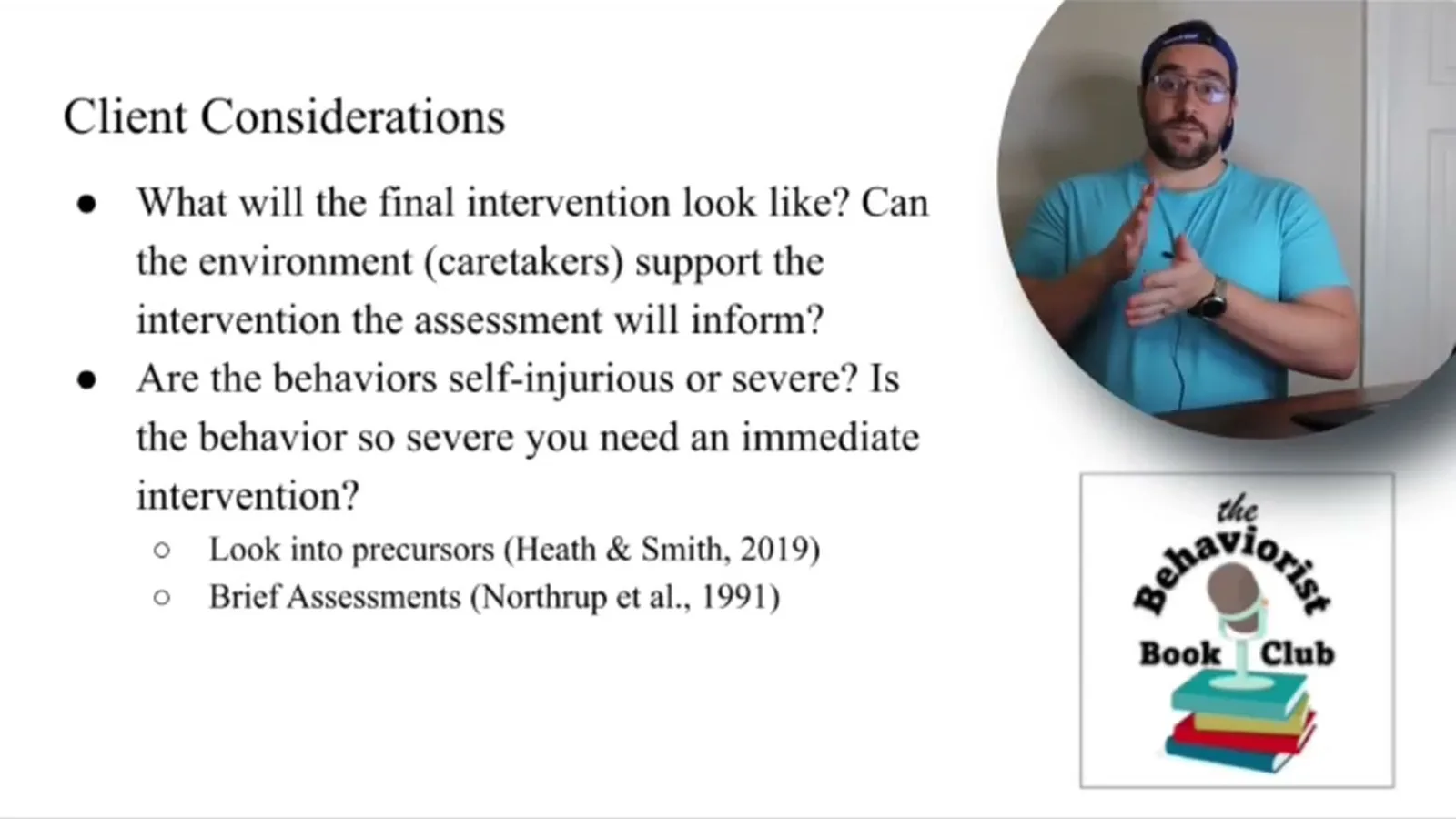
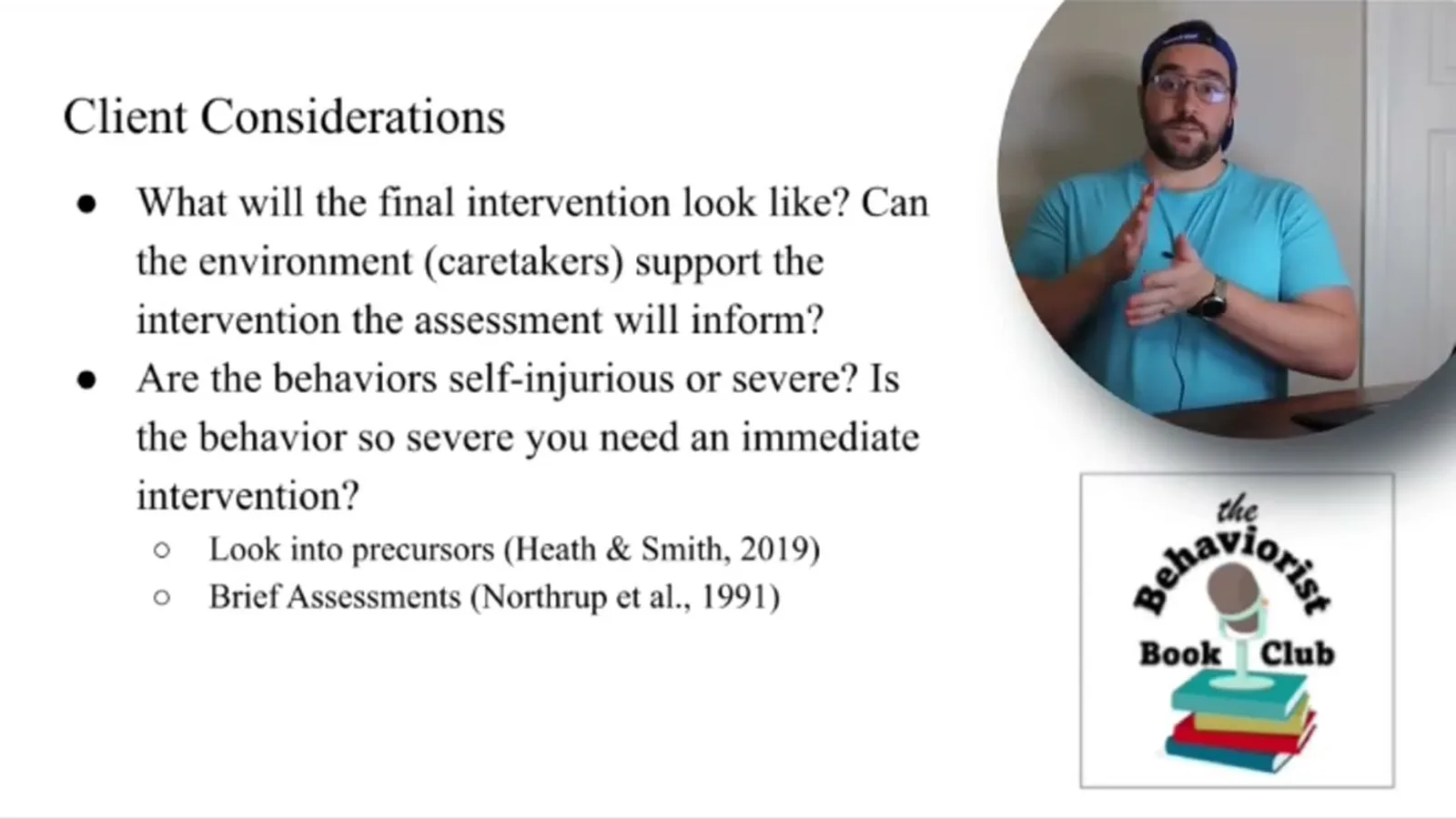
Confessions of a New Behavior Analyst in Functional Analysis
Free learning path on this topic
Child Development for Behavior Analysts
Typical development for behavior analysts. Kristen Byra's overview, then Kelly Brzak's deep dives on ages 2 to 5, 6 to 8, and 9 to 11, with milestones, common problem behaviors, and programming tips for each band.
Experts who cover this
The recording behind this guide covers descriptive assessment aba.
- Featured talk2.50 CEUs
Confessions of a New Behavior Analyst in Functional Analysis
Matt HarringtonThe Behaviorist Bookclub
Clarifies the descriptive assessment's real purpose is not to identify a confirmed function but to inform and refine functional analysis conditions (format…
On this page · 8 sections▾
A descriptive assessment means watching behavior in real life. You observe the person in their normal setting. You write down what happens before and after the behavior. You use your own eyes, not a survey.
This step matters for BCBAs, RBTs, and teachers. It helps you see patterns in problem behavior. But it has real limits, too. Knowing those limits keeps you from drawing the wrong conclusion.
What a descriptive assessment is#
A descriptive assessment is direct observation in context. You do not change anything on purpose. You just watch and record what is already there. Joshua Jessel puts it in plain terms.
Or you can conduct a descriptive assessment, which requires observing the behavior with your own eyes. From the talk — Dr. Joshua Jessel
This is different from a survey or interview. Those methods ask people about the behavior. A descriptive assessment measures the behavior itself. You catch it as it happens.
Often you record antecedent-behavior-consequence data. That means the trigger, the behavior, and what follows. This narrow focus keeps your notes useful. Over time, patterns start to show up.
What it can and cannot tell you#
Here is the key point. A descriptive assessment shows correlations, not proof. You see what tends to happen together. You do not see true cause. Jessel is clear about this ceiling.
But what you will get with a descriptive assessment at most is environment behavior correlations. And it'll still leave you with some uncertainties. From the talk — Dr. Joshua Jessel
Think about why this happens. In real life, many things occur at once. A child may scream when a demand comes. But attention and lost toys may also be present. You cannot pull those apart by watching alone.
So the data point you toward a likely function. They do not confirm it. That gap is normal. It is why a functional analysis exists as a next step.
Its real purpose is to inform your FA#
Some clinicians treat the descriptive assessment as the final answer. That is a mistake. Its job is to set up a better functional analysis. Matt Harrington frames the purpose as a direct question.
Let's focus on the descriptive assessment and specifically focus on what the purpose is of the descriptive assessment. Is it to identify a function? No. From the talk — Matt Harrington
If the goal is not to name the function, then what is it? The goal is to shape the test that comes next. Your observations tell you which conditions to run. They tell you what materials and format to use.
What about informing the conditions of a functional analysis? Bingo. That's what we're looking for. From the talk — Matt Harrington
This is a helpful shift in thinking. The descriptive assessment is a scout, not a judge. It gathers clues about the setting. Then the functional analysis tests those clues one at a time.
How to run one well#
 Advertisement
Start by picking a clear target behavior. Define it so two people would agree. Then watch during the times it usually happens. Record the antecedent, the behavior, and the consequence.
Keep your notes neutral and factual. Write what you saw, not what you guessed. Guessing too early can bias the whole plan. Let the raw data speak first.
A structured format tends to work better than open notes. It gives every observer the same categories. That makes the data easier to compare. It also makes your later hypotheses stronger.
Turning observations into FA conditions#
The payoff of a descriptive assessment comes at the next step. Your notes should shape the functional analysis you run. Each pattern you saw becomes a condition to test. This is how the two methods connect.
Say your data show more behavior when demands go up. That points you toward an escape condition to test. Say the behavior clusters when adults look away. That points you toward an attention condition instead.
You also learn the practical details from watching. You see which materials the person likes. You see how long sessions can run before fatigue. You see the setup that feels natural to them.
All of this makes the analysis sharper. You test fewer wrong ideas. You waste less session time. The descriptive step, used this way, earns its place in the process.
Where descriptive data helps beyond function#
Descriptive methods are not only for problem behavior. You can also use them to set goals. For example, you can watch typical social skills to build a benchmark. That benchmark then guides your teaching targets.
The same logic applies to quality of care. You can observe a setting to spot what needs to change. Direct observation gives you objective data. That beats relying on memory or opinion alone.
In every use, the value comes from careful watching. You record what is really there, not what you expect. You keep your categories clear and steady. Then the data can guide a smart, grounded plan.
What the research says#
Research supports careful, trained use of descriptive assessment. One large review compared descriptive assessments with functional analyses. It found exact correspondence in about half of the comparisons. Descriptive methods were better at ruling a function out than confirming one (Contreras, Tate, Morris, & Kahng, 2023).
Training seems to raise the value of this tool. One study examined direct training on ABC recording. It looked at how training shapes data collection, interpretation, and treatment choice (Tereshko, Weiss, Harper, & Ross, 2022). Without guidance, clinicians often interpret results however they see fit.
Descriptive data can also reveal setting effects. One study watched problem behavior during transitions. It found behavior was more likely when moving to a low-reinforcement activity (Castillo et al., 2018). That kind of pattern would be hard to guess from a survey.
FAQ#
What is the difference between a descriptive assessment and a functional analysis?
A descriptive assessment watches behavior in its natural setting. It shows correlations between events and behavior. A functional analysis tests conditions on purpose to confirm the function. The descriptive step informs the analysis that follows.
Can a descriptive assessment identify the function of behavior?
Not by itself. It can point to a likely function. But it only gives environment-behavior correlations, not proof. You still need a functional analysis to confirm the cause.
Is a descriptive assessment worth doing if it is not conclusive?
Yes. It builds the map you need for a strong functional analysis. It tells you which conditions, materials, and formats to use. It can also flag setting factors you would otherwise miss.
You can see how these assessment pieces fit together in Redefining the Boundaries of Efficiency during a Functional Analysis of Problem Behavior - Applied 2022.
 Advertisement
Turn this topic into a CEU
You just studied this. Now get credit for it.
Watch Confessions of a New Behavior Analyst in Functional Analysis with Matt Harrington and earn 2.5 free BCBA CEUs. Detailed certificate, delivered the moment you finish.
Keep going with a free learning path
Child Development for Behavior Analysts
Typical development for behavior analysts. Kristen Byra's overview, then Kelly Brzak's deep dives on ages 2 to 5, 6 to 8, and 9 to 11, with milestones, common problem behaviors, and programming tips for each band.