Treatment Utility in ABA: Does the Assessment Help?
Treatment utility asks if an assessment actually improves treatment. Learn why BCBAs value it over psychometric perfection in functional analysis.
Key takeaway
Treatment utility asks one honest question. Does this assessment actually make treatment better? It is the degree to which an assessment helps the outcome. If the results do not change the plan, the utility is low.
Confessions of a New Behavior Analyst in Functional Analysis
Free learning path on this topic
Master PFA and SBT
Matt Harrington's 12-article walk through practical functional assessment and skill-based treatment, from Hanley's 2014 study to the enhanced choice model. Then assent, since SBT depends on it, and the ethical guardrails that keep behavior reduction defensible. Five CEUs, one of them ethics.
Experts who cover this
The recording behind this guide covers treatment utility aba.
- Featured talk2.50 CEUs
Confessions of a New Behavior Analyst in Functional Analysis
Matt HarringtonThe Behaviorist Bookclub
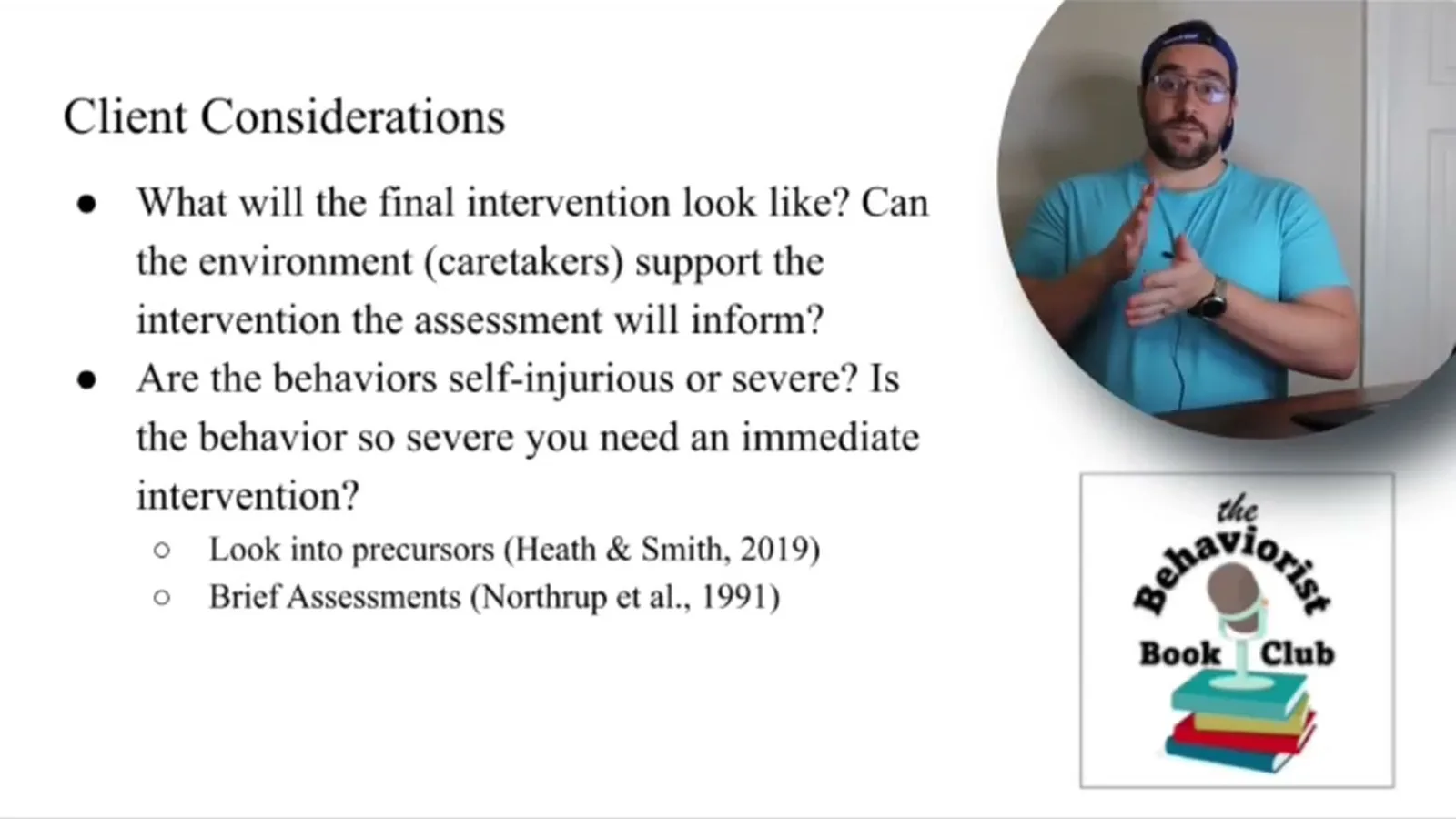
The central lesson of mistake #4: an FA is only worth running if it will meaningfully inform a socially significant, generalizable intervention, and…
On this page · 6 sections▾
Treatment utility asks one honest question. Does this assessment actually make treatment better? It is the degree to which an assessment helps the outcome. If the results do not change the plan, the utility is low.
This idea matters for BCBAs, RBTs, and clinical teams. Assessments take time, effort, and trust. So each one should earn its place. Treatment utility keeps the focus on real client results, not just numbers.
It is easy to get lost in assessment detail. You can fine-tune a test for hours. But the test is only a means to an end. The end is a plan that helps the client. Treatment utility keeps that end in view. It reminds you that a clean data set is not the win. A better life for the client is the win.
The point of any assessment#
Every assessment should lead somewhere useful. Matt Harrington puts treatment utility at the center of that goal. He ties it directly to a positive outcome.
Treatment utility is one of the more crucial things that we should always be considering when we talk about functional analysis formats and selections. The reason why it's so essential is because it's the extent to which the assessment contributes to a positive treatment outcome. From the talk — Matt Harrington
This gives a simple test for your work. Ask if the assessment will change what you do. If it will not, the reason to run it fades.
Without treatment utility, why are we doing an assessment? That's a good question. If there is a situation where the assessment isn't going to inform an intervention, do we care about the function, right? From the talk — Matt Harrington
Utility over perfect numbers#
Assessments are often judged on their psychometric quality. That means their reliability and validity as measures. Treatment utility offers a different goalpost. It asks about the effect on treatment, not the math.
Matt Harrington argues that clinicians should lead with utility. He is blunt about what he cares about in daily work.
I think going by treatment utility as kind of our goalpost as practitioners is a really good place to be because at the end of the day, I don't really care about the psychometric validity of a practical functional analysis that I conducted with my 12-year-old client. From the talk — Matt Harrington
This does not mean numbers never matter. Researchers still need strong measures. But a busy clinician has a different job. Their test is whether the assessment helped the client.
How to use utility as a filter#
 Advertisement
Treatment utility works as a decision filter. Before you run an assessment, ask what it will change. Picture the plan you would build from each result. If every result leads to the same plan, you may not need the test.
Also weigh the cost against the payoff. A long functional analysis has a real cost. It takes time and can be hard on the client. The payoff must be a better, more targeted plan.
Keep the goal socially meaningful too. A useful assessment points to a plan that matters. It should support a generalizable, real-world change. That link to a real outcome is the heart of utility.
This mindset also guides your reports. You do not collect data just to fill a page. Each number should earn a place in the plan. If it does not shape treatment, question why you gathered it.
It helps new clinicians most of all. Early in a career, tests can feel like the goal. Treatment utility flips that view. The plan and the client's progress become the real target.
Why it matters most in functional analysis#
Functional analysis is a good place to see this idea. An FA tries to find why a behavior happens. But finding the function is not the real goal. Using it to build a better plan is.
Some FA formats are long and demanding. They can stress the client and the team. Treatment utility helps you weigh that cost. You ask if the format will point to a stronger plan.
Sometimes a shorter, practical format is enough. It may not be a perfect measure of the function. But if it guides a plan that works, it did its job. That is the trade many clinicians choose.
This keeps the client at the center. You are not chasing a clean data pattern for its own sake. You are chasing a real change in the person's life. Treatment utility keeps that focus sharp.
What the research says#
Treatment utility often decides how much reliability we need. One study tested the practical functional assessment process. Parts of the process were only somewhat reliable. Yet the treatments it produced still worked well and generalized (Rajaraman et al., 2022).
The idea also shows up in feeding research. One large case series studied inappropriate mealtime behavior. It linked functional analysis results to treatment planning. The authors stressed the treatment utility of that assessment (Saini et al., 2022).
Functional analysis has proven useful with new problems too. One study applied it to nail biting in an adult. The results guided a modified habit reversal plan. Nail biting dropped and nails grew back (a functional analysis and treatment of nail biting).
Utility even shapes how we build new tools. One project developed a functional assessment of depression. The authors planned to test its incremental validity and treatment utility. The goal was a measure that improves treatment planning (a paper on developing a functional assessment of depression).
You can go deeper on this topic in Confessions of a New Behavior Analyst in Functional Analysis.
FAQ#
What is treatment utility in ABA?
It is the degree to which an assessment improves treatment. In short, does the test change what you do? If the results guide a better plan, utility is high. If not, the assessment adds little value.
How is treatment utility different from validity?
Validity asks if a measure is accurate and reliable. Treatment utility asks if it makes treatment better. A test can have modest reliability but still guide strong plans. Clinicians often care most about that real-world payoff.
Why should I consider treatment utility before an assessment?
It keeps your work focused on real outcomes. You avoid running tests that do not change the plan. You save time and reduce burden on the client. Every assessment then earns its place in the plan.
 Advertisement
Turn this topic into a CEU
You just studied this. Now get credit for it.
Watch Confessions of a New Behavior Analyst in Functional Analysis with Matt Harrington and earn 2.5 free BCBA CEUs. Detailed certificate, delivered the moment you finish.
Keep going with a free learning path
Master PFA and SBT
Matt Harrington's 12-article walk through practical functional assessment and skill-based treatment, from Hanley's 2014 study to the enhanced choice model. Then assent, since SBT depends on it, and the ethical guardrails that keep behavior reduction defensible. Five CEUs, one of them ethics.