IISCA: A Faster, More Personal Functional Analysis
What is an IISCA? Learn how the interview-informed synthesized contingency analysis works, why it is fast, and how experts use it in real cases.
Key takeaway
An interview-informed synthesized contingency analysis (IISCA, often said "ISCA") is a short, personalized functional analysis. A functional analysis is a test that shows why a problem behavior happens.
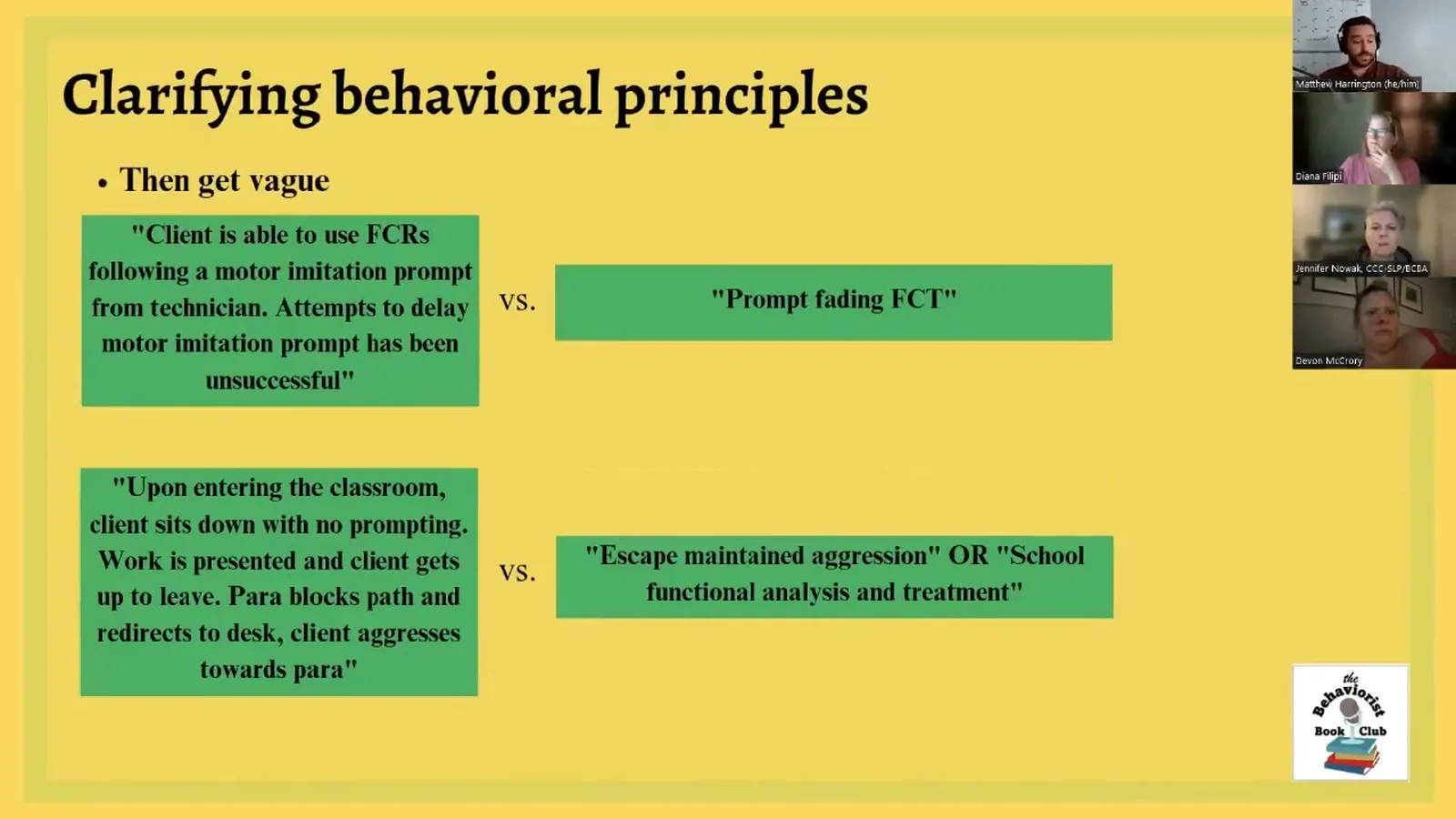
Research to practice - extending past the pages
Free learning path on this topic
Master PFA and SBT
Matt Harrington's 12-article walk through practical functional assessment and skill-based treatment, from Hanley's 2014 study to the enhanced choice model. Then assent, since SBT depends on it, and the ethical guardrails that keep behavior reduction defensible. Five CEUs, one of them ethics.
Experts who cover this
3 recordings on openceu cover interview-informed synthesized contingency analysis.
- Featured talk1 CEU
Research to practice - extending past the pages
Matt HarringtonThe Behaviorist Bookclub
Chosen as the assessment for a rigid 14-year-old who struggled with transitions, because its logic of regaining control and tolerating delayed reinforcement…
- 2.50 CEUs
Confessions of a New Behavior Analyst in Functional Analysis
Matt HarringtonThe Behaviorist Bookclub
Held up repeatedly as a model highly ecologically relevant format because of individualized conditions, short sessions, and its focus on turning behavior…
- 1 Supervision CEU
Reflective Supervision and Client Outcomes
B. Kuereine GrayThe Behaviorist Bookclub
Compares a classic FBA to an ISCA-style open-ended interview to illustrate how reflective supervision digs deeper into behavioral patterns than standard data…

On this page · 11 sections▾
An interview-informed synthesized contingency analysis (IISCA, often said "ISCA") is a short, personalized functional analysis. A functional analysis is a test that shows why a problem behavior happens. The IISCA builds one test condition from what caregivers report. Then it compares that condition to a matched control where the same rewards are free. Gregory Hanley and his colleagues developed the approach, and Joshua Jessel and others have studied it widely.
Why does this matter? A classic functional analysis can take hours. It also tests one cause at a time, like attention or escape, in separate conditions. The IISCA blends the causes caregivers describe into one real-life situation. That makes it faster, safer, and closer to how behavior shows up at home or school. Behavior analysts use it to move from assessment to treatment sooner.
The three stages of practical functional assessment#
Dr. Joshua Jessel describes the IISCA as the last step in a larger process. That process is called practical functional assessment, or PFA. It has three stages. First comes an open-ended interview with the caregiver. The clinician asks broad questions and does not walk in with conditions already picked out. Second comes an unstructured observation. Here the clinician sees the problem behavior directly and tries out hunches from the interview. The caregiver gives feedback on how true to life the situation feels.
The final stage is the functional analysis, which has earned its own special term, the ISCA, or the interview informed synthesized contingency analysis.
From the talk — Dr. Joshua Jessel
By the end of the observation, Jessel says, you should be ready to write out your test procedures. So the IISCA is not a stand-alone tool. It rests on the interview and the observation that come before it. If those early steps are rushed, the test itself may miss the real situation. Jessel also notes the interview is freely available in English for clinicians who want to use it.
One test condition and one matched control#
The core design of the IISCA is simple. There is one test condition and one control condition. Jessel explains the difference in a single sentence.
What defines the functional analysis as the ISCA is that it includes a single test condition in which the individualized contingency informed by the open-ended interview and observation is compared to the non-contingent delivery of those same reinforcers in the matched control.
From the talk — Dr. Joshua Jessel
A contingency is an "if this, then that" link between behavior and what follows it. In the test, the rewards come only after the problem behavior. In the control, the child gets those same rewards freely, no matter what. If behavior shows up in the test but not the control, the clinician has found what drives it.
Jessel adds a safety point. Any behavior in the same response class is reinforced during testing. A response class is a group of behaviors that serve the same purpose. Rewarding the early, milder ones helps prevent severe bursts. Jessel also avoids talking about single, isolated functions. He prefers to describe a "socially relevant context" where behavior does and does not happen.
Why speed matters in a functional analysis#
Efficiency is a big part of the IISCA story. Jessel reports that most analyses need only about five sessions. The usual pattern is three test sessions and two control sessions. He has used it with children and adults, with and without diagnoses. The behaviors included self-injury and aggression.
If I come back to this review and add the data from the 127 ISCA's in the literature at the time, you can see that the ISCA only required a mean of 30 minutes to conduct.
From the talk — Dr. Joshua Jessel
Jessel calls this around an 80% gain in efficiency over longer formats. He gives three reasons this matters. First, the functional analysis is the only time problem behavior is meant to be triggered and rewarded. Second, a shorter analysis means less exposure to that triggered behavior. Third, a faster analysis means treatment can start sooner. He puts it plainly: we should not overstate the role of the functional analysis. Treatment is the most important part.
Ecological relevance: matching the real world#
Matt Harrington focuses on a different strength. He calls it ecological relevance. In plain words, the test should match the real places and people in a learner's life. Harrington describes a worry from his own clinic work. Some functional analyses done in a controlled room did not help once the learner went home. The cause found in the clinic did not always hold up in the home setting.
Let's consider the ISCA as a small case example. This is undoubtedly one of the most efficient and most ecologically relevant functional analysis formats that we have at our disposal.
From the talk — Matt Harrington
Harrington points to three traits that make it fit real life. The conditions are heavily personalized from the caregiver interview. One client's test condition can look nothing like another client's. The sessions are short, which helps it move fast. He also cites a 2020 review that found the IISCA and the trial-based functional assessment were the most efficient formats. Both, he notes, are highly ecologically relevant.
Precursors and turning behavior on and off#
 Advertisement
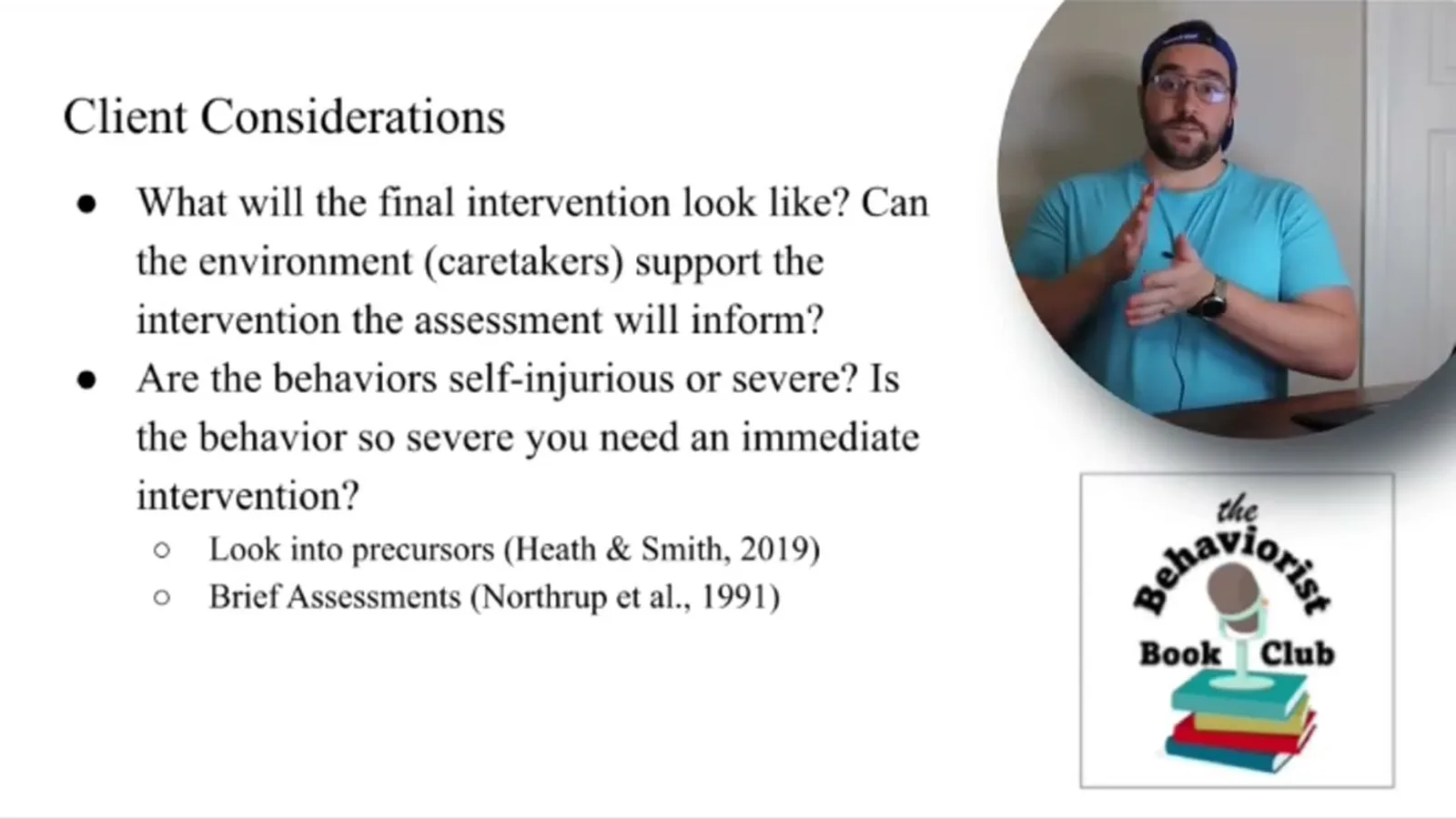
Harrington's third trait is a focus on turning behavior on and off. In an IISCA, the clinician tracks how long severe behavior lasted. The clinician also tracks how long it took to stop once the rewards were given. A big advantage, Harrington says, is the use of precursors. A precursor is a milder behavior that usually comes right before the more dangerous one. Think of whining or a tense body before a hit.
So essentially, we have a functional analysis format, which has heavily individualized conditions, and it has a focus on turning the behavior on and off. That results in a highly ecologically relevant intervention and informs the treatment.
From the talk — Matt Harrington
Harrington argues these traits can carry over to other formats. In fact, he says any functional analysis format can be run on precursor behavior. He also points to research showing caregivers can report precursors accurately. That matters because the IISCA leans so heavily on what caregivers tell you. If caregivers can spot the early signs, the test can stop before behavior gets dangerous.
Using the IISCA for feeding problems#
Dr. Holly Gover shows how the IISCA works in a feeding program. Her team ran the analysis with every client before treatment began. She says feeding makes the IISCA unusually simple.
An ISCA with a feeding issue is one of the easiest you can run because your EO is already identified and your reinforcers are pretty much identified.
From the talk — Dr. Holly Gover
An EO, or establishing operation, is a condition that makes a reward more wanted. At mealtime, the EO is already clear. It is being asked to eat a food the child does not want. The caregiver interview then fills in the details. Which foods are part of the problem? Which foods will treatment target? What are the child's personal favorite things?
There are standard ISCA's of escape from eating the bite of food that the therapist is telling you to eat to a preferred food.
From the talk — Dr. Holly Gover
Gover notes one key change for feeding. Her team always included food as a reward in the test. Clinicians usually try to avoid edibles in other IISCAs. But at meals, food is part of the real situation. A parent might say, "He gets his mac and cheese." Or the child leaves the table to watch TV and eat popcorn. So the test copies what really happens at home.
From IISCA to skill-based treatment#
In a separate talk, Harrington walks through a real case. The learner was very rigid and found any transition hard. He had a large vocabulary, yet said very little during his first assessment. Harrington chose to start with an IISCA and then move into skill-based treatment, or SBT. SBT teaches a learner to ask for what they want, then slowly builds tolerance for waiting or hearing "no."
Harrington explains why the IISCA fit this learner. Every struggle came back to tolerating something hard. That meant tolerating a transition, an unpleasant task, or a delay before getting a reward back. He notes this used to be called the "my way" situation. He describes the approach this way:
using an FCR to gain back control of your environment and then tolerating when it is unavailable.
From the talk — Matt Harrington
An FCR, or functional communication response, is a safe way to ask for the thing the behavior was trying to get. Harrington also liked that SBT uses unpredictable reward schedules. The parents had said that anything done a few times became a fixed habit. Breaking the habit then set off intense behavior. Mixing up when rewards came helped build flexibility from the start.
Finding research when no study matches your case#
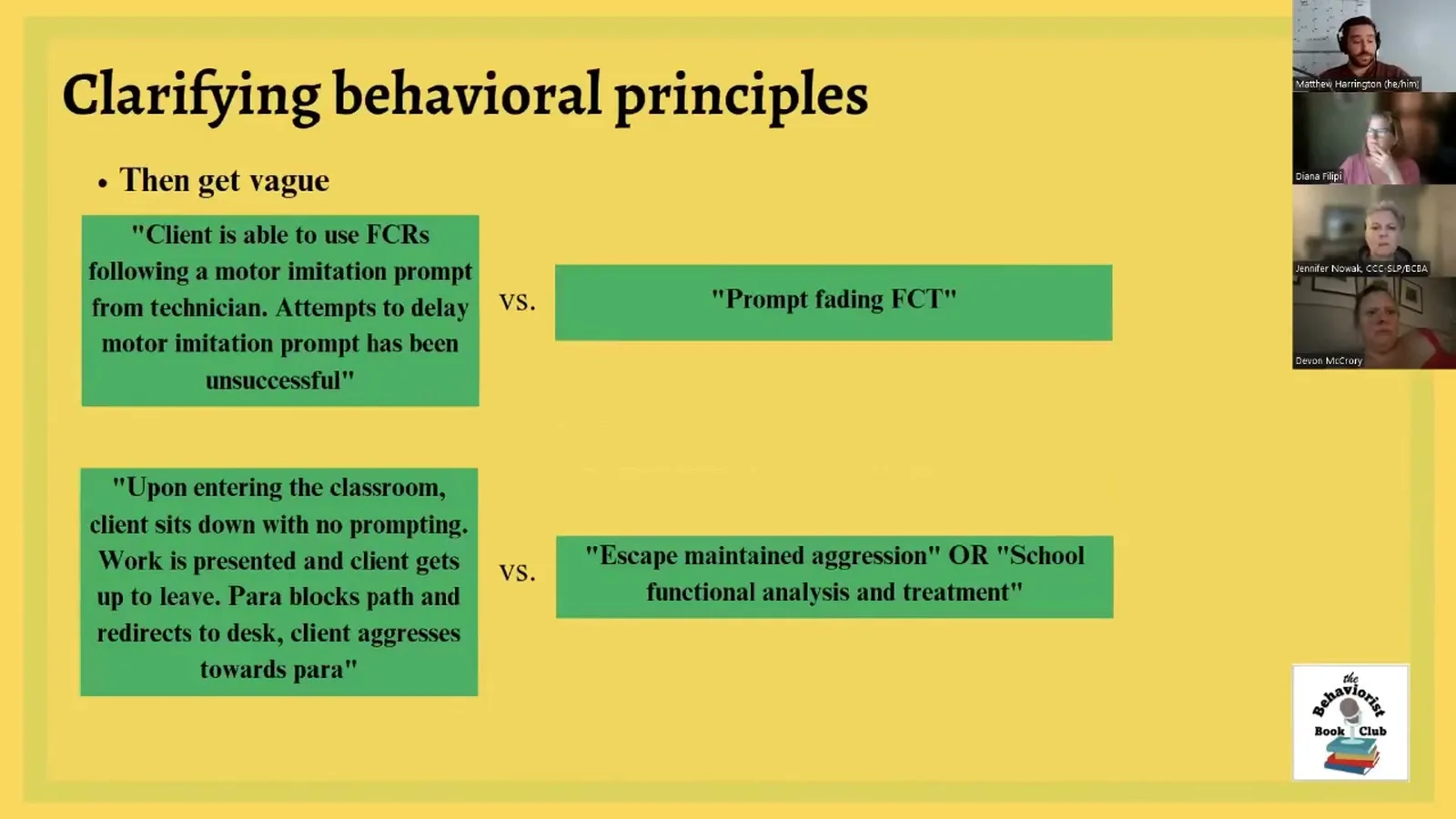
Harrington also uses the IISCA to teach a research skill. Sometimes no study asks your exact question. You may want to know how to run a functional analysis in a school, for example. There may be no paper that compares school settings directly. Harrington suggests looking at large case series instead.
You'll see Josh Jessel. He'll, you know, one article will be 15 successful demonstrations of the ISCA. And then one year later, he does 30 successful demonstrations of the ISCA.
From the talk — Matt Harrington
The next year, Harrington notes, came a series of 50 in a row. Some of those cases were likely done in schools. A clinician can read those cases and see how the procedures worked in that setting. That way you find a useful answer without a study built for your exact question. It is a practical way to bring the research into daily work. If you want to hear more from Harrington about running these analyses, watch Confessions of a New Behavior Analyst in Functional Analysis.
The IISCA as a way to learn the whole story#
Other speakers treat the IISCA as more than a lab test. Megh Crowley talks about clinical values and how to learn what matters to a family. She lists tools that help. These include the intake packet, the Behavioral Health Index, a safety assessment, and a family empowerment scale. For Crowley, the IISCA belongs on the list because it gathers personal details about the client early on. B. Kuereine Gray uses the IISCA as a comparison in a talk on reflective supervision. Gray contrasts a classic functional behavior assessment with the IISCA's open-ended interview. The IISCA, Gray says, tries to find everything that shapes a pattern, including things we might not see at first. Gray uses this to show how good supervision should dig deeper than the data alone. Both speakers see the same value. The IISCA starts by listening closely to the people who know the client best.
What the research says#
Published work backs up much of what these speakers describe. Coffey and colleagues reviewed 17 studies of the IISCA and the treatment that followed it (Coffey et al., 2019). They looked at how well it worked across different people, settings, behaviors, and functions. They also gave guidance for clinicians thinking about using it.
A newer version is called the performance-based IISCA. It runs in a single session and uses a trauma-assumed approach. That means it measures calm and rewards precursors to avoid escalation and physical holds. It was used 12 times in the United States and Brazil. Results matched the original IISCA and led to effective treatment (Jessel et al., 2023). A follow-up study used it with three autistic children with dangerous behavior. The skill-based treatment that followed ended the dangerous behavior and built new skills. Caregivers ran treatment sessions for two of the three children (Fruchtman et al., 2025).
Training matters too. In one early study, two BCBAs (board-certified behavior analysts) built test and control conditions from an open-ended interview. Their accuracy was moderate at first and high after brief behavioral skills training (Metras, 2017).
FAQ#
What is the difference between an IISCA and a standard functional analysis? A standard functional analysis tests one possible cause at a time in separate conditions. The IISCA combines the causes caregivers describe into one test condition. It then compares that test to a matched control with the same rewards given freely. This makes it much shorter, with a reported average of about 30 minutes.
Is the IISCA safe for severe behavior? The IISCA is built with safety in mind. Clinicians reward milder precursor behavior so it does not build into severe bursts. Sessions are short, which cuts the time behavior is triggered. The newer performance-based IISCA also measures calm and aims to avoid physical holds.
What comes after an IISCA? Most often, the results guide skill-based treatment. The learner first learns a safe way to ask for what they want. Then they learn to wait, accept "no," and do tasks before getting the reward. The IISCA tells the clinician which rewards and situations to use in that teaching.
 Advertisement
Turn this topic into a CEU
You just studied this. Now get credit for it.
Watch Research to practice - extending past the pages with Matt Harrington and earn 1 free BCBA CEU. Detailed certificate, delivered the moment you finish.
Keep going with a free learning path
Master PFA and SBT
Matt Harrington's 12-article walk through practical functional assessment and skill-based treatment, from Hanley's 2014 study to the enhanced choice model. Then assent, since SBT depends on it, and the ethical guardrails that keep behavior reduction defensible. Five CEUs, one of them ethics.
Want the primary literature? Read the IISCA research roundup on our sister site, Behaviorist Book Club.