Functional Behavior Assessment: What an FBA Involves
A functional behavior assessment finds out why a behavior happens. Learn the three phases, consent rules, and what BCBAs say about doing one well.
Key takeaway
A functional behavior assessment, or FBA, is the process a behavior analyst uses to find out why a behavior keeps happening. It is not one test.
Practical Takeaways for School-Based Behavior Analysts
Free learning path on this topic
Supervision, Done Right
Four supervision CEUs that build on each other. What reflective supervision is, how to build a supervision system, how to assess supervisee competence instead of counting hours, and how supervision affects provider outcomes. The BACB asks supervisors for three supervision CEUs per cycle. This covers it.
Experts who cover this
5 recordings on openceu cover functional behavior assessment.
- Featured talk1 Supervision CEU
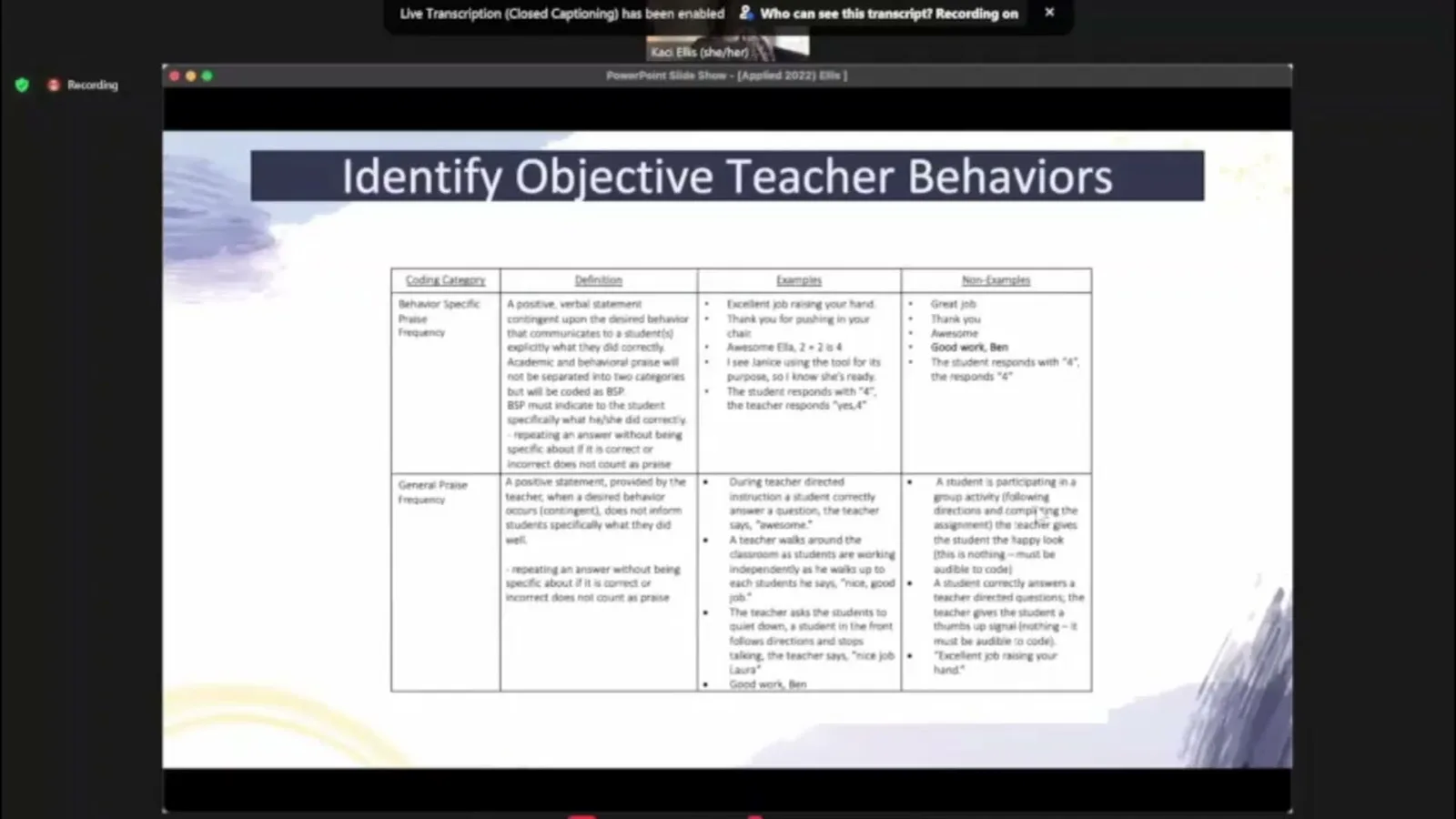
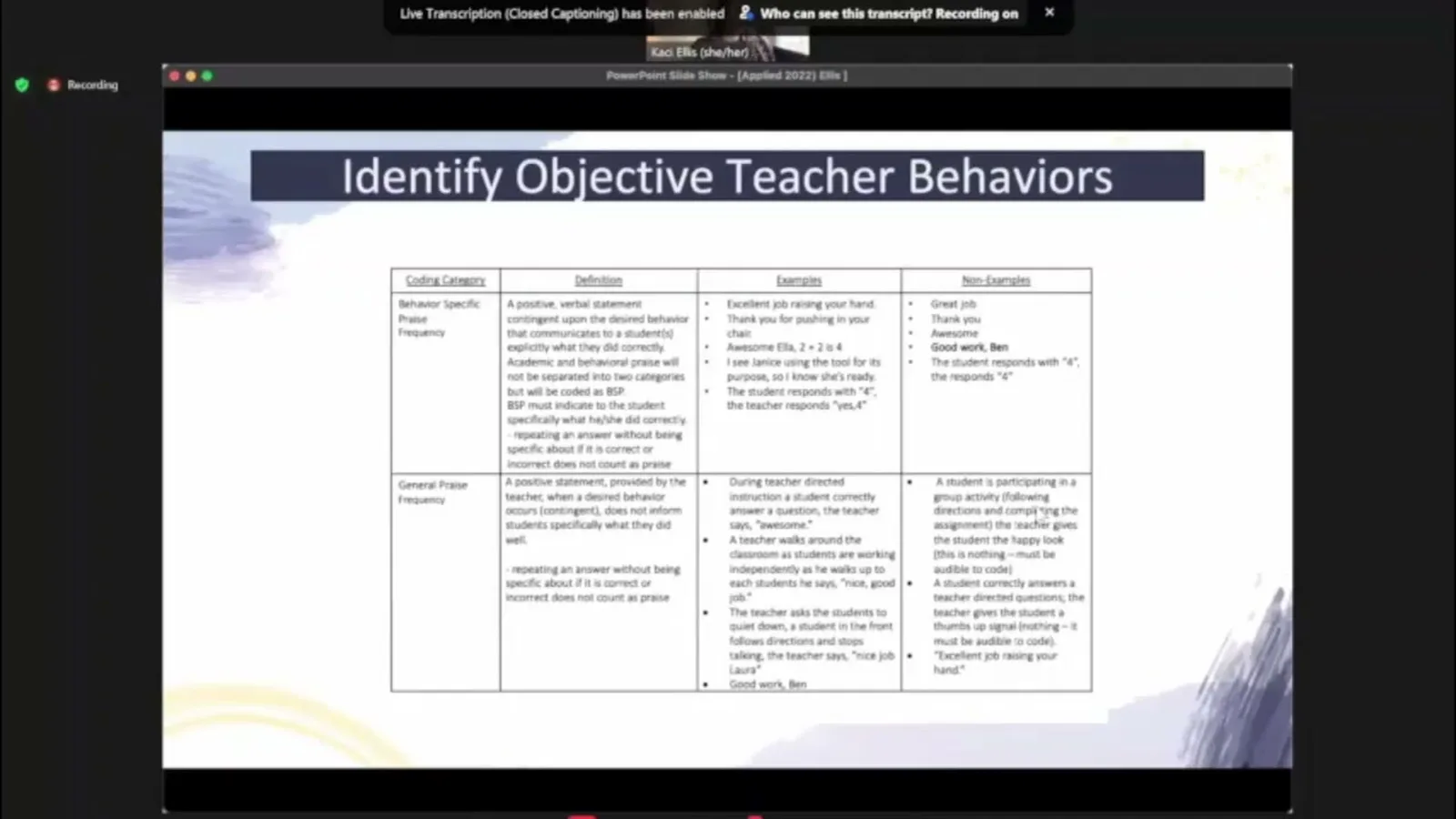
Practical Takeaways for School-Based Behavior Analysts
Dr. Kaci EllisThe Behaviorist Bookclub
Discussed both as a legal trigger requiring parent consent and as a skill many general education teachers are asked to conduct despite feeling unprepared…
- 2.50 CEUs
Confessions of a New Behavior Analyst in Functional Analysis
Matt HarringtonThe Behaviorist Bookclub
Presents the FBA as an umbrella term covering three distinct phases (indirect, descriptive, and experimental functional analysis) that build on each other…
- 1 CEU
The Interdisciplinary Case Conference
Michelle VencesThe Mindful Learner LLC
Michelle applies ABA's function-of-behavior framework to interdisciplinary cases, reasoning through whether elopement or self-injurious head-banging serves an…
- 0.50 PDUs
Bite-Size Behavior Analysis: Differential Reinforcement
Anlara HoskinsCandid Contingencies, LLC
Referenced as the process a BCBA conducts to determine the function of a challenging behavior such as aggression or self-injury.
- 1 CEU
It’s Complicated: Teaching Relationship Safety That Reflects Real Life
Patricia "Tricia" Lund, CSE, LBA & Carolyn Broner, M.S. Ed.The Behaviorist Bookclub
Lund notes she runs functional behavior assessments specifically targeted at sexual behaviors, framing it as the standard behavior-analytic starting point…


On this page · 12 sections▾
A functional behavior assessment, or FBA, is the process a behavior analyst uses to find out why a behavior keeps happening. It is not one test. It is a set of steps that ends with a good guess about what the behavior gets for the person.
That "why" is called the function. Once you know the function, you can teach a safer behavior that does the same job. This page walks through the phases of an FBA, the legal rules in schools, and where experienced BCBAs land differently.
What an FBA actually includes#
People use several names for this work. You will hear functional assessment, functional behavior assessment, and functional analysis in the same meeting. Matt Harrington treats the FBA as the big container that holds all of it.
In his course on functional analysis, Harrington breaks the process into three phases. Each phase has a different job. Each one feeds the next.
I like to think of the functional behavior assessment, the functional assessment in general, as an umbrella term for three distinct phases. You have the indirect assessment, the descriptive assessment, and then the functional analysis. From the talk — Matt Harrington
The indirect phase is talking to people. The descriptive phase is watching the behavior in real life. The functional analysis is the experimental piece, where conditions are set up on purpose to test a function.
Knowing which phase you are in matters. A team that skips straight to testing often wastes the session. Harrington opens his course with a story about doing exactly that, and losing more time than he saved.
Why the interview phase comes first#
The indirect assessment is usually a caregiver or teacher interview. It feels like the least scientific part. Harrington argues it is the part that makes everything after it work.
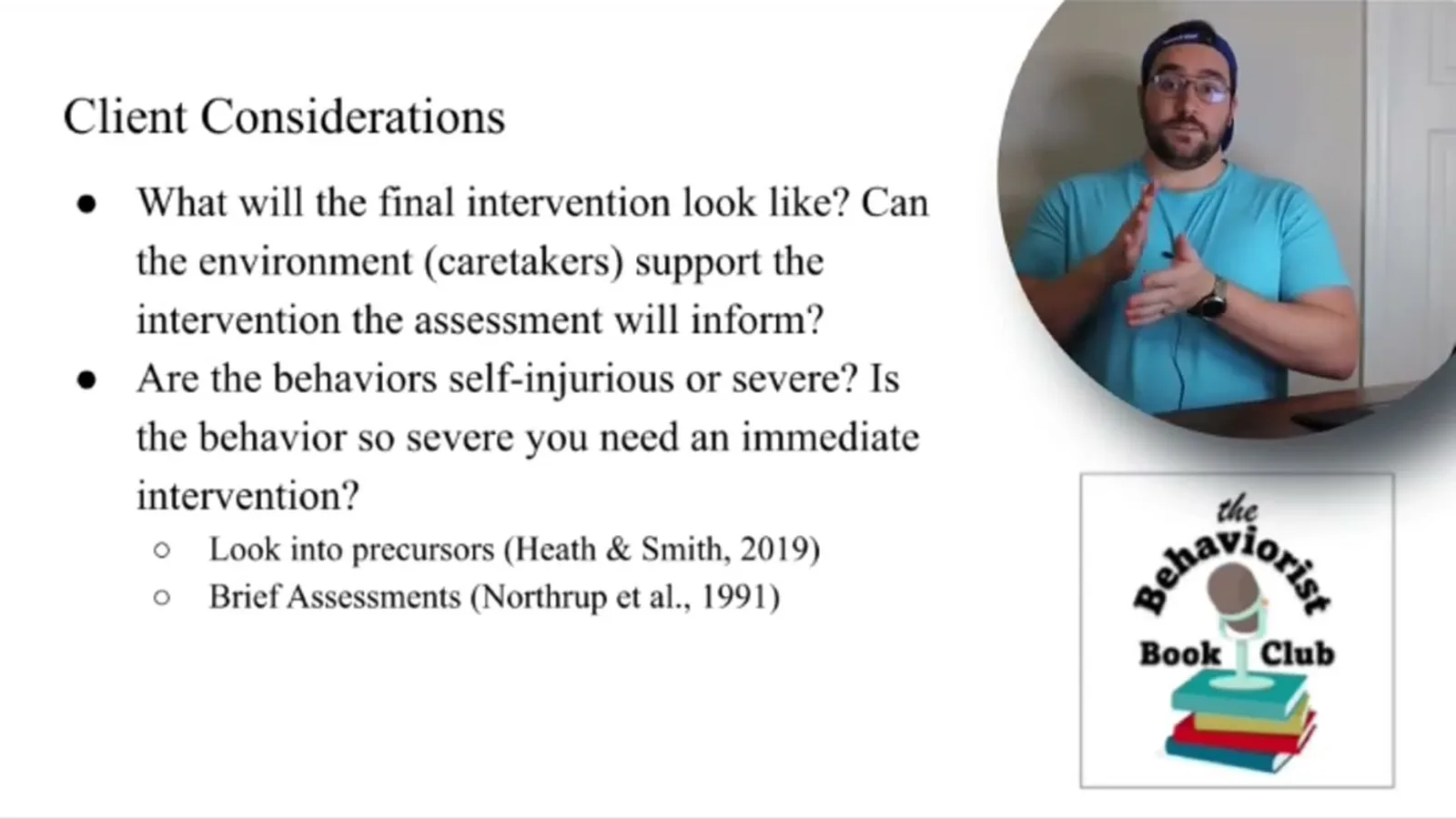
Remember, there are three parts. We talked about it before. I think it's worth a short review. The indirect assessment, which is the caregiver interview and the conversations that happen that help refine your functional analysis conditions. The descriptive assessment, which is the observation phase. From the talk — Matt Harrington
The interview does two things at once. It builds trust with the family, and it gives you details you cannot get from a checklist. You learn what the room looks like. You learn what people usually do right after the behavior.
Those details shape the conditions you test later. A generic escape condition may not match the demand a child actually hates. A caregiver can tell you which task sets things off in ten seconds. Skipping that conversation to save an hour often costs a full session.
What the observation phase can and cannot tell you#
The descriptive assessment is the watching phase. You record what happens before the behavior and what happens after it. Many teams call this ABC data, for antecedent, behavior, and consequence.
Harrington is blunt about the limits here. Watching does not prove a function. In his course he explains that descriptive data gives you correlated or hypothesized functions at best. He puts the match rate with a true functional analysis at roughly half the time.
So what is observation good for? It tells you which conditions are worth testing. It shows you the real classroom or home setup you need to copy. It narrows a long list of maybes down to two or three.
That framing keeps teams honest. A report that says "the descriptive data shows the function is attention" is claiming more than the method can support. A report that says "observation points us toward attention and escape" is being accurate.
Functions are rarely as tidy as the textbook#
Most training lists four functions of behavior. Michelle Vences uses that list with her interdisciplinary teams, but she treats it as a starting point rather than a closed set.
there's four functions to the behavior. From the talk — Michelle Vences
In her case discussions, Vences walks through a child who runs off. Sometimes the running escapes a hard task. Sometimes it is just how that child plays. Sometimes attention shows up in the middle of it.
She pushes teams to rule things in and out rather than pick one label fast.
So can we rule out the function of behavior being automatic or is it escape? From the talk — Michelle Vences
Vences also brings occupational therapists into the question. If head banging feels good to a child, sensory input is part of the story. An OT can describe that side of it better than a BCBA can alone. Her point is that the FBA gets sharper when more than one discipline reads the data.
Consent comes before the first observation#
 Advertisement
In schools, an FBA is a legal event, not just a clinical one. Dr. Kaci Ellis spends real time on this with school-based behavior analysts, because the order of operations trips people up.
There has to be parent consent before an FBA happens, which means that you have to have parent consent before you go in and do your observation. From the talk — Dr. Kaci Ellis
Her practical rule is simple. Before you watch a student, ask one question: does this child have an IEP, an Individualized Education Program? If the answer is yes, consent has to be signed before you assess.
Ellis admits that people read the law differently. She still lands on the cautious side every time.
You definitely need informed consent for the initiation of an FBA. From the talk — Dr. Kaci Ellis
She also covers students who are not in special education but are getting tiered supports. Those families may not have to sign a form. Ellis still thinks they should know an assessment is happening. Her test is personal: what would you want if it were your own kid?
Schools ask teachers to do work they were never trained for#
IDEA, the Individuals with Disabilities Education Act, says a school must write a behavior plan when behavior blocks learning. It does not say who does the assessment. That gap gets filled in very different ways from district to district.
Ellis surveyed teachers about this. Most said they felt able to run an FBA. That number worried her more than a low one would have.
That's 67% felt that they could implement the FBA. But again, what I was saying is, am I going to want to go to a doctor for a surgery that's 67% prepared to implement my sinus surgery? No, I don't. From the talk — Dr. Kaci Ellis
Her survey also listed what teachers get asked to do. Pick reinforcers. Choose strategies to reduce behavior. Write a crisis plan. Those are graduate-level skills handed to people with no behavioral coursework.
Ellis does not blame teachers for this. She uses it to define the BCBA's job in a school. You are there to bring the behavioral expertise into a process that will happen with or without you.
Data collection falls apart in a busy classroom#
Grace Chanchio works on the advocacy side of school cases. She points to a rule many families never hear about.
For an FBA, for instance, here in Florida, they're not required to. It doesn't have to be a BCBA. It doesn't have to be a BCABA. Anybody can take the data. From the talk — Grace Chanchio
A BCABA is a Board Certified Assistant Behavior Analyst, one credential level below a BCBA. That rule creates a daily problem. The adult closest to the behavior is usually the teacher. The teacher is also running a class of twenty other students at the same moment.
A teacher cannot teach the class and take the data for ABC data. It's just not going to be done with fidelity. From the talk — Grace Chanchio
Chanchio's fix is staffing, not paperwork. Put a second trained adult in the room during data collection. Tell that person exactly what to record and why it matters. Thin data leads to a weak plan, and a weak plan sends the team back to the start.
Where experts disagree#
The sources here agree on the basic shape of an FBA. They split on who should be allowed to collect the data.
Chanchio describes a state where anyone may take it, and works within that rule by adding a second trained adult to the room. Ellis reads the same gap and pushes in the other direction. She argues that a 67% teacher-confidence rate is not good enough for work this consequential, and questions whether the assignment should fall to classroom teachers at all.
Both want better data. One is fixing staffing today. The other is questioning whether the assignment should exist at all.
Neither argument is settled. If you consult in schools, you will meet both views in the same IEP meeting.
The FBA is what makes the intervention make sense#
An FBA is not a report you file. It is the reason your plan has any chance of working. Anlara Hoskins makes that link when she teaches differential reinforcement. She explains that BCBAs addressing behavior like aggression or self-injury have usually already run some version of an FBA. That earlier assessment is what tells them the behavior's function.
Her point is that you cannot pick a replacement behavior without knowing the function. Two behaviors that look nothing alike can serve the same purpose. Hoskins calls that a response class. Hitting and asking for a break can both mean "this is too much."
If you know the function, you can teach the safe member of that class. If you guess wrong, you reinforce the wrong thing and the behavior stays. Harrington's course Confessions of a New Behavior Analyst in Functional Analysis walks through cases where a missed function forced a full restart.
FBAs outside the classroom#
The FBA logic is not only for aggression and elopement in schools. Patricia "Tricia" Lund uses it when she teaches relationship safety and sexual health skills.
I use functional behavior assessments that are specifically focused on sexual behaviors. From the talk — Patricia "Tricia" Lund
That may sound like a stretch. Lund frames it as plain behavior analysis applied to a new content area. You do not start by picking a curriculum. You start by finding out what the learner does not yet know or cannot yet do.
Every good behavior analyst knows that we start with an assessment, right? We start with an assessment to find out where the areas of weakness are. And then when we can determine where the areas of weakness are, then we know kind of where to program our interventions. From the talk — Patricia "Tricia" Lund
She pairs the FBA with knowledge tools built for that topic. The assessment tells her which skills to teach. The FBA tells her what the behavior is currently doing for the person. Both answers are needed before any lesson gets written.
What the research says#
Training matters, and the format of that training changes results. One randomized study compared live workshops to web modules for special educators learning FBA. Both groups gained knowledge, but the live group gained more. Only the live group reported feeling more skilled (Dutt, Cheng, Ang, & Nair, 2023, Behavioral Interventions). Self-paced modules help, but they are not a full replacement for live coaching.
The classroom itself is part of the assessment. Researchers argue that behavior analysts should check baseline classroom conditions before treating one student's behavior (Kestner, Peterson, Eldridge, & Peterson, 2018, Behavior Analysis in Practice). They highlight four variables: how often students respond, whether the work fits, and how feedback and reinforcement are delivered. They also point to how clear instructions and transitions are. Some referrals disappear once the class-wide setup improves.
Measuring teacher skill in FBA also has to travel across languages. A team adapted and validated a Chinese version of an inventory (Chen, Dutt, & Nair, 2024, Behavioral Interventions). It measures teacher skills and training needs in FBA and behavior intervention. Tools like that let districts see where training is actually missing.
The method stretches beyond disability services too. One paper applied functional assessment logic to unintentional firearm discharges by police (O'Neill, 2018, Journal of Organizational Behavior Management). It sorted the events into six antecedent classes, such as startle stimuli and routine tasks. The same question drives it: what conditions come right before the behavior?
FAQ#
What is a functional behavior assessment? An FBA is the process used to find out why a behavior keeps happening. It combines interviews, direct observation, and sometimes an experimental test. The result is a hypothesis about what the behavior gets for the person.
What are the three parts of an FBA? The indirect assessment, the descriptive assessment, and the functional analysis. The indirect part is interviews with caregivers or teachers. The descriptive part is watching the behavior happen. The functional analysis tests suspected functions directly.
Do schools need parent consent before an FBA? In most cases, yes. Dr. Kaci Ellis teaches that consent should be signed before any observation of a student with an IEP. Practice varies by state and district, so check your local rules and lean toward asking.
 Advertisement
Turn this topic into a CEU
You just studied this. Now get credit for it.
Watch Practical Takeaways for School-Based Behavior Analysts with Dr. Kaci Ellis and earn 1 free BCBA CEU. Detailed certificate, delivered the moment you finish.
Keep going with a free learning path
Supervision, Done Right
Four supervision CEUs that build on each other. What reflective supervision is, how to build a supervision system, how to assess supervisee competence instead of counting hours, and how supervision affects provider outcomes. The BACB asks supervisors for three supervision CEUs per cycle. This covers it.
Want the primary literature? Read the Functional Behavior Assessment research roundup on our sister site, Behaviorist Book Club.