PDA: Collaborating for Success
Presented by B. Kuereine Gray
What You’ll Learn & How It Applies to Your Practice This presentation explores Pathological Demand Avoidance (PDA) as a behavioral response pattern and highlights collaborative, evidence-based strategies to support learners with a PDA profile. Participants will review key characteristics of PDA, reflect on personal bias, and identify proactive interventions that increase positive outcomes. The session emphasizes competence, collaboration, and practical application in educational and behavioral settings.
Cancel any time. Cert delivered to your inbox the moment you pass the quiz.
Learner ratings
from 110 learners
97% would recommend this CEU to other professionals in their field (90 responses)
“Very informative”
— Meredith C.“I was very familiar with PDA as a phenomenon, but it was good to hear a behaviour analyst conceptualize it.”
— James S.“Very interesting information:)”
— Michelle A.“Great presentation! Really love the exploration of this topic. Also, the use of colour in the PPT slides makes me happy!”
— Sarah G.
About this CEU
What You’ll Learn & How It Applies to Your Practice This presentation explores Pathological Demand Avoidance (PDA) as a behavioral response pattern and highlights collaborative, evidence-based strategies to support learners with a PDA profile. Participants will review key characteristics of PDA, reflect on personal bias, and identify proactive interventions that increase positive outcomes. The session emphasizes competence, collaboration, and practical application in educational and behavioral settings.
From the talk
What was covered
PDA as a response class: map the escalation sequence, drop demand pressure, and collaborate with the client, not just about them.
- Treat PDA as a response class (behaviors that share one job) you can define and measure, not a diagnosis you wait for.
- Write out the whole sequence for your learner: engaged, delay and avoidance, withdrawal, refusal, escalation.
- Use "persistent drive for autonomy" with families and teams so buy-in is not lost to pathologizing language.
- Check that food and toileting needs are met before you judge any demand or intervention.
- Build choice into order, pacing, and effort so the learner keeps a real say in the session.
- Write co-regulation goals (calming down with someone's help) instead of self-regulation goals, then track your own triggers as part of the plan.
Where PDA Sits in the Research Right Now
PDA stands for Pathological Demand Avoidance (a pattern of avoiding everyday demands). Gray was blunt about its status. It has no ICD code (the code health systems use for a diagnosis). It is not in the DSM-5 (the main manual of mental health diagnoses). She said it is not up for a later edition either. Interest has grown fast, and that cuts both ways. The research base is thin. No one has pinned down exactly how PDA presents across people.
So what do we do with it at work? Gray gave behavior analysts a working frame. Treat PDA as a response class (a group of behaviors that share one job). That frame fits our field. We do not need a label before we define behavior, take data, and build support.
She named the first U.S. peer-reviewed journal article on PDA: Carlazi, 2025, released late last November. She also pointed to a newer free-access paper on sensory sensitivity in PDA. It compares three groups: autistic people with PDA, people with PDA, and neurotypical people. There were clear differences between the groups. That result hints PDA may be a frequent comorbidity (two things that often show up together) rather than a type of autism.
One more myth got knocked down. Early write-ups described very verbal kids with big vocabularies and high intelligence. Gray pointed to a 2021 review, Kildall, that checked this claim against the literature. It found no link between intellectual ability and PDA. The profile shows up across the full range of ability, not just in highly verbal, high-IQ kids.
There is no link in level of intellectual ability and PDA.
From the talk — B. Kuereine Gray
Persistent Drive for Autonomy: The Words You Use With Families
Gray asked us to change the phrase we say out loud. With other professionals, use both terms so we all share a vocabulary. With caregivers, teachers, and the learner, call it a persistent drive for autonomy. Tell them the psychological community calls it pathological demand avoidance. Then move on to the version people can work with.
This is not soft talk. It is a buy-in problem. Families already hear that the behavior is bad parenting. Gray noted that some caregivers are told they set no expectations. She called that a full circle back to the old fridge mom story. A pathologized label makes that worse and closes the conversation.
The autonomy frame gives you a script instead. You can say you see that the person really wants to be independent right now. You can say they need a say in how this goes. That opens the door to problem solving with them.
Gray also flipped the meaning of collaboration for this talk. Most CEUs on collaboration mean caregivers and other professionals. She wants the client in that circle too. Choosing intervention methods with the learner is rare in current research and in most plans.
It is really difficult to get over a barrier of caregiver buy-in when you are pathologizing behavior.
From the talk — B. Kuereine Gray
Seven Areas to Define at Intake
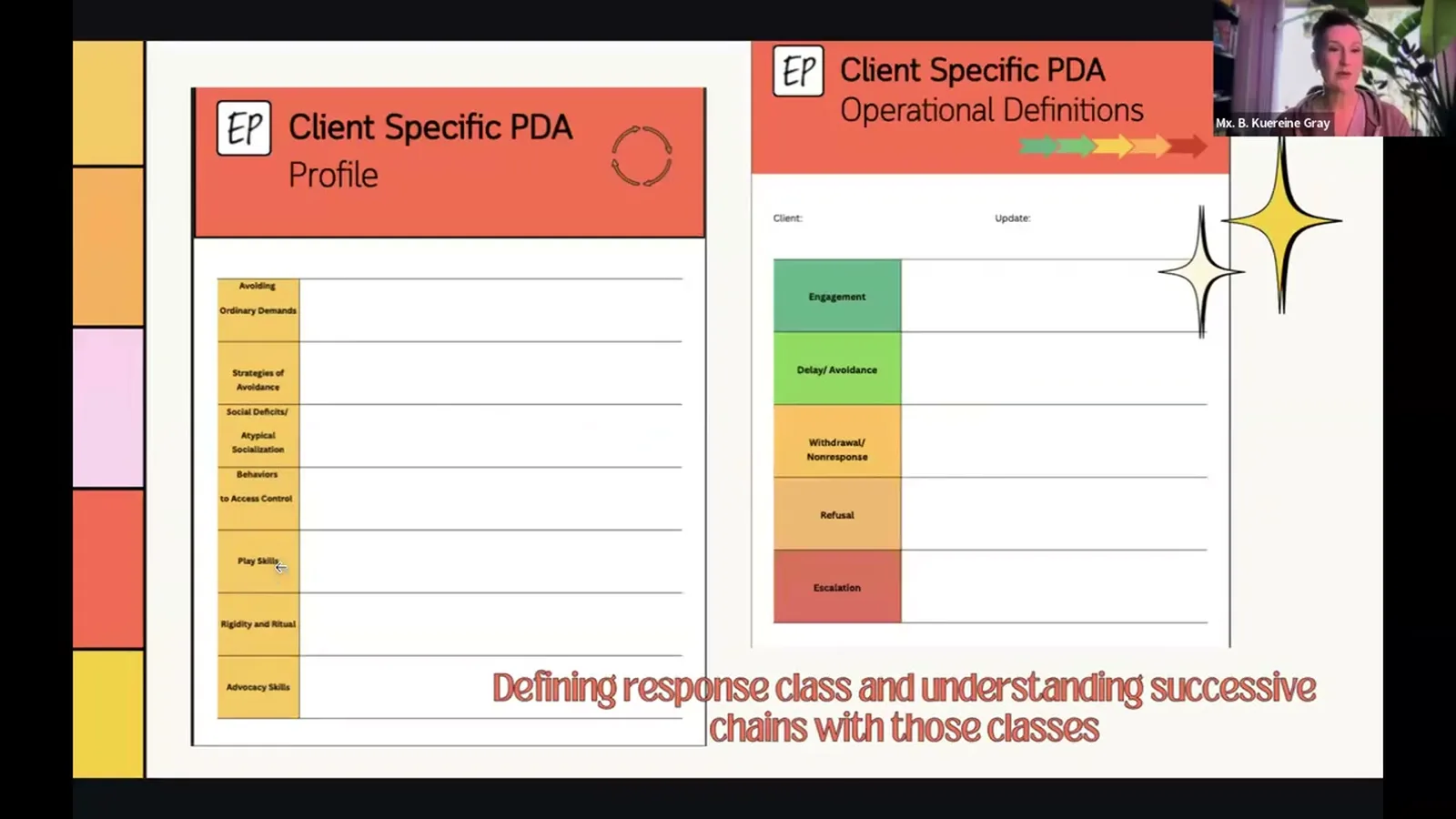
Gray shared a planning form with seven areas to describe for each learner. They are avoiding ordinary demands, strategies of avoidance, social deficits or atypical socialization, behaviors to access control, play skills, rigidity and rituals, and advocacy skills. Fill it in early. Doing it at intake shows the pattern came in with the person. It did not grow out of your intervention.
Ordinary demands can mean resisting toilet training in a young child. In adults it can look like putting off the bathroom for hours. It can mean going long stretches without eating, or eating only on one schedule. Avoidance strategies range from no response, to walking away, to negotiating, to off-topic talk right after a discriminative stimulus (a cue that a demand is coming).
Social differences here are not a simple skills gap. Gray said these learners often blend into a group well enough that nobody looks closer. Teachers and employers may report that everything is fine. When she observed, the blending was costing a huge amount of effort. Some social attempts are delayed echolalia (repeating words heard earlier) used to get a laugh from someone.
Access to control shows up in seating, hair, clothes, word-for-word repetition, and the route home. Advocacy needs the most care.
it's really important that advocacy is not just being able to say, I need help.
From the talk — B. Kuereine Gray
Mapping the Escalation Sequence From Engaged to Escalation
This was the core clinical tool of the session. Gray sorts the response class into five levels: engaged, delay and avoidance, withdrawal and non-response, refusal, and escalation. All of them serve one job. The job is access to safety, certainty, and relief from worry about what comes next. She called the anxiety piece mentalistic, and she still wants us to plan around it.
Then you write down what each level looks like for your learner. Engaged might be quiet, still body, even pacing, normal prosody (the rhythm and tune of speech). Delay may start as not looking up. It may escalate inside its own level into walking away or starting a different task. Then come the off-topic questions that sound helpful but move the task away.
Refusal brings questions like why do I have to do that. It can bring what our literature calls socially shocking behaviors (sudden, out-of-character behavior that grabs attention fast). These are low effort with a huge payoff: swearing or name calling from a learner who never does that. Caregivers get sidelined by the surprise and start correcting. The behavior was still refusal and still avoidance. Only after that do you see aggression, property destruction, or self-injury.
Gray also mapped this onto a severity tier system some ABA programs use to grade behavior intensity. Engagement and learning time sit at the mild end. Delay and avoidance behave like small mid-tier responses. Withdrawal and refusal can also land in that mid range depending on how severe they get. Escalation sits at the most severe tier. Written out, the whole team can name where they are in the chain.
Well, we know that the behaviors don't come out of nowhere, but sometimes that sequence of escalation can be subclinical or very nuanced, and it is hard to grapple.
From the talk — B. Kuereine Gray
Physiological and Safety Needs Come Before Any Program
With most learners we jump straight to proactive, interactive, and reactive strategies. Gray says PDA starts one step lower. Check that basic body needs are met first. Then check that safety needs are met. Only then does the usual intervention stack make sense.
She gave a clear example from her caseload. A young adult avoided toileting so strongly that the family could predict a full escalation. The demand was not coming from a parent. Nobody told him to go. The demand came from his own body, and he had no control over it. Coaching the family on the escalation cycle changed how they responded. Telling him to just get over it had never helped.
Safety needs are about people, not just the room. The learner needs good rapport with whoever is working with them. Staff need their own training and backing so they can hold that support in the moment.
This step reframes a lot of plan failures. If the body is in distress, the task was never the problem.
we want to ensure that physiological needs are met or that we're allowing space for them to occur without demands
From the talk — B. Kuereine Gray
Proactive Supports: Choice, Certainty, and a Cool Room
Gray listed proactive moves that have worked for her. Scaffold the task, and keep choice inside it. Let the learner pick the order. Let them finish one part alone. Agency is not a reward here. It is the thing that keeps them regulated enough to work at all.
Reduce uncertainty about what is coming, but fit the dose to the person. One adult she supports wants the whole day walked through, then walked through again at night. Another can only handle the next two steps. For that person she names two things and asks which comes first. That gives certainty and a real say at the same time.
Keep arousal low. Lines like we only have five minutes left make the moment hot. A hot moment lowers the odds of easy, known skills showing up.
That last point matters for how we read data. The skills are often in baseline already.
we have skills that are baseline competencies, but we are inconsistently able to demonstrate them because of the difficulty with regulation
From the talk — B. Kuereine Gray
Interactive and Reactive Moves: Regulate, Compromise, Co-Regulate
Stay regulated yourself, and mean it. Gray warned that a flat therapist voice reads as reactive procedure mode. Learners pick up our cues. We rely on that when we pair ourselves with good things, so it works both ways. If you cannot hold your own state today, tap out. Gray also points out that praise timing matters. Big, bright affect during a demand can raise the effort of that demand.
Compromise where the outcome does not change. Blue pants or red pants are both pants in winter. Math first or dishes first still gets both done. Two minutes of independent work instead of ten still counts. Ask whether you need full completion, full independence, or something you can build on next time.
In reactive moments, drop the clock. Give time, care, and compassion, and adjust the target so the session can end well. Endings become learning history. Gray warned that repeated battles can build brand new rigidities and new problem behavior. Explain the reason behind non-negotiables, even for people with severe intellectual disabilities.
Her strongest plan-writing note was about goals. Treatment plans everywhere are stacked with self-regulation goals. Young children co-regulate (calm down with support from another person) before they self-regulate. PDA learners need that support too.
If they could do it on their own, then they would be in control and they can't.
From the talk — B. Kuereine Gray
Checking Your Data and Your Own Bias
Gray held back a question about intervention efficacy until the end, and then gave a simple rule. If you see someone several times a week, look for a positive trend within a week. Response may not be consistent yet. A trend should be there. If you see them once a week, that is not enough data to judge.
Pushing on with a flat intervention is not neutral. It can teach the learner that this demand is bigger than they thought. That raises worry next time and makes the task harder to start. The cost shows up later, not today.
Then she turned the lens around. We have setting events too (conditions that make a response more likely). Losing patience. A change in tone. Affect we think is neutral that lands as stern. Body language that pulls away.
If your triggers line up with a learner's pattern, say so. Gray framed that as professional honesty, not failure. Someone else may be the better fit while you work on your own response in session. She also promised a part three on complex profiles, caregiver training, replacement behaviors, and trauma-informed practice.
as providers, it's important that we look at what are our triggers, what are our setting events for maladaptive response?
From the talk — B. Kuereine Gray
Common questions
Is PDA an official diagnosis?▾
No. Gray said PDA has no ICD code and is not in the DSM-5. It is also not being considered for a later edition. For behavior analysts, she suggests treating it as a response class you can define, measure, and support.
Is PDA only seen alongside autism?▾
Most of the research so far has studied autistic groups, which is why the two look tightly linked. Gray noted that many adults who identify with PDA do not consider themselves autistic, and some report ADHD instead. A 2021 review she cited included study samples with ADHD, and one with ADHD and epilepsy.
Does PDA only show up in certain settings?▾
No. Gray said the pattern shows up across people and places, though a supportive setting may make it less frequent or less intense. She compared it to autism or ADHD with good accommodations in place. If you truly see it in only one setting, it may be very subtle, or it may be something else.
Do people with a PDA profile mask their feelings?▾
There is no published literature on this yet. In Gray's own experience, across ages three to twenty-six, masking of emotion is common until the setting becomes unsustainable. What follows can look like a big reaction out of nowhere. That is why writing out the escalation sequence matters.
How fast should I expect an intervention to work?▾
Gray looks for a positive trend within a week for learners she sees several times a week. Consistency may not be there yet, but direction should be. If you see someone only once a week, you do not have enough data yet to judge.
What is the PANDA approach?▾
PANDA is a support framework Gray showed from the U.S. and UK PDA websites. It stands for pick your battles, anxiety management, negotiation and collaboration, disguise and manage demands, and adaptation. Each part comes with examples on those sites.
About the speaker
B. Kuereine Gray has been a clinician since 2007, working mainly in homes and also in schools and offices. Her work includes public speaking, advocacy, and expert testimony, and she holds credentials in areas such as reflective supervision that she hopes the field will connect more closely to behavior analysis. She has supported people with PDA profiles for many years, from age three to twenty-six, and this session was part two of her PDA series.
This summary was generated from the recording’s transcript. Quotes are taken word for word from the talk.
What you'll learn
- 1Learning Objectives
- 21.06 Maintaining Competence
- 3Review of PDA presentation as a response class
- 42.14 Selecting, designing and implementing behavior change procedures
- 5Will identify evidence based behavioral interventions and explicit changes to increase probability of successful outcomes for learners with PDA profile
- 61.10 Personal Bias and Challenge
- 7Will demonstrate reflective practice with regard to personal bias or challenge when encountering PDA behavior response and generate collaborative and proactive support interventions for self, colleagues and stakeholders
Concepts in this CEU
Related talks
Talks that cover the same concepts
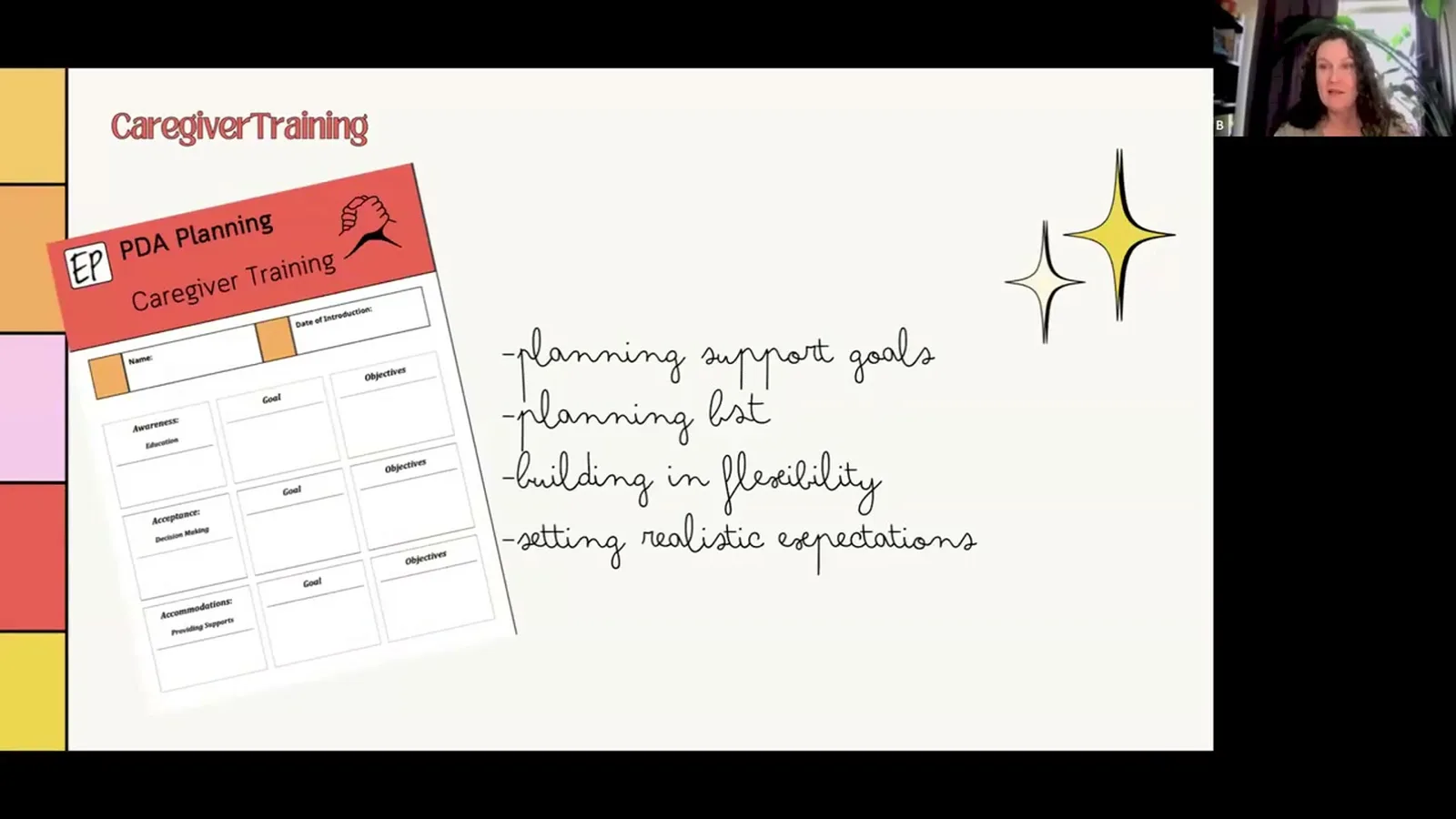
PDA Caregivers, Complex Profiles, Replacement Behaviors, and Being Trauma Informed
The Behaviorist Bookclub

Streamlining BIPs & Data Collection Systems for Schools
NRS Compassionate Behavior Services

Shaping Behavior Change when ADHD is in the Picture
The Behaviorist Bookclub
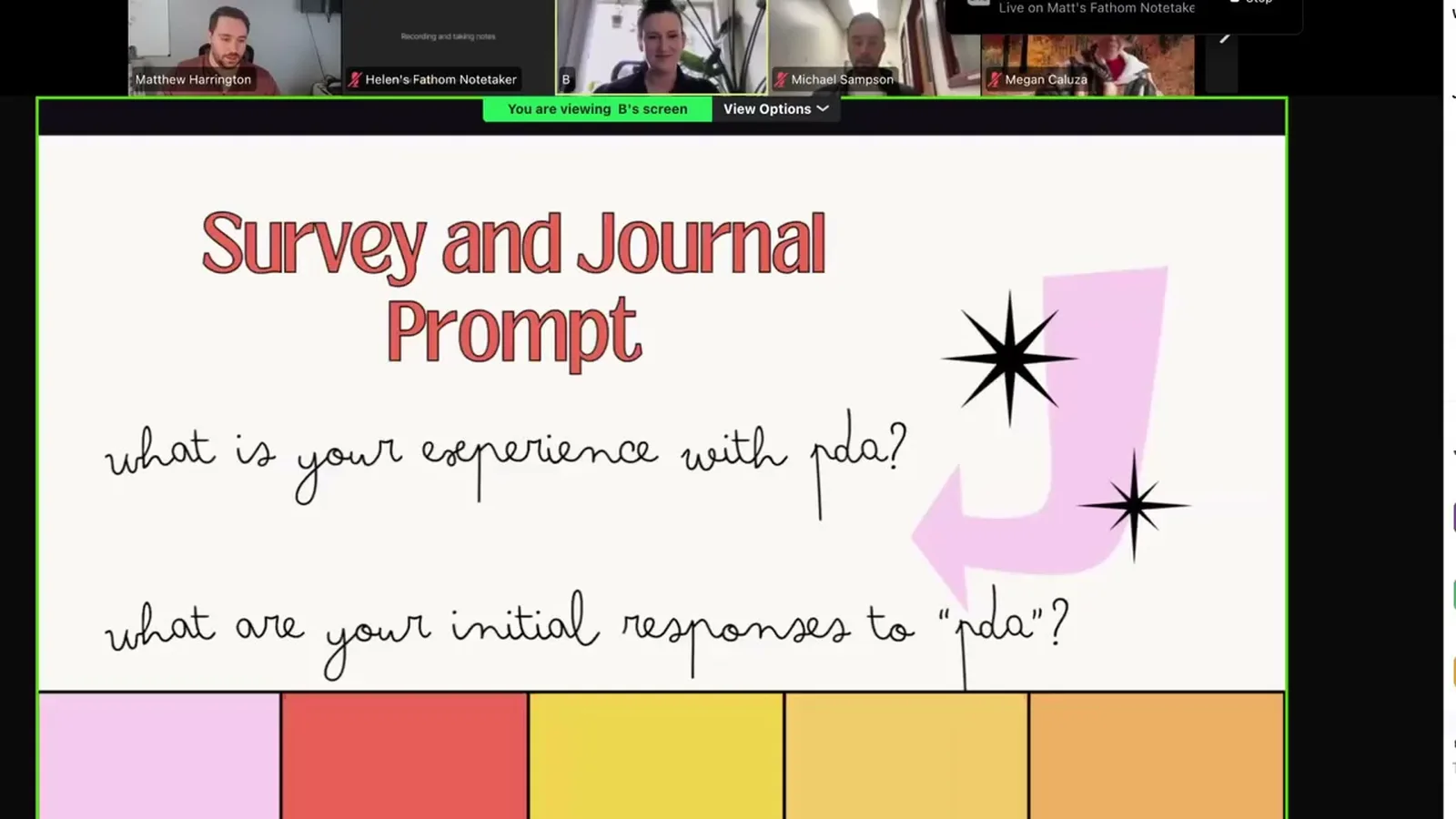
PDA: What it is and What it isn't
The Behaviorist Bookclub
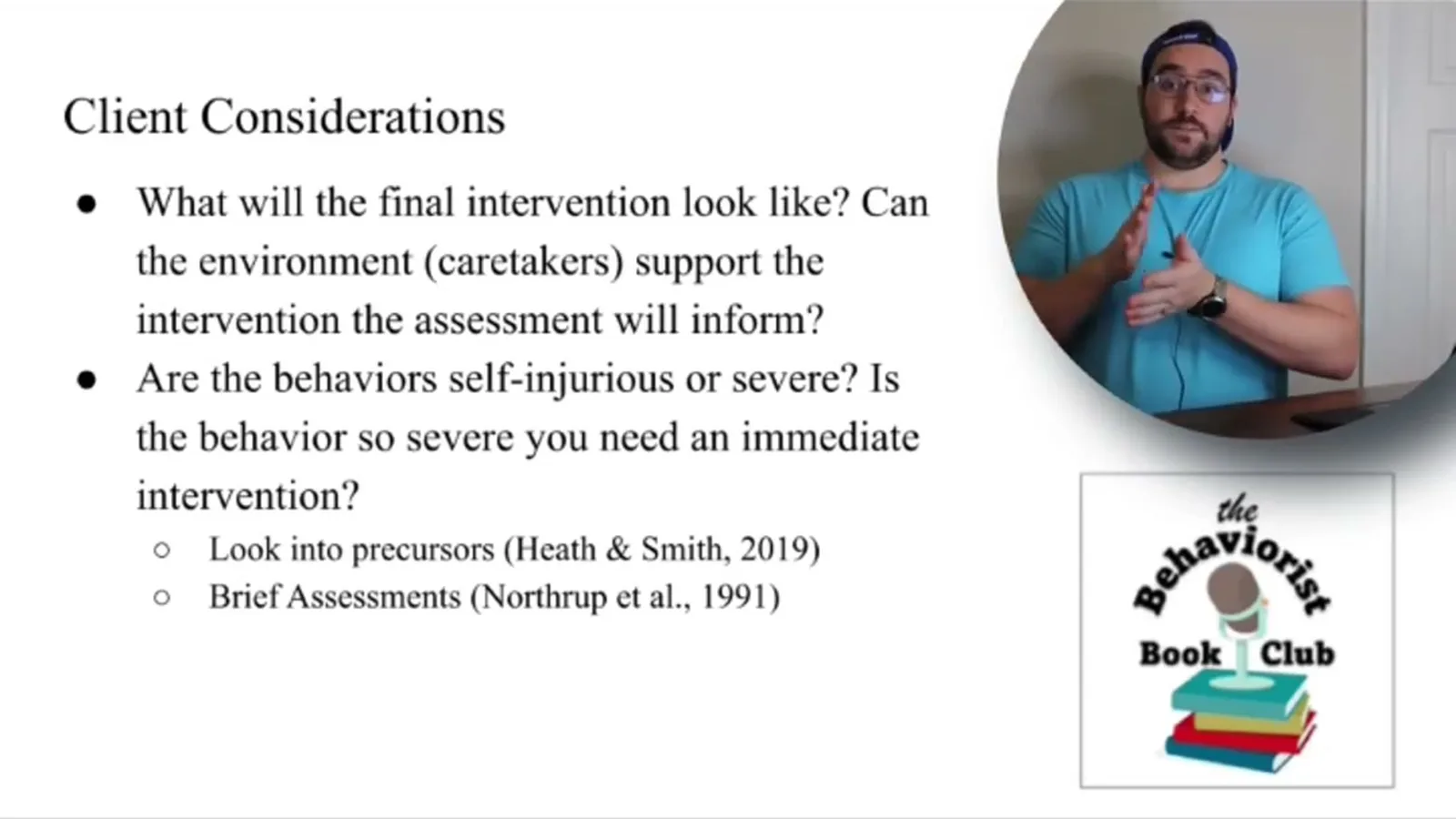
Confessions of a New Behavior Analyst in Functional Analysis
The Behaviorist Bookclub
Is It Technical or Relational? A Framework for Pinpointing Caregiver Collaboration Breakdowns
Parenting with ABA
More from The Behaviorist Bookclub
Harm Reduction Within ABA Practice
The Behaviorist Bookclub
Supervising Beyond Technical Skills: Professionalism, Communication, and Clinical Judgment
The Behaviorist Bookclub
Reflective Supervision and Client Outcomes
The Behaviorist Bookclub
OpenCEU is supported by advertising from third-party sponsors. Sponsors are clearly labeled, have no influence over course content, instructors, or CEU decisions, and never appear on certificates. The BACB does not sponsor, approve, or endorse OpenCEU sponsors or their products.