Pathological Demand Avoidance (PDA): A BCBA's Guide
PDA describes an extreme need to resist everyday demands, often to protect a sense of control. Learn the profile, the debate, and how to support autonomy.
Key takeaway
Pathological demand avoidance is often shortened to PDA. It describes an extreme need to resist everyday demands. Even simple, familiar requests can trigger strong avoidance.
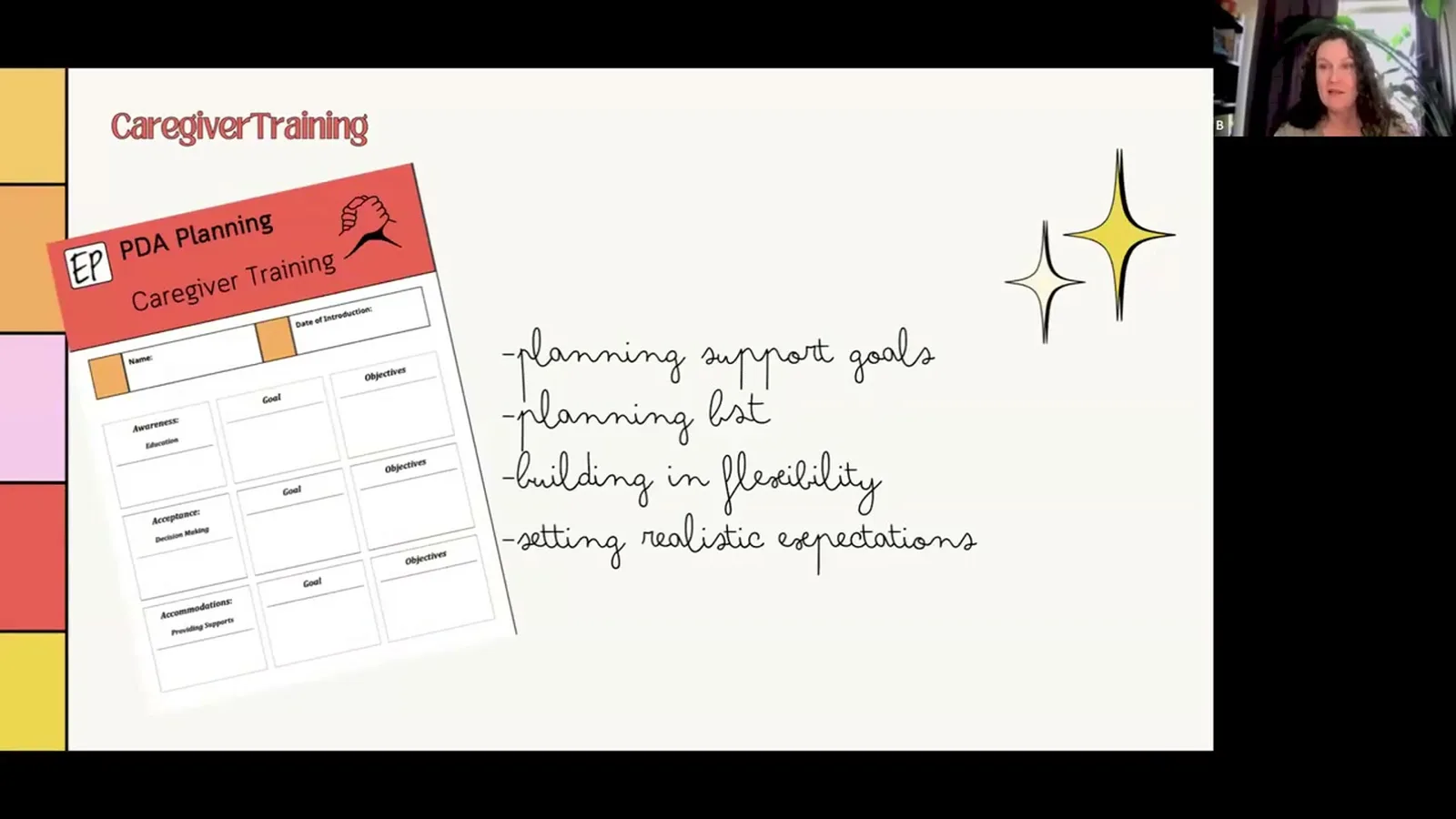
PDA Caregivers, Complex Profiles, Replacement Behaviors, and Being Trauma Informed
Experts who cover this
4 recordings on openceu cover pathological demand avoidance.
- Featured talk1.50 CEUs
PDA Caregivers, Complex Profiles, Replacement Behaviors, and Being Trauma Informed
B. Kuerine GrayThe Behaviorist Bookclub
The core topic of the whole talk: B. Kuerine Gray covers why PDA is hard to program for, walks through five complex case examples, and argues intervention…
- 1 CEU
PDA: Collaborating for Success
B. Kuereine GrayThe Behaviorist Bookclub
The core topic of the talk. The presenter frames PDA as a response class rather than a diagnosis, traces the emerging (non-peer-reviewed-heavy) research base…
- 1 CEU
PDA: What it is and What it isn't
B. Kuereine GrayThe Behaviorist Bookclub
The core topic of the talk: B frames PDA as a profile marked by resisting ordinary, previously-mastered demands through social strategies, high masking, and a…
- 2.50 CEUs
Confessions of a New Behavior Analyst in Functional Analysis
Matt HarringtonThe Behaviorist Bookclub
In the Q&A, the speaker gives his opinion that PDA (not in the DSM-5, a proposed ASD subset) shouldn't change the FA approach itself; conditions should still…
On this page · 7 sections▾
Pathological demand avoidance is often shortened to PDA. It describes an extreme need to resist everyday demands. Even simple, familiar requests can trigger strong avoidance. The person may use humor, delay, or distraction to escape.
This matters because PDA can look like defiance. It is not. Many now see it as a deep drive for control and autonomy. Understanding that shift changes how you support the person. This page covers the profile, the debate, and a practical approach.
What the PDA profile looks like#
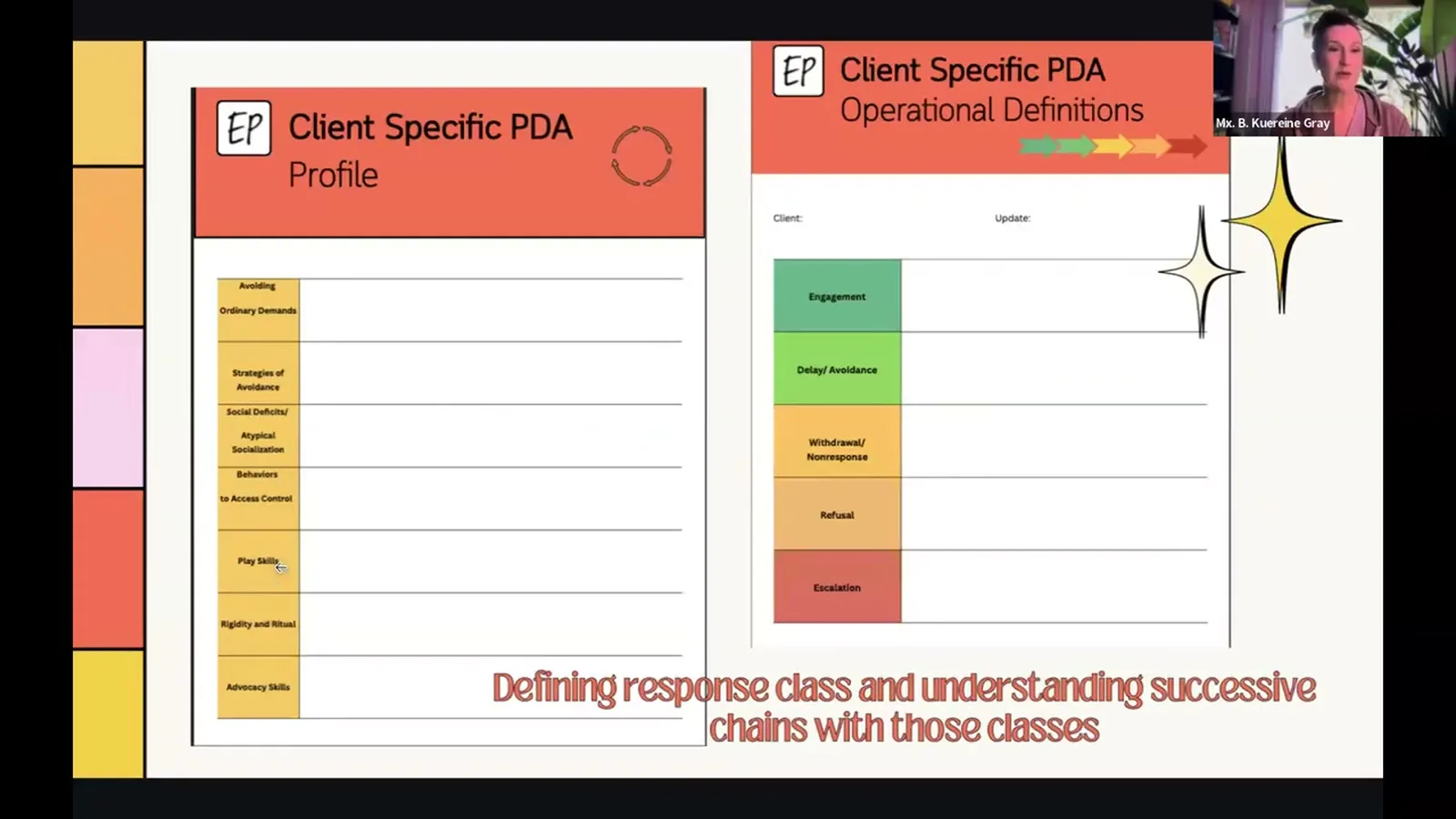
PDA involves resisting ordinary demands of daily life. This includes tasks the person has done many times before. The resistance is not about the task being hard. It is about the demand itself.
B. Kuereine Gray frames it as a need to stay in charge. The behavior protects a sense of control. That need can feel urgent to the person. Gray describes it as a persistent, pervasive drive for autonomy.
Many in the community prefer that gentler framing. It moves away from the word "pathological." It centers the person's need for choice instead. The new name reframes the whole idea.
No longer discussing pathological demand avoidance. We're now looking at persistent drive for autonomy. From the talk — B. Kuereine Gray
The demand feels bigger than it is#
A key trait of PDA is how a demand is perceived. A small request can feel huge to the person. The brain reacts as if the task were a real threat. That reaction drives the avoidance.
Gray describes this mismatch between the demand and the response. The size of the task is not the point.
PDA rarely happens because the demand is hard, but your brain tricks you into thinking it's really hard. From the talk — B. Kuereine Gray
This helps caregivers stay calm. The person is not being difficult on purpose. Their nervous system is sounding a false alarm. Your job is to lower that alarm, not win a battle.
Small changes to how you ask can help. A demand phrased as a choice feels safer. Indirect language often works better than a direct order. You lower the pressure while still moving toward the goal. The task gets done without the false alarm.
Why it is not a formal diagnosis#
 Advertisement
PDA is not listed in the DSM-5. It sits outside the official diagnostic manual. That surprises many families who see the profile clearly. It also makes services harder to access.
Gray explains the gap. The research base is thin and the definitions vary.
Because of the lack of peer-reviewed research, because of the lack of specificity in defining how it presents for people, that has prevented PDA from becoming its own recognized diagnostic category. From the talk — B. Kuereine Gray
So treat PDA as a helpful description, not a stamped label. It names a pattern you may see. It does not replace a careful, individual assessment. Keep that distinction clear with families.
Supporting autonomy, not new programs#
A common fear is that PDA needs a whole new toolkit. Gray pushes back on that idea. You already have the interventions you need. The change is in delivery, not content.
You lead with choice and shared control. That single shift can transform how a session goes.
It's not about reinventing the wheel as far as, oh, we now need to have all these new interventions just for PDA. It's how do we present these interventions through the lens of PDA, where our first goal is to provide autonomy to the individuals that we're working with so that they have some choice. From the talk — B. Kuerine Gray
This "PDA lens" reframes the behavior. Before you react, you ask a question. Is this a response to a felt loss of control? That one question can change your whole plan.
Keep your assessment honest#
The PDA label should not shortcut your analysis. It is easy to assume every behavior is demand-based. That assumption can hide other functions. You might miss an attention or tangible driver.
Matt Harrington warns against that trap. He still builds his approach from real data. The diagnosis does not replace the assessment.
I'm not just saying, well, it's pathological demand avoidance, so there's no reason to include an attention function because we know it's probably going to be something to do with demands. I'm still considering all the variables and I'm still going off the indirect and descriptive assessment rather than just the diagnosis. From the talk — Matt Harrington
So use the label to build empathy and choice. Do not use it to skip steps. The individual assessment still leads your plan.
What the research says#
The evidence base for PDA is young and debated. A systematic review of studies in children and adolescents found that most relied only on parent report. No studies included the views of PDA individuals themselves. Reviewers also warned about neglecting anxiety as a possible cause.
Early work tried to map the profile against nearby conditions. One study compared children given the PDA term to autism and conduct-problem groups. The PDA group showed autistic traits similar to the autism group.
Others question where PDA fits at all. One analysis contrasts Newson's PDA with Asperger's descriptions. It shows how diagnosis can focus on either common or unusual features (Philippe, 2022). Taken together, the research supports caution. PDA is a useful description, but not yet a settled category.
You can go deeper into the history and profile in PDA: What it is and What it isn't.
FAQ#
Is PDA the same as being defiant? No. Defiance frames the behavior as a choice to disobey. PDA frames it as an anxiety-driven need to protect control. The support you give is very different.
Is PDA an official diagnosis? Not in the United States. It is not in the DSM-5. Clinicians use it as a description of a pattern, not a formal diagnostic category.
How should I respond to PDA-style avoidance? Lead with choice and reduce the sense of pressure. Offer control where it is safe to do so. Keep assessing the real function instead of assuming every behavior is about demands.
 Advertisement
Turn this topic into a CEU
You just studied this. Now get credit for it.
Watch PDA Caregivers, Complex Profiles, Replacement Behaviors, and Being Trauma Informed with B. Kuerine Gray and earn 1.5 free BCBA CEUs. Detailed certificate, delivered the moment you finish.
Parent or caregiver? Find a vetted ABA provider near you on ProviderSpark.