5 Days of Manding Mastery
Presented by Matt Harrington
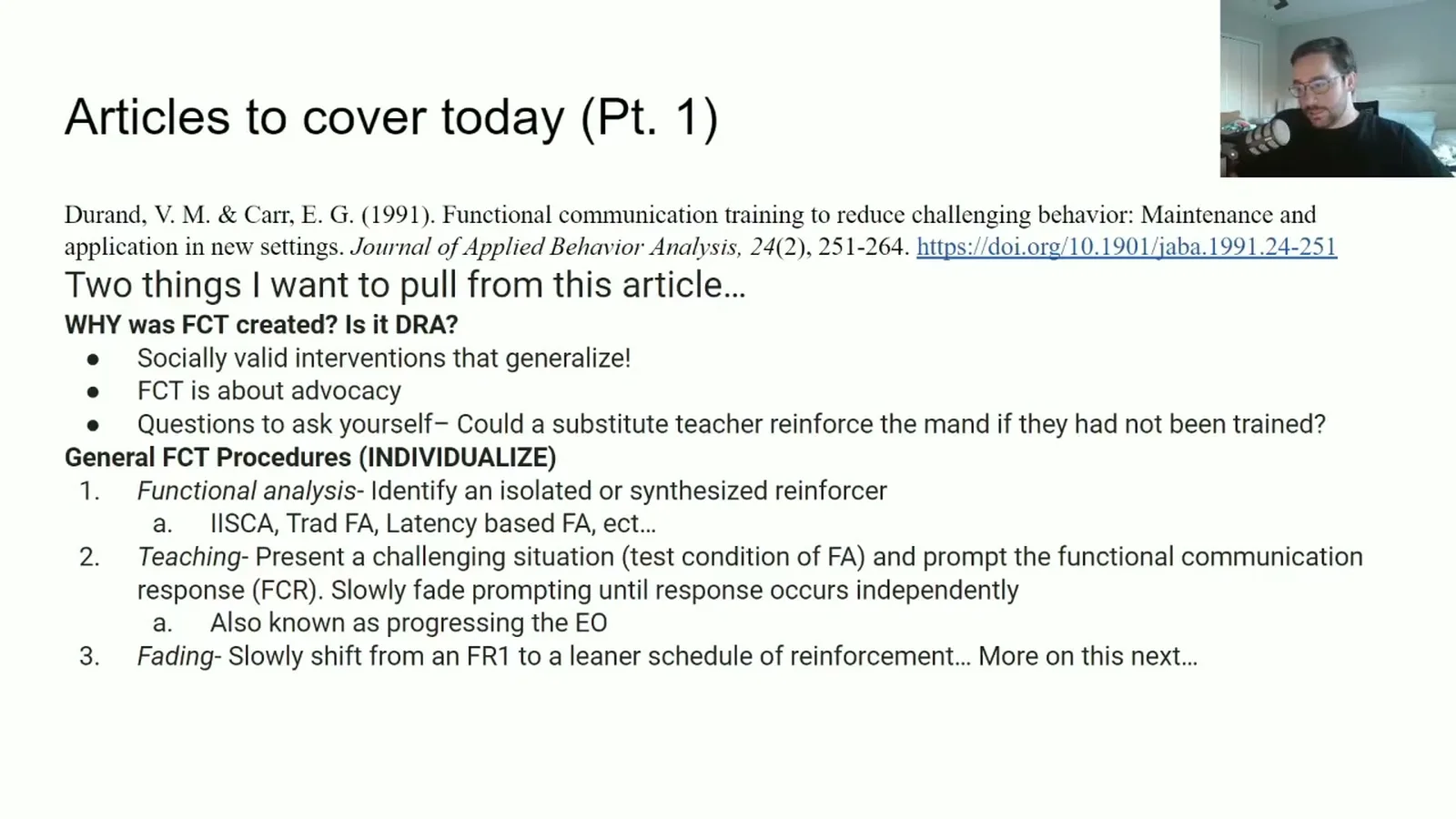
The “5 Days to Manding Mastery” course, created by Matt Harrington and presented by the Behaviorist Book Club, is a practical, research-informed training designed to help behavior analysts and practitioners enhance their understanding and implementation of mand training. The course addresses common challenges faced in early intervention and verbal behavior programs, particularly the tendency to implement mand training without adequate consideration of prerequisites, modality selection, or programming sequence. Over five sessions, participants explore foundational concepts such as prerequisite assessments, efficient prompting strategies, programming order, and generalization techniques. The course also introduces strategies for extending basic manding to more complex skills, such as manding for information and integrating functional communication training (FCT) to reduce problem behavior. It blends research findings with real-world clinical examples, offering a structured but flexible path to more effective, individualized communication programming.
Register free & watch nowCancel any time. Cert delivered to your inbox the moment you pass the quiz.
About this CEU
The “5 Days to Manding Mastery” course, created by Matt Harrington and presented by the Behaviorist Book Club, is a practical, research-informed training designed to help behavior analysts and practitioners enhance their understanding and implementation of mand training. The course addresses common challenges faced in early intervention and verbal behavior programs, particularly the tendency to implement mand training without adequate consideration of prerequisites, modality selection, or programming sequence. Over five sessions, participants explore foundational concepts such as prerequisite assessments, efficient prompting strategies, programming order, and generalization techniques. The course also introduces strategies for extending basic manding to more complex skills, such as manding for information and integrating functional communication training (FCT) to reduce problem behavior. It blends research findings with real-world clinical examples, offering a structured but flexible path to more effective, individualized communication programming.
What you'll learn
- 1By the end of this course, participants will be able to:
- 2Assess Prerequisites for Mand Training
- 3Identify key prerequisite skills (e.g., imitation, echoics, matching) that influence modality selection for manding.
- 4Discuss how caregiver input and client preferences should factor into modality decisions.
- 5Design Basic Mand Training Arrangements
- 6Set up naturalistic manding trials using progressive prompt delays.
- 7Describe the role of establishing operations (EOs) and how to capitalize on deprivation/satiation.
- 8Improve Acquisition Efficiency
- 9Analyze research comparing programming orders (e.g., mand-tact vs. tact-only training).
- 10Evaluate strategies such as EO manipulations and stimulus discrimination to improve response accuracy and generalization.
- 11Extend to Complex Mands and Generalization
- 12Differentiate between simple and complex mands, including manding for information.
- 13Implement caregiver training strategies to promote generalization outside of sessions.
- 14Integrate Functional Communication Training (FCT)
- 15Describe the relationship between FCT and mand training in problem behavior reduction.
- 16Identify prompting strategies and fading procedures for maintaining FCT while minimizing challenging behavior.
Concepts in this CEU
More from The Behaviorist Bookclub
Foundations of Reflective Supervision in Behavior Analysis
The Behaviorist Bookclub
Teaching WH-Questions Isn’t Enough: Building True Conditional Discrimination
The Behaviorist Bookclub
Reframing Behavior through an ADHD Lens
The Behaviorist Bookclub
OpenCEU is supported by advertising from third-party sponsors. Sponsors are clearly labeled, have no influence over course content, instructors, or CEU decisions, and never appear on certificates. The BACB does not sponsor, approve, or endorse OpenCEU sponsors or their products.