Parsimony in ABA: Rule Out Simple Causes First
Parsimony means ruling out simple explanations before complex ones. Learn how this Occam's razor principle sharpens clinical problem-solving in ABA.
Key takeaway
Parsimony is a rule for thinking. It says to rule out simple causes before complex ones. You test the easy explanations first. Then you move up only if you need to.
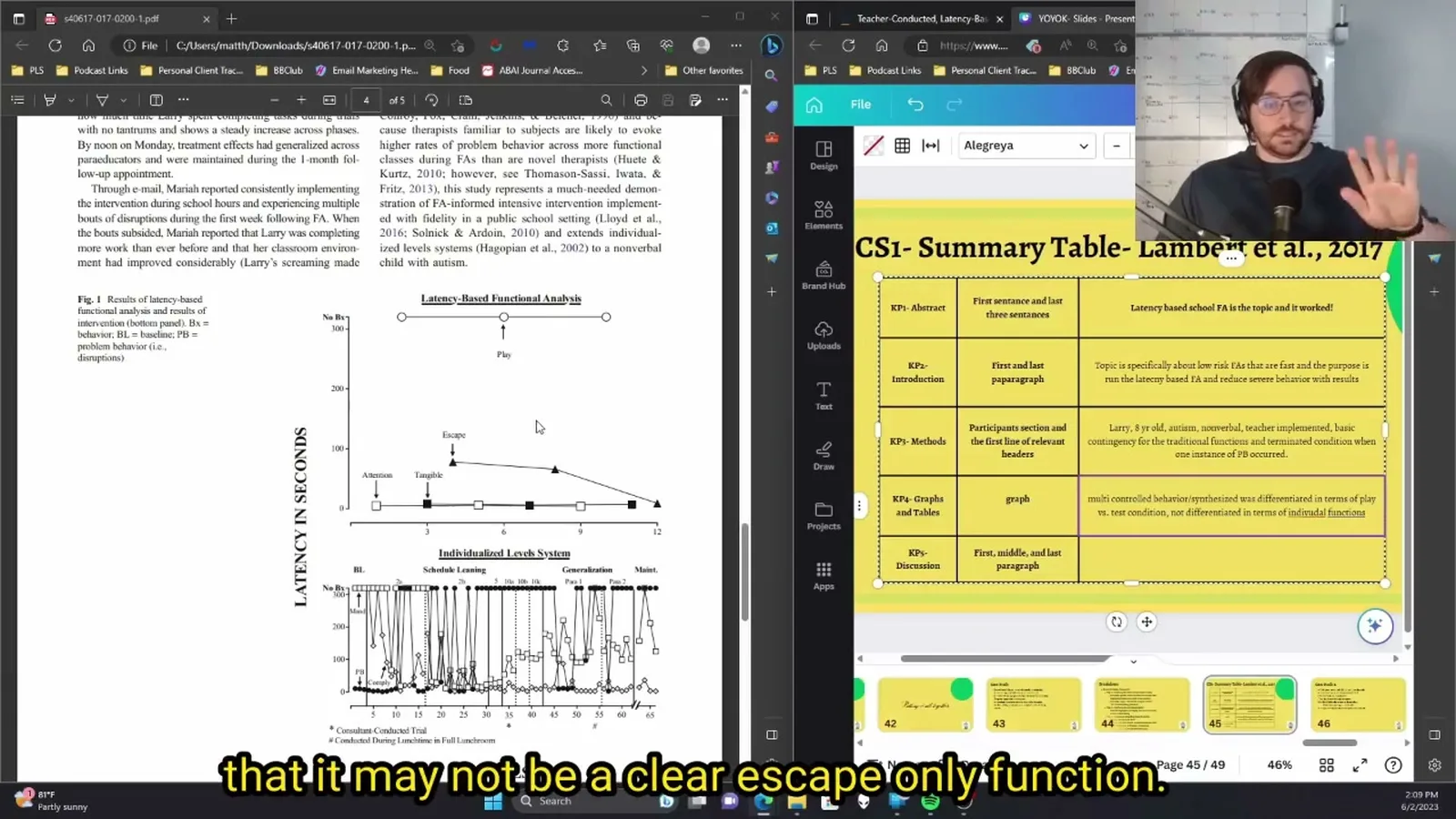
Solving Clinical Challenges with Research
Free learning path on this topic
Child Development for Behavior Analysts
Typical development for behavior analysts. Kristen Byra's overview, then Kelly Brzak's deep dives on ages 2 to 5, 6 to 8, and 9 to 11, with milestones, common problem behaviors, and programming tips for each band.
Experts who cover this
3 recordings on openceu cover parsimony aba.
- Featured talk2.50 CEUs
Solving Clinical Challenges with Research
Matthew HarringtonThe Behaviorist Bookclub
Harrington defines parsimony directly from Cooper's text and frames it as an Occam's-razor principle in ABA, urging clinicians to rule out simple variables…
- 1 CEU
Streamlining BIPs & Data Collection Systems for Schools
Nicola Schneider, LBA-NJNRS Compassionate Behavior Services
Schneider explicitly invokes parsimony as the design principle behind her simplified data system: the simplest data collection method that still produces a…
- 1 CEU
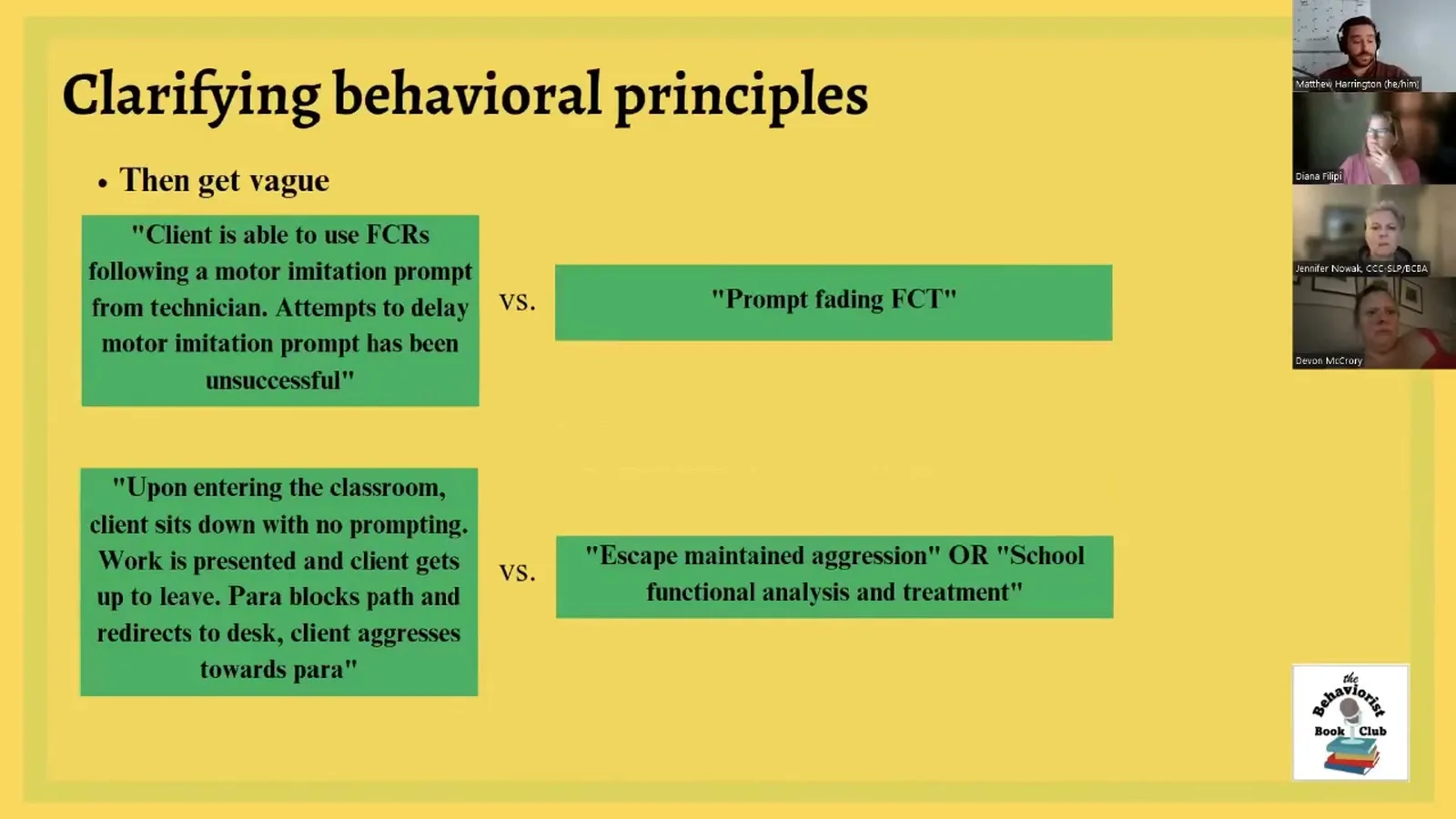
Research to practice - extending past the pages
Matt HarringtonThe Behaviorist Bookclub
Defined as ruling out simple, logical explanations before moving to complex ones, and applied to clinical troubleshooting by first conceptually ruling out…

On this page · 7 sections▾
Parsimony is a rule for thinking. It says to rule out simple causes before complex ones. You test the easy explanations first. Then you move up only if you need to.
This matters for daily clinical work. When a plan stops working, it is tempting to redesign everything. Parsimony pushes back on that urge. It saves time and keeps your reasoning honest. This page explains the rule and shows how to apply it.
The textbook definition#
Parsimony is one of the core attitudes of science in ABA. Matt Harrington pulls the definition straight from the Cooper text. It sets a clear order of operations for your thinking.
Parsimony is defined in the Cooper book, as all simple logical explanations for the phenomenon under investigation be ruled out experimentally or conceptually before moving to complex or abstract explanations before more complex or abstract explanations are considered. From the talk — Matthew Harrington
Read that slowly. It does not say simple answers are always right. It says you must clear them first. Only then do you reach for complex ideas. That order protects you from chasing the wrong cause.
Occam's razor for behavior analysts#
You may know this idea by another name. Occam's razor says the simplest answer is often best. Parsimony is that same razor applied to behavior. It is a family value of the science, not a personal style.
This is the classic Occam's razor kind of principle of behavior analysis, right? The simplest solution is oftentimes the best and most correct solution. From the talk — Matthew Harrington
The word "oftentimes" carries weight here. Simple is a strong bet, not a guarantee. Harrington is careful to spell out that limit. He does not want you to force every problem into an easy box.
I want to be clear, parsimony doesn't mean that every single time you have a challenge, the simplest solution will always be the correct solution. It just means that you should go there first. From the talk — Matthew Harrington
Why it keeps problem-solving focused#
 Advertisement
Clinical puzzles can spiral. There are endless articles to read and theories to chase. Without a starting rule, the search never ends. You can burn hours and still feel lost.
Parsimony gives you that rule. It tells you to simplify before you expand. That focus turns a huge question into a small, testable one.
Without parsimony, the search is endless. Meaning that as you go through this process, you need to focus on simplifying the challenge. From the talk — Matthew Harrington
In practice, the obvious cause is often the real one. When an intervention fails, check the basics first. Harrington says the most obvious answer is usually that the plan is not function based. That mismatch is the usual suspect.
A simple checklist to apply it#
Start with your measurement. Is your data reliable? Check whether two observers agree before you doubt the whole plan. Bad data can fake a real problem.
Next, check fidelity. Is the plan being run as written? Many "failures" are really staff drift, not a bad plan. Watch a session before you rewrite the program.
Then check your assessment. Is your preference or function data current? An outdated preference assessment can quietly break a good reinforcer. A stale reinforcer looks like a failed plan.
Only after those pass should you reach for bigger changes. Maybe the function really did shift. But you earn that conclusion by clearing the simple causes first. You can see this workflow modeled in Research to practice - extending past the pages.
A worked example#
Say a self-injury plan stops working. The team's first instinct is to suspect a new function. That is a big, complex change to chase. Parsimony says slow down and check the easy stuff.
Harrington uses this kind of case to show the logic. The self-injury happens clearly and out in the open. There is no hidden or covert part to it. So exact agreement between observers is likely high.
You can rule out some causes on paper. A basic technician can score obvious self-injury well.
It's reasonably likely that that topography of behavior would have high exact IOA with a technician who has a basic skillset, right? From the talk — Matt Harrington
So you cross measurement off the list quickly. Then you check fidelity and the reinforcer. Only after that do you consider a new function. That is parsimony in action.
What the research says#
Parsimony is a real subject of study, not just a slogan. A review of Elliott Sober's work describes two paradigms of parsimony used in science. They are tied to different views of probability (Smith, 2017). This shows the idea is deep and debated.
Parsimony also guides theory building. Researchers proposed a unified account of impulsivity. They argue their model has a good balance of parsimony and empirical grounding (Sosa & dos Santos, 2018). A simpler theory that still fits the data is preferred.
The same reasoning appears in debates over how behavior is explained. One reply argues that a model's heuristic value and parsimony can be judged from a stochastic view of causation (Sanabria, 2020). Across these papers, parsimony helps scientists choose between explanations.
FAQ#
Does parsimony mean the simplest answer is always correct? No. It means you test simple answers first. Sometimes the true cause is complex. Parsimony just stops you from jumping there before ruling out the easy stuff.
Where do I start when an intervention stops working? Check the simplest causes first. Look at your data reliability, treatment fidelity, and current assessments. Most failures trace back to one of those before any deep clinical change is needed.
Does parsimony apply to research questions too? Yes. It helps you narrow a broad question into a testable one. You rule out simple explanations before diving into the literature. That focus keeps your search from becoming endless.
 Advertisement
Turn this topic into a CEU
You just studied this. Now get credit for it.
Watch Solving Clinical Challenges with Research with Matthew Harrington and earn 2.5 free BCBA CEUs. Detailed certificate, delivered the moment you finish.
Keep going with a free learning path
Child Development for Behavior Analysts
Typical development for behavior analysts. Kristen Byra's overview, then Kelly Brzak's deep dives on ages 2 to 5, 6 to 8, and 9 to 11, with milestones, common problem behaviors, and programming tips for each band.