Escape-Maintained Behavior in ABA, Explained
Escape-maintained behavior happens when a person acts out to get away from a task. Learn what drives it and how to treat it.
Key takeaway
Escape-maintained behavior is behavior that keeps happening because it helps a person get away from something. That something is usually a task, a demand, or a hard moment.
Research to practice - extending past the pages
Free learning path on this topic
Master PFA and SBT
Matt Harrington's 12-article walk through practical functional assessment and skill-based treatment, from Hanley's 2014 study to the enhanced choice model. Then assent, since SBT depends on it, and the ethical guardrails that keep behavior reduction defensible. Five CEUs, one of them ethics.
Experts who cover this
2 recordings on openceu cover escape-maintained behavior.
- Featured talk1 CEU
Research to practice - extending past the pages
Matt HarringtonThe Behaviorist Bookclub
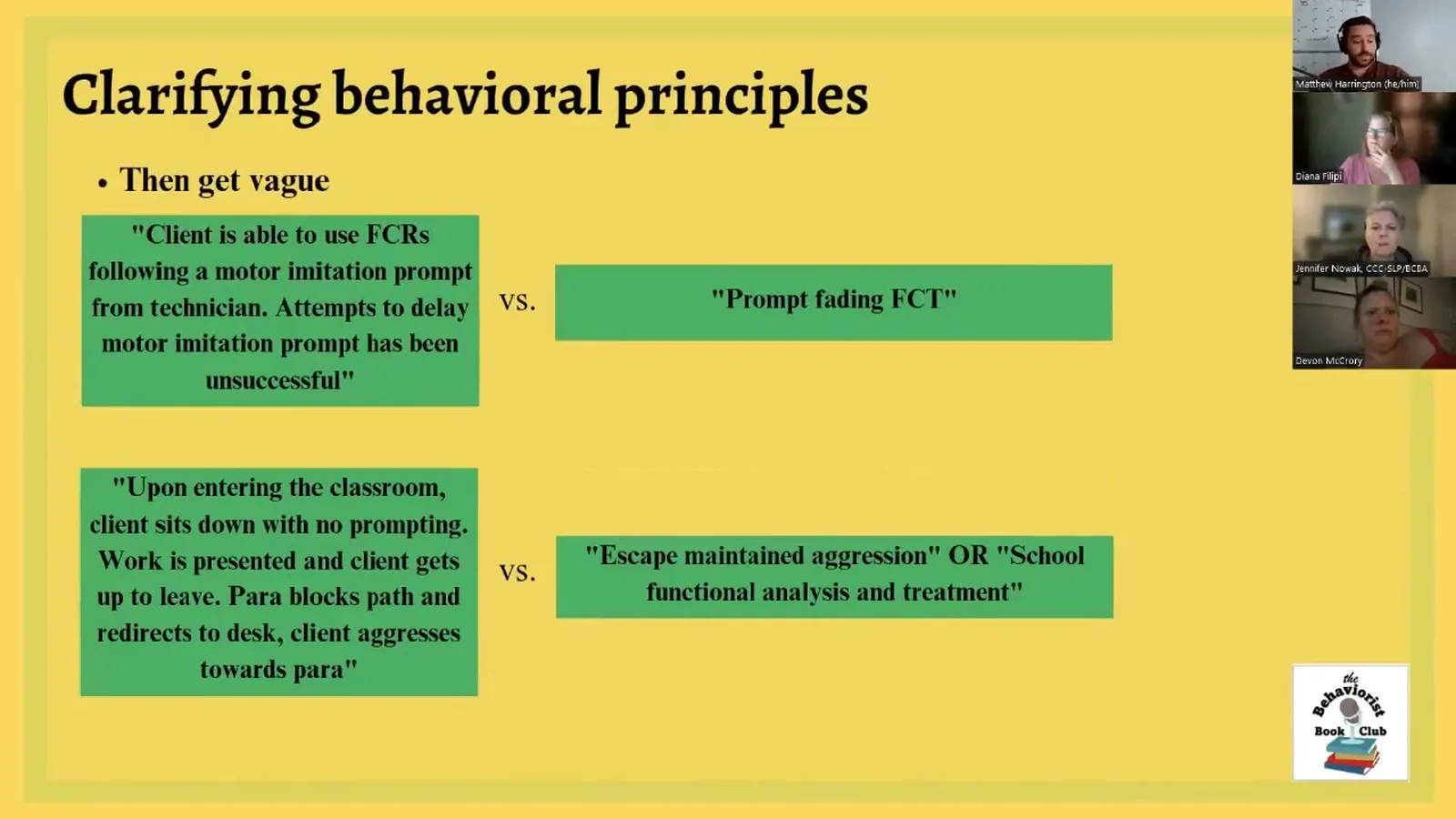
Used as the example clinical problem in the search-term walkthrough, showing how a specific classroom scenario (blocked path, redirect, aggression) translates…
- 0.50 CEUs
Beyond Compliance: What Assent-Based ABA Looks Like in Real Life
Danielle VirnelsonDani Elle Mentorship and Consulting
Reframes escape-maintained behavior through an assent lens, asking whether challenging behavior is communicating withdrawal from a non-consented-to demand…

On this page · 8 sections▾
Escape-maintained behavior is behavior that keeps happening because it helps a person get away from something. That something is usually a task, a demand, or a hard moment. The behavior works, so it comes back.
This matters because it is one of the most common reasons kids act out during work. When you know a behavior is about escape, your whole plan changes. You stop guessing and start teaching. This page pulls together what several experts and studies in ABA, or applied behavior analysis, the science of how behavior is learned, say about it.
What escape-maintained behavior means#
Behavior sticks around when it pays off. With escape, the payoff is a break from a demand. A student throws a worksheet, the worksheet goes away, and the throwing gets stronger over time. In behavior science this is called negative reinforcement, which means a behavior grows because something unwanted gets removed.
The behavior itself can look like many things. It can be aggression, dropping to the floor, yelling, or leaving the room. The shape does not tell you the function. What matters is what happens right before and right after. If the pattern points to a break from work, you are likely looking at escape.
How a vague report becomes a searchable problem#
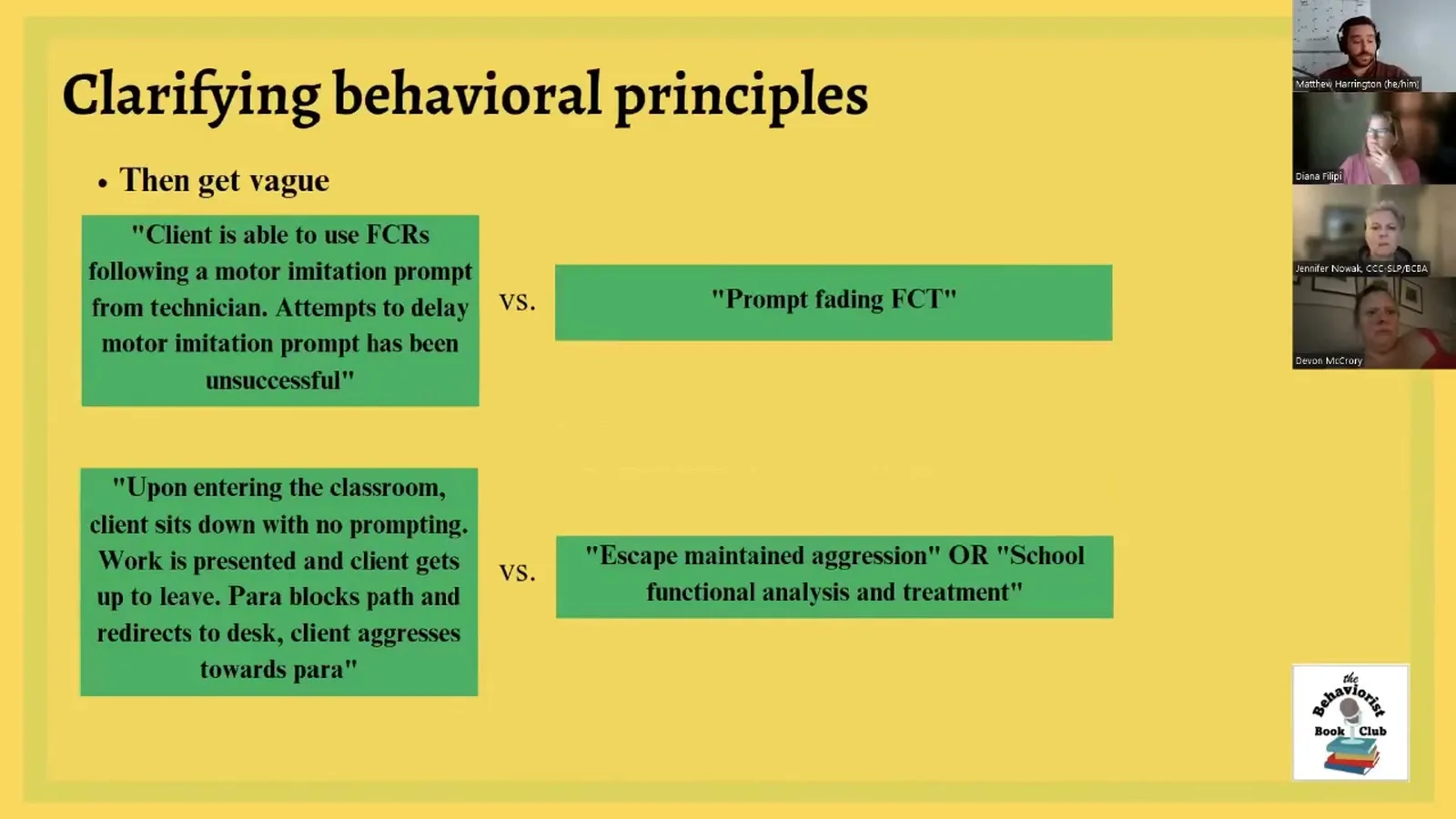
Matthew Harrington teaches teams to turn fuzzy notes into a real, testable problem. A note that just says "client is aggressive" gives you almost nothing. You cannot plan from it, and you cannot search the research with it. You need the sequence around the behavior.
He walks through a classroom example. Work is placed in front of the student. The student gets up to leave. A staff member blocks the path and redirects them. Then the aggression starts. Once you describe that chain, the picture is clear.
Work is presented and client gets up to leave. Para blocks path, redirects to desk, and the client aggresses towards para... Now we're looking at closer to escape maintained behavior, right? From the talk — Matthew Harrington
With that sequence in hand, you get a real search term. Harrington points teams toward phrases like "escape maintained aggression" and "school functional analysis and treatment." Now you have something to look up. The research opens up once the words match what is actually happening.
The antecedent side: what sets it off#
Escape behavior starts with a trigger. In most cases the trigger is a task instruction. When you know which demands set off the behavior, you can plan around them. One study looked closely at these antecedent stimuli, which just means the events that come right before a behavior.
The researchers found that the behavior showed up fast across different settings and staff. The task instruction itself acted as the signal to escape. Interestingly, the behavior dropped a bit when the task was familiar. That hints at a useful lever. Task difficulty and novelty both shape how much a person wants out.
Teaching skills so escape is not needed#
 Advertisement
Sometimes a person escapes because the task is genuinely too hard. If the skill is missing, the demand feels endless. Build the skill and the reason to escape shrinks. One case study on dressing tasks tested this idea directly.
The team used frequency building, which means practicing a small motor skill until it is fast and smooth. As the students got quicker and more accurate at dressing, their escape behaviors went down. This is a hopeful point. Some escape behavior is really a signal that we skipped a step in teaching.
Choice, communication, and fading demands#
Escape does not have to mean full removal of the task. You can give a better way to ask, and you can shape how breaks are earned. Two common tools help here. Functional communication training teaches a clear request, like saying "break please." Differential reinforcement of compliance rewards a person for following directions.
One study chained these two tools together on a schedule. Both lowered challenging behavior, but the communication piece produced the largest drops, and every participant preferred it. When the two were combined and slowly stretched out, behavior stayed low and cooperation stayed high.
Choice also helps. In another study, a child could pick a positive reward or an escape break for finishing work. The positive reward won more often and kept behavior low. But when the work demand got long, that steady preference started to wobble. Fading demands too fast can undo good progress.
Even a simple time-based break can help. A fixed-time escape schedule gives a break on a set clock, not tied to any behavior. In two junior high students, this cut disruption and raised time on task. The break comes anyway, so acting out to force one stops paying off.
Reframing escape through assent#
Danielle Virnelson adds a question many plans skip. She asks us to look at escape behavior through an assent lens. Assent means the learner is willing and not pushing back against care. Under this view, escape is not only a problem to erase. It can be a message. Virnelson says the whole treatment approach changes once a team makes that reframe.
She pushes teams to weigh the demand itself, not just the behavior. Maybe the person has a fair reason to want out. You can hear that message and still teach skills.
We are not just reducing escape. We are asking whether the learner should have the right to escape this particular demand. From the talk — Danielle Virnelson, MS, BCBA, LBA
You can go deeper on this idea in Beyond Compliance: What Assent-Based ABA Looks Like in Real Life.
What the research says#
The studies below back up the tools on this page. They come from peer-reviewed ABA journals.
Ferris, E. L., Howard, A. R., Baker, E., Hodge, D. J., Craig, A. R., Roane, H. S., & Sullivan, W. E. (2026). Chaining Differential Reinforcement of Compliance and Functional Communication Training to Treat Challenging Behavior Maintained by Negative Reinforcement. Behavioral Sciences, 15(7). https://doi.org/10.3390/bs15070891
This study showed that teaching a request and rewarding compliance work well together. Chaining them on one schedule kept behavior low and cooperation high, even as demands grew.
Zabala, K. A., & Wunderlich, K. L. (2021). The Use of Contingency-Based Procedures to Promote Tolerance of Schedule Thinning for Hypothesized Multiply Maintained Problem Behavior. Behavior Analysis in Practice, 15(1), 312-317. https://doi.org/10.1007/s40617-021-00646-9
This work looked at helping people wait longer for a break. The method helped both participants tolerate delays, especially after switching to a lower effort task.
Bryson, A. M., & Zea, M. D. (2023). The Effects of Motor Fluency on Dressing Tasks and Decreasing Escape Behaviors. Behavior Analysis in Practice, 17(1), 316-322. https://doi.org/10.1007/s40617-023-00839-4
This case study built up motor skills for dressing. As the skills got faster and more accurate, escape behaviors dropped during the task.
Frequently asked questions#
How do you know a behavior is escape-maintained?
You watch what comes before and after it. If the behavior tends to follow a demand, and it tends to end with a break from that demand, escape is likely. A functional analysis, which is a careful test of why a behavior happens, confirms it. A board certified behavior analyst, the clinician who plans care, usually runs that test.
Is escape extinction the only fix?
No. Escape extinction means the break no longer follows the behavior, and it can help, but it is rarely used alone. Teaching a clear way to ask for a break often works better and feels kinder. Building missing skills and offering choices also lower the need to escape in the first place.
Can escape behavior ever be reasonable?
Yes, and this is worth sitting with. Sometimes a person is telling you a demand is too hard, unfair, or unwanted. You can honor that message while still teaching. The goal is not blind compliance. It is a plan the learner can agree to.
 Advertisement
Turn this topic into a CEU
You just studied this. Now get credit for it.
Watch Research to practice - extending past the pages with Matt Harrington and earn 1 free BCBA CEU. Detailed certificate, delivered the moment you finish.
Keep going with a free learning path
Master PFA and SBT
Matt Harrington's 12-article walk through practical functional assessment and skill-based treatment, from Hanley's 2014 study to the enhanced choice model. Then assent, since SBT depends on it, and the ethical guardrails that keep behavior reduction defensible. Five CEUs, one of them ethics.