Social Validity in ABA: Goals, Methods, and Real Results
Social validity asks if ABA goals matter, if methods are acceptable, and if results help. See how 17 BCBAs measure it, and where they disagree.
Key takeaway
Social validity is how much clients and families agree that a plan's goals, methods, and results are worthwhile. In plain words, it asks the family and the client one question.

genArete: To Teach or not to Teach!
Free learning path on this topic
Child Development for Behavior Analysts
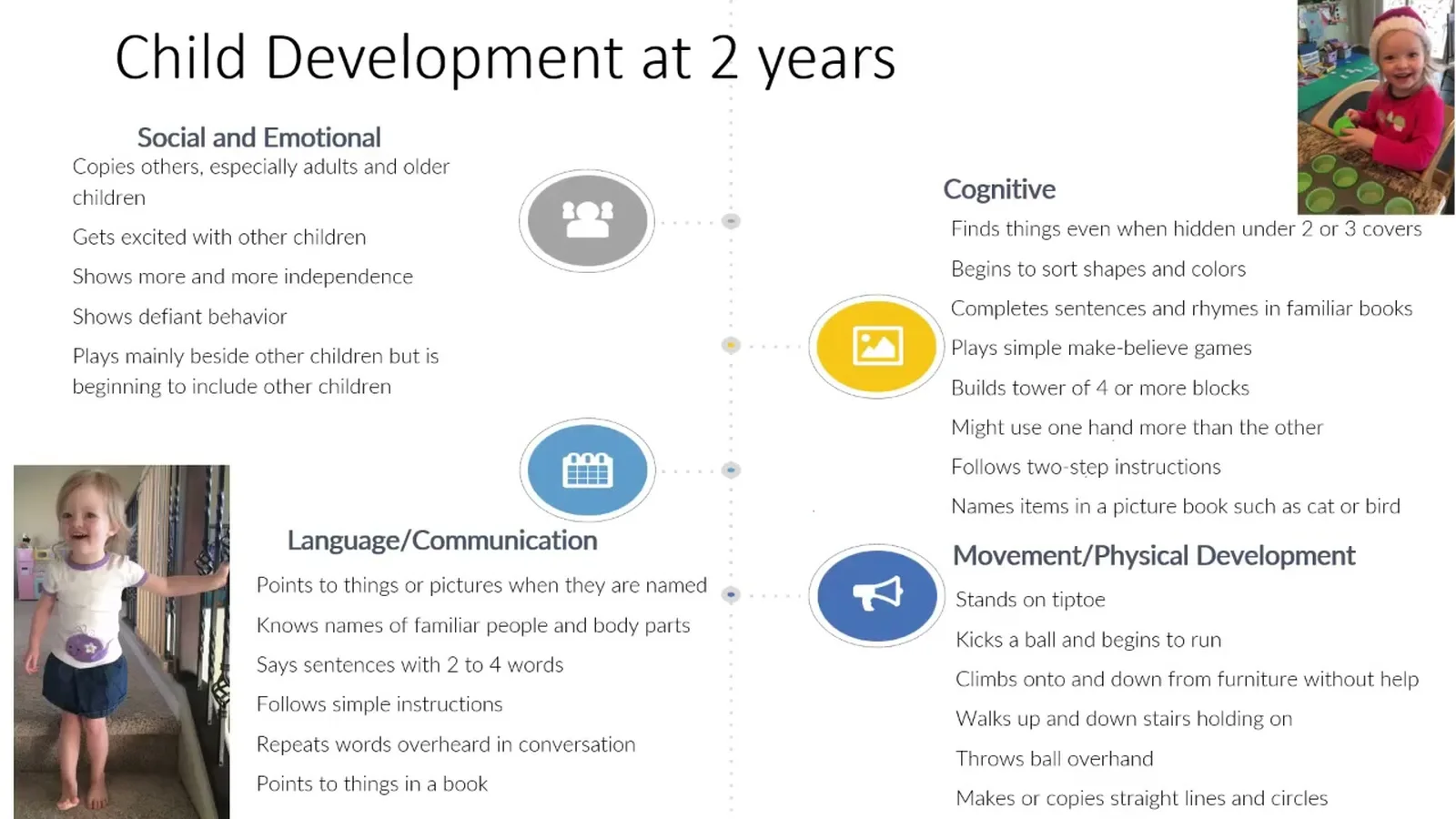
Typical development for behavior analysts. Kristen Byra's overview, then Kelly Brzak's deep dives on ages 2 to 5, 6 to 8, and 9 to 11, with milestones, common problem behaviors, and programming tips for each band.
Experts who cover this
10 recordings on openceu cover social validity.
- Featured talk1 CEU
genArete: To Teach or not to Teach!
Mark MaladyThe Behaviorist Bookclub
Mark reviews Wolf's 1978 three levels of social validity (goals, procedures, effects) and cites a 2010-2020 JABA review finding only 17-18% of studies measured…
- 1 CEU
From Research to the Applied Setting: Breaking Down the Three-Legged Stool of "Evidence Based Practice"
Dr. Jessica OsosCopper Consulting Group
The third leg covers family priorities, cultural considerations, child preferences, feasibility, and organizational constraints, with the caveat that honoring…
- 1 CEU
Is It Technical or Relational? A Framework for Pinpointing Caregiver Collaboration Breakdowns
Leanne PageParenting with ABA
Describes a 'good fit form' tool that captures social validity on the fly, letting caregivers check boxes rating how doable a plan is instead of verbally…
- 1 Supervision CEU
Toward an Evidence-based Supervision Model: Training Students in Independent Fieldwork
Dr. Allison Bowhers-PeutinWillow Mentorship & Consulting, LLC
Both supervisors and trainees completed social validity questionnaires after trainings to gauge acceptability of the program; scores were consistently high…
- 1 CEU
School Collaboration as an Area of Competence - Applied 2022
Dr. Clelia SigaudThe Behaviorist Bookclub
Applied to IEP practice as a caution against imposing the clinician's own idea of what matters: goals and participation must reflect what's meaningful to the…
- 1 CEU
Research to practice - extending past the pages
Matt HarringtonThe Behaviorist Bookclub
Framed as the ultimate goal of pulling research into practice, illustrated by a client independently attending a friend's wedding as a ring bearer and by the…
- 1 CEU
Shaping Behavior Change when ADHD is in the Picture
Nicole StewartThe Behaviorist Bookclub
Nicole highlighted parent-reported real-world outcomes (e.g., managing a birthday party or a sleepover) as an important, sometimes overlooked, measure of…
- 1 CEU
PDA: Collaborating for Success
B. Kuereine GrayThe Behaviorist Bookclub
Referenced through a 2025 study design that measured whether caregivers implementing PDA interventions perceived them as effective, not just whether the…
- 1 CEU
Child Development for Behavior Analysts
Kristen ByraThe Behaviorist Bookclub
Listed as one of the key considerations, alongside functionality and age, when deciding whether a goal is actually a good fit for a given child.
- 1 Supervision CEU
So You Think You Can Lead, Ten Self Reflection Questions for Leaders in ABA
Sean YocumHickory Learning Group
Invoked via Wolf (1978) to argue leadership must value how staff and clients are treated as much as the clinical data produced, extending social validity…




On this page · 15 sections▾
Social validity is how much clients and families agree that a plan's goals, methods, and results are worthwhile. In plain words, it asks the family and the client one question. Is this worth doing, and is it working for you?
It matters because a plan can look perfect on paper and still fail a family. Graphs can climb while daily life stays hard. Across 17 conference talks, BCBAs (board certified behavior analysts) returned to this idea again and again. They agree it is important. They do not fully agree on who should be asked, how often, or how much weight the answer should carry.
What social validity means: the three parts#
Almost every speaker went back to the same starting point. That is a 1978 article by Wolf. It split social validity into three parts that still frame the topic today.
In a talk co-presented with Kaelynn Partlow, BCBA Anna Marie Stoudemire laid those three parts out plainly.
One of my favorite articles is by Wolf from 1978. And he really kind of sets the definition for what social validity is. The three areas that he highlights are selecting meaningful goals, using procedures that are acceptable to the consumers, and then ensuring that we achieve outcomes that actually are achieving those initial goals that we set out with.
From the talk — Anna Marie Stoudemire (with Kaelynn Partlow)
So there are three questions. Do the goals matter? Are the methods (the procedures, or the steps of the plan) acceptable? Did the results actually help? Stoudemire added that Wolf defines "society" loosely. He means the client, the relevant stakeholders, and their community.
Brian Middleton gave a one-line definition that works well for families.
Social validity refers to the extent to which behavior analytic interventions are socially acceptable, meaningful, and relevant to the individuals and communities being served.
From the talk — Brian Middleton
Dr. Shane Spiker stressed that all three parts belong together. He compared them to a three-legged barstool. You need all three legs for it to work. He also pointed to research by Park and Blair. It found that support aimed at socially significant goals tends to be more successful. It also found few studies that checked all three parts at once.
Why the field keeps skipping it#
Every speaker who looked at the research found the same gap. Social validity is praised often and measured rarely.
Stoudemire cited a 2018 review by Ferguson and colleagues. It covered every article in JABA (the Journal of Applied Behavior Analysis) up to 2018. Only 12% measured any kind of social validity. That was 141 of about 1,200 articles. Then she narrowed it further.
So 17 out of 1200 articles asked the question, are these goals that we are about to tell you how to teach or talk about actually meaningful?
From the talk — Anna Marie Stoudemire (with Kaelynn Partlow)
Mark Malady found a similar pattern in a newer window. From 2010 to 2020, about 17 to 18% of JABA studies included any social validity measure. That was about 160 studies.
Lauren Weaver said the field has known better for decades. She named Schwartz and Baer's 1991 guidance as the clearest roadmap. Yet in every review her team has done, the gap remains. When social validity is measured, it usually happens at the very end of services.
Stoudemire asked the obvious question. Social validity shows up in Wolf, in the seven dimensions of ABA, in the ethics code, and in the task list. So why is it still missing from so much published work? No speaker claimed a full answer. Stoudemire did warn against filling in colored boxes just to satisfy funders. Kristen Byra made the same warning about parent interviews.
The forgotten part: effects nobody predicted#
Mark Malady reread Wolf's article and noticed a detail most people skip. The third question is about outcomes. Wolf did not only ask about the outcomes the team was aiming for.
Are consumers satisfied with the results, all the results, including any unpredicted ones.
From the talk — Mark Malady, BCBA
Malady said this is where the field has the most room to grow. He pointed to the unplanned byproducts of our change procedures. Teams rarely track them, even though families live with them every day.
The research backs him up. When reviewers broke social validity into Wolf's three levels, the first level got the most attention. The second got a similar amount. The third, satisfaction with effects, got almost nothing. Malady put the job on working clinicians. He asked whether social validity data is actually used to make decisions, and whether teams adapt when it says something is off.
He also read aloud a playful passage from Wolf. Wolf was mocking the old attitude that client opinions do not count.
I thought to myself, what in the world am I going to do with this one? They're asking the participants in a behavioral treatment program how much they like it. Why, of course, they should like it.
From the talk — Mark Malady, BCBA
The joke lands because some of that attitude still exists. Wolf's sarcasm continues with "we know what is best for them." That is exactly the stance social validity was built to challenge.
Goals: who decides what matters#
Picking goals is the first part of Wolf's model. It is also where most of the research is missing. Several speakers focused here.
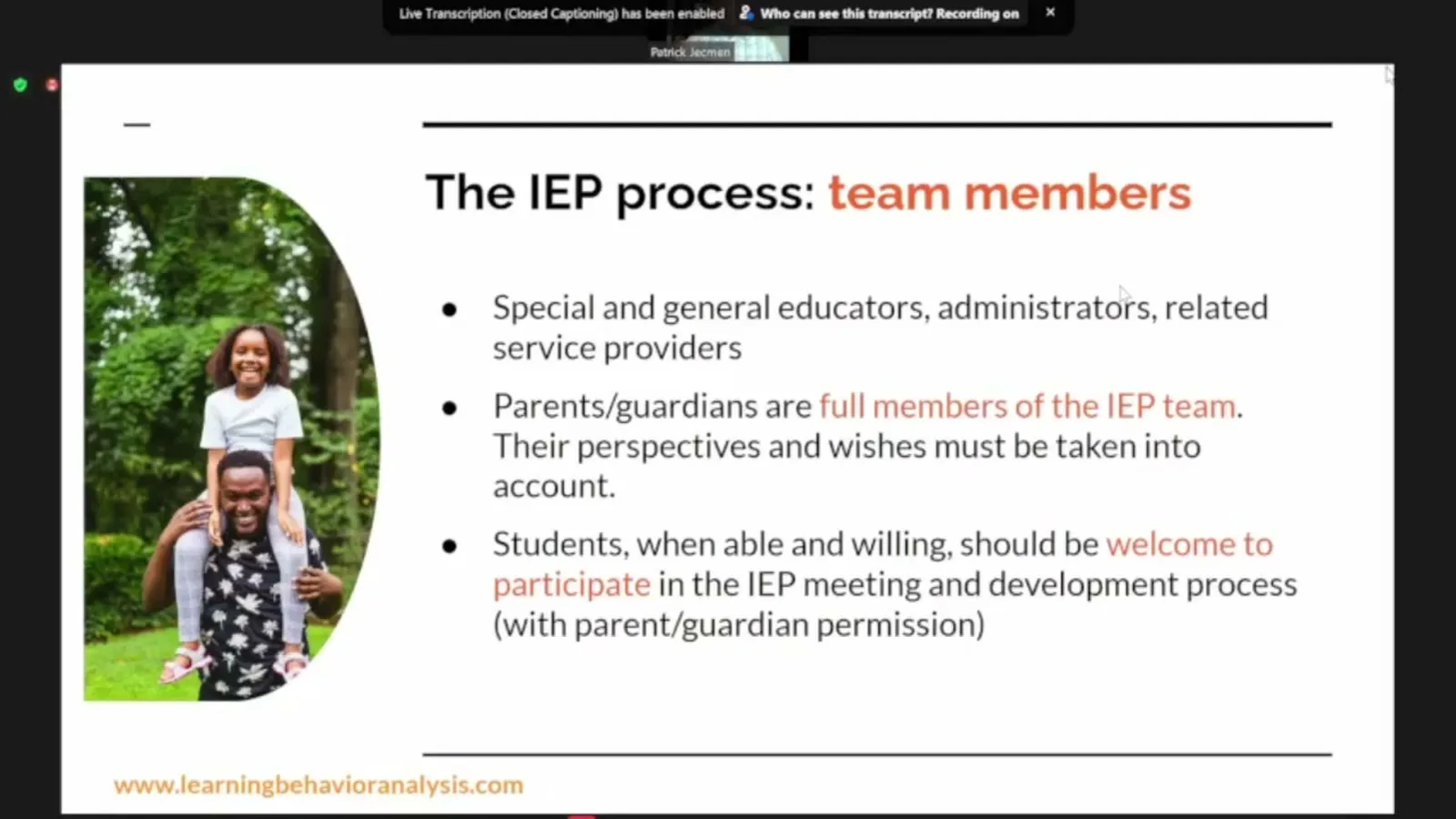
Patrick Jackman works in schools, where IEP (individualized education program) meetings set a student's goals. He said students and parents are often left out of those meetings. To him, that makes claims of meaningful goals hard to believe.
social significance is about the individual... it's really difficult to be leaving out students, parents and guardians, and then claim that we are working on socially significant targets for students.
From the talk — Patrick Jackman
Jackman asked clinicians to make space for families to speak. He said to listen to learn, not to respond. He also urged humility, because public schools serve families with very different norms and values.
Kristen Byra gave a goal-picking checklist of 12 areas. Social validity sat right next to the skill's usefulness and the child's age. Her example was a 12-year-old being taught to fill in nursery rhymes. That goal misses on all three counts. It is not useful, not meaningful to the family, and not right for the child's age.
Penny Holloway builds goals by "programming backwards." For every goal, she asks whether the client can still do it at 18. If an adult has to hold his hand or drag him along, the goal does not pass.
Procedures: when the method itself is the problem#
The second part of social validity asks whether the methods are acceptable. Dr. Shane Spiker used this lens to question physical restraint in schools and clinics.
In what world would it be okay that we restrain our coworkers? Probably not, right?
From the talk — Dr. Shane Spiker
He pointed out that restraint is rare outside special education and behavior classrooms. If a coworker did something wrong, we would give feedback or talk to a supervisor. Nobody would hold them down. Spiker warned that once teams assume restraint is needed, they start to treat it as acceptable.
Restraint is not a common thing. It should not be a socially acceptable thing.
From the talk — Dr. Shane Spiker
He did not say risk never exists. He said teams must balance the context. But he asked a simple test. Would you feel good if this showed up on TV? He admitted most of us would feel good that someone stayed safe. We would not feel good about how it looked. His fix was to add social validity checks to the assessment battery at the start and keep them going.
Dr. Holly Gover faced the same question in feeding therapy. Many feeding programs have used escape extinction (not letting a child avoid the bite). It can work, but it often causes crying and distress. Her research team set out to find an option that worked without that distress.
Outcomes: when great graphs are not enough#
 Advertisement
The third part asks whether the results truly helped. Penny Holloway told the most personal story on this point.
Holloway and her colleague Ellie took on a new client halfway through the year. Their data looked great. Problem behavior was down and skills were climbing. She was sure insurance would be happy. Then they asked the parents.
we still score very low. So this really breaks my heart because we have not made progress for this family yet.
From the talk — Penny Holloway
For Holloway, that ended the debate. If the parent says they see no change, the graph does not matter much. She asked what the work was for if the family feels nothing has changed. Her team now writes social validity questions for every single goal at the start of treatment.
Her questions came from a study by Josh Jessel. Parents are asked whether they found the treatment acceptable. They rate whether they were satisfied with the amount of problem behavior. They also rate the change in communication skills.
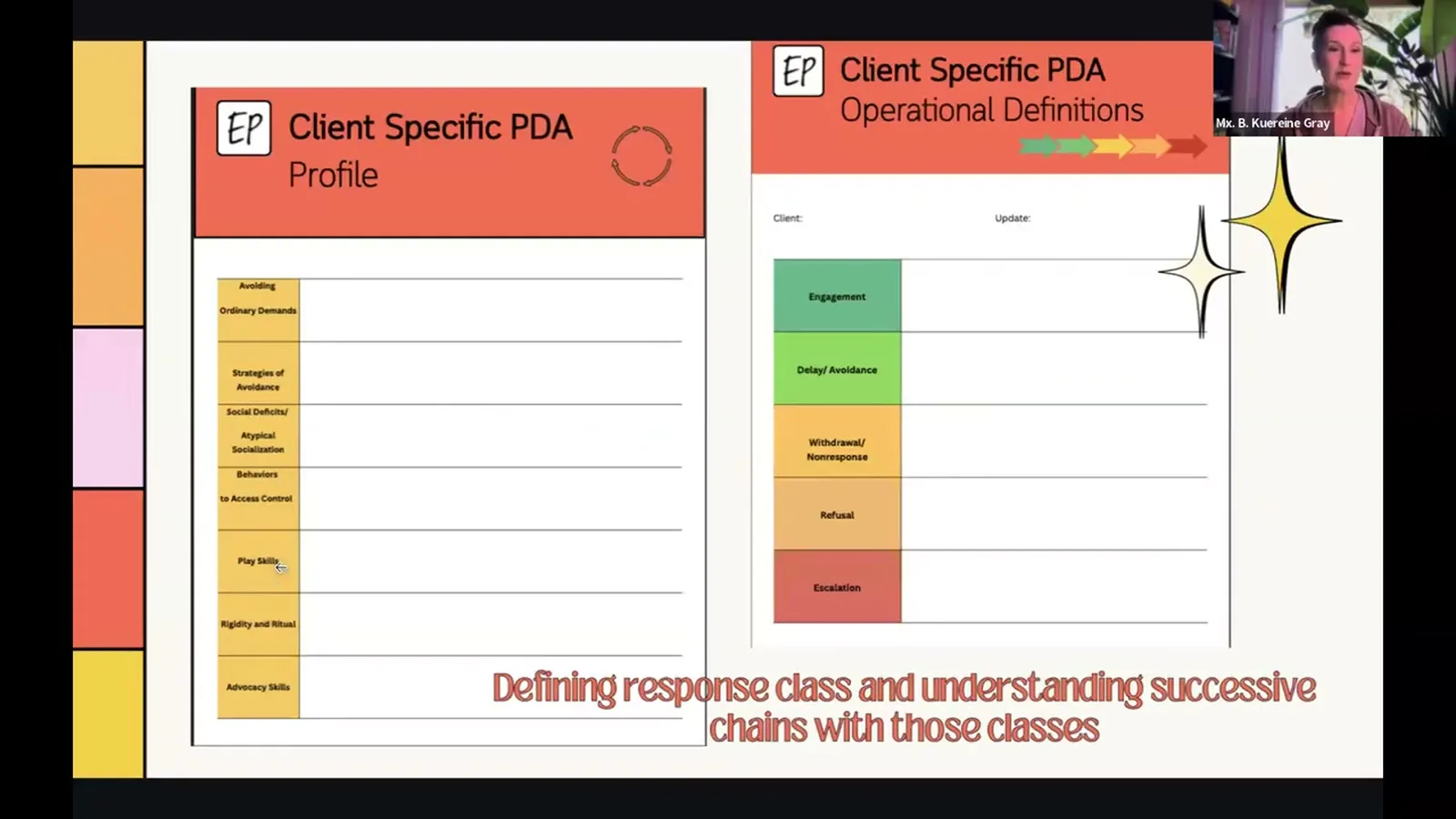
B. Kuereine Gray pointed to a similar shift in research on PDA (pathological demand avoidance). She described a new study that looked past whether an intervention works in theory.
It looks not at, is the intervention efficacious, but caregivers implementing the intervention and the social validity.
From the talk — B. Kuereine Gray
The study asked whether caregivers saw an impact and rated one. It also checked that against an independent measure.
Real-world wins that never show up on a graph#
Some of the clearest signs of social validity happen far from the therapy room. Two speakers shared examples.
Matt Harrington described helping his own three-year-old sit through church. He used research on multiple schedules (clear signals for when something is available). Step by step, he built up time in the pew. Then a real test arrived. The children were ring bearers at a close friend's Catholic wedding.
this was able to help them get that real social validity of attending one of their best friends' weddings and having their kids participate.
From the talk — Matt Harrington
He was honest that his son still ran around the back of the church. The graph was not the point. When a goal is so valuable that a family reshapes a whole weekend to practice it, solving it builds deep trust. Harrington said that trust only came from pulling research, combining it, and fitting it to the child in front of him.
Nicole Stewart works with children who have ADHD. She said session data is not enough, because the real test is life outside the session.
Social validity would be really important. Our parents reporting this.
From the talk — Nicole Stewart, BCBA
Stewart listens for moments like a first sleepover or a trip to a Yankees game. She also counts a meltdown at McDonald's that the family handled together. To her, a family managing hard moments better is real progress, even if the behavior still happens.
Measure it before, during, and after#
A strong theme across talks was timing. Most research checks social validity once, at the end. Several speakers called that too late.
Lauren Weaver built her whole consultation model around ongoing checks in schools. She uses Likert-scale surveys (rating scales, like 1 to 5) and interviews. She gathers input from the student, the family, and the school team. She also warned about a quiet assumption in the field.
We have assumed that social validity obtained in one study means those procedures are socially valid for forever, but there's more nuance than that.
From the talk — Lauren Weaver
A method rated acceptable for one family in one study may not fit your client. The only way to know is to ask. Weaver's survey questions included whether the plan targeted the goals and whether people were comfortable with the procedures. One question stood out. It asks whether the team believes the student experienced trauma from the assessment or intervention. She closed with the line from Schwartz and Baer that framed her talk.
Social validity assessments should be conducted prospectively and throughout an intervention, as well as at the end. Otherwise consumers' concerns about the program cannot be answered in ways that defend the consumers, the program, and the discipline.
From the talk — Lauren Weaver
Weaver also used a decision flowchart. It helps the team sort things out when people disagree about goals or procedures.
Who gets asked: including the client#
Dr. Jen Austin raised a harder question. Even when social validity is measured, who answers the survey? Her team at Georgia State is reviewing the research on when it happens, what is measured, and who is asked.
Social validity appears very much to be an afterthought. It typically occurs at a single point in time in research that tends to be at the end of a study.
From the talk — Dr. Jen Austin
She also found that goals, methods, and results are usually rated by someone other than the client. That might be a parent, a teacher, or direct care staff. Austin framed this through trauma-informed care, which values shared governance (the client having a real say in decisions).
For social validation to qualify as shared governance, we need to be doing it before, during, and after treatment, and we need to include the client.
From the talk — Dr. Jen Austin
Austin admitted this is easier with clients who can talk about what they want. But she noted the field already has tools for clients with limited speech. She pointed to Greg Hanley's work on concurrent chains. In that setup, a client picks between options and shows which treatment they prefer by their choices.
Tools for catching problems early#
Several speakers shared simple tools for asking families what they think. The shared goal is to get honest answers, not polite ones.
Leanne Page coaches parents. She noticed that parents often say "yep, I get it" even when they have doubts. So she built what she calls a good fit form.
I call social validity on the fly
From the talk — Leanne Page
The form lets parents check boxes about how doable a plan feels. It gives them an easy way to say "no, thank you." Page tied this to power. Many families have been talked down to by professionals before. A checkbox can be safer than disagreeing out loud.
Holloway's version is a questionnaire on every goal, given at the start of treatment and repeated over time. Weaver's is a Likert survey plus interviews, repeated through the consultation. The formats differ. The purpose is the same. Each one creates a regular, low-risk moment for families to say something is not working.
Plain language and real informed consent#
Families cannot judge a plan they do not understand. Brian Middleton made this point through the lens of "behaviorese," the jargon behavior analysts use with each other.
Middleton listed clear communication itself as a marker of social validity. When families understand, confusion drops and engagement rises. He said confused people shut down, while understanding breeds engagement. Parents in his coaching sessions start using behavior terms in everyday language.
Informed consent. Not a hope of it. Actual informed consent. Like, we can't have the hope that people understand what's going on. Informed consent means they understand what's happening.
From the talk — Brian Middleton
Patrick Jackman made the same point about school evaluations. He said it is not informed consent if stakeholders do not understand what you are saying. Both speakers treated plain language as the ground floor. Without it, any rating a family gives is shaky.
Beyond clients: staff and trainees#
Two speakers applied social validity to the people who deliver services. This stretches Wolf's idea past clients and families.
Sean Yocum talked about leadership in ABA companies.
Wolf 1978 tells us all about social validity and leadership means that the way we treat our staff and clients is just as important as the clinical data we produce.
From the talk — Sean Yocum
For Yocum, this shows up in small habits. He mentioned asking about a staff member's weekend and actually listening. He also mentioned celebrating small wins instead of only pointing out mistakes.
Dr. Allison Bowhers-Peutin measured it directly in a supervision study. After each training, supervisors rated the program. Their average scores were about 4.1 to 4.2.
Trainees were also given an opportunity to complete a social validity questionnaire.
From the talk — Dr. Allison Bowhers-Peutin
The trainee survey asked whether goals were helpful and how trainees felt treated in the supervisory relationship. Their average rating was 4.6. That gave her team evidence that the model was acceptable to both sides.
Where experts disagree about how much weight it carries#
Every speaker agreed social validity matters. But they did not agree on two big questions.
Should it override the data? Penny Holloway put it at the top.
the most important measurement is social validity
From the talk — Penny Holloway
For her, a family seeing no change means no progress, whatever the graphs say. Dr. Jessica Osos drew a firmer line. She said client values matter a lot. But she said they do not require accepting every request, especially ones based on misinformation or pseudoscience. She named facilitated communication as an example.
Practice is going to require us to honor values while still grounding our decisions in evidence and ethics.
From the talk — Dr. Jessica Osos
Dr. Holly Gover's feeding work shows why this tension is real. She described the SOS feeding method, which many OTs and speech therapists use.
What is incredible about SOS is it has high social validity. Parents love it. Kids love it.
From the talk — Dr. Holly Gover
Yet Gover said the published evidence for SOS is weak. So high acceptance alone did not settle it for her team. Their goal was to keep what families liked and add what the evidence supports. Gover asked for something that does not make kids cry and also works. For Holloway, a low family rating means the work has failed. For Osos and Gover, a high family rating cannot stand in for evidence. These positions can fit together, but they pull in different directions when a family asks for something unproven.
Who counts as the consumer? Holloway, Nicole Stewart, and Leanne Page lean mostly on parent reports. Dr. Jen Austin argued that parent, teacher, and staff ratings are not enough. For her, social validity only becomes shared governance when the client is included. Lauren Weaver takes a middle path, asking the student, the family, and the school team together. The field has not settled whose voice counts most when these groups disagree.
What the research says#
Recent research lines up closely with what these speakers reported. The gap is well documented, and so are ways to close it.
Huntington and colleagues looked at how social validity is measured in behavior analytic research (Huntington et al., 2024). The most common tool was a survey the authors made themselves, given at a single point in time. They also found that people with disabilities were often left out of the ratings. That matches Dr. Jen Austin's concern closely.
Taylor and Taylor (2024) showed what ongoing measurement can look like in practice. In a home feeding program for a 3.5-year-old, caregivers gave input before treatment, at discharge, and at 6-month and 1-year follow-ups. The child's own choices, measured through preference assessments, guided how fast treatment moved.
Stephens and colleagues reviewed social validity data for functional analyses published from 2020 to 2024 (Stephens et al., 2025). A functional analysis is a test of why a behavior happens. Very little social validity data had been published. What did exist was generally positive.
Vollmer and Pendergrass (2025) argued that social validity should be a standard part of self-evaluation. They said it should keep evolving as the field grows. They treat recent criticism of the field as a reason to reflect and improve.
FAQ#
What are the three parts of social validity? The three parts come from Wolf's 1978 article. First, are the goals meaningful to the client and family? Second, are the procedures acceptable to them? Third, are they satisfied with the results, including results nobody planned for? Speakers stressed that all three should be checked, not just one.
When should social validity be measured? Most research measures it once, at the end. Lauren Weaver, Dr. Jen Austin, and Dr. Shane Spiker all argued for checking at the start, during treatment, and at the end. Asking early lets a team fix a problem before a family gives up. Weaver noted that a method rated acceptable in one study may not fit your client.
How do BCBAs measure social validity in practice? Common tools include rating-scale surveys, interviews, and simple checklists. Penny Holloway writes questions for every goal. Leanne Page uses a "good fit form" with checkboxes so parents can easily say no. For clients with limited speech, choice-based setups can show which treatment they prefer.
Dr. Jessica Osos covers how client values fit with evidence and clinical skill in From Research to the Applied Setting: Breaking Down the Three-Legged Stool of "Evidence Based Practice".
 Advertisement
Turn this topic into a CEU
You just studied this. Now get credit for it.
Watch genArete: To Teach or not to Teach! with Mark Malady, BCBA and earn 1 free BCBA CEU. Detailed certificate, delivered the moment you finish.
Keep going with a free learning path
Child Development for Behavior Analysts
Typical development for behavior analysts. Kristen Byra's overview, then Kelly Brzak's deep dives on ages 2 to 5, 6 to 8, and 9 to 11, with milestones, common problem behaviors, and programming tips for each band.