New Year, New Care Collab Goals
Presented by Matt Harrington
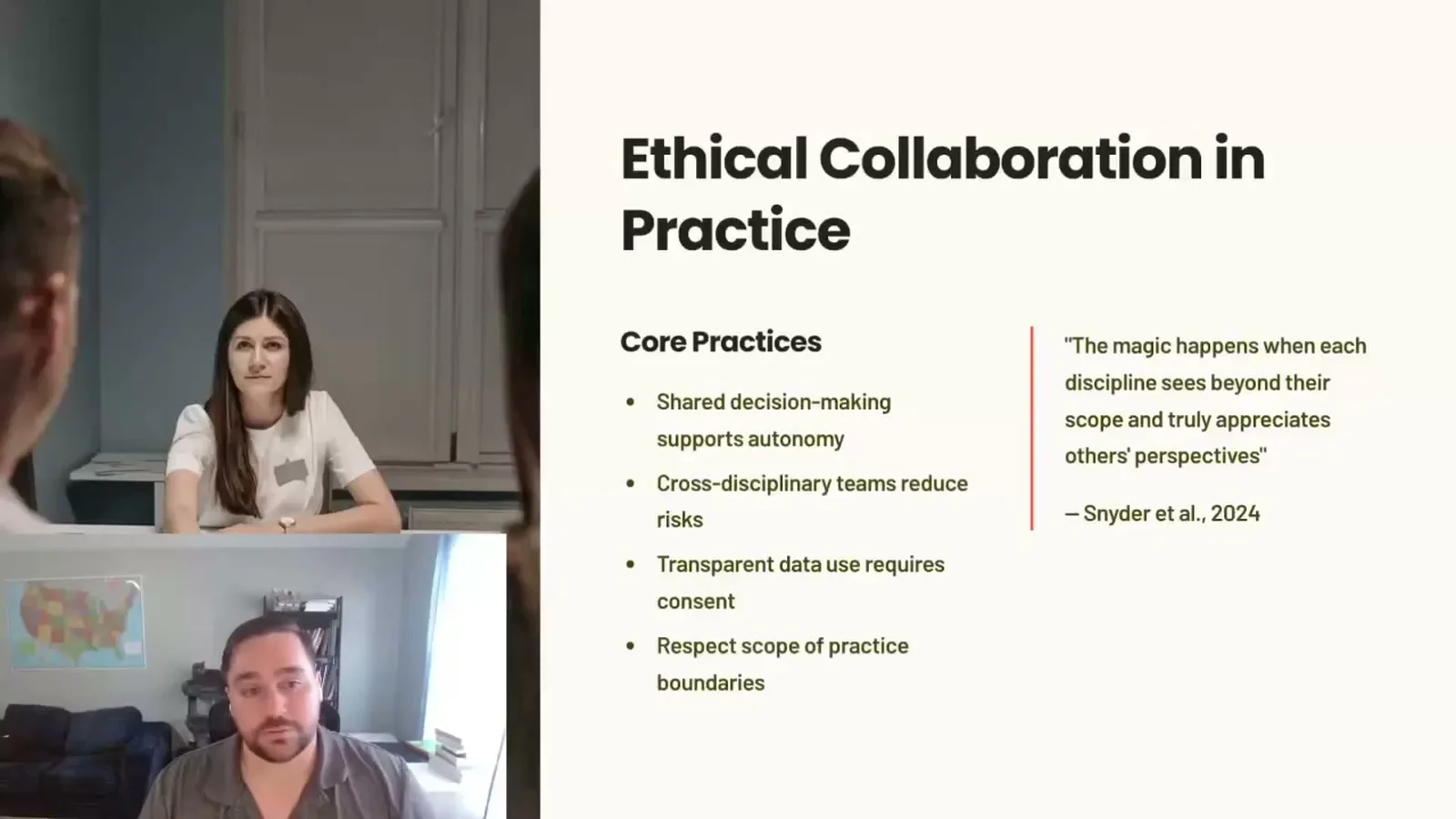
Care collaboration is an ethical requirement—and a practical lever for better client outcomes. This CEU gives behavior analysts a simple, repeatable workflow to make collaboration “automatic” instead of something that falls to the bottom of the list. We’ll cover how to prep caregivers, reduce response effort, and run brief, focused collaboration touchpoints across six common partners: pediatricians/diagnosticians, SLPs, OTs, schools/IEPs, mental health providers, and psychiatrists. Emphasis is placed on scope-of-practice boundaries, consent/ROI, caregiver inclusion, and sharing concise, decision-useful data (not 60-page plans) to tighten treatment alignment and reduce fragmented interventions.
Register free & watch nowCancel any time. Cert delivered to your inbox the moment you pass the quiz.
Learner ratings
from 19 learners
100% would recommend this CEU to other professionals in their field (16 responses)
About this CEU
Care collaboration is an ethical requirement—and a practical lever for better client outcomes. This CEU gives behavior analysts a simple, repeatable workflow to make collaboration “automatic” instead of something that falls to the bottom of the list. We’ll cover how to prep caregivers, reduce response effort, and run brief, focused collaboration touchpoints across six common partners: pediatricians/diagnosticians, SLPs, OTs, schools/IEPs, mental health providers, and psychiatrists. Emphasis is placed on scope-of-practice boundaries, consent/ROI, caregiver inclusion, and sharing concise, decision-useful data (not 60-page plans) to tighten treatment alignment and reduce fragmented interventions.
From the talk
What was covered
A repeatable care collaboration workflow: prep caregivers, make it low effort, and share one page with each partner type.
- Build collaboration into a routine you run on a schedule, not a task you plan from scratch each authorization period.
- Ask the caregiver to open the door first; a family request almost never gets refused by another provider.
- Keep the caregiver on every thread and in every meeting so they only have to steer the plan once.
- Bring a one-page summary with two or three graphs to every medical partner, never a full behavior plan.
- Track how closely caregivers follow another provider's home program, so they can decide from data instead of a story.
- End every collaboration meeting by asking what data would help that provider at the next visit.
Why the ethics code makes care collaboration a duty
Care collaboration (working with a client's other providers) is not a bonus task. The ethics code tells behavior analysts to work with other providers when it is needed. The talk makes the reason concrete. The point is not to keep people in the loop. The point is a better outcome for the learner. Picture a speech therapist building an AAC device (a tool that helps someone talk) with 70 icons. Meanwhile the behavior plan runs two pictures on a board. Both providers work hard. The child gets less than either one intended.
Autonomy is the second reason. When providers never talk, caregivers are left to pick a side. Most often they follow whoever explains things best. That is not a fair test of what helps the child. We cannot ask a parent to redo the years of training we had. Without shared information, a family cannot make an informed choice.
Justice is the third reason, and it is easy to miss. Some families never learn what services exist. A parent gets a packet, calls one number, and lands in 40 hours of ABA. Speech therapy, occupational therapy (OT), and psychiatry never come up. Talking to other providers opens those doors. The last reason is plain respect. Other helping fields train for years too, and treating them as peers lifts our own field.
Coordinated care maximizes welfare and minimizes risk from fragmented interventions.
From the talk — Matt Harrington
Why collaboration slips to the bottom of the list
The talk grew out of the speaker's own pattern. Every six months he would write a new plan and look back. Care collaboration had slid to the bottom again. That happened even at a company with an ABA wing and a mental health wing. That company reinforced and rewarded the work. Good intentions were not the problem. It just took too much effort to sustain.
His fix was to stop treating it as a project. He made it a routine, like any other part of practice. Less planning, fewer decisions, more repetition. As he did more of it, his clients did better.
A second blocker is fear. Many behavior analysts freeze before emailing a speech therapist. They picture a fight over manding (asking for what you want) versus gestalt processing (learning language in whole chunks). The speaker sends outreach email for a living. Out of thousands of emails to speech therapists, he counted two replies he would call negative. Most of that was a plain no thanks. Bad stories travel. Ordinary good ones do not.
There is a practice case too. Referrals from other providers carry built-in trust and tend to hold. Collaboration also lifts clinical quality, and better outcomes protect your reputation. Staff burn out less when clients actually progress. Treatment planning gets clearer for everyone.
And it was one of those things that it got so frustrating that I realized that if I don't make it dead simple, then I'm not going to do it.
From the talk — Matt Harrington
Treat caregivers as the first partner, not the gatekeeper
Caregivers sit at the top of the collaboration pyramid. Cold outreach scripts exist for a reason, but they are the last resort. The first move is to ask the caregiver to open the door. In the speaker's experience, a provider almost never refuses when the family asks. A caregiver request turns a cold email into an expected one.
Opening the door is not the same as being a partner. It is tempting to drop the parent off the email so the talk can get technical, then translate later. That habit costs more than it saves.
There are three reasons to keep them in. First, the family feels a team around them. Second, the caregiver only has to steer once. If a value or a cultural need shapes the plan, everyone hears it at the same time. Repeating themselves over and over is how families stop speaking up. That is medical gaslighting (being doubted until you give up), and it happens by accident. Third, generalization (skills carrying into daily life) runs through the caregiver anyway.
Sometimes you do need a provider-only call. Keep it to what has to be said. Then loop the caregiver in fast with a full account. Families do find out when they were talked about. A provider's first duty is to the family, not to another provider.
Well, crucially, conversation should happen with the caregiver, not around them.
From the talk — Matt Harrington
A caregiver prep checklist that lowers the real barriers
Name the barriers before you fix them. Time is the biggest one. A caregiver gets the child to school, then packs a full day into a few hours. School ends and they are back in caregiver mode. Appointments, shopping, and homework all take double the time. An hour-long meeting is a real cost.
So be flexible about format. Offer a three-way phone call, a video call, or joining the next appointment in person. The goal is having the caregiver present, even if they only listen. If they truly cannot attend, close the gap fast with a short summary or a privacy-safe note taker.
Language, literacy, and culture form a second barrier. Use translation services through the insurer, visuals, plain words, and materials that fit the family. Privacy worry is a third. Some caregivers do not see why a behavior provider needs to know about medication. That often means someone overstepped with them before. Answer it with scope of practice (the work you are trained for). Say what you will ask and why it changes the plan.
The prep itself is short. Confirm the caregiver is coming. Hand them a family-friendly version of their data. Check that the ROI (release of information form) is still active. Share a caregiver-facing resource if you have one. Put the next check-in on the calendar, monthly or even weekly, not just quarterly, so it stays a system.
The main thing you want to hit on right before you step into care collaboration meetings is just making sure the parent knows what to expect.
From the talk — Matt Harrington
Pediatricians and diagnosticians: bring context, not a 60-page plan
Pediatricians and diagnosticians are usually the first medical contact. They start or support the ABA referral and hold the medical picture. They also hand families that giant screening packet. Dozens of pages on ABA, speech, OT, and diagnostics land at once. Most families skim it or bin it. The questions come back at the next visit instead.
Their view matters to you. If a pediatrician frames sleep as a medical issue, the family will hear your sleep plan that way. Their input can also flag medical drivers you cannot see. Sleep, chronic pain, medication timing, and stomach trouble all move behavior. The speaker cited a number from memory on stomach and gut issues in autism and told the room to check it. Treat it that way. The point holds without the figure.
What you give back is context. These providers see the client least and often hold the most trust with the family. Recall in a short visit is fuzzy by nature. In one case a parent described afternoons as up and down. The data told a sharper story, and the visit ended with a medication change and less behavior.
So keep the deliverable small. One page: client, starting goals, current goals, a couple of behavior graphs, a couple of skill graphs. Run the meeting in five steps. Confirm the ROI first. Then trade context: your goals for their medical update. Share data, ask what would help next time, and set the next date.
Please do not walk into a pediatrician care collaboration with a 60-page document.
From the talk — Matt Harrington
SLPs and OTs: align on the shared goal, then track fidelity
Speech therapists (SLPs) and behavior analysts carry the worst reputation with each other. The feedback the speaker hears most is that providers are relieved when a behavior analyst listens instead of correcting.
The overlap is large: communication targets, AAC, feeding, and language goals across home, school, and clinic. Each side has a fair complaint. We can be too rigid and weak on generalization. They can be so naturalistic that progress feels slow. Learn their plan first, then offer yours as a tightening. You have far more hours than their weekly session, so your data can sharpen their targets. Feeding deserves a hard rule. A picky eater who swallows safely is one thing. A child who gags or is moving from liquids to solids is another. Bring a speech therapist in from the start on anything with swallowing.
OT overlaps most in sensory work and emotional regulation. If you teach a child to wait, the OT may teach the same skill under a different name. Same goal, two methods, is the thing to fix. ABA brings the routine building. The speaker once got a sensory diet (a planned list of movement tasks) as a homework list. He turned it into a visual schedule inside the daily routine, so it actually happened.
The bigger gift is fidelity data (how closely a plan was followed). If a home program runs half the time and behavior does not move, that tells you little. If it runs every time and behavior still does not move, the plan itself may be mismatched. Help the caregiver track it, and the OT can decide from data instead of a story.
So when it comes to SLPs, the best thing you can do to have a good conversation is simply to respect them and listen to them.
From the talk — Matt Harrington
Schools, mental health, and psychiatry: three underused partners
School teams usually mean the IEP (a school's special education plan). Be in the room if your client has one, and learn your state's rules. Sitting beside a parent who is lost in that process is a real service. Work the teacher and the school psychologist directly too. School is the best generalization setting because you do not control it. A plan that survives a real classroom is a plan that holds.
What you bring is options outside the usual school playbook. Most teams lean on PBIS (a school-wide behavior support system) and the few strategies they trust. When those fail, staff improvise while juggling everything else. Come with what has worked in clinic and in other classrooms, then blend it into something the teacher can run. In the IEP, align goals and gather context. In a one-on-one, brainstorm. And bring the teacher coffee. The speaker has never had that turned down.
Mental health providers are the most underrated partner in the talk. The speaker's best gains with teen clients came from working beside one. With language-able learners, ACT (a values-based therapy approach) gives us tools. A therapist still brings a different read on emotion. The modalities bridge more than people expect. CBT (talk therapy that targets thinking) and graduated exposure (facing fears in small steps) map onto what we do. These meetings are less about editing your plan and more about learning, then shifting your goals to match.
Psychiatry runs on thin information. A psychiatrist may get ten minutes and then make a large medication decision. Sleep data, challenging behavior, mood tracking, and medication fidelity are gold in that room. A chart that flips from steady to low is decision-useful. Run the visit like a medical one. Review the medications, share the data, and ask what data would help next time.
But at its core, psychiatrists need our data more than any other field.
From the talk — Matt Harrington
Your first 15-minute call: how to start this week
Start small enough that it survives a busy week. For one client, send one outreach email. If you do not have the contact, the first step is asking the caregiver for a name. Use a template, personalize two lines, and send it. Name the ROI in the first sentence. Say you want to collaborate. Ask for a time slot and offer to be flexible.
Then pick a couple of partners across your caseload instead of all six at once. Check that each ROI is active. Book one 15-minute call and put it on the calendar. Schedule the next check-in before you leave the meeting. That one habit turns collaboration from a goal into a routine.
The payoff builds. Each call makes the next one easier and the scripts shorter. The speaker's warning is worth repeating. Do not let a year pass and then regret the collaboration you never did.
I promise you, the more you do care collaboration, the more it becomes a muscle and you see the value of it.
From the talk — Matt Harrington
Common questions
What are the six care collaboration partners covered in this CEU?▾
The talk walks through pediatricians and diagnosticians, speech therapists, occupational therapists, school teams, mental health providers, and psychiatrists. For each one it covers why to partner and how they help your plan. It also covers how your data helps theirs and what to send first. Caregivers sit above all six as the first partner you go through.
What should I actually send another provider?▾
One page, not a behavior plan. Include the client, the starting goals, the current goals, and two or three graphs that show real movement. Medical partners will not read a 60-page document, and sending one costs you the next meeting.
Should the caregiver be on collaboration calls and emails?▾
Yes, by default. Keeping them in means they correct the plan once instead of repeating themselves to every provider. It also makes the team feel like a team. If a provider-only conversation is truly needed, keep it short and give the caregiver a full account right after.
What if the other provider reacts badly to a behavior analyst reaching out?▾
That fear is far more common than the outcome. The speaker has sent thousands of outreach emails to speech therapists. He counted two replies he would call negative, mostly a simple no thanks. Going through the caregiver lowers the odds further, since providers rarely refuse when the family asks.
How do I keep care collaboration from falling to the bottom of my list?▾
Lower the effort it takes and make it a scheduled routine instead of a fresh decision each time. Keep templates ready, confirm the ROI during regular reviews, and book the next check-in before you end a meeting. Starting with one email for one client is enough to build the habit.
About the speaker
Matt Harrington has been a BCBA (board certified behavior analyst) for five years. He has worked as a clinician and a clinic director across telehealth, home, hospital, and clinic settings. He trained in a hospital setting that leaned heavily on care collaboration. He points to collaboration as the biggest outcome differentiator for his clients. He now runs the ABA Clubhouse and the Behaviorist Book Club, a community of BCBAs. He also runs an ABA marketing agency focused on care collaboration and referrals.
This summary was generated from the recording’s transcript. Quotes are taken word for word from the talk.
What you'll learn
- 1Learning Objectives: By the end of this CEU, participants will be able to:
- 2List 3 ethics-aligned practices that support effective care collaboration (e.g., ROI, scope boundaries, caregiver inclusion, transparent data sharing).
- 3Use a caregiver prep checklist to reduce barriers (time, privacy concerns, language/culture) before a collaboration meeting.
- 4Identify one high-impact data deliverable (e.g., one-page summary, targeted graphs, fidelity tracking) to share with each of the six partner types to improve coordination and outcomes.
Concepts in this CEU
Related talks
Talks that cover the same concepts
Stronger Together: Care Collab
The Behaviorist Bookclub
Shaping Behavior Change when ADHD is in the Picture
The Behaviorist Bookclub

Teaching RBTs to Think Clinically: Training In-the-Moment Decision Making
Copper Consulting Group
Compliance to Commitment: Seven Habits of the Highly Effective Caregiver Trainer
The Behaviorist Bookclub
Supervision Articles Deep Dive
The Behaviorist Bookclub
PDA: What it is and What it isn't
The Behaviorist Bookclub
More from The Behaviorist Bookclub
Harm Reduction Within ABA Practice
The Behaviorist Bookclub
Supervising Beyond Technical Skills: Professionalism, Communication, and Clinical Judgment
The Behaviorist Bookclub
Reflective Supervision and Client Outcomes
The Behaviorist Bookclub
OpenCEU is supported by advertising from third-party sponsors. Sponsors are clearly labeled, have no influence over course content, instructors, or CEU decisions, and never appear on certificates. The BACB does not sponsor, approve, or endorse OpenCEU sponsors or their products.