Care Collaboration in ABA: A Guide for BCBAs
Care collaboration means working with SLPs, OTs, and doctors for one shared plan. See why it is ethical, how to do it, and where to start.
Key takeaway
Care collaboration means working with the other people who help your client. That can be a speech therapist, an OT, a teacher, or a doctor.
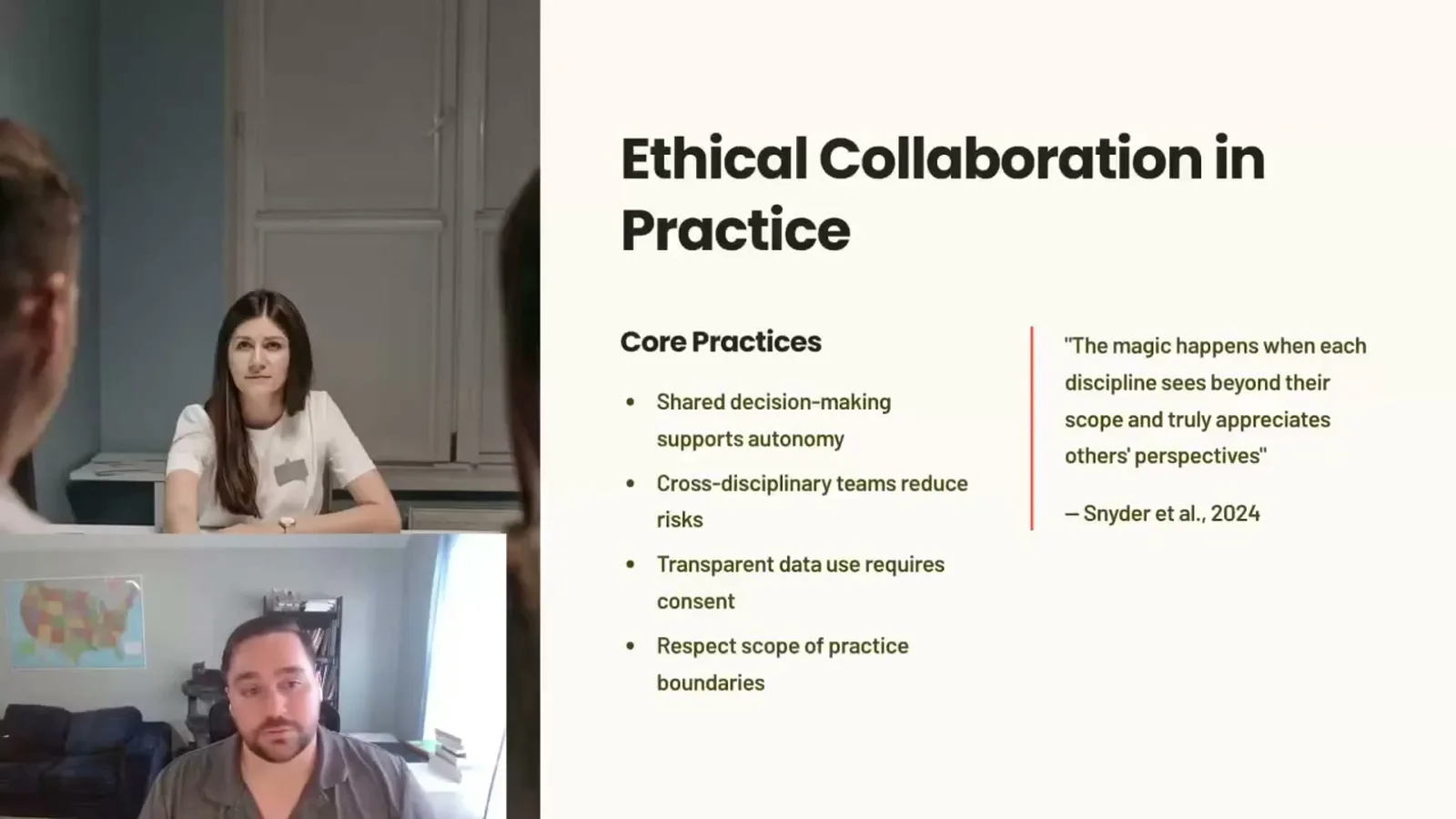
New Year, New Care Collab Goals
Free learning path on this topic
Supervision, Done Right
Four supervision CEUs that build on each other. What reflective supervision is, how to build a supervision system, how to assess supervisee competence instead of counting hours, and how supervision affects provider outcomes. The BACB asks supervisors for three supervision CEUs per cycle. This covers it.
Experts who cover this
2 recordings on openceu cover care collaboration.
- Featured talk1 CEU
New Year, New Care Collab Goals
Matt HarringtonThe Behaviorist Bookclub
Matt Harrington builds an ethics-first case for care collaboration (coordinated care maximizes welfare, minimizes fragmented interventions) and then walks…
- 1 CEU
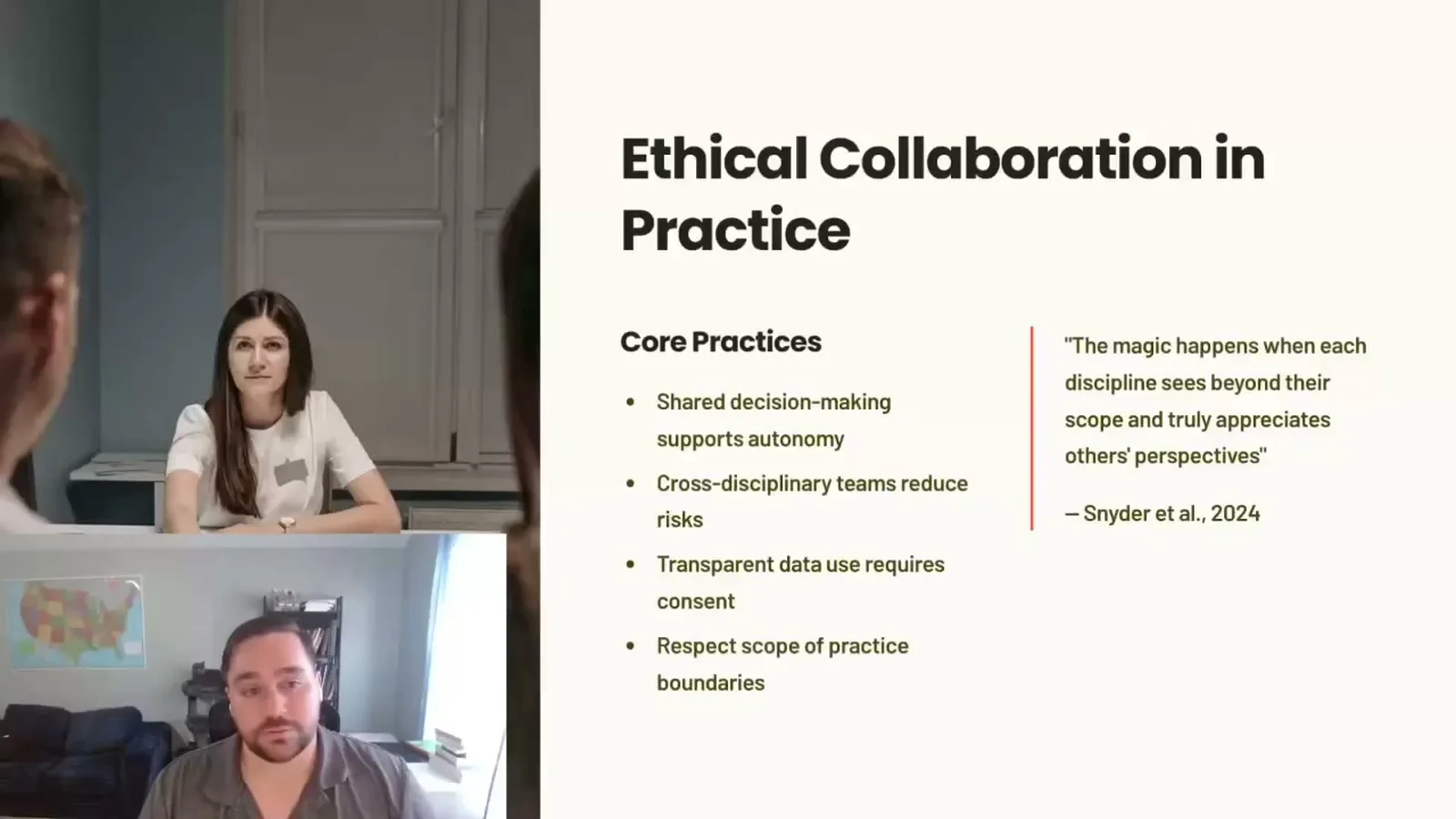
Stronger Together: Care Collab
Matt HarringtonThe Behaviorist Bookclub
The entire talk is built around why and how BCBAs should systematically collaborate with SLPs, OTs, pediatricians, psychiatrists, and schools. Matt Harrington…
On this page · 8 sections▾
Care collaboration means working with the other people who help your client. That can be a speech therapist, an OT, a teacher, or a doctor. Instead of each person working alone, the team shares one plan. This keeps the care lined up and pulling in the same direction.
This matters for BCBAs, RBTs, families, and teachers. A child often has many helpers at once. When those helpers do not talk, the care can clash. Care collaboration fixes that by tying everyone to shared goals.
Why it matters so much#
Matt Harrington makes care collaboration his main focus. He says it is what he thinks about all day, every day. It has become one of his favorite topics to present on. He sees it as the heart of good, ethical work. Ethical here means putting the client's welfare first.
He gives a clear reason why it helps clients. When care is coordinated, the client gets more and risks less. When care is split, the pieces can fight each other.
Coordinated care maximizes welfare and minimizes risk from fragmented interventions. Imagine if the SLP is working on AAC, you're working on PEX, but the SLP has 70 different icons on their iPad and you're doing two on your PEX board. From the talk — Matt Harrington
That gap confuses the child. One tool at speech, another tool with you. Care collaboration closes that gap.
Two reasons: ethical and profitable#
Matt frames the case in two clear parts. The first reason is ethical. The client should sit at the center of every choice we make.
so why does care collaboration matter well it's ethical because client outcomes should be at the center of what we're doing and it's profitable because you get a bunch more referrals and build your brand as a company From the talk — Matt Harrington
The second reason is practical. When you build trust with other providers, they send you clients. So doing right by the client also grows your business. Both reasons point the same way.
Give every meeting a purpose#
Collaboration is not just being friendly. Matt warns against meetings with no clear point. A meeting should shape your plan and your next steps.
when it comes to care collaboration you need to have a purpose for these meetings and that purpose should be to inform not only your overall intervention structure but also the pathway you're going to get to your end goals From the talk — Matt Harrington
A strong meeting might tie to a shared assessment. It might set who works on what. Without a purpose, it becomes a box you check. With one, it moves the client forward. Matt digs deeper into this in Stronger Together: Care Collab.
Know your partners#
 Advertisement
Matt walks through the main partners a BCBA works with. Each one needs a slightly different approach. Pediatricians want quick, clear updates. Speech therapists share language and communication goals. OTs help with motor and sensory needs.
Schools, mental health providers, and psychiatrists round out the team. For each partner, Matt uses a short script and a one-page handout. That makes the first reach-out easy. It also shows the partner you respect their time.
The AAC example above shows why this matters. AAC means a device or board a child uses to talk. If the speech therapist uses many icons and you use two, the child gets stuck. A quick chat can line up the tools. Then the child sees the same system in both places.
It helps at the hospital too#
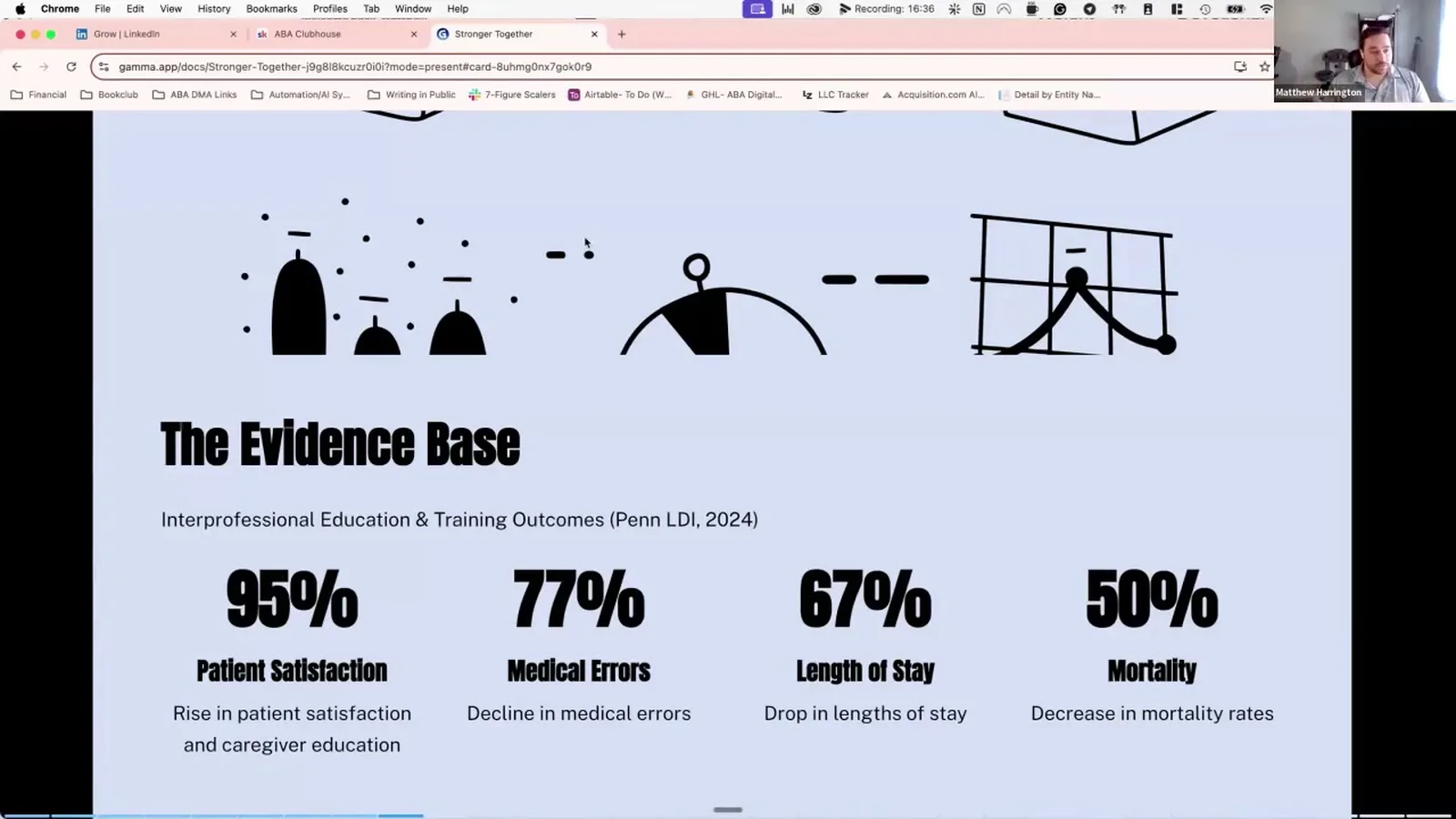
Matt notes that the good news is not just talk. He points to real data from a hospital setting. Coordinated care there made a clear, measured difference.
there is a general consensus that care collaboration helps i have some data to show you at a hospital that showed that it significantly helped but oftentimes there's personal barriers From the talk — Matt Harrington
He is honest that barriers get in the way. People are busy, and turf can feel touchy. But the payoff for the client is worth the push.
It gets easier with practice#
Care collaboration can feel awkward at first. Matt is honest that it takes reps to feel natural. But it grows stronger the more you do it.
I promise you, the more you do care collaboration, the more it becomes a muscle and you see the value of it. Don't be like me. Don't let all your care collaboration rot until the end of the year. From the talk — Matt Harrington
His advice is to spread the work across the year. Do a little often instead of a rush at the end. Small, steady contact builds real trust over time.
What the research says#
The field now treats collaboration as a core skill, not a bonus. One article lays out the ethical duty to collaborate when treating autistic clients. It names common barriers and offers ways to build a strong team (Henderson, T. B., Ludden, B. J., & Romero, R. A. (2023). The Ethical Obligations, Barriers, and Solutions for Interprofessional Collaboration in the Treatment of Autistic Individuals. Behavior Analysis in Practice, 16(4), 963-976).
Other work gives shared rules for the whole team. One paper offers standards for interprofessional practice in autism care. These standards value each field's training and keep the client's needs first (Bowman, K. S., Suarez, V. D., & Weiss, M. J. (2021). Standards for Interprofessional Collaboration in the Treatment of Individuals With Autism. Behavior Analysis in Practice, 14(4), 1191-1208).
Researchers have also read the four core team skills through a behavior lens. These skills are values and ethics, roles, communication, and teamwork. The paper shows how each one fits behavior analysis (Slim, L., & Reuter-Yuill, L. M. (2021). A Behavior-Analytic Perspective on Interprofessional Collaboration. Behavior Analysis in Practice, 14(4), 1238-1248). Newer work adds that these skills should reach families and clients too, not just other pros (Spencer, T. D., Thompson, V., & Watson-Thompson, J. (2026). Community-Engaged Scholarship: An Interpartner Approach for Collaborative Practice. Behavior and Social Issues).
FAQ#
What is care collaboration in ABA? It is working with a client's other providers on one shared plan. That team can include SLPs, OTs, doctors, and teachers. The goal is care that lines up instead of clashing. This gives the client better, safer results.
Why is collaboration an ethical duty for BCBAs? The client's welfare must come first in our work. Split, clashing care can slow progress or cause harm. Working as a team lowers that risk. So collaboration is part of doing right by the client.
How do I start collaborating with other providers? Pick one partner and give the meeting a clear purpose. Use a short script and a one-page handout to reach out. Keep the contact small and steady across the year. Trust and referrals grow from there.
 Advertisement
Turn this topic into a CEU
You just studied this. Now get credit for it.
Watch New Year, New Care Collab Goals with Matt Harrington and earn 1 free BCBA CEU. Detailed certificate, delivered the moment you finish.
Keep going with a free learning path
Supervision, Done Right
Four supervision CEUs that build on each other. What reflective supervision is, how to build a supervision system, how to assess supervisee competence instead of counting hours, and how supervision affects provider outcomes. The BACB asks supervisors for three supervision CEUs per cycle. This covers it.