Stronger Together: Care Collab
Presented by Matt Harrington
This one-hour continuing education webinar explores the critical role of care collaboration in modern ABA practice. Participants will examine the research foundation demonstrating how collaborative approaches improve client outcomes across developmental, behavioral, and educational domains, while reviewing BACB ethical guidelines that mandate professional cooperation. The session provides practical frameworks for building and maintaining partnerships with other professionals, including evidence-based communication protocols, information sharing guidelines, and conflict resolution strategies. Finally, attendees will discover how collaborative practice serves as a powerful business growth strategy, driving client retention, referral generation, and practice differentiation in competitive markets. Through case studies, interactive discussions, and actionable planning tools, BCBAs will leave equipped to transform their practice through strategic collaboration.
Register free & watch nowCancel any time. Cert delivered to your inbox the moment you pass the quiz.
Learner ratings
from 40 learners
100% would recommend this CEU to other professionals in their field (32 responses)
About this CEU
This one-hour continuing education webinar explores the critical role of care collaboration in modern ABA practice. Participants will examine the research foundation demonstrating how collaborative approaches improve client outcomes across developmental, behavioral, and educational domains, while reviewing BACB ethical guidelines that mandate professional cooperation. The session provides practical frameworks for building and maintaining partnerships with other professionals, including evidence-based communication protocols, information sharing guidelines, and conflict resolution strategies. Finally, attendees will discover how collaborative practice serves as a powerful business growth strategy, driving client retention, referral generation, and practice differentiation in competitive markets. Through case studies, interactive discussions, and actionable planning tools, BCBAs will leave equipped to transform their practice through strategic collaboration.
From the talk
What was covered
Make care collaboration change outcomes: purpose, consent, shared goals, real data, conflict repair, and the referral payoff.
- Give every collaboration meeting a purpose that changes your plan, the same way a good assessment does.
- Pull other providers off the intake form on day one and ask the caregiver for a three way email introduction.
- Ask other providers how they taught a skill, not just what they taught, because the answer tells you which prompts will work.
- Match the channel to the provider: a phone call for pediatricians and clinical psychologists, sometimes psychiatrists, and a video link for SLPs, OTs, and mental health therapists.
- Bring graphed sleep, mood, and behavior data to psychiatry appointments so prescribing is not based on memory alone.
- In conflict, drop the credentials contest, use humble and curious language, and document what worked for next year.
Why Check-the-Box Care Collaboration Does Almost Nothing
Most behavior analysts book a few care collaboration meetings (meetings with a client's other providers) each month. In the live chat poll, most answers were low: zero to five meetings in a rolling 30 days was typical. Harrington said he sat in that same range for most of his years in practice. The count is not the real issue. The purpose behind the meeting is.
He made the case with an assessment analogy. Think about a functional analysis (a test that finds why a behavior happens). You would never run one on a behavior you do not plan to treat. The data would sit there and change nothing. Meetings work the same way. A report you send just to send a report does not move a goal.
Speech therapy is the clearest example. Many behavior plans carry language goals. The speech language pathologist (a speech and language expert) should not glance at your plan and wish you well. Their read should change how you teach. Your data should change how they teach. That back and forth is the whole point.
when done to check the box care collaboration is kind of useless
From the talk — Matt Harrington
What the Research Says, Mostly From Outside Behavior Analysis
There is not much research on care collaboration inside behavior analysis. So Harrington looked at healthcare more broadly. The story was steady across what he found. Team care helps. People are still the hard part.
He pointed to a 2022 article by Samar Weo and colleagues on doctors and nurses. That friction goes back a long way. Grand rounds (a team visit to each patient room) is a plain form of collaboration. Staff pushed back on it so hard that it had to be made a rule.
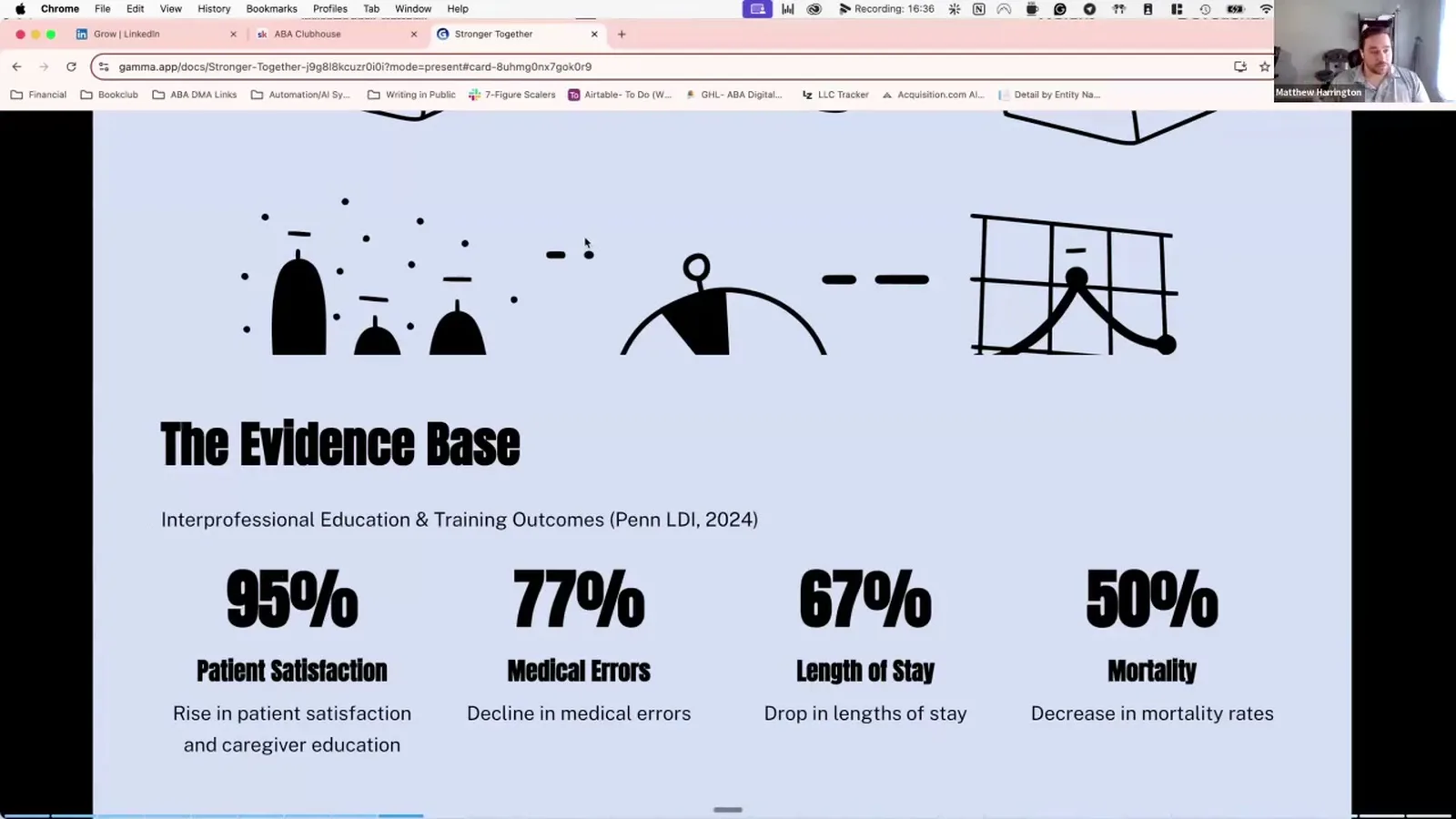
Another hospital paper looked at interprofessional training, where staff from different fields learn together. Three results stood out to him. Patient satisfaction rose. Caregiver education rose. Medical errors dropped, and so did length of stay. Our field spends hours on caregiver training, so that second number should get our attention.
Work on ABA and occupational therapy (care that builds daily living skills) named the usual barriers. Providers misread what other fields do. They use different words for the same idea. And sometimes people are simply unprofessional. Harrington sees this at home too. His brother is a pediatric OT, and the two once argued over weighted blankets. He wanted a functional analysis first. His brother talked about proprioceptive input (feedback from muscles and joints). They wanted the same thing for the child.
so when you step into care collaboration understand there will be conflicts it's not your fault it is the name of the game
From the talk — Matt Harrington
Ethics Codes and the 'Everything Is Behavior' Trap
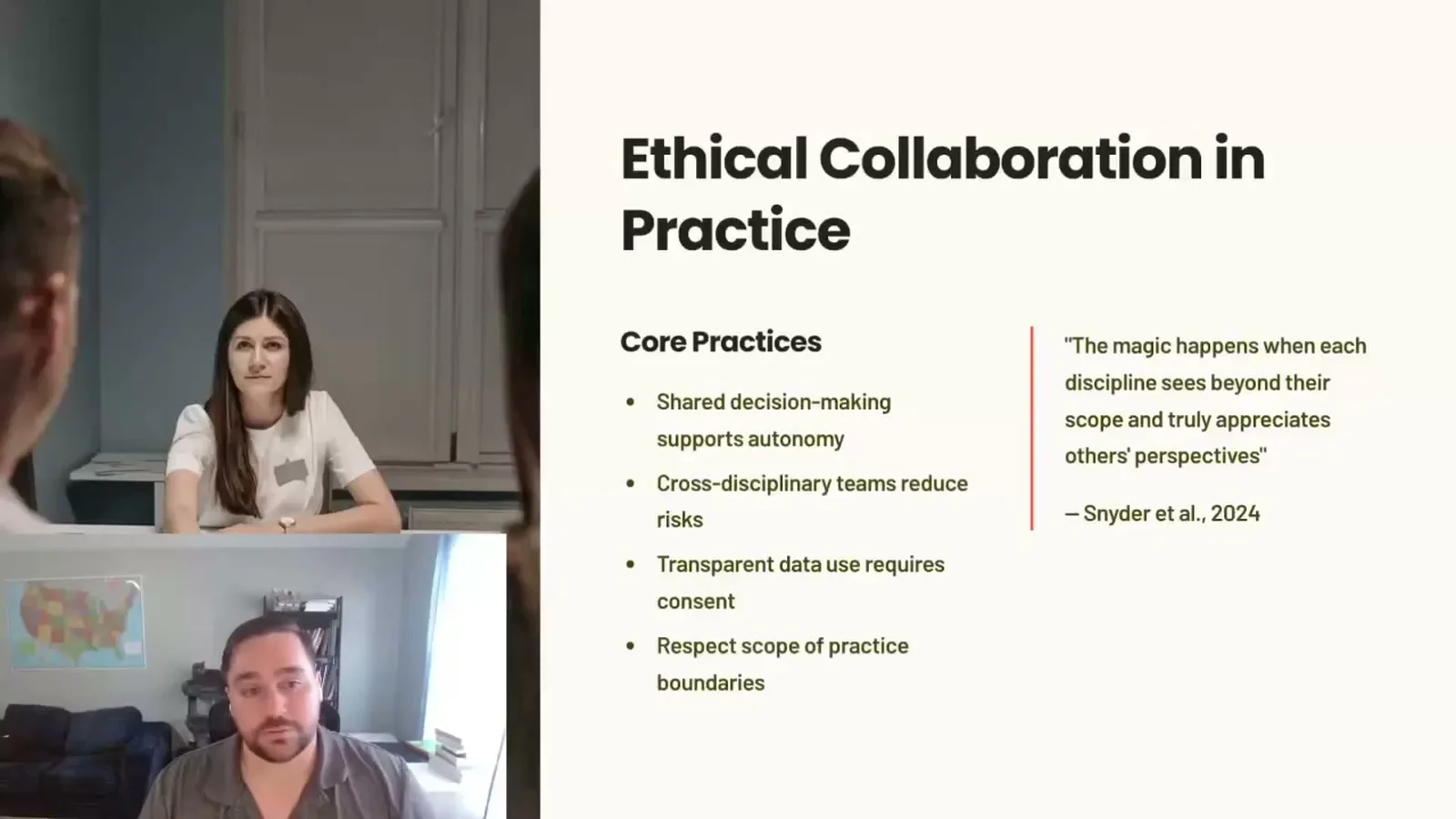
Three codes from the BACB (the board that certifies behavior analysts) came up: 1.05, 2.02, and 4.02. They cover professional and scientific relationships, and services given in collaboration with others. They also cover involving clients and families in planning and consent. Collaboration is not a favor you do when time allows. It sits inside the job.
Then came the scope of practice (the work your training covers) warning. Many of us learned that everything is behavior, so the science applies to everything. That part is true. The leap after it is not.
Harrington learned this while his wife was finishing a master's in special education. She was training in the science of reading (how children learn to decode words). He watched her practice letter sounds in a mirror, again and again, to get each one exact. He had never once thought about that level of skill. Walking into a room and assuming you know best erases years of someone else's training.
Scope can also shrink on you. In a hospital feeding unit he could work with gagging, vomiting, and swallowing risk. A swallow study (an x ray of swallowing) was easy to get there. In private practice that backup was gone. A family asked for feeding work and he said no at first. They saw the doctor, got a swallow study, and he set up standing contact with that medical team. Then he took the case.
what that doesn't mean is that we are the experts in everything
From the talk — Matt Harrington
Consent First: Releases, and What to Share or Skip
Everything starts with a release of information (a signed form that allows provider contact). Many practices bury it near the end of a long intake packet. Harrington wants the opposite. Put it up front, or give it its own short conversation. Ask the family who else works with their child. Then say what you will do with that contact and why. He said families almost never turn it down once they hear the reason.
Should releases be done as needed or at intake? His answer is both. As needed keeps the list honest and keeps families from signing ten forms at once. A checklist at intake keeps busy clinicians from forgetting. Chasing a caregiver who has ignored a form three times costs you rapport (the trust you build with a family).
Once you have the release, start broad. Agree on the outcome before you argue about method. As a new BCBA he talked sensory diets with an OT team that was focused on handwriting. They were in two different worlds. After the outcome is shared, trade what works. One of his favorite questions to an SLP is how they taught a skill. Two weeks of natural environment teaching (teaching during play and daily routines) tells you the learner copies others well. Three months tells you to build observational learning (learning by watching others) first. Safety plans belong on the list too, since behavior can block another provider's session.
Leave out assessment scores, personal opinions, gossip, and any comment about the family that does not touch treatment. Under HIPAA (the health privacy law), get written informed consent and document what you shared. Apply the minimum necessary standard (share only what is needed) and use secure channels. Some states also require you to document collaboration attempts.
ultimately the caregivers have the first and final say in what is shared
From the talk — Matt Harrington
How to Get the First Meeting With Another Provider
The list is already in your hands. Most insurance intakes require you to record other services, provider names, and phone numbers. Thirty minutes of speech, twice a week, with a name attached is your starting point. Harrington treats that line as a task, not a form field.
His preferred opener is a three way email introduction from the caregiver. You ask the parent to connect you and the pediatrician, then you and the SLP, then you and the psychiatrist. This changes who you are on the other end. You are not a stranger with a release form. The family has already consented, and the provider has a reason to reply. Keep the caregiver on the thread unless they ask to step off.
Use the first call to set the frame. Clarify roles. Agree on shared goals and how each of you plans to get there. Set a rhythm for meetings and reports. Then ask a simple question: how would you like to receive my feedback, and how should I send you mine? That does not need a formal decision tree. It needs to be said out loud once.
Channel preference is real. Pediatricians, clinical psychologists, and sometimes psychiatrists want a phone call or an office visit. SLPs, OTs, and mental health therapists want a link on their calendar. Offer both in one short message: here are times I can call, and here is my scheduling link.
you are a key member of the team who's been introduced by the parent
From the talk — Matt Harrington
Bring Data to the Appointment, and Stay in Touch Between Reports
Before you attend an appointment with a family, prep the provider you are visiting. One question does most of the work. Ask what information they want you to gather ahead of time.
Psychiatry visits show why this matters. A prescriber often has to work from what the family remembers in the room. Now picture the same visit with sleep data, mood data, and behavior data graphed together. A two week spike in behavior that lines up with poor sleep changes the conversation. Harrington has seen sleep drive medication response again and again, in hospital work and in his current client work.
If you cannot attend, send the graphs to the caregiver and prep them. He sends them when he knows an appointment is coming, even without a reply. A caregiver who understands the basics can hold their ground when a prescriber asks whether to double a dose.
Between visits, run systems. Standard reports, shared data sheets, and a standing meeting every few months cut the mental load for your team. Formal contact alone is fragile, though. Eighteen months of quarterly reports gives you no history when a crisis hits. Short informal check-ins build that history. So does celebrating wins. Ask a provider to tell you the story of a learner's progress. You get rapport and useful information in the same call.
one of the key questions i like to ask is what information do you want me to gather prior to this appointment that will help you
From the talk — Matt Harrington
Handling Conflict Without a Credentials Contest
Conflict comes with the work. When he polled the room, plenty of people raised a hand. One attendee noted that their sharpest conflicts are with other behavior analysts. The thing to avoid is any move that puts you above the other person. You just do not understand. That is not how we do it. Here is my citation. Each one reads as a shove, so the other person shoves back. Now it is a contest over who has the longer string of letters after their name.
Treat drift like behavior you already know how to catch early. You would not wait for a full escalation. You would act as soon as you see precursors (small signs before a big behavior). The same goes for assent withdrawal (signs a learner wants to stop). If you sense that you and another provider are heading different directions, say something that week.
The language matters. I could be totally misunderstanding this. Please walk me through that part. Anything that puts you in the learner's seat lets the other person meet you on level ground. That is not weakness. It is the fastest route back to the plan.
Let data settle what it can. That does not mean backing an intervention with clear disproof behind it. It means staying open enough to build something together that is better than what either of you brought. Then document it. Not as a gotcha, but because you will likely sit across from that same provider at next year's IEP (individualized education plan) table.
the goal is not to uh be smarter the goal is to get the client to uh the end place as efficiently as safely as possible
From the talk — Matt Harrington
The Business Case, and a 30 Day Plan to Start
Billing varies. Working telehealth in Virginia, Harrington had a billing code for collaboration. It covered roughly an hour to an hour and a half a month. In Florida, to his knowledge, there is no billable code for it. Check your own payer. He recommends the work either way, and he expects funders to require it in time.
Here is the argument he uses with owners and directors. Better outcomes keep families enrolled. A client who might leave at six months stays eighteen months and graduates. Happy families tell other families. Pediatricians send the next referral to the analyst who called them. In his experience, one strong partnership can bring five to eight referrals a year. It also means fewer early discharges and more school contracts.
He was candid about why the business section exists at all. As a clinic director and lead BCBA, he could not get plans approved without tying them to revenue. If you need buy-in for unbilled hours, bring the retention and referral picture with you.
The starting plan is small. Pick three collaboration partners across your caseload, the providers your families see most. Ask each caregiver for a three way introduction. Then build the system: a set rhythm, a shared outcome, and an agreed way to trade feedback. Add a few more meetings each month after that, and the habit builds itself.
better outcomes for clients pay off in spades even if these appointments are non-billable
From the talk — Matt Harrington
Common questions
Can I bill for care collaboration?▾
It depends on your state and your payer. Harrington had a code in one telehealth state. It covered about an hour to an hour and a half per month. In Florida, to his knowledge, there is no billable code for it. Check with your payer, and plan to do the work either way.
What can I share with another provider without breaking HIPAA?▾
Start with a signed release and real informed consent from the caregiver. Share agreed outcomes, what you are working on, strategies that work, and safety protocols. Keep out assessment scores, personal opinions, and anything about the family that does not touch treatment. Use the minimum necessary standard and a secure channel, and document what you shared.
How do I get a pediatrician or psychiatrist to actually talk to me?▾
Ask the caregiver for a three way email introduction instead of cold calling the office. That makes you part of the child's team rather than a stranger with a form. Match the channel too. Doctors often prefer a phone call or an office visit. SLPs, OTs, and therapists prefer a scheduled video meeting. Offer both options in one short message.
What do I do when a provider says they do not like ABA?▾
Expect it and do not take it personally. Often the school or clinic had one bad experience years ago that still shapes the room. Lead with questions. Ask what they have tried and what has worked. Keep the focus on the shared outcome for the child. Avoid any line that ranks your training above theirs, because that turns a plan into a contest.
How many collaboration meetings should I have each month?▾
There is no magic number, and a high count of pointless meetings helps nobody. Harrington suggests picking three partners across your caseload and getting introductions this month. Add a few more the next month, and a few more after that. The goal is meetings that change your plan, not meetings that fill a log.
About the speaker
Matt Harrington is a BCBA with 11 years in the field, with specialties in severe behavior and verbal behavior. His clinical work included supervision on a hospital severe behavior unit, feeding work, and early intervention. He founded The Behaviorist Book Club in 2020, which has provided over 5,000 CEUs. In September 2024 he started a marketing agency that helps ABA companies build referrals through relationships.
This summary was generated from the recording’s transcript. Quotes are taken word for word from the talk.
What you'll learn
- 1Learning Objectives
- 2Upon completion of this CEU, participants will be able to:
- 31. Analyze the evidence base supporting care collaboration and identify ethical obligations for collaborative practice under BACB guidelines
- 42. Develop communication protocols and relationship management strategies for effective professional partnerships
- 53. Evaluate the business benefits of collaborative care and implement ROI measurement strategies for practice growth
Concepts in this CEU
Related talks
Talks that cover the same concepts
New Year, New Care Collab Goals
The Behaviorist Bookclub

Teaching RBTs to Think Clinically: Training In-the-Moment Decision Making
Copper Consulting Group
PDA Caregivers, Complex Profiles, Replacement Behaviors, and Being Trauma Informed
The Behaviorist Bookclub
Prediction and Probabilities: Three foundational equations to successful behavior reduction
The Behaviorist Bookclub
Dunder Mifflin’s Guide to BCBA Ethics: Lessons from The Office
The Behaviorist Bookclub
12 days of PFA & SBT
The Behaviorist Bookclub
More from The Behaviorist Bookclub
Harm Reduction Within ABA Practice
The Behaviorist Bookclub
Supervising Beyond Technical Skills: Professionalism, Communication, and Clinical Judgment
The Behaviorist Bookclub
Reflective Supervision and Client Outcomes
The Behaviorist Bookclub
OpenCEU is supported by advertising from third-party sponsors. Sponsors are clearly labeled, have no influence over course content, instructors, or CEU decisions, and never appear on certificates. The BACB does not sponsor, approve, or endorse OpenCEU sponsors or their products.