Getting the Right Answer Isn’t Enough: Establishing Speaker–Listener Repertoires for Complex Learning
Presented by Dana Pettus
Cancel any time. Cert delivered to your inbox the moment you pass the quiz.
Learner ratings
from 90 learners
97% would recommend this CEU to other professionals in their field (70 responses)
“Interested”
— Sapna M.“Was beneficial and productive”
— Fizza Z.
About this CEU
Learners may follow multi-step instructions, complete worksheets, or answer comprehension questions correctly—yet performance often collapses when prompts fade, delays increase, or task demands shift during novel tasks. Accurate responding does not necessarily indicate functional problem solving. In many cases, the controlling variables reflect restricted stimulus control rather than established speaker–listener mediation. This presentation examines verbal mediation and joint control as critical teaching tools in moving learners from basic skills into complex learning. Joint control occurs when a rehearsed verbal operant and a tact jointly evoke a response under shared topographical control. Participants will analyze how self-echoic rehearsal, tacting, and intraverbal responding interact to support responding across delay, distance, and novelty. Emphasis will be placed on identifying missing prerequisite repertoires, establishing overt verbal mediation, and transferring control to covert mediation. Applications will include multi-step instructions, mediated selection, recalling past events, and reading comprehension—supporting more durable and generative repertoires.
From the talk
What was covered
Why a correct answer can hide a missing skill. How to teach the self-talk that makes complex learning hold up.
- Before you call a skill mastered, test it after a delay and across the room.
- When a learner errors, run the repeat-it-back prompt again instead of pointing at the right answer.
- Teach joint control (two cues control one response) using items and instructions the learner already knows.
- Have the learner say the key words out loud first, then pull that prompt back so the self-talk goes silent.
- Wait two to three seconds before praising a counted set, so you know the learner stopped on their own.
- Make repeating instructions a daily habit so the practice happens outside of teaching sessions.
Why a Correct Answer Can Hide a Missing Skill
The session opened with a small test. What is two plus two? You just know it, and the answer shows up with no work at all. Then came a second question. What did you have for breakfast last Sunday? Most people cannot answer that one right away. You search first, you picture where you were, and you name what you brought. Then the answer arrives.
Both answers can be correct, and on a data sheet they look the same. But the second one runs through covert verbal behavior (silent talking in your head). Pettus argued that we often teach the second kind of question like the first. We drill the answer until it is fast. That builds narrow stimulus control (what makes a response happen). The answer holds up in the teaching room, and it falls apart everywhere else.
Most real verbal behavior needs more than one cue at a time. Ask a learner what color something is. That question alone shows divergent control (one cue, many possible answers). It could pull blue, red, or green. The picture by itself could pull ball, round, or small. A correct answer needs both cues together, which is convergent control (several cues, one response). A simple intraverbal (answering without repeating the words) comes straight from practice. A complex one runs through self-talk first, and more examples will not build the part that is missing.
You knew the answer was four.
From the talk — Dana Pettus
Verbal Mediation Is the Skill Under the Skill
Pettus grounded the session in Skinner's definition of problem solving. Under that definition, most of what we ask learners to do counts as problem solving. Even non-identical matching (matching items that are not the same) qualifies. You tact (naming what you see) both pictures, compare them, and pick. Following a three step direction qualifies too. You have to hold coat, boots, and line up while you walk down the hall.
Verbal mediation (talking to yourself to remember) is how people carry that load. You repeat a short grocery list on the way to the store. You list countries by working through one continent at a time. You repeat key words and reword them while you take notes. Most of us picked up these habits on our own, and many learners never do.
The tie to working memory (holding facts while you use them) is direct. Holding a phrase in your head while you act on it sits at the center of both. Pettus reviewed a few studies that point the same way. In one, blocking participants from using self-talk hurt their performance on false belief tasks (tests of predicting others' false beliefs). Another used visual imagining to support a sorting task, and another used self-prompts to support a listing task.
Our assessments do not reach this far. The VB-MAPP (a language skills assessment) includes plenty of skills that need mediation. These include following multi step directions and answering hundreds of intraverbals. But it stops at 48 months, and some of these skills do not come online until later. The ABLLS (another skills assessment) reaches further into past events, novel questions, and telling stories. Neither one tests the self-talk that makes those answers possible.
Skinner defined problem solving as any behavior which through the manipulation of variables makes the appearance of a solution more probable
From the talk — Dana Pettus
What Joint Control Actually Is
Joint control is one form of verbal mediation, and it is one of the easiest to teach directly. A first cue sets off a rehearsal, so the learner repeats a word or phrase while moving, waiting, or scanning. Then a second cue shows up in the world and matches that rehearsed word. Both cues now control the same response, and the match is what triggers action.
Pettus used a shopping example. An empty peanut butter jar is the first cue. The store is far away, so she rehearses peanut butter on the way. At the shelf she starts labeling: jam, no; flour, no; peanut butter, yes. Her hand moves when the rehearsed word and the label line up. Most adults do all of this silently and never notice it.
She made the point with two live activities. Attendees held a six digit number, then scanned an array to find it. They reported rehearsing the digits and labeling each number as they scanned past it. The shape activity followed the same steps: describe the picture, rehearse the description, scan and label, and stop at the match.
This is also where many learners break down. You send one to the bedroom for a sweater, and three feet later a toy pulls them away. The instruction is gone because the word never got rehearsed, so nothing was left to match. Joint control and working memory are related, but they are not the same thing.
Working memory is just a much broader term.
From the talk — Dana Pettus
Program One: Following Instructions Over Distance
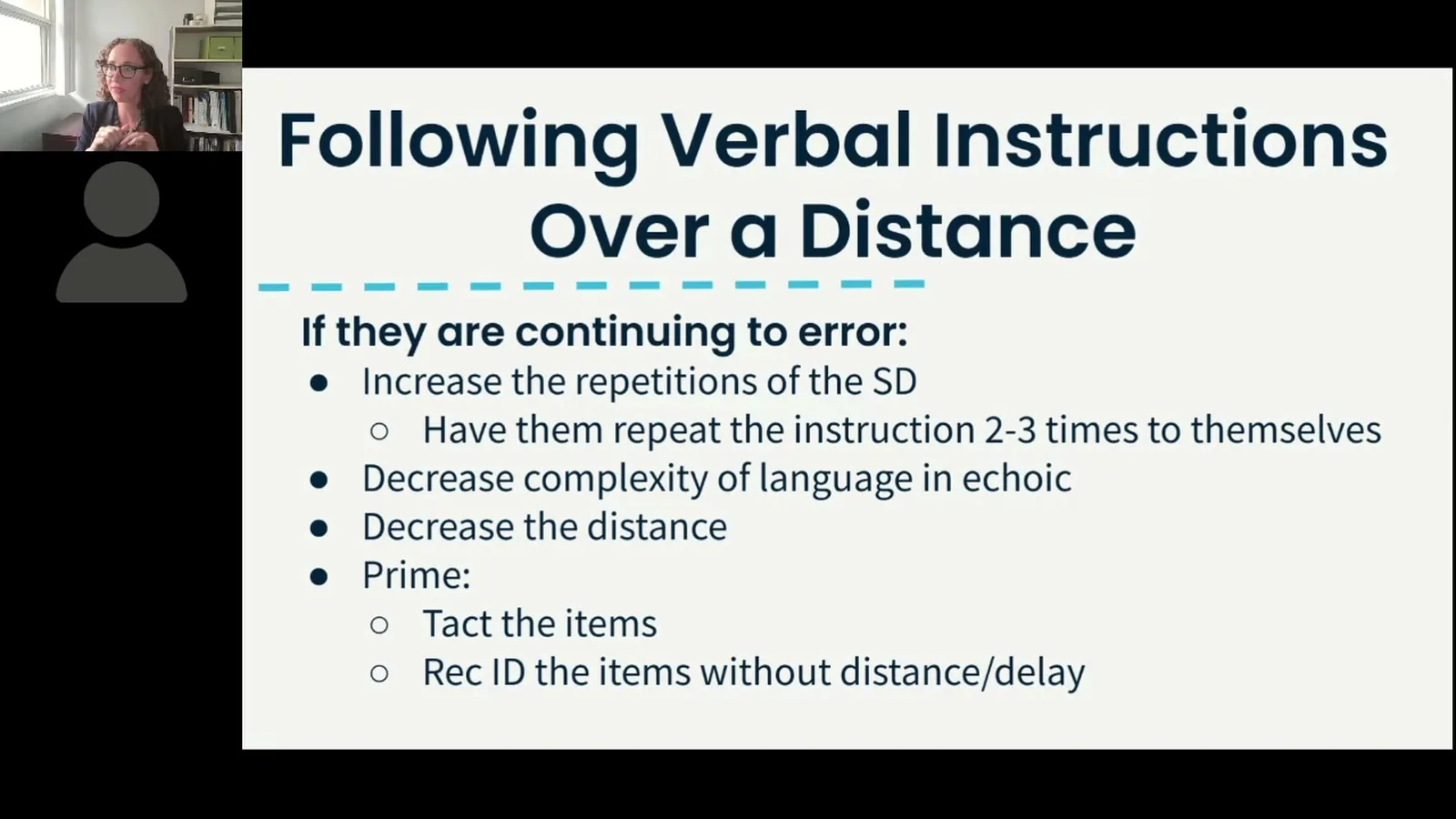
The first program is simple on purpose. The learner goes and gets a requested item from somewhere in the room. Three prerequisites matter. The learner can already receptively identify every item used (picking an item when named). The learner labels items while selecting them. And the learner has some echoic repertoire (can repeat what they hear). This is not a program for teaching new words.
The teaching loop is short. Give the instruction, such as go get your pencil. Then prompt the learner to repeat the key word right away. Point to yourself and say pencil, then point to them so they say it back. Go back and forth two or three times and end with the learner saying it. Then give a clear cue to move, such as go do it. Fade the gesture prompt quickly (remove your help over time). The goal is a learner who hears the instruction and rehearses it silently.
Errors are where this program earns its keep. The instinct is to prompt the right answer, and Pettus said to do the opposite. Put the item back, bring the learner back to the start, and run the prompting loop again. Reinforcing a correct selection teaches selection. It does not teach the self-prompt that has to carry the response over distance.
If errors keep coming, she offered several adjustments. Have the learner repeat the words two or three times instead of once. Shorten the phrase when the echoic itself is hard. A long phrase eats up the effort needed to hold it. Cut the distance to three or five feet and build it back up slowly. Prime the array first (practice right before the real task) by having the learner label everything in it. If the walk back upsets the learner, shrink the distance and keep corrections warm. Make trials more errorless too (set up so mistakes are rare).
we want to bring them back and repeat the joint control prompting procedure
From the talk — Dana Pettus
Scaling Up: Multiple Items and Multi Step Instructions
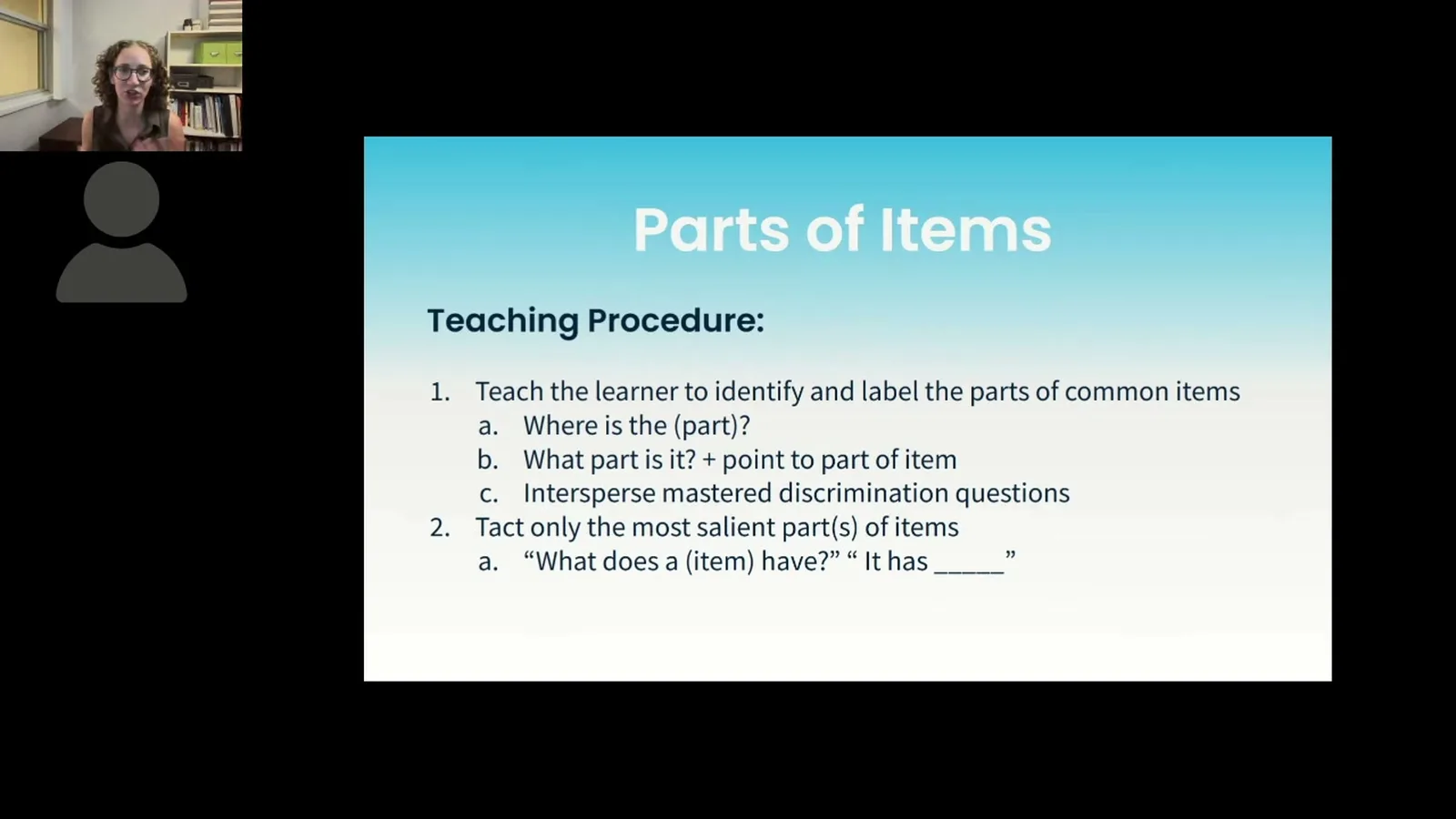
The second program is selecting multiple items in the order requested. You say give me the ball and cat. The learner repeats ball cat two or three times, then selects. Order is not a small detail here, because the order is your evidence that rehearsal actually happened.
Start with set combinations if the learner needs that support. Mastery means any novel pairing of known items, not one memorized pair. Then grow the string. Two items becomes three, then four, and each step adds a little more to hold at once.
The third program is following multi step instructions. Only combine instructions the learner can already do alone. This program builds the number of steps, not the steps themselves. Teach the learner to shorten what they repeat. Go get your backpack and line up at the door becomes backpack, line up. You may have to model that shortening a few times.
From there the difficulty grows in layers. Add a describing word, so it is the blue pencil and not just the pencil. Add a location, such as the book under the table when a book also sits on it. Add a place to go first. Eventually the learner can hold bedroom, blue car, on bed and carry all three across the house.
We often have to hold multiple steps.
From the talk — Dana Pettus
Counting and Block Building Run on the Same Process
Give me five pom poms looks like a counting program, but it is really a joint control program. The learner has to hold five while counting one, two, three, four, five. The match between the rehearsed number and the current count is the signal to stop.
That shapes the teaching procedure. Give the instruction, prompt the learner to repeat the target number two or three times, then cue them to respond. Pettus flagged a common staff error here. Praise often fires the second the learner reaches five. That hides whether they would have kept going to six or seven.
Block imitation works the same way. Attendees described their own self-talk: label the color, label the number of bumps, label where a piece sits. You label the model, then scan and label the loose pieces until the two match. Teaching it means making that visible. Prompt the learner to touch and label the first block, find it, and then repeat for the next one.
Delayed block imitation is the harder version and the more useful one. Show the model, remove it, wait, then hand over the blocks. Prompt the learner to label the model in build order, such as blue, green, yellow, red. Have them rehearse that string while the model is gone, then label each block as they build. This is early recall practice: label in the moment, rehearse, then rebuild.
This one, you are giving them that two to three seconds.
From the talk — Dana Pettus
Reading Comprehension Needs the Same Self-Talk
Pettus showed a short passage and one question about where James went. Attendees listed what that simple question actually requires. Read and decode the words. Know what they mean. Know that where asks for a place, so blocks is not an acceptable answer. Hold the events in order. Compare the question against what the passage said.
One attendee named the strategy most adults use. You often do not remember the answer at all. You hold the key words from the question and go hunting for them in the text. That hunt is joint control. The key words are the rehearsed part, and the passage supplies the match.
Many learners cannot do that, and you can watch it happen. A learner misses a comprehension question and the therapist sends them back to the text. They read it again and still miss it. The passage was never the problem. They could not hold the question in their head while they read.
So teach that step. Have the learner read the question and pull out the key words. Where did James go last night becomes James, go, last night. Have them rehearse that out loud, then send them back through the passage. When they hit a place in the text, the match does the work. She added one guardrail: test at the learner's comprehension level, not their decoding level. Plenty of learners read far past what they understand.
Go back and reread the passage and then try.
From the talk — Dana Pettus
How to Troubleshoot a Program That Stalls
When a program is not moving, Pettus starts with one question. Do the task yourself and watch what you actually do to get the answer. Ask a coworker too, since someone else may describe it in a way that fits your learner better. Then teach those behaviors instead of running more trials of the same thing.
She gave a short list of places the breakdown can sit. The learner may not be attending to the question itself. The learner may not have solid labels for the items or the instructions. Or the learner may have every piece and still lack a strategy that ties them together. Each one points to a different fix, and only one of them is more practice.
The other half of the work happens outside of programs. Make repeating instructions a routine, out loud at first, so you can hear that the instruction landed. Label things out loud through the day so labeling stays easy and automatic. Practice echoing in ordinary moments, so saying it back becomes the default when a learner needs to remember something.
The through line is simple. When a learner misses, do not hand over the answer. Find the source of control that is missing and teach that instead. Teaching it early sets learners up for the harder skills that come next.
So think about what are the actual sources of stimulus control for this response?
From the talk — Dana Pettus
Common questions
What is joint control in ABA (applied behavior analysis)?▾
Joint control happens when a rehearsed word and a label for something you see control the same response. You repeat peanut butter on the way to the store. Then you label items on the shelf until one matches what you rehearsed. That match is what makes you reach for the jar. Dana Pettus described it as one of the easier forms of self-talk to teach directly.
How is joint control different from working memory?▾
Working memory is the broad ability to hold information while you do something with it. Joint control is one specific version of that. You rehearse something, then something in the environment matches what you rehearsed, and the match evokes the response. Pettus described joint control as a subsection of the much broader working memory.
What should I do when a learner picks the wrong item during a joint control program?▾
Do not prompt the correct item. Put the item back, bring the learner back to the start, and run the repeat-it-back procedure again. Prompting the right answer teaches the selection, not the self-prompt you are trying to build. If the trip back upsets the learner, cut the distance and keep the correction warm rather than sharp.
Can these procedures work with a learner who does not speak vocally?▾
Yes, with changes. If the learner signs, you can model the sign, and their own sign serves as the rehearsal. With a speech device, the button on the screen becomes a visual prompt. The task can turn into a visual match instead of a real rehearsal. Pettus noted you can still model for the learner, but be aware the source of control shifts.
When is a learner ready for joint control programs?▾
They should already identify every item used and label items while selecting them. They should also have some ability to repeat what they hear. These programs are not for teaching new vocabulary. You run them with known items and known instructions, so the only new thing being taught is the self-prompt.
About the speaker
Dana Pettus is a board certified behavior analyst and a registered behavior analyst who has worked in the field since 2013. She works as a clinical manager at AlphaBee. Most of her work is with children and teens with autism, along with some clients with other diagnoses. This session was the second part of her three part series for The Behaviorist Book Club. The series covers speaker and listener repertoires.
This summary was generated from the recording’s transcript. Quotes are taken word for word from the talk.
What you'll learn
- 11. Define joint control as the onset of joint stimulus control over a common response topography and distinguish it from simple listener responding 2. Analyze learner performance to determine whether correct responding reflects mediated problem solving or restricted stimulus control. 3. Identify prerequisite repertoires (e.g., self-echoic, tact, listener, and mixed operants) necessary for establishing functional speaker–listener interactions. 4. Design instructional procedures that establish overt verbal mediation and systematically transfer responding to covert mediation. 5. Apply joint control procedures to teach a variety of skills including multi-step instructions, mediated selection, listing, and early academic problem-solving tasks.
Concepts in this CEU
Related talks
Talks that cover the same concepts
Teaching WH-Questions Isn’t Enough: Building True Conditional Discrimination
The Behaviorist Bookclub

When the Foundations Are Right: Unlocking Advanced Verbal Repertoires
The Behaviorist Bookclub

Child Development Deep Dive: Middle Childhood (6-8 year olds)
The Behaviorist Bookclub

genArete: To Teach or not to Teach!
The Behaviorist Bookclub

Child Development for BCBAs- Age 9-11
The Behaviorist Bookclub
Solving Clinical Challenges with Research
The Behaviorist Bookclub
More from The Behaviorist Bookclub
Supervising Beyond Technical Skills: Professionalism, Communication, and Clinical Judgment
The Behaviorist Bookclub
Reflective Supervision and Client Outcomes
The Behaviorist Bookclub
Empowering Autonomy and Self-Management in ADHD Learners
The Behaviorist Bookclub
OpenCEU is supported by advertising from third-party sponsors. Sponsors are clearly labeled, have no influence over course content, instructors, or CEU decisions, and never appear on certificates. The BACB does not sponsor, approve, or endorse OpenCEU sponsors or their products.