Verbal Mediation: How Self-Talk Helps Solve Problems
Verbal mediation is self-talk that creates extra cues for complex answers. Learn how rehearsal, subcategories, and inner speech help learners in ABA.
Key takeaway
Verbal mediation in behavior analysis is when a person talks to themselves to bridge a question and a complex answer. It is the quiet self-talk that helps us remember, sort, and solve.
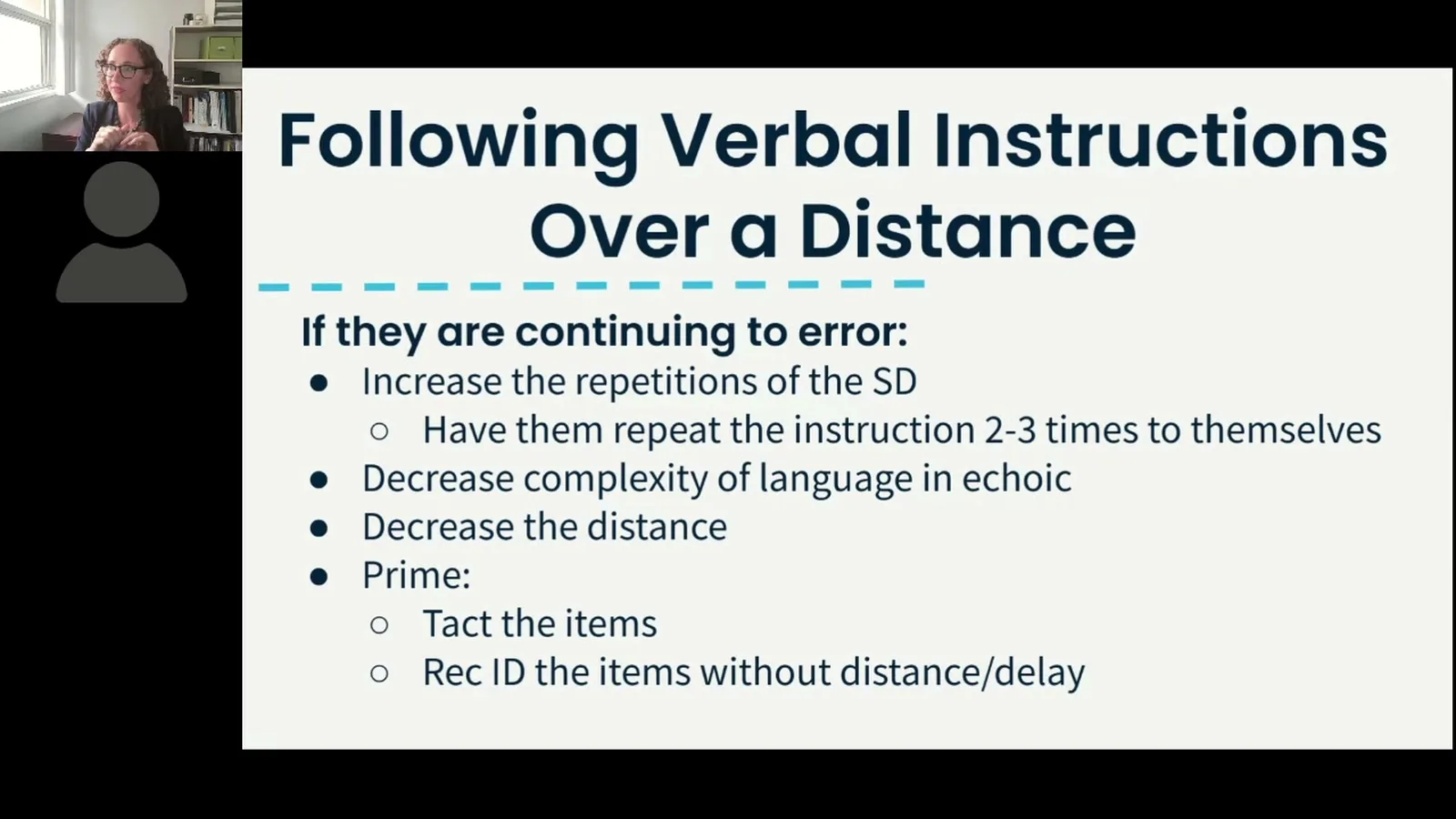
Getting the Right Answer Isn’t Enough: Establishing Speaker–Listener Repertoires for Complex Learning
Experts who cover this
2 recordings on openceu cover verbal mediation.
- Featured talk1 CEU
Getting the Right Answer Isn’t Enough: Establishing Speaker–Listener Repertoires for Complex Learning
Dana PettusThe Behaviorist Bookclub
Defined as using one's own covert verbal behavior to create additional sources of stimulus control that support problem solving, illustrated with examples like…
- 1 CEU
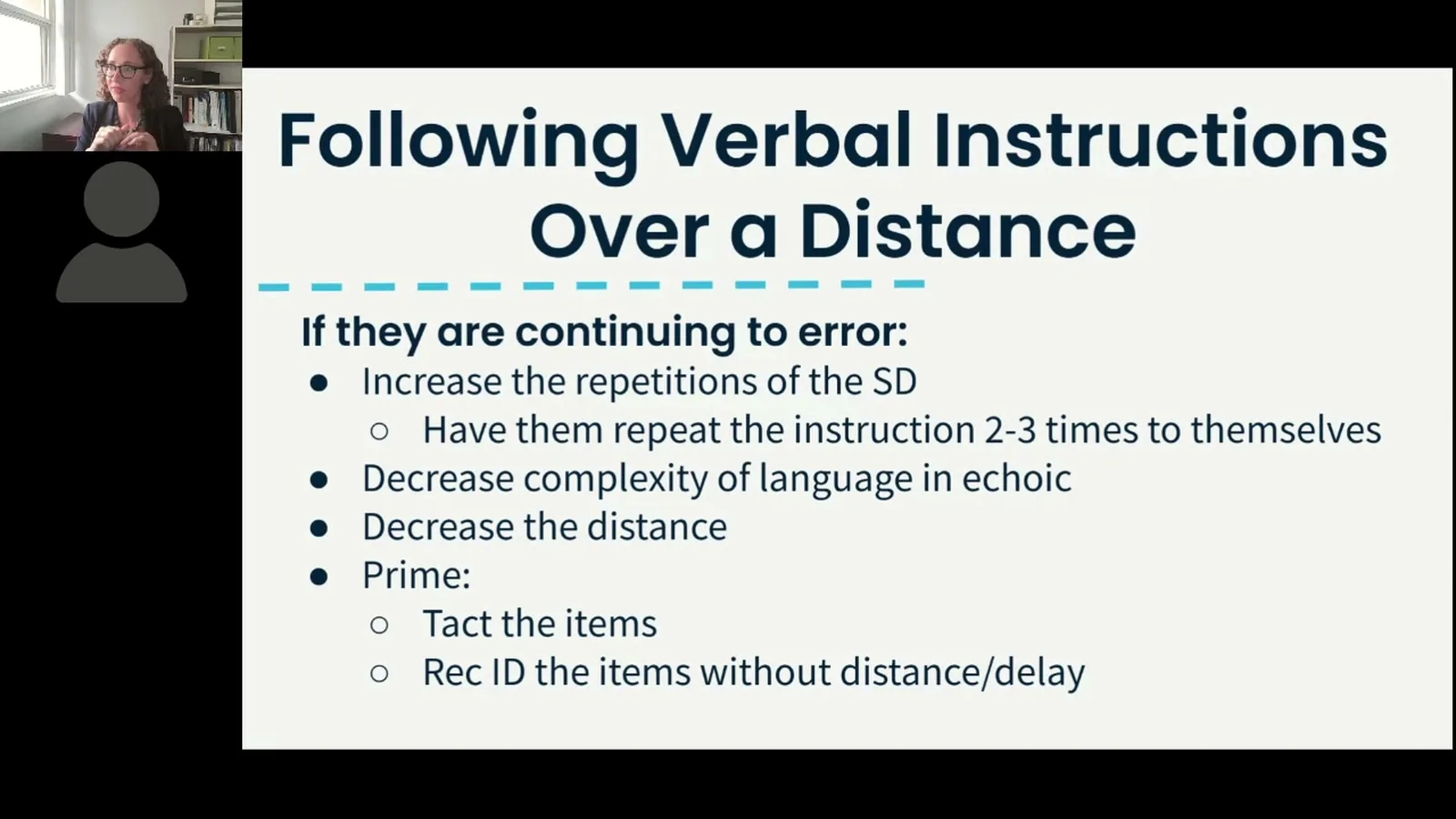
When the Foundations Are Right: Unlocking Advanced Verbal Repertoires
Dana PettusThe Behaviorist Bookclub
Central concept: verbal mediation is self-talk (rehearsing, subcategorizing, repeating/rephrasing) that generates extra stimulus control to help answer complex…
On this page · 9 sections▾
Verbal mediation in behavior analysis is when a person talks to themselves to bridge a question and a complex answer. It is the quiet self-talk that helps us remember, sort, and solve.
Most adults do this all day without noticing. Many learners, though, never pick it up on their own. This page explains what verbal mediation looks like, why it matters for complex skills, and what research says about it.
What verbal mediation means#
Dana Pettus teaches clinicians how to build advanced verbal skills. In her talk on speaker and listener skills, she gives a simple definition.
This is basically using our own own verbal behavior or talking to ourselves to create Additional sources of stimulus control.
From the talk — Dana Pettus
That definition has one key phrase: stimulus control. Stimulus control means a cue reliably sets off a behavior. A question is a cue: it is meant to evoke an answer.
Sometimes one cue is not enough to reach the right answer. So we add more cues ourselves. We do it by talking. The words we say to ourselves become new cues. Those new cues help guide what we do next.
Pettus calls this covert verbal behavior. Covert just means hidden or silent. It is talking that happens inside your head. Nobody else hears it. But it still shapes what you say and do.
Inner monologue, self-talk, and the clinical term#
People use many everyday words for this. Some call it inner monologue. Others call it self-talk. During one session, a viewer asked Pettus for the right term for that inner voice. Her answer was direct.
The term for inner monologue, Stacey was verbal mediation.
From the talk — Dana Pettus
She then described it as covert verbal behavior that is mediating your behavior. To mediate means to stand in the middle. The self-talk sits between the cue and the final response. It links the two together.
This framing matters for clinicians. Inner monologue sounds like a private mental event. Verbal mediation puts it in behavior terms instead. It is verbal behavior, just like talking out loud. That shift turns a vague idea into a skill a clinician can plan to teach. It is not simply something a learner has or lacks.
Rehearsal: the grocery list example#
The easiest example is one most people know well. Pettus describes getting ready for a trip to the store. You need apples, pears, and bananas. So you repeat the list. Apples, pears, bananas. Apples, pears, bananas.
That repeating is called rehearsal. Each time you say the list, you create a fresh cue. The cue keeps the items alive until you reach the store. Without it, one item might slip away before you get there.
Pettus uses the same idea for directions with several steps. Picture a teacher who says, "Go get your coat, your boots, and line up." A person who follows that well may be quietly saying, "Coat, boots, line up." Pettus describes this as working with the steps in her head to remember them.
Rehearsal helps the learner hold all three steps until each one is done. It is a small skill, but it carries a lot of weight in a busy classroom.
Subcategories: prompting yourself to list more#
A second type of verbal mediation is using subcategories. A subcategory is a smaller group inside a bigger one. Pettus gives a fun test. Try to name as many countries as you can.
At first the names come fast. Then you get stuck. So you prompt yourself. "Okay, think about Europe." Now a new batch of names shows up. When those run out, you might shift to South America.
A prompt is an extra cue that helps a correct response happen. Usually a teacher gives the prompt. Here, the learner gives the prompt to themselves. Pettus describes this as prompting yourself and creating an additional source of stimulus control.
Each subcategory acts like a self-made hint. It opens a new path when the first path runs dry. A learner who can break a big group into smaller groups has more ways to keep going. A learner without that skill may stop after only a few answers, even if they know many more.
Answering complex questions#
Pettus returns to one question across both of her talks. What did you have for breakfast on Sunday?
Some people eat the same thing every day, so they just know. Most people have to work it out. Pettus walks through her own thinking out loud. Sunday, I was at home. I was cooking. Oh, right, I had eggs and toast.
Then she points out what really happened. The question was an SD, short for discriminative stimulus. That is a cue that signals a certain response will pay off. Here, it set off a chain of problem solving and silent talk. All of those steps combined to produce the answer. In her talk on advanced verbal skills, she sums it up this way.
using our own verbal behavior. behavior or talking to ourselves. To create additional sources of stimulus control.
From the talk — Dana Pettus
The answer did not come straight from the question. It came from the steps in between. In her first talk, Pettus makes the same point plainly. You did not just know what you ate. You had to use covert verbal behavior to solve the problem.
Reading comprehension and verbal mediation#
Pettus also links verbal mediation to reading comprehension. She uses a short passage. Jane came to her house last night. They built a tower with big blocks. The tower fell down, and they laughed. They had fun and said good night.
Then comes a simple question. Where did Jane go last night? The goal is to answer basic factual "wh" questions about a passage just read. These are who, what, and where questions.
It looks easy. But Pettus asks her audience to list every skill the learner needs to answer it. She calls it a fairly straightforward question. Then she adds a sharper one. What verbal mediation does the learner need to do?
That framing is useful for any clinician. A correct answer can hide many small steps. A wrong answer can hide a missing step, too. Pettus pushes clinicians to look past the final answer. She wants them to ask what silent work sits behind it. That is how a team can spot which piece to teach next.
Why verbal mediation often needs to be taught#
Pettus makes a point that is easy to miss. We use verbal mediation all of the time. But it is something we often do not teach our learners.
Many people pick it up naturally. They learn to rehearse, sort, and reason through questions without a formal lesson. Some learners do not. For them, Pettus says, we may have to teach it on purpose.
This idea sits behind her talk title, "Getting the Right Answer Isn't Enough." A learner might give a right answer from rote memory alone. Rote means memorized, without the steps behind it. Pettus focuses on the repertoire behind the answer, not just the answer itself. A repertoire is the full set of skills a person can use.
Her second talk, When the Foundations Are Right: Unlocking Advanced Verbal Repertoires, covers the same theme. It walks through rehearsal, subcategories, and the breakfast question. It also stresses that advanced verbal skills rest on this kind of self-talk.
What the research says#
Lab studies support the idea that self-talk guides problem solving. Many use matching-to-sample tasks. In these tasks, a person sees a sample and picks the matching choice.
One study tested college students and adults with intellectual disabilities (Sundberg, Sundberg, & Michael, 2018). Making symbols hard to label hurt the college students' scores. It did not hurt the other group. The authors suggest the students leaned on silent naming and joint control.
Another study taught listener selection to six children with autism (Zhou et al., 2025). Listener selection means picking an item when someone names it. Teaching based on joint control worked better than standard teaching. The authors see joint control as one form of verbal mediation.
Some studies ask people to talk out loud during tests. In one, students' spoken words tended to match their choices (Dingus et al., 2024). That pattern hints that verbal mediation helped them group the stimuli. The same study found that talking aloud may sometimes get in the way.
A fourth study looked at size relations like biggest and smallest (Luoma et al., 2024). Training alone was not enough for most adults. They solved the tests by naming items and relating them in words.
FAQ#
What is verbal mediation in simple terms?
Verbal mediation is talking to yourself to help solve a problem. The words you say become extra cues. Those cues guide you toward the right answer.
Is verbal mediation the same as inner monologue or self-talk?
Mostly, yes. Inner monologue and self-talk are everyday words. Verbal mediation is the behavior analysis term for that same silent verbal behavior.
Can verbal mediation be taught?
Yes. Many learners pick it up on their own. Others need direct teaching of skills like rehearsal and using subcategories to list more items.
Turn this topic into a CEU
You just studied this. Now get credit for it.
Watch Getting the Right Answer Isn’t Enough: Establishing Speaker–Listener Repertoires for Complex Learning with Dana Pettus and earn 1 free BCBA CEU. Detailed certificate, delivered the moment you finish.