Stimulus Control in ABA: What It Is and How It Works
A plain guide to stimulus control in ABA. Learn how cues shape behavior, why it drives sleep treatment, and what the research shows.
Key takeaway
Stimulus control is when a cue reliably sets off a behavior. A red light makes you stop. A phone buzz makes you check it. The cue does not force the action.
Explore free BCBA CEU courses
Free learning path on this topic
Supervision, Done Right
Four supervision CEUs that build on each other. What reflective supervision is, how to build a supervision system, how to assess supervisee competence instead of counting hours, and how supervision affects provider outcomes. The BACB asks supervisors for three supervision CEUs per cycle. This covers it.
Experts who cover this
The recording behind this guide covers stimulus control.
- 1 CEU
Getting the Right Answer Isn’t Enough: Establishing Speaker–Listener Repertoires for Complex Learning
Dana PettusThe Behaviorist Bookclub
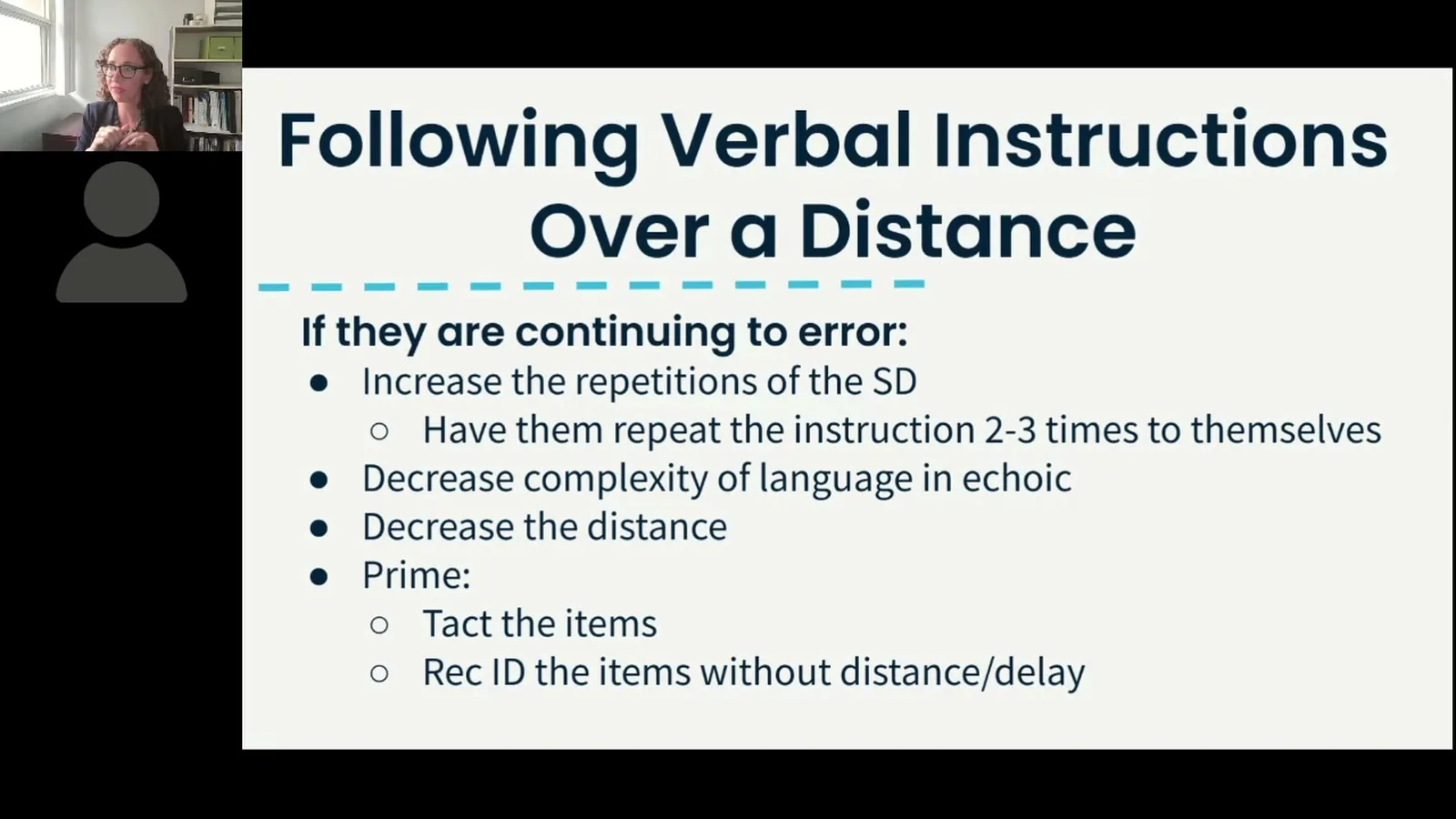
The session's organizing theme: complex learning requires natural, multiple sources of stimulus control rather than single-SD teaching. The presenter offers a…
On this page · 7 sections▾
Stimulus control is when a cue reliably sets off a behavior. A red light makes you stop. A phone buzz makes you check it. The cue does not force the action. It just makes that action much more likely.
This idea sits at the heart of ABA. When a cue signals that a behavior will pay off, that cue starts to guide the behavior. For BCBAs, RBTs, teachers, and parents, strong stimulus control means the right behavior shows up at the right time and place.
What stimulus control means#
A cue that signals reinforcement is called a discriminative stimulus, or SD for short. Over time, behavior comes under the control of that cue. The behavior happens when the cue is present. It fades when the cue is gone.
Sleep is a powerful example. Dr. Emily Ice calls stimulus control one of her top treatment tools. It has a long research history in behavioral sleep work.
The top three that I use is stimulus control. It's one of the most researched areas for behavioral sleep treatment. Woodson began his exploration of this back in the 70s with regard to sleep. From the talk — Dr. Emily Ice
The bed becomes a cue for sleep. If a person only sleeps in bed, and does not lie awake there, the bed signals sleep strongly. That link is stimulus control at work.
Why it helps with sleep#
The goal is to make the bed mean sleep and only sleep. When the cue is clean, sleep comes faster. Ice points to the payoff for people who struggle to fall asleep.
he found that it's a great opportunity for decreasing sleep onset time and overall chronic insomnia experiences. From the talk — Dr. Emily Ice
This is why sleep advice often says to leave the bed if you cannot sleep. Lying awake in bed muddies the cue. It teaches the bed to mean "awake." Keeping the bed for sleep protects the stimulus control you want.
Many cues can control one behavior#
Real life is not tidy. A behavior often answers to more than one cue at once. Ice ties this to Greg Hanley's idea of synthesized reinforcement. She reframes it for cues instead of rewards.
Just as Hanley discusses synthesized reinforcement, here I want you to think about this as synthesized SDs. The reinforcer of sleep is multiply controlled. From the talk — Dr. Emily Ice
In plain terms, several cues team up to signal sleep. The dark room, the quiet, the routine, and the bed all work together. No single cue does the whole job. When you build a sleep plan, you shape the full set of cues, not just one.
How to build strong stimulus control#
 Advertisement
The steps are simple but need care. First, pick the cue you want to control the behavior. Next, make sure the behavior pays off only when that cue is present. Then keep the cue away when you do not want the behavior.
The link grows through repetition. Each time the cue leads to reinforcement, the bond gets stronger. Each time the cue is present without payoff, the bond weakens. So be consistent about when the cue appears. Clear, steady patterns build control faster than mixed ones.
For sleep, that means the bed is for sleep. Keep screens, snacks, and play out of it. Keep the room dark and calm. Over time, the bed becomes a clean, strong cue. The child falls asleep faster because the cue and the behavior are tightly linked.
Consistency is what builds the link. The same cue must lead to the same result again and again. Mixed signals weaken control. So keep the routine steady across nights and caregivers. A clear, repeated cue trains the behavior faster than any single big change.
Weak stimulus control and how to fix it#
Sometimes the cue does not control the behavior well. The behavior shows up at the wrong times, or not when you want it. This is weak stimulus control. It is common and fixable.
One cause is a muddy cue. If the bed means both sleep and screen time, it cannot signal sleep well. The fix is to clean up the cue. Keep the bed for sleep only. Remove the competing uses.
Another cause is control by the wrong part of a cue. A learner may respond to only one piece of a complex cue. To catch this, test each part on its own. Then teach the full cue to work together. Clear, consistent cues build strong control over time.
What the research says#
Stimulus control is well studied in the lab and the clinic. One case study shows a risk to watch for. When teaching with compound cues, a learner may respond to just one part of the cue. Careful checks can catch this narrow control (Grey, H. C., Morris, C., Perrin, J., & Oliveira, J. P. (2024). Evaluating the Effects of Compound Stimuli on Stimulus Control during Match-to-Sample Procedures. Behavior Analysis in Practice, 17(4), 1211-1215).
Basic research keeps refining the concept. One study found that control by a cue depends on how reinforcement is arranged across cue dimensions. As errors got reinforced along one dimension, control by that dimension dropped (Gomes-Ng, S., Cowie, S., & Elliffe, D. (2023). Divided stimulus control depends on differential and nondifferential reinforcement: Testing a quantitative model. Journal of the Experimental Analysis of Behavior, 120(3), 344-362).
Stimulus control even extends to social behavior. In one study, two pigeons had to peck together in close time to earn a reward. This coordinated response came under stimulus control, acting like a discriminated social operant (Lattal, K. A. & Okouchi, H. (2023). Stimulus control of a social operant. Journal of the Experimental Analysis of Behavior, 120(3), 330-343). Together these studies show the concept runs deep and wide.
FAQ#
What is stimulus control in simple terms? It is when a cue makes a behavior much more likely. The cue signals that the behavior will pay off. A stop sign, a phone buzz, or a bed can all act as cues that guide what we do.
What is a discriminative stimulus? It is a cue that signals reinforcement is available. People often shorten it to SD. When the cue is present, the behavior is likely to happen and get reinforced.
How does stimulus control help with sleep? It makes the bed a clean cue for sleep. If you sleep in bed and do not lie awake there, the bed signals sleep strongly. That link helps you fall asleep faster and stay asleep.
To see stimulus control applied to sleep treatment, watch Waking to Reinforcement with Dr. Emily Ice.
 Advertisement
Keep learning
Earn free BCBA CEUs on openceu
Browse on-demand recordings from verified ACE providers and earn CEUs across autism, ABA, and behavior analysis. Detailed certificate, delivered the moment you finish.
Keep going with a free learning path
Supervision, Done Right
Four supervision CEUs that build on each other. What reflective supervision is, how to build a supervision system, how to assess supervisee competence instead of counting hours, and how supervision affects provider outcomes. The BACB asks supervisors for three supervision CEUs per cycle. This covers it.
Want the primary literature? Read the Stimulus Control in ABA research roundup on our sister site, Behaviorist Book Club.