Private Events in ABA: Teaching the Body's Warning Signs
Private events are thoughts, feelings, and body signals treated as behavior. Learn how BCBAs spot them and teach learners to name them.
Key takeaway
Private events are behaviors that happen inside the skin, like thoughts, feelings, and body sensations. In behavior analysis, they follow the same rules as behavior anyone can see.
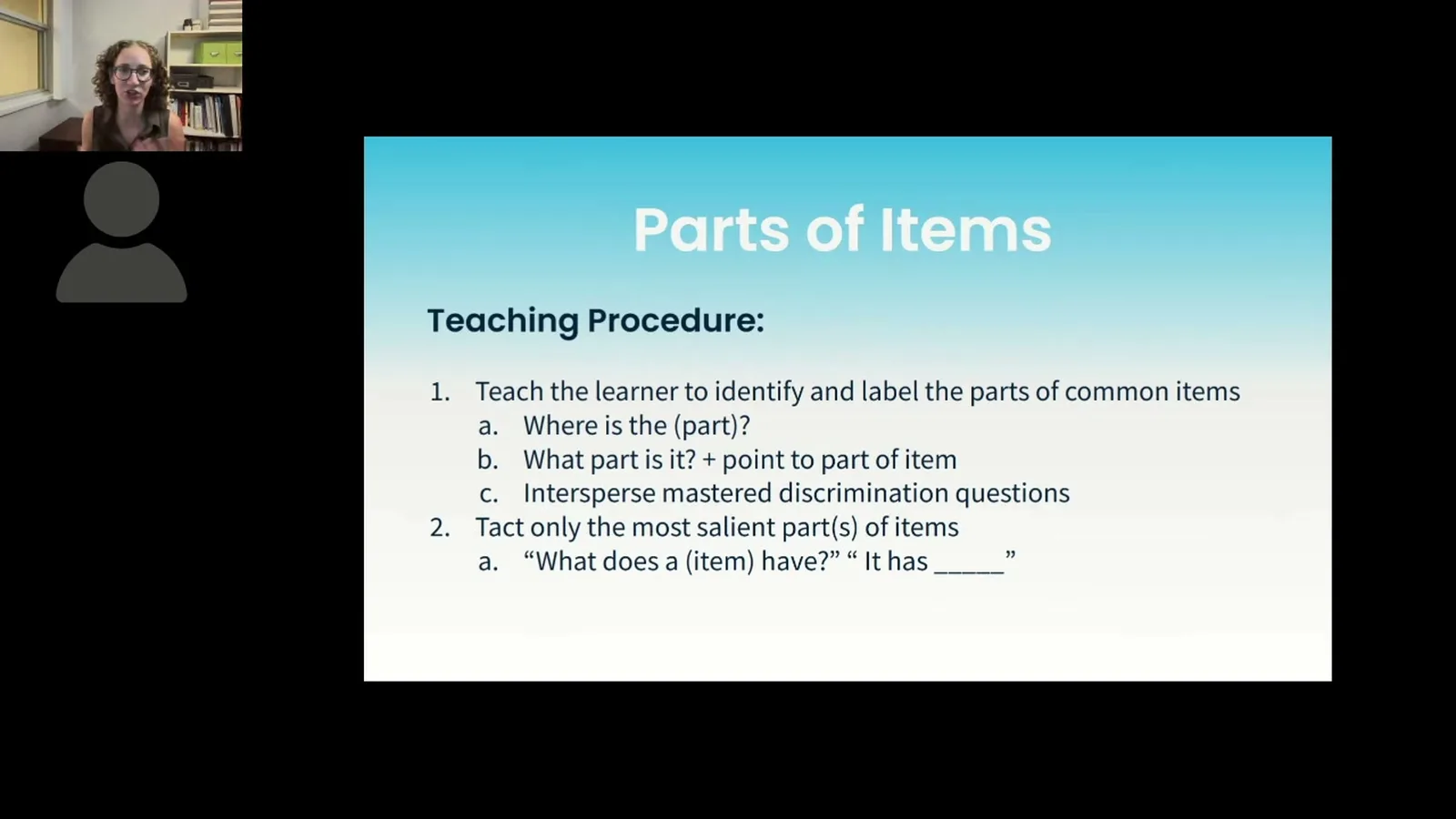
What Does Your Body Know? Teaching Individuals with IDD to Recognize Internal Warning Signs`
Free learning path on this topic
Verbal Behavior: Beyond WH-Questions
Dana Pettus's three-part series on building generative verbal behavior. Why WH-question programs stall, how to establish speaker-listener repertoires, and how to scaffold advanced verbal skills like recall and simple inference. Three hours, three CEUs.
Experts who cover this
6 recordings on openceu cover private events.
- Featured talk1 CEU
What Does Your Body Know? Teaching Individuals with IDD to Recognize Internal Warning Signs`
Tricia LundThe Behaviorist Bookclub
Carolyn reframes internal warning signals like fear or physiological arousal as private events, arguing from a radical behaviorist perspective that these are…
- 1 CEU
When the Foundations Are Right: Unlocking Advanced Verbal Repertoires
Dana PettusThe Behaviorist Bookclub
Reviews the distinction between a pure tact (controlled only by a nonverbal stimulus) and an interverbal tact (controlled jointly by a question and a visible…
- 1 CEU
Getting the Right Answer Isn’t Enough: Establishing Speaker–Listener Repertoires for Complex Learning
Dana PettusThe Behaviorist Bookclub
Recaps that a pure tact is controlled solely by a nonverbal SD (seeing an object and naming it), whereas most functional tacts clinicians teach are actually…
- 1 CEU
Teaching WH-Questions Isn’t Enough: Building True Conditional Discrimination
Dana PettusThe Behaviorist Bookclub
Defines the pure tact as a nonverbal SD evoking a labeling response maintained by generalized reinforcement, used as the baseline concept before introducing…
- 1 CEU
It’s Complicated: Teaching Relationship Safety That Reflects Real Life
Patricia "Tricia" Lund, CSE, LBA & Carolyn Broner, M.S. Ed.The Behaviorist Bookclub
Broner frames a child's internal, hard-to-articulate discomfort or unease as private events, and argues that emotional safety language (like 'something feels…
- 1 CEU
genArete: To Teach or not to Teach!
Mark MaladyThe Behaviorist Bookclub
Framed as the vital, early-acquirable repertoire that lets a learner self-advocate for accommodations from the very start, in any response modality, not…


On this page · 11 sections▾
Private events are behaviors that happen inside the skin, like thoughts, feelings, and body sensations. In behavior analysis, they follow the same rules as behavior anyone can see. A racing heart, a tight stomach, or a sense that "something is off" all count. The term comes from radical behaviorism, the philosophy behind ABA. It has nothing to do with privacy in the everyday sense.
Why does this matter? Many learners feel warning signs in their bodies long before they can talk about them. If clinicians ignore those signals, they miss early clues about fear, stress, or danger. If they study them, they can teach learners to notice, name, and act on what their bodies are telling them.
What counts as a private event#
A private event is anything a person does or feels that only they can directly contact. Carolyn Broner, a BCBA who co-presented with Tricia Lund on internal warning signs, gives a clear list. She names fear, discomfort, uncertainty, physiological arousal (the body's "revved up" state), and a sense that something feels off. In ABA, all of these are treated as private events.
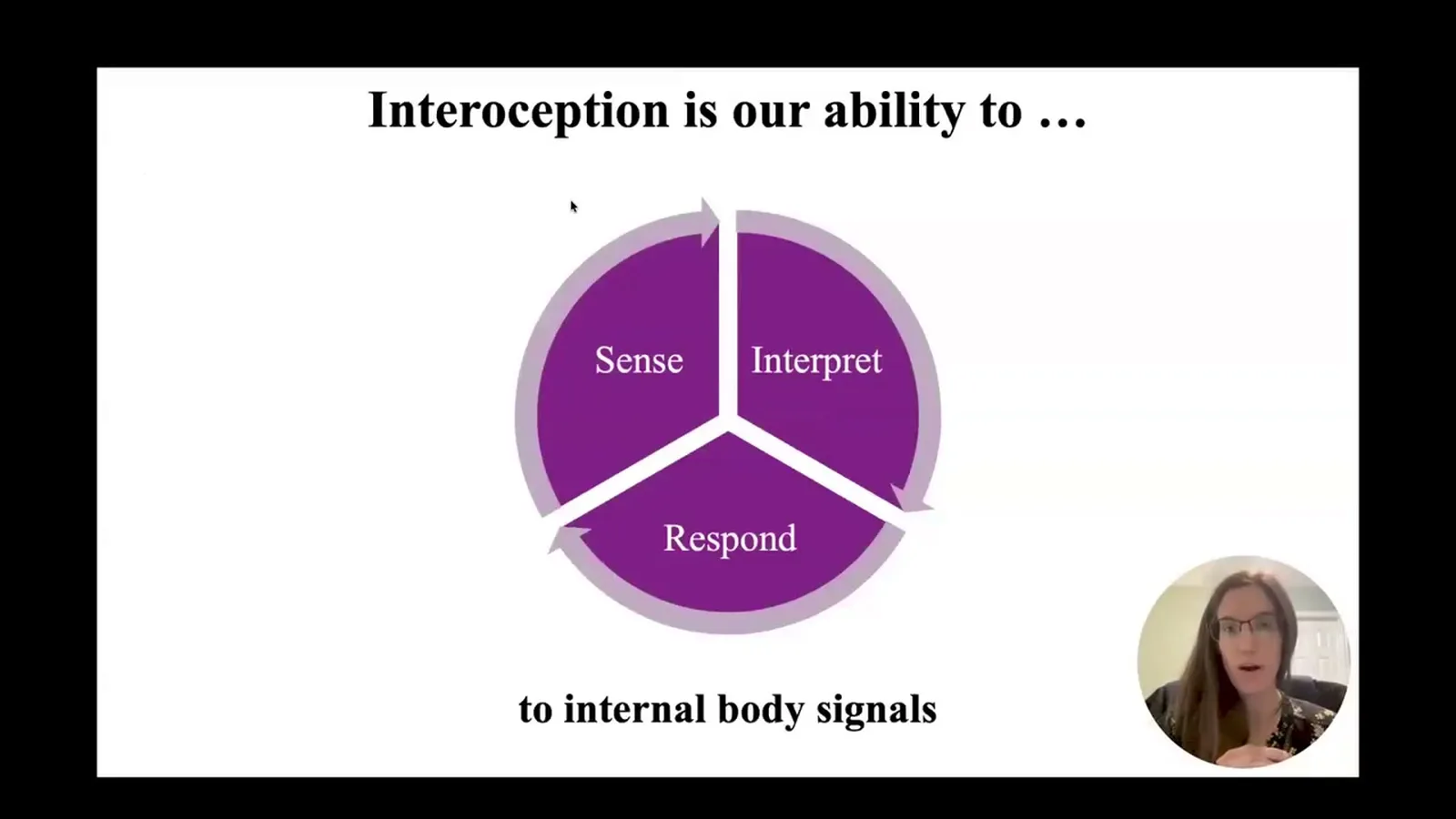
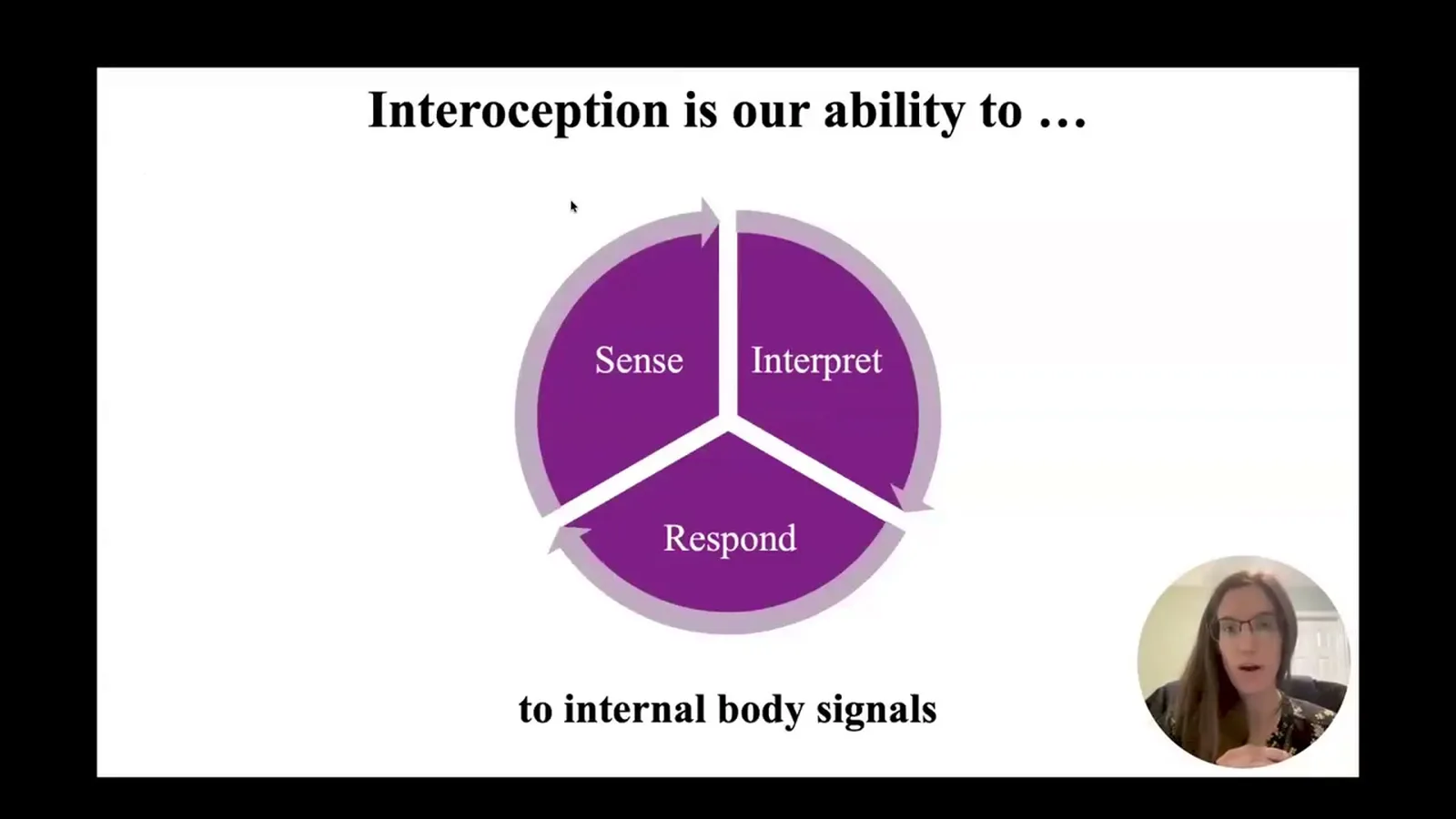
This idea connects to interoception. Interoception is the ability to sense what is happening inside your own body. It is how you know you are hungry, tired, or scared. Lund and Broner frame interoception as the starting point. First a person senses an internal change. Then the question becomes how behavior analysts should think about that change.
The answer from radical behaviorism is simple. Thoughts and feelings are not a separate, mysterious world. They are behavior. The only difference is where they happen. Public behavior happens where others can see it. Private behavior happens where only the person can feel it. That one shift opens the door to teaching, measuring, and supporting these hidden experiences.
Why private events still belong to behavior science#
Some people assume ABA ignores feelings. That is a myth, and Broner addresses it head on. She explains that inner experiences are part of the science, not outside of it.
From a radical behaviorist perspective, private events are not outside the science of behavior. They are covert behaviors subject to the same environmental influences as our overt behavior.
From the talk — Carolyn Broner
"Covert" means hidden. "Overt" means out in the open. Broner's point is that the same forces shape both. Past experiences, current settings, and consequences all affect how a person feels inside. They also affect how a person acts on the outside.
This has a big practical upside. If private events follow the same laws, they can be changed with the same tools. A learner's fear response is not fixed. It has a history, and it responds to the environment. That means clinicians can help. It also means they should take inner states seriously when they plan treatment, instead of treating them as off limits.
The core problem: you cannot see inside the skin#
There is a real challenge here, and Broner names it plainly. Behavior analysts are trained to observe and measure. Private events cannot be observed by anyone except the person having them.
We cannot directly observe a child's heart rate increasing, their stomach tightening, their breathing changing, or that internal sense of discomfort or threat.
From the talk — Carolyn Broner
Broner contrasts these hidden events with behaviors we can see. Aggression, avoidance, crying, freezing, and moving away are all observable. A heartbeat speeding up is not. So the clinician is always working with partial information.
This is not a reason to give up. It is a reason to be careful. A clinician should not guess at what a child feels and treat the guess as fact. Instead, the job is to look for reliable outside signs that tend to travel with inside changes. That is where the next idea comes in.
Reading the public accompaniments#
Since clinicians cannot see private events, they look at what shows up alongside them. Broner calls these public accompaniments.
So as behavior analysts, we often rely on public accompaniments, the observable responses that tend to occur alongside those internal changes.
From the talk — Carolyn Broner
She gives concrete examples. A child might tense their body or hold their breath. They might scan the room, cover their body, or move away. They might go quiet, laugh nervously, refuse, or suddenly show challenging behavior.
Broner's key point is that these behaviors may not be random. They may be collateral responses, meaning responses that rise and fall together with an internal state. When a clinician tracks these patterns over time, they become useful clinical data. They can signal rising arousal before a learner escalates, shuts down, or goes quiet. They can also signal that a learner is about to comply on autopilot, or lose access to good communication.
This changes how a team reads a hard moment. A stiff body is not only "noncompliance." It may be a warning light. Seeing it that way gives the team a chance to step in early, before a crisis.
Precursors a child cannot yet name#
 Advertisement
Broner takes this idea further in a follow-up talk on relationship safety. She notes that safety often begins in the body. Warning signals can show up before a child has words to describe them.
behavioral precursor responses may reflect private events the child cannot yet articulate.
From the talk — Carolyn Broner
A precursor is a behavior that comes before a bigger behavior. It is an early sign. Broner's point is that a child's small, early reactions may be the only clue that something feels wrong. The child may feel it clearly but have no way to say it.
She also stresses that interoception is not a fixed trait. It is a teachable repertoire, meaning a set of skills that can be built. Learners can be taught to notice, label, trust, and act on their internal signals. This is hopeful news for learners with intellectual and developmental disabilities (IDD). A child who does not sense or report body signals today can learn to do so over time.
Giving children words: emotional safety language#
Noticing a feeling is only half of the job. Broner argues that a child also needs words for it. Without words, a feeling stays locked inside.
emotional safety language gives children more than rules. It gives them language for what they are experiencing. In other words, private events.
From the talk — Carolyn Broner
Broner suggests simple, honest phrases. "I feel unsure." "Something feels different." "My body is telling me something." These do not ask a child to decide right away if something is safe or unsafe. They let the child start with what is actually true.
That's a practical function of emotional safety language. It gives children a way to surface an experience that doesn't yet have a clear name.
From the talk — Carolyn Broner
Broner also warns about binary language. When children only have "safe" and "unsafe" as choices, many real experiences do not fit either word. Those experiences become harder to report. The child still perceives something. They just lack a word that feels accurate enough to say out loud. A simple phrase like "something feels different" is enough to start a talk with a trusted adult. Broner notes that this talk is often where protection begins.
From noticing to doing: safety actions#
Words matter, but Broner says children also need something to do. Noticing body cues and naming feelings are important steps. Still, a child who feels uneasy needs a plan.
Broner recommends a flexible set of responses rather than one rigid script. Her list of developmentally appropriate safety actions includes:
- Pausing, and not feeling pressure to answer right away
- Moving away to create space when something feels uncomfortable
- Asking questions to gather more information
- Slowing down the interaction
- Getting help from a trusted adult or support person
- Reporting discomfort using words
This connects back to private events in a direct way. The private event is the early signal. The words let the child share it. The safety actions let the child respond to it. Each step builds on the one before.
Broner also points out a gap in many older safety programs. They often focus on stranger danger. Yet people are far more likely to be harmed by someone they know and trust. Those programs may also miss subtle relational cues and fail to teach children to honor their own discomfort. Teaching learners to tune in to private events helps fill that gap.
Tacting private events: where verbal behavior fits#
Naming a private event is a kind of tact. In verbal behavior, a tact is a label for something a person contacts, like saying "car" when you see a car. Dana Pettus, who teaches advanced verbal repertoires, reviews how tacts work across several talks. Her definition below comes through in fragments because of gaps in the talk's transcript; the word she is reaching for is "nonverbal."
What I think about a pure tact is that it's a non-ver... ...SD that results in... response that has some sort of generalized reinforcer.
From the talk — Dana Pettus
In plain terms, a pure tact is a label cued only by the thing itself. An SD (discriminative stimulus) is the cue that signals a response will pay off. A generalized reinforcer is a broad payoff, like praise or attention.
Pettus then makes an important point. Pure tacts are not how most people label things in daily life. You rarely walk into a room, see a chair, and just say "chair." Most labeling is an intraverbal tact. That kind of tact is controlled by two things at once: a spoken question and a visible stimulus. Her example is "What color is it?" plus a picture of a car, which leads to "blue." Pettus calls this convergent control, meaning two cues join to produce one answer.
This distinction is useful for private events. A child who says "my tummy hurts" only when an adult asks may not say it on their own. Clinicians can ask which kind of control they are actually building, and plan for both.
Self-advocacy and the mand-tact#
Mark Malady, a BCBA who speaks on accommodations, adds a related angle. He focuses on the mand-tact repertoire. A mand is a request. A tact is a label. A mand-tact combines the two, like naming a need and asking for help with it.
Malady argues this repertoire is vital for self-advocacy. (The talk transcript spells "mand-tact" as "man-tacked.")
the man-tacked repertoire is vital to teach the person to be able to advocate for their own accommodations.
From the talk — Mark Malady, BCBA
He points out that formal accommodation agreements, at school or at work, are not enough on their own. People also need the skill to ask for their accommodations. He notes this can be a very early learner skill. It does not need to be complex, and it does not need to be vocal. Any response form can work, as long as the function is there.
This lines up with Broner's work. A learner who can notice a private event, name it, and ask for help has real power. They can speak up before things fall apart. The skills build on each other.
What the research says#
Published studies support the core ideas from these talks. Researchers have taught children with autism to tact sensations using public accompaniments. In one study, children learned to label tactile sensations on body parts (Rajagopal et al., 2021). The children generalized to new objects, and to a lesser extent new body parts. They did not generalize to new sensations. That result suggests each new sensation may need direct teaching.
Another study taught children with autism to tact the private events of others. The children learned to link outside cues with common feelings, such as a bandage with "hurt." They learned the skill quickly (Belisle et al., 2019). Related work used video scenarios and relational training. It taught adolescents to identify the private events of others in context (Schmick et al., 2018).
Measurement is also possible. A review of precision teaching studies looked at inner behaviors like thoughts, anger, and self-critical statements. It found these could be reliably measured and changed (Van & Kubina, 2026). The authors also noted gaps in reporting and social validity data.
Finally, some researchers are working on the theory side. Meindl and Ivy (2023) propose a neurobiological-behavioral approach. It treats private behavior as partly controlled by internal body stimuli, which can act as cues, motivators, or consequences.
FAQ#
What is a private event in ABA? A private event is a behavior that happens inside the skin. Examples include thoughts, feelings, and body sensations like a racing heart. Radical behaviorism treats these as real behavior. They follow the same rules as behavior others can see.
How do you teach a child to tact private events? Clinicians start with public accompaniments, the outside signs that travel with inside changes. They then teach the child simple words for what they feel, like "something feels different." Research shows children with autism can learn to tact sensations and feelings with direct teaching and prompting.
Why are private events important for safety? Warning signs often show up in the body before a child can explain them. A child who can notice and name those signals can tell a trusted adult sooner. Teaching simple, honest safety language helps children report experiences that do not fit neatly into "safe" or "unsafe."
For more on building these skills, see It's Complicated: Teaching Relationship Safety That Reflects Real Life. Also see When the Foundations Are Right: Unlocking Advanced Verbal Repertoires.
 Advertisement
Turn this topic into a CEU
You just studied this. Now get credit for it.
Watch What Does Your Body Know? Teaching Individuals with IDD to Recognize Internal Warning Signs` with Tricia Lund and earn 1 free BCBA CEU. Detailed certificate, delivered the moment you finish.
Keep going with a free learning path
Verbal Behavior: Beyond WH-Questions
Dana Pettus's three-part series on building generative verbal behavior. Why WH-question programs stall, how to establish speaker-listener repertoires, and how to scaffold advanced verbal skills like recall and simple inference. Three hours, three CEUs.