Teaching WH-Questions Isn’t Enough: Building True Conditional Discrimination
Free · 1 Learning CEU · certificate included
This presentation challenges the assumption that teaching WH-questions in isolation produces flexible verbal repertoires. Drawing on the work of Dr. Francesca degli Espinosa, participants will examine how autoclitic frames and the scaffolding of skills can be used to systematically establish robust discriminated responding across verbal forms and to prevent faulty stimulus control before it becomes entrenched.
Register free & watch nowClaim your certificate as soon as you pass the quiz.
Presented by Dana Pettus
About this CEU
Many behaviour analysts can establish correct responding to individual WH-questions. However, when programs stall at more complex discriminations—such as discriminating features from functions questions, or adjectives from class relations—the issue is rarely the learner’s ability. The breakdown often reflects faulty stimulus control resulting from programming that uses a train and hope method of teaching question discrimination.
Abstract
This presentation challenges the assumption that teaching WH-questions in isolation produces flexible verbal repertoires. Drawing on the work of Dr. Francesca degli Espinosa, participants will examine how autoclitic frames and the scaffolding of skills can be used to systematically establish robust discriminated responding across verbal forms and to prevent faulty stimulus control before it becomes entrenched.
Credits
1 CEU · 60 min
From the talk
What was covered
Why mastered WH-questions (who, what, where, when questions) collapse when you mix them, and how autoclitic frames (set phrases that prompt the right answer) build real question discrimination (telling questions apart instead of guessing).
- Test every mastered question inside a mixed array before you trust the data.
- Do not call a new target mastered until the learner answers it mixed with older targets.
- Read the error pattern: item labels for every question, compound answers, and guessing all point to the wrong cue in control.
- Teach the frame first with echoic trials and no pictures on the table.
- Answer an error with a frame prompt before you give a full verbal prompt.
- Add textual cards in one fixed spot when the learner still ignores the question.
Why a Learner With 200 Tacts Still Fails Mixed WH-Questions
Many learners hit the same wall. They have more than 200 tacts (labels for things they see). They know colors, shapes, actions, and functions. Ask one question type over and over and they are fine. Mix the questions and the whole thing falls apart.
Dana Pettus has watched this since 2013. She wrote programs from the usual skills assessments. Learners gained skill after skill. Then they hit a plateau at harder question mixes. The problem was rarely the learner. It was how the skills were taught.
Look at the sequences we lean on. In the labeling section of the ABLLS (a common skills assessment), learners tact objects, actions, features, functions, and classes. Nothing in that part checks whether they can tell the questions apart. The interverbal section has them answer what, where, who, and when, again with no mixed test until a later item. VB-MAPP (another common skills assessment) asks for 50 generalized tacts and noun plus verb combinations. Nothing there tests whether the learner knows that mommy answers who and drinking answers what. The mixed check comes later still.
By then the wrong history may be set. Dana later worked with a verbal behavior approach built on the work of Dr. degli Espinosa. She saw learners pick up advanced work much faster. Their base was built for mixing from the start.
they just picked it up because they had a really solid base.
From the talk — Dana Pettus
Pure Tact vs. Interverbal Tact: What Controls the Answer
A pure tact looks simple on paper. A nonverbal cue leads to a label. The label earns a generalized reinforcer (praise or another broad reward). That is the classic definition. It is also rare in real life. We almost never walk past a chair and say chair.
Most labeling is an interverbal tact (a label under two controls). The question and the item both matter. "What color is it" plus a toy car pull the word blue. Neither one does it alone.
Two kinds of control are at work here. Convergent control means many cues control one answer. Divergent control means one cue evokes many answers. Picture a green ball. The ball can pull ball, round, small, or green. The words "what color" can pull blue, red, or yellow. Put them together and only green fits.
This is why clean data can fool you. You hold up a card and ask what it is. The learner says car. You still do not know what ran that answer. It could be the question and the card. It could be the card alone. That second case is faulty stimulus control (the wrong cue controls answering), and it hides well.
When was the last time you walked into a room?
From the talk — Dana Pettus
How to Test WH-Question Discrimination With Mastered Targets
The test is cheap. Pull a stack of mastered cards, or set out a small array. Hold up one picture. Ask one or two mastered questions about it. Move down the line and switch questions as you go. Make this routine, not a one time probe. Dana also sets her mastery criteria (the bar for calling it learned) around mixing. Animal sounds stay in teaching until the learner also handles what is it and what color in the same run.
Start with two or three parts. Object versus color is the basic form. Ask what is it, what color, what color, what is it. Ask both questions about at least one card. Four cards is plenty. Many learners give the item name every time. You hear cat, car, apple, fish, no matter what you asked. Others start to guess, even though each skill is fluent alone.
Action pictures work the same way. Use four pictures of known people doing known actions. Ask what is she doing, who is it, what is he doing, who is it. Add where are they if that is mastered.
Then raise it. Ask many questions about one object. Try what is it, what sound does it make, what color, and what does it have. Add what do you do with a car, and what is a car for. After that, move to scenes. Ask about the person, the action, the place, and the prepositions. Who is cooking. What is mommy doing. Where is the glass of milk. What is in the frying pan. What color are the flowers.
should be able to answer any master question about that picture.
From the talk — Dana Pettus
Error Patterns That Reveal Faulty Stimulus Control
The error pattern tells you what is in control. The most common one is plain. The learner labels the item no matter the question. Sometimes the label comes out before you even ask. The picture is doing all the work.
Next come compound answers. You ask what is she doing and get mommy drinking. That is right. Then you ask who is it and get mommy drinking again. The learner is not hearing the difference between the two questions.
Then there is scrolling. The learner cycles through answers and hopes one lands. Recent reinforcement drives the choice, not the question. All three patterns point the same way. The question is not part of what controls the answer.
Typical development gives you a rough benchmark. Children usually tell apart several questions about one object around two and a half to three years old. It grows from there as language grows. Research shows autistic children make steady errors on these mixed question tasks. A bigger vocabulary alone does not fix it.
Also, sometimes you'll see them guess their response. So they might change their answer. Based on what was most recently reinforced.
From the talk — Dana Pettus
What Autoclitic Frames Are and Why They Work
An autoclitic frame (a set phrase with slots) has a fixed part and a variable part. The fixed part stays put. The variable part changes. "In the" points to a place. "It says" points to a sound. "She is" points to an action.
The fixed part pulls the rest along. Say "in the" and the next word is likely kitchen. It is not likely moo. You have a long history with one pairing and none with the other. That pull is the tool.
Here is how it shows up in teaching. You ask a tight, structured question. You teach a frame that sounds like the question. "What does it say" leads to "it says moo." The frame narrows the field to sounds. The picture picks which sound. "What color" leads to "color green." The frame narrows the field to colors.
Yes, "color green" is awkward. So is "shape circle." Dana's point is that learners lean on the frame only while they need it. Once the discrimination is solid, they drop it. You can also reinforce the short answer for a while and the frame fades out. The frames carry a bonus too. They push answers toward sentence form instead of single words.
exploit this interverbal control between an autoclidic frame and the potential variable parts to help our learners learn.
From the talk — Dana Pettus
The Teaching Sequence: Echoic Training, Autoclitic Tacting, Discrimination
Check the prerequisites first. The learner needs roughly 100 to 200 tacts, fluent and steady. Colors, animals, numbers, and letters are good stock. They also need a two word echoic (repeating what you just heard). Both parts of any pair must be mastered alone first. Then pick the first pair from an area of strength. Number versus color, letter versus color, shape versus color, and item versus color are common choices. Item versus color is often the hardest one, since labeling items carries such a long history.
Step one is echoic training with nothing on the table. You say, "Say color purple." The learner says, "Color purple." You run four colors and four numbers, not every one. No picture is present on purpose. You want the frame tied to the words, not to an item. Step two is autoclitic tacting. Bring out plain stimuli: black and white numbers, or simple color swatches. Ask "what number" and the learner says "number four." Use an array of four. There is no mixing yet. You are just pairing the question, the frame, and the label.
Step three is the discrimination. Prime with a few echoic trials first: color blue, color green, number one, number three. Then set out four colored numbers. Go down the line and ask one of the two questions about each one. Ask both questions about one of them. At first you can drop in a filler phrase as you point. This helps the learner remember to use the frame. Many learners click here. The question pulls the frame, and the frame pulls the right answer.
The procedure has support behind it. In 2020, Dr. degli Espinosa described and evaluated the procedure with two children with autism. She taught them what is it versus what color. Both learned the discrimination with taught items and untaught items. One learner then handled number versus color with no extra teaching. In 2021, Milishkovic et al. extended the work with three more participants. They used shape versus number and item versus color. Item versus color was harder for most of them. Also in 2021, degli Espinosa compared teaching with and without the frames. Four children reached generalized responding. Two needed the frames to get there, and all four learned faster with them.
They must have mastered the components. Before being able to put it in discrimination.
From the talk — Dana Pettus
Prompting, Textual Cues, and Fixing Common Errors
Prompt least to most (start small, add help slowly). Your first move after an error is the frame prompt. You ask "what color" and then say "color." That cues the learner to prompt their own answer. Give the full verbal model only if you must. Enough mixed trials with reinforcement will teach correct answers either way. That is not the goal here.
Match the fix to the error. If the learner misses the plain label, the tact training was not strong enough. Pause the program and build fluency. If the learner uses the wrong frame, such as number yellow, go back to autoclitic tacting and add echoic priming. If the learner still ignores the question, use the textual prompt (a written or picture cue). For example, they might say number four when you asked for color.
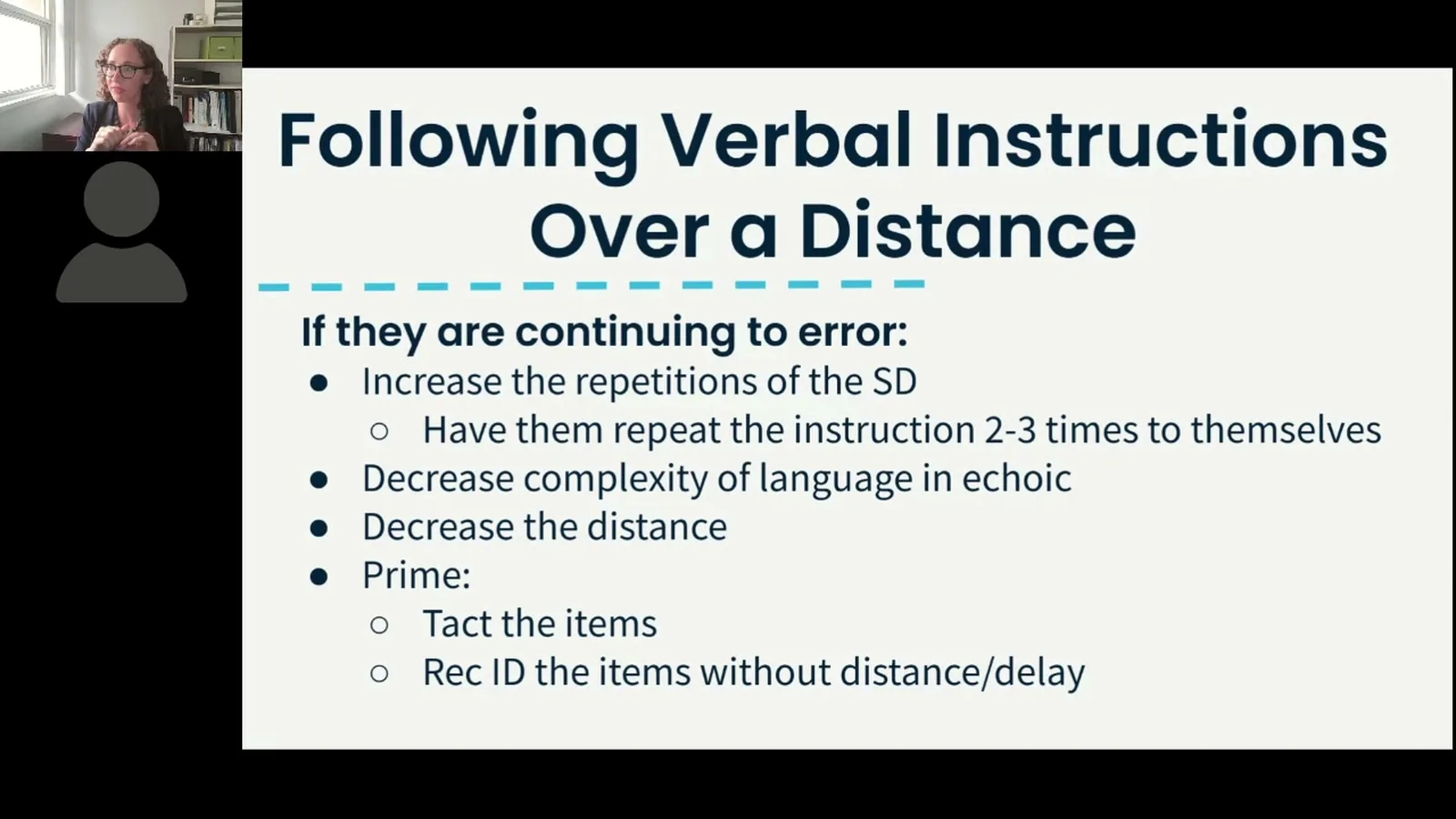
Make one card that says color and one that says number. Give the SD (the cue that signals responding) with no target items in view. Prompt the learner right away to pick the card and say the frame. Then present the item, and the learner finishes with color blue. Keep the cards in the same spot every time. This is a support, not a test. For learners who do not read, use a card with several colors and a card with several numbers. That takes extra teaching up front and still works.
Then fade. Some learners drop the cards fast. Others move to pointing at the cards, then to touching the same spot on an empty table. Sometimes saying the frame after the SD and before the items is enough. Read your learner and pick the level. One note on speech: hold off on this procedure until the learner can say multi-word responses. Signing learners can use it. On a device, a folder name that speaks the category can act a lot like a frame. The cue is visual rather than heard.
we're trying to teach the more generalized skill of being able to prompt yourself.
From the talk — Dana Pettus
Layering Skills: Class, Parts, Functions, and Scenes
Stop thinking in blocks. Colors, then sounds, then categories is the trap. Think in layers instead. Each new skill is mastered while mixed with every skill before it. When you teach categories, you still ask what color, what is it, and what does it say. Keep them in the same run. When parts come in, parts join that same mix. The frames carry over. It's a car, color blue, shape circle, and number four. You'll also hear letter B, a cow says moo, and a car is a vehicle. A car has wheels, and you eat with a fork.
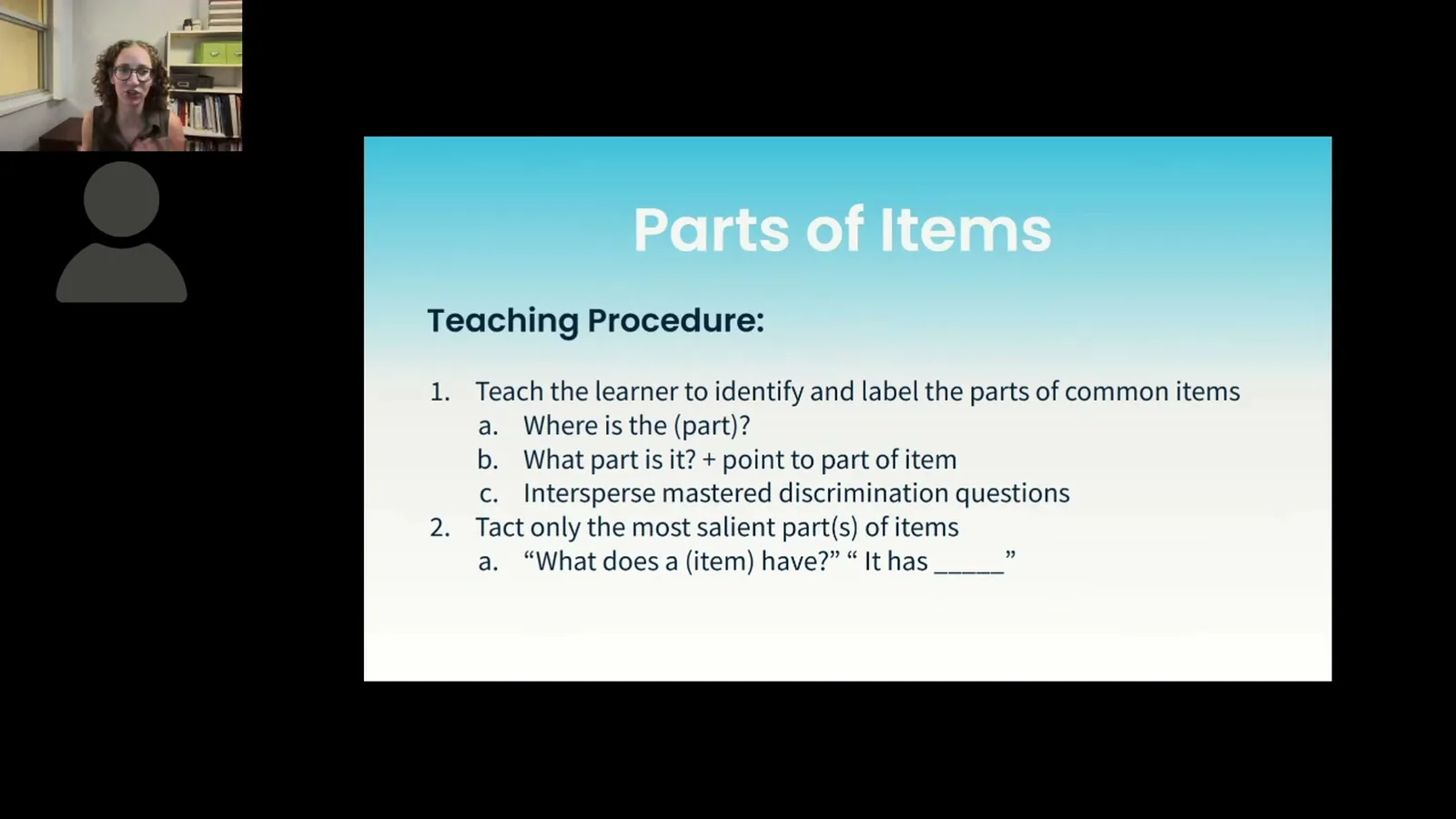
Order matters inside each layer. Treat animals as objects at first, so the answer is it's a dog, not animal dog. Class labels come later, often through sorting work, where pizza is a food. For parts, teach the item label first. If you ask what is it while pointing at a wheel, the learner may say car. That is not wrong, just confused. Asking what part clears that up. Start with the most obvious part of the item.
Scenes are where this pays off. Being able to say who is in a picture and what they are doing is a real social skill. Start with two parts: who is it, what are they doing. The learner answers they are running. Then add where are they, then details like what color is his shirt, then functions. Each step sits on top of a base that was built mixed from the beginning.
Common questions
What is an autoclitic frame in ABA?▾
It is a verbal frame with a fixed part and a variable part. "It says" is fixed, and moo, oink, or woof fill the slot. The fixed part has a long history with certain words, so it pulls the answer toward that class. In teaching, the question prompts the frame and the frame prompts the right answer.
Should any pictures be on the table during echoic training?▾
No. The first step is purely verbal, with no items in view. The point is to build the link between the frame and the words that follow it. Adding a picture too early ties the frame to the item instead.
Will my learner get stuck saying awkward phrases like "color green"?▾
Dana reports that learners use the frame while they need it and drop it once the discrimination is solid. If it lingers, you can reinforce the short answer for a while. The short stretch of odd grammar buys you real question discrimination.
What prerequisites does a learner need before this procedure?▾
Roughly 100 to 200 fluent tacts, including colors, animals, numbers, and letters. The learner also needs a two word echoic, since the answer is a frame plus a label. Both halves of your first pair must already be mastered alone. If the echoic is not there yet, work on that first and come back.
How do I know if my learner really discriminates WH-questions?▾
Put out four mastered pictures and ask one or two mastered questions about each one, switching as you go. Ask both questions about at least one picture. If you hear the item name every time, or compound answers, or guessing, the question is not in control. Fluent answers one question at a time do not prove anything.
Where can I learn more about this approach?▾
Dana pointed attendees to Dr. degli Espinosa's National Autism Conference presentations at Penn State, which are archived online. She also noted the 2020 and 2021 studies covered in the talk. Her slides include the links.
About the speaker
Dana Pettus is a Board Certified Behavior Analyst based in Toronto, Ontario. She has worked in ABA (applied behavior analysis) since 2013, mostly with children and teens with autism, including clients with dual diagnoses and developmental or intellectual disabilities, and her work spans early language training through older learners. She works at AlphaBee, where she applies a verbal behavior approach drawn from the work of Dr. degli Espinosa, and she speaks from clinical practice rather than research.
This summary was generated from the recording’s transcript. Quotes are taken word for word from the talk.
What you'll learn
- 11. Discriminate between correct WH responding under limited stimulus control and responding under true conditional and multiply controlled stimulus control. 2. Analyze learner errors to identify competing, restricted, or faulty stimulus control within tact and WH-question programs. 3. Design cumulative instructional sequences to establish discriminated responding across WH forms, adjectives, features, functions, and class relations. 4. Revise existing verbal behaviour programs to strengthen stimulus control, promote maintenance, and reduce rote responding.
Course materials
Sign in and register for this course to download these files.
Related talks
Talks that cover the same concepts

Mastering the VB-MAPP: A Deep Dive into the Milestones, Barriers, and Transitions Assessments
Copper Consulting Group
The Four Function Paradigm (Part 1)
Upskill ABA
Practical RFT
Upskill ABA

Language Changes the Game (Part 2)
Upskill ABA

When the Foundations Are Right: Unlocking Advanced Verbal Repertoires
The Behaviorist Bookclub
When the Foundations Are Right: Unlocking Advanced Verbal Repertoires
alphabeePRO
More from alphabeePRO
OpenCEU is supported by advertising from third-party sponsors. Sponsors are clearly labeled, have no influence over course content, instructors, or CEU decisions, and never appear on certificates. The BACB does not sponsor, approve, or endorse OpenCEU sponsors or their products.