Conditional Discrimination: Answering in Context
Conditional discrimination is choosing the right answer based on the question and the item together. See how experts teach it in ABA therapy.
Key takeaway
Conditional discrimination is when the right answer depends on the situation. A learner has to notice two things at once. They notice the question, and they notice the item in front of them.
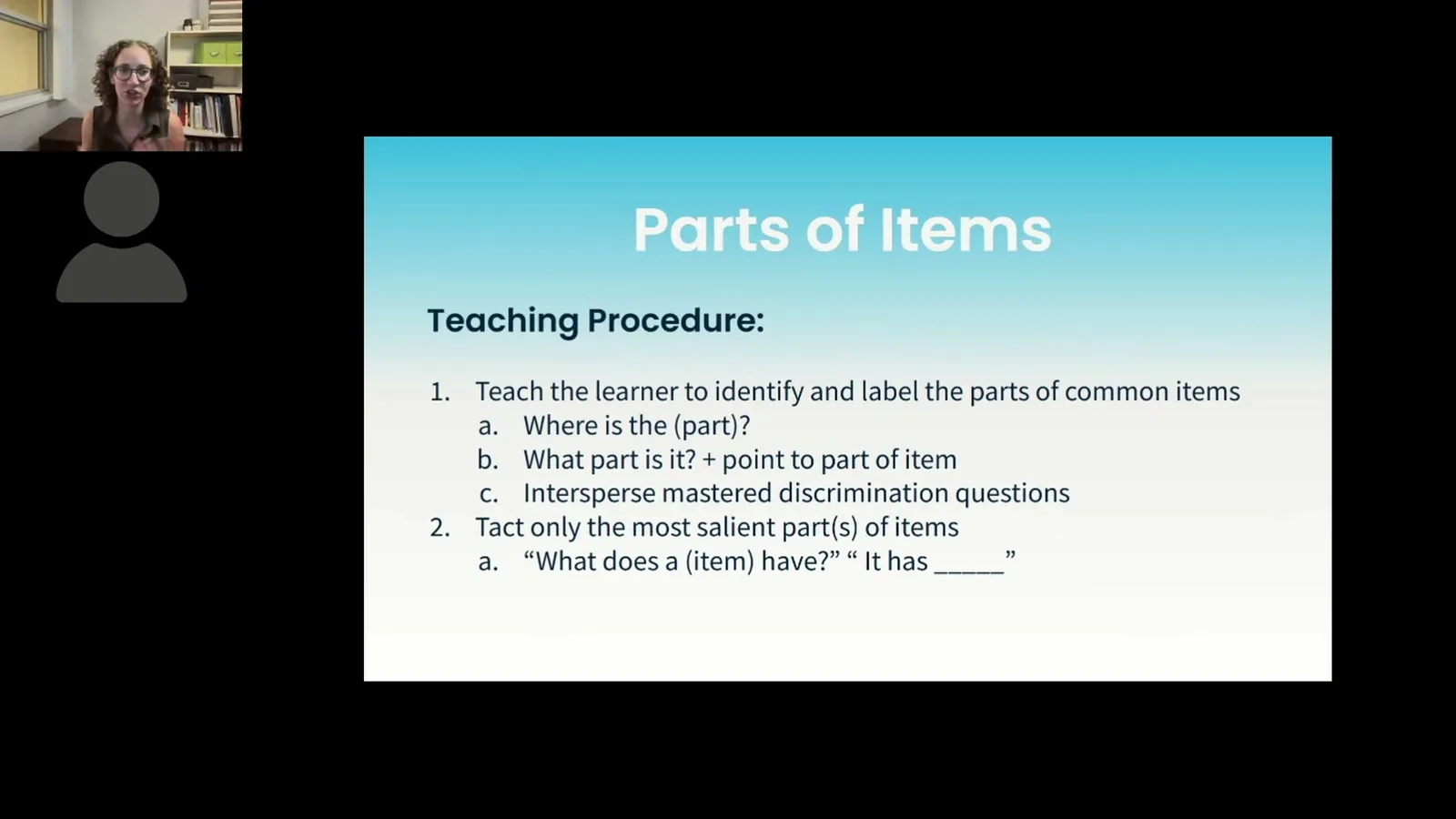
Teaching WH-Questions Isn’t Enough: Building True Conditional Discrimination
Experts who cover this
2 recordings on openceu cover conditional discrimination.
- Featured talk1 CEU
Teaching WH-Questions Isn’t Enough: Building True Conditional Discrimination
Dana PettusThe Behaviorist Bookclub
The core topic of the talk: learners who can label items in isolation often fail to discriminate between different WH-questions about the same stimulus, and…
- 1 CEU
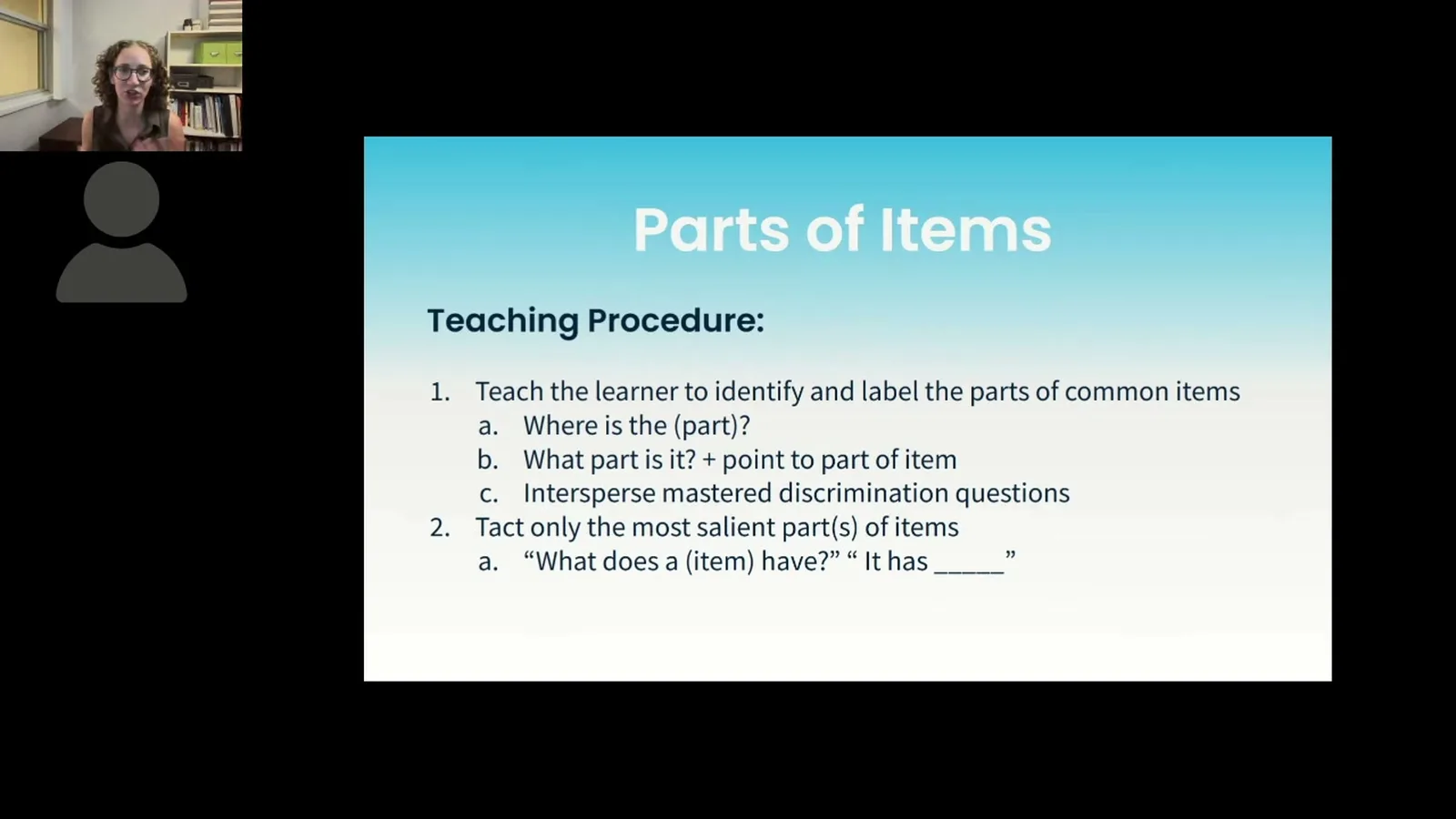
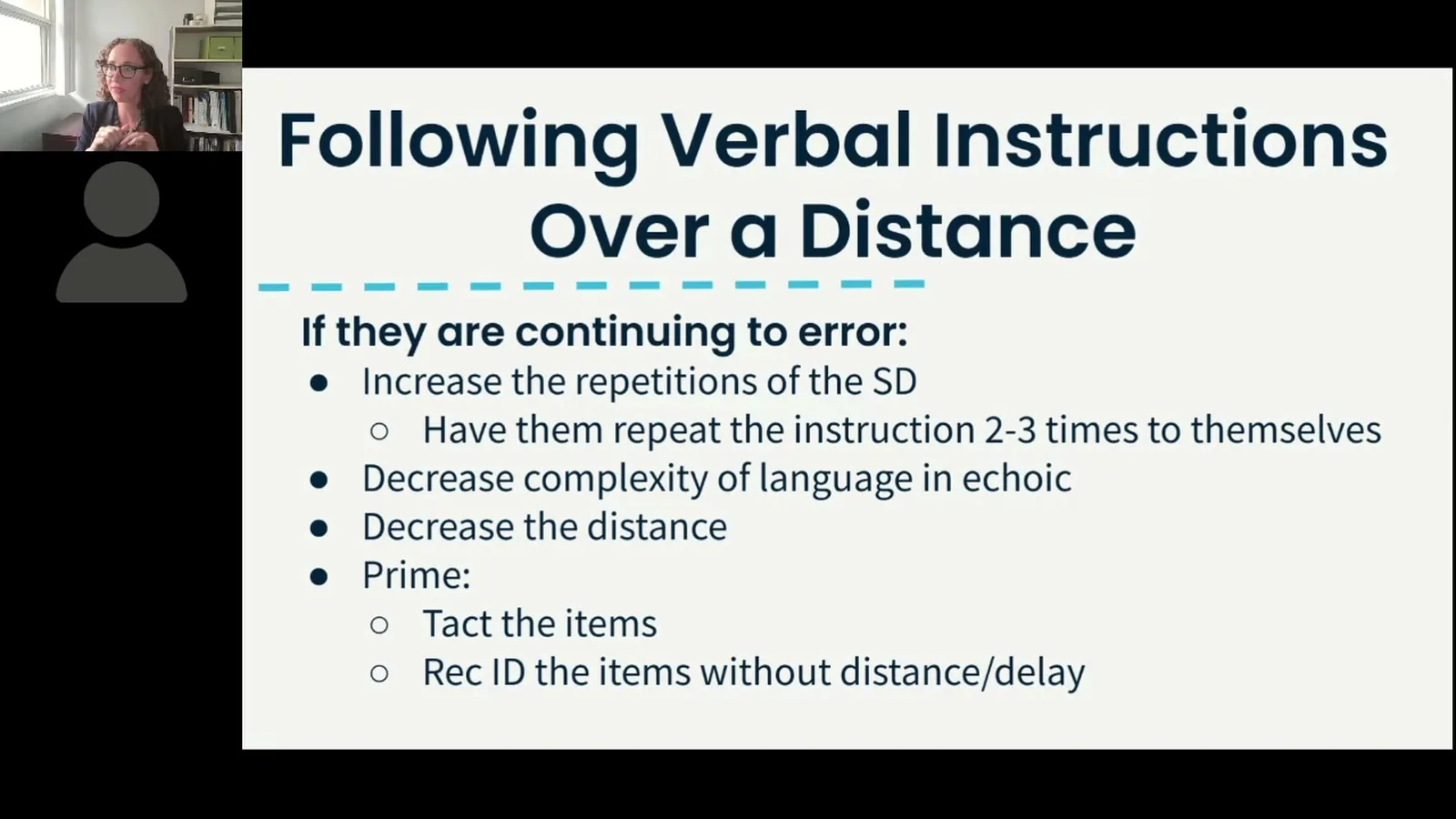
Getting the Right Answer Isn’t Enough: Establishing Speaker–Listener Repertoires for Complex Learning
Dana PettusThe Behaviorist Bookclub
Defines convergent control as multiple stimuli jointly controlling a single response (a question plus a picture both evoking 'blue') and divergent control as a…
On this page · 8 sections▾
Conditional discrimination is when the right answer depends on the situation. A learner has to notice two things at once. They notice the question, and they notice the item in front of them. Then they give the answer that fits both.
This skill matters more than it looks. A child can name a red ball, count to ten, and point to a dog. But real language asks them to switch answers based on the question. Ask "what color" and they say red. Ask "what shape" about the same ball and they should say round. When that switch breaks down, therapy needs a better plan.
What conditional discrimination really means#
Think of a single toy on a table. That one toy can pull for many correct answers. It has a color, a shape, a name, and a use. The learner has to pick the answer the question is asking for.
So the toy alone does not tell the learner what to say. The question and the toy work together. That teamwork between two clues is the heart of this skill. Behavior analysts call the two clues the sources of control. The learner has to respond to both at the same time.
When a learner only responds to one clue, errors show up fast. They might say the same answer no matter what you ask. Or they might guess. The goal is answers that shift with the question, every time.
Why labeling in isolation is not enough#
Dana Pettus builds her whole talk around a common trap. A learner can pass every skill when you test the skills one at a time. Then you mix the questions and the learner falls apart.
This is the gap between knowing labels and true conditional discrimination. Naming a color by itself is easy. Naming a shape by itself is easy. The hard part is doing both under different questions about one item.
But as soon as you put it together, it falls apart.
From the talk — Dana Pettus
Pettus wants teachers to test the mix on purpose. Do not just teach WH-questions like "what" and "where" in separate blocks. Blend them so the learner has to read the question each time.
Convergent and divergent control, explained simply#
Pettus uses two words to explain the breakdown. The first is convergent control. Two clues come together to point at one answer. The question and the item both matter, and together they make one correct response.
it's that convergent control between both the question what color and that stimuli.
From the talk — Dana Pettus
The second word is divergent control. Pettus describes it as one variable that evokes, or calls up, many responses. Here one clue alone pulls for many answers. That is what a single toy does when it can be named many ways.
The lesson is simple. You want convergent control, where the question and the item join to make one answer. You do not want the learner stuck on one clue. Teaching both clues together is how you get there.
Building listener skills from the ground up#
 Advertisement
Some learners are not ready for question-and-answer work yet. They cannot yet match a spoken word to the right object. This early skill is called auditory-visual conditional discrimination. In plain terms, it means matching what you hear to what you see.
Thakore and colleagues studied two young twins who were stuck at this stage. The twins could copy actions with objects, but they could not follow spoken words. The team used imitation as a bridge. First the child copied an action with an object. Then that same object became the target for a listening trial.
This worked well for both children. They learned to follow the spoken words, and the skill spread to new items. It shows a useful order. Before a learner juggles many questions, they first need to link one word to one object.
Prompts and tools that help teach it#
Teaching this skill takes careful setup, so tools and prompts matter. Niland and colleagues tested two kinds of digital hints on a tablet. One hint moved the correct picture. The other pointed to it. Both helped most of the children learn, with small tweaks for each child.
Tablets can also help the adults teaching the lessons. Kennedy and colleagues compared teachers using flashcards, binders, and a tablet program. The teachers stayed accurate after a short training, but they worked slowly. The tablet program actually did the teaching faster than the people did.
Good data sheets help too. Platt and colleagues found that richer data sheets show error patterns clearly. When a teacher can see the pattern of mistakes, they can fix the lesson. That kind of tracking fits with what Pettus asks for. Watch the mix, not just the single skills.
Language and culture matter#
The clues in a lesson include the words the teacher uses. For bilingual learners, the language of teaching is part of the setup. Romo and colleagues studied three bilingual children with autism. They taught nouns in English and Spanish in different orders.
The best order was not the same for every child. A mixed sequence helped one child most. A Spanish-then-English order helped the other two. Which language the child preferred did not change how fast they learned.
The takeaway is about fit, not a single recipe. Teachers should test what order works for each learner. Culturally responsive care means matching the lesson to the child, then checking the data.
What the research says#
Five peer-reviewed studies inform this page. Each one shapes how teams teach this skill.
Thakore, A., Petursdottir, A., Ho, C., & Mireles, M. (2025). Using Object Imitation to Establish Auditory-Visual Conditional Discrimination in Children Diagnosed With Autism. Behavioral Interventions, 40(2). https://doi.org/10.1002/bin.70009
Niland, H. S., Bergmann, S., Rader, K. A., Flores, K. M., Salazar, R. I., & Richey, C. (2026). Comparing Digital Stimulus Prompts to Teach Conditional Discriminations to Children With Autism Spectrum Disorder. Behavioral Interventions, 41(1). https://doi.org/10.1002/bin.70060
Romo, C., Lechago, S. A., Martin, A., Santiago Rodrigues, J. L., & Carrera, J. (2025). The Effects of English and Spanish Instructional Sequences on the Acquisition of Conditional Discriminations. Behavioral Interventions, 40(2). https://doi.org/10.1002/bin.70005
Kennedy, T., Cariveau, T., Grelck, K., Brown, A., Platt, D. F., & Ellington, P. (2024). An analysis of instructor- and tablet-presented conditional discriminations: Fidelity and rapidity. Behavioral Interventions, 39(2). https://doi.org/10.1002/bin.1992
Platt, D. F., Cariveau, T., Ellington, P., & Brown, A. (2023). Prediction of Response Patterns during Conditional Discrimination Training across Data Recording Methods. Behavior Analysis in Practice, 16(4), 1113-1123. https://doi.org/10.1007/s40617-023-00778-0
Frequently asked questions#
What is a simple example of conditional discrimination?
Picture one red square on a table. Ask "what color" and the child says red. Ask "what shape" and the child says square. The answer changes with the question, even though the item stays the same. Reading the question and the item together is the skill.
Why can my learner label items but still fail mixed questions?
Labeling one thing at a time is a simpler task. Mixed questions ask the learner to notice the question and the item at once. If they respond to only one clue, they give the wrong answer. This gap is common, and it means the mix needs direct teaching.
How do teachers start teaching this skill?
Many teams start with matching a spoken word to an object. Some learners need an even earlier bridge, like copying an action first. From there, teachers blend different questions instead of drilling them in separate blocks. Clear data sheets help spot which clue the learner is missing.
 Advertisement
Turn this topic into a CEU
You just studied this. Now get credit for it.
Watch Teaching WH-Questions Isn’t Enough: Building True Conditional Discrimination with Dana Pettus and earn 1 free BCBA CEU. Detailed certificate, delivered the moment you finish.