Eye Contact in ABA: Function Over Form
Why eye contact in ABA is about function, not form. Experts on joint control, culturally fair goals, and teaching it without force.
Key takeaway
Eye contact means looking at another person's eyes during social moments. For years, ABA (applied behavior analysis, the field of therapy built on learning science) treated it as a skill to drill.

genArete: To Teach or not to Teach!
Free learning path on this topic
Verbal Behavior: Beyond WH-Questions
Dana Pettus's three-part series on building generative verbal behavior. Why WH-question programs stall, how to establish speaker-listener repertoires, and how to scaffold advanced verbal skills like recall and simple inference. Three hours, three CEUs.
Experts who cover this
3 recordings on openceu cover eye contact.
- Featured talk1 CEU
genArete: To Teach or not to Teach!
Mark MaladyThe Behaviorist Bookclub
Used as the field's clearest cautionary example of topography over function: the field fixated on eye contact's form without identifying joint control as its…
- 1 CEU
Getting the Right Answer Isn’t Enough: Establishing Speaker–Listener Repertoires for Complex Learning
Dana PettusThe Behaviorist Bookclub
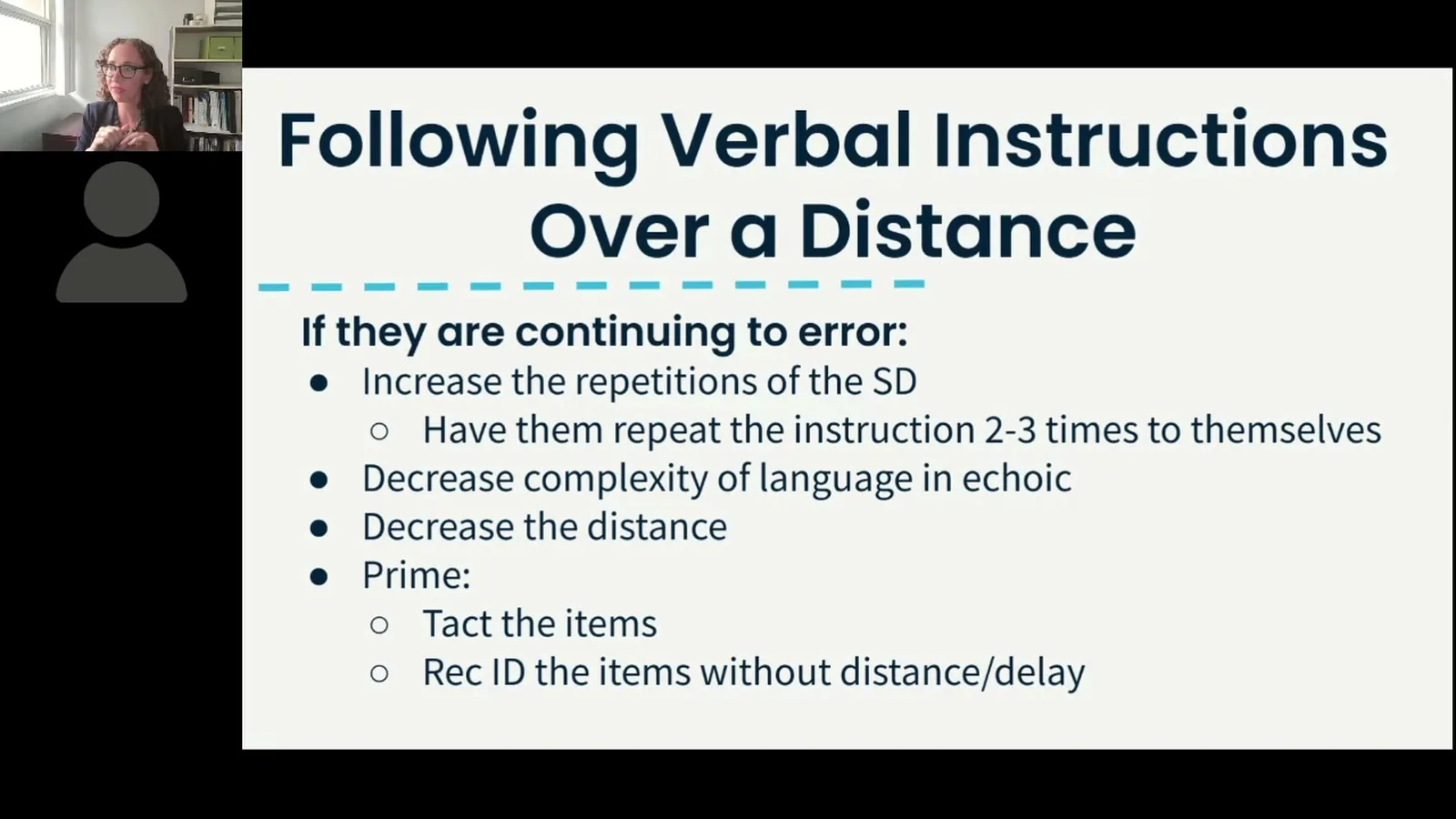
The presenter defines joint control as a response evoked by rehearsing one SD (e.g. a target item's name) that comes under additional convergent control of a…
- 1 Ethics CEU
Cultural Considerations in ABA Clinical Practice
Mackenzie SandlerThe Behaviorist Bookclub
Used as the talk's main example of a culturally non-neutral goal: some insurers now reject plans containing eye-contact goals outright, teens' 'eye contact' is…


On this page · 8 sections▾
Eye contact means looking at another person's eyes during social moments. For years, ABA (applied behavior analysis, the field of therapy built on learning science) treated it as a skill to drill. Teach the child to look, count the seconds, reward the stare. That focus on the look itself missed the point.
The point of eye contact is what it does for a person. It opens the door to social connection. It creates more chances to learn. When we chase the form and forget the reason, we can build a goal that helps no one. This page pulls together what recent talks and studies say about doing it better.
Function matters more than the look itself#
Mark Malady, BCBA (a board certified behavior analyst), uses eye contact as a clear warning. Our field saw that eye contact mattered, but we did not name why. The real value was joint control, which means two people sharing attention on the same thing. That shared focus is what lets social learning happen.
When you drill the look on its own, you can get a child who stares on command. But you have not given them the social payoff the look was supposed to unlock. The form is easy to measure. The function is the part that actually helps.
So we didn't identify joint control as the important part of eye contact for a while, but we identified that eye contact was really important. But functionally, what it was doing was it was allowing for social interaction and it was allowing for increased learning opportunities. The form of it itself, the eye contact, wasn't necessarily the important part of that.
From the talk — Mark Malady, BCBA
Eye contact as a result of looking at faces#
One idea reframes the whole debate. What if contact with the eyes is not the behavior we teach? What if it is the result of looking at faces? Faces carry information. A person's eyes tell us what they feel, what they want, and what they might do next.
Seen this way, the goal is not "make the child look." The goal is to make social interaction feel good, so looking at faces pays off on its own. The child looks because people are worth looking at. That is a very different target than a forced glance held for three seconds.
When eye contact is not a fair goal#
Eye contact is not the same everywhere. Mackenzie Sandler makes this the main example of a goal that is not culturally neutral. In some cultures, looking straight at an elder is seen as rude. A treatment plan that ignores this can push a child against their own family's values.
The pushback is now showing up in real policy. Some insurers reject a whole plan if it lists an eye contact goal. Sandler also points out how odd the target can be for teens. A teenager's "eye contact" is usually their phone, not the person in front of them.
I'm happy to say that some insurance companies will now completely reject plans if you have an eye contact goal in there.
From the talk — Mackenzie Sandler
The lesson is simple. Before you write an eye contact goal, ask whose norm you are teaching. If it clashes with the family's culture, it may not belong in the plan at all.
Listening to autistic advocates#
 Advertisement
Autistic adults have spoken up hard about this target. Many say being made to hold eye contact caused them real stress. Malady notes that our field has taken that feedback seriously and started to rethink old practice.
This is not a small point of manners. It is about whether a goal respects the person living with it. Good ethics means we check our targets against the people they affect. When advocates say a goal hurts, that is data we should not ignore.
the eye contact one has been chased a lot by autistic advocates. And our field has been pretty responsive of kind of listening and working through that and trying to reorganize ourselves around, hey, should we have been doing that over this time period?
From the talk — Mark Malady, BCBA
Be careful with the neat story#
It is easy to tell a tidy story. Eye contact builds social skills, so we should teach it. Malady warns against trusting that story too fast. A clean narrative in your head is not proof that the goal helps this child right now.
The story might be true in general and still be wrong for one person. So we slow down. We check the function. We ask if the target fits the child's life before we jump in with a recommendation.
Teaching it gently, when it fits#
When eye contact is the right goal, the research points to soft methods. One telehealth study (coaching delivered by video call) taught parents in India to shape eye contact during play. Shaping means rewarding small steps toward a goal. No prompts. No candy or toys as rewards. The reward was the fun social activity itself. Both children learned to look, and the parents reported real joy in their kids.
Another study slowly removed prompts and treats over time. The children kept the skill for a month, and it carried over to new adults. The common thread is clear. Build eye contact on real social reward, without force, and let it grow at a natural pace.
What the research says#
The study behind the "function over form" idea makes a bold claim. It says we should define contact with the eyes not as a behavior but as a consequence for looking at faces. The real question is whether we make social interaction a reward for eye looking (Espinosa, 2025).
A telehealth study backs the gentle approach (Strömberg et al., 2025). Parents used a shaping method through remote coaching, with no prompts and no nonsocial rewards. Both children learned to make eye contact during play. Social validity, a measure of how well families accept an approach, was high.
Together these studies point the same way. Eye contact can grow from real social reward instead of drills, and it can hold up over time.
Full citations:
- Espinosa, F. d. (2025). Eye Contact: To Teach or Not to Teach? That is Not the Question. Perspectives on Behavior Science, 48(3), 529-537. https://doi.org/10.1007/s40614-025-00456-2
- Strömberg, D., Awasthi, S., Bertilsson, E., Odom, S. L., Mounzer, W., & Roll-Pettersson, L. (2025). Shaping Social Eye Contact in Children With Autism Via Telehealth: A Parent-Implemented Intervention. Behavioral Interventions, 40(4). https://doi.org/10.1002/bin.70044
Frequently asked questions#
Should ABA teach eye contact at all?
There is no single yes or no. The better question is why you are teaching it and whether the family values it. If the aim is forced looking, skip it. If the aim is real social connection, and the goal fits the child's culture, gentle methods can help.
Why do some insurers reject eye contact goals?
Because eye contact is not the same across cultures. In some places, looking straight at an elder is disrespectful. A goal that ignores this can harm a child instead of helping. Some insurers now reject entire plans that list an eye contact goal.
What is joint control and why does it matter here?
Joint control means two people sharing attention on the same thing. That shared focus is the real value of eye contact. It opens social interaction and creates more chances to learn. When you teach the look without the shared attention, you miss the part that actually helps.
For more on how culture shapes fair goal setting, see Cultural Considerations in ABA Clinical Practice.
 Advertisement
Turn this topic into a CEU
You just studied this. Now get credit for it.
Watch genArete: To Teach or not to Teach! with Mark Malady, BCBA and earn 1 free BCBA CEU. Detailed certificate, delivered the moment you finish.
Keep going with a free learning path
Verbal Behavior: Beyond WH-Questions
Dana Pettus's three-part series on building generative verbal behavior. Why WH-question programs stall, how to establish speaker-listener repertoires, and how to scaffold advanced verbal skills like recall and simple inference. Three hours, three CEUs.
Parent or caregiver? Find a vetted ABA provider near you on ProviderSpark.