Error Correction Procedure in ABA: Fixing Errors Well
What an error correction procedure is in ABA, how the steps work, when a wrong answer may not be wrong, and what research says about it.
Key takeaway
In ABA, an error correction procedure is how a teacher responds to a wrong or missing answer. The goal is to make the next answer right.

Child Development Deep Dive: Middle Childhood (6-8 year olds)
Experts who cover this
4 recordings on openceu cover error correction procedure.
- Featured talk1 CEU
Child Development Deep Dive: Middle Childhood (6-8 year olds)
Kelly BrzakThe Behaviorist Bookclub
Kelly critiques a viral training video where a rigid error correction on 'bird flies in the tree' overrode the child's own possible narrative, arguing…
- 1 CEU
Getting the Right Answer Isn’t Enough: Establishing Speaker–Listener Repertoires for Complex Learning
Dana PettusThe Behaviorist Bookclub
Within joint control teaching, error correction means physically returning the item and re-running the self-echoic prompting sequence rather than just…
- 1 CEU
The Use of Matrix Training to Teach Multi-Component Tacting Through Telehealth
Dr. Jessica OsosCopper Consulting Group
During diagonal training, incorrect or non-responses were addressed with an error correction procedure, with mastery criteria set at two consecutive sessions…
- 1 Supervision CEU
Article Club: Treatment Integrity Errors During Discrete Trial Instruction
Pauli Catanese & Sam MuellerAchieve Behavior Partners
Noted as the DTT component that already has written checklists and training focus, unlike the more general procedural outline (e.g., gaining attention…



On this page · 9 sections▾
In ABA, an error correction procedure is how a teacher responds to a wrong or missing answer. The goal is to make the next answer right. It is most often used in discrete trial teaching, a style of teaching built from short, repeated practice turns.
The idea sounds simple. Yet the speakers who teach it treat this one step with real care. Some focus on getting the steps exactly right. Others ask a harder question: was the "wrong" answer really wrong? Below are both views, plus what published studies report.
The basic steps of an error correction#
A clear version comes from a study on teaching tacts. A tact is a label for something the learner sees, like naming a picture the teacher shows. The teacher showed a picture. If the learner named it correctly alone, the teacher gave praise. If the learner named it wrong, the teacher ran an error correction.
That correction had two parts. First, the teacher modeled the right label. Then the teacher showed the picture again so the learner could say it alone. A correct label during the correction did not earn reinforcement, which means a reward that makes a behavior more likely. If the learner still missed it, the teacher repeated the correction up to three times. Then the teacher moved on to the next picture (Chang, Nainani, & Kim, 2024).
Notice the shape of it. The teacher shows the answer, then gives a fresh chance. Praise is saved for answers the learner gives on the first try. And there is a cap on repeats. After three tries, the teacher moves on to a new picture.
Error correction inside a telehealth program#
Dr. Jessica Osos shared how error correction fit into a telehealth study. Telehealth means therapy done over video instead of in person. Her team used matrix training, a way of teaching word combos, like a color plus a shape. Each session had nine trials. Each of three target pictures came up three times.
The teacher showed a picture of a colored shape and asked, "What is it?" The learner had five seconds to answer. A correct answer earned praise, and the caregiver handed over a favorite snack. Osos explained what came next for the other cases.
If they didn't respond or they had an incorrect response, we then did an error correction procedure and then the mastery criteria to move on to the post-test session.
From the talk — Dr. Jessica Osos
Mastery criteria are the rules for when a skill counts as learned. Here, the learner needed two sessions in a row at 89% or higher. Two details stand out. A non-response got the same correction as a wrong answer. And the caregiver, not the clinician, delivered the snack.
Fixing the answer versus fixing the control#
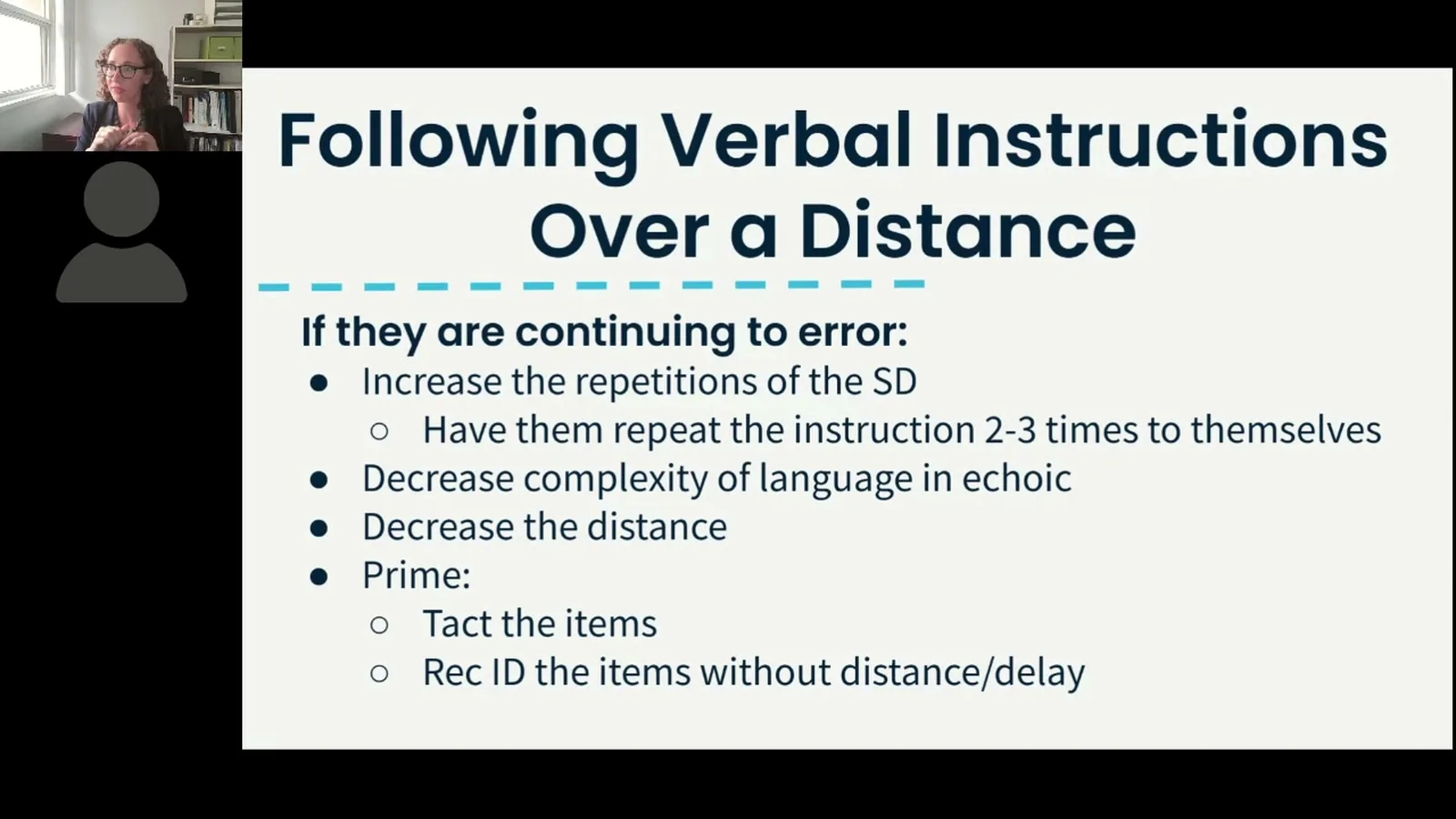
Dana Pettus pushes the idea further in her talk on Getting the Right Answer Isn't Enough. She teaches with joint control. In plain words, the learner repeats the name of an item to herself while she searches for it. That self-repeating is called a self-echoic. It acts as the learner's own prompt.
Pettus warns against a shortcut. A teacher could just point the learner to the right item. The learner would pick it, get reinforced, and look successful. But Pettus says that is not the goal. She wants the learner choosing under the right stimulus control. Stimulus control means the right cue is what triggers the answer. For her, that cue is the learner's own self-echoic.
If they are We're just going to stop them, put the item back. have them come back and repeat the joint control prompting procedure.
From the talk — Dana Pettus
In her video, a learner named Lisa is sent to get a pencil case. When Lisa errs, Pettus brings her back to restart the whole sequence. She notes she could have just prompted the correct response there. Instead, she wants Lisa responding correctly under the right cue. The lesson is that a correction should rebuild the skill, not just patch one answer.
When a "wrong" answer might not be wrong#
Kelly Brzak tells a story that changed how she teaches. Years ago, she searched YouTube for intraverbal programs. An intraverbal is an answer to someone else's words, like finishing a sentence. The first video showed a teacher saying, "Bird flies in the," and a child saying, "tree."
Brzak calls what came next the most beautiful error correction she had ever seen. The teacher used a small candy. She tickled the child. Her voice was excited. Then she corrected him.
She corrects the kid and says, bird flies in the sky. And then she does the error correction.
From the talk — Kelly Brzak
Here is Brzak's point. Birds do fly into trees. She has seen it. The child's answer may have made sense to him. It may even have been the start of something bigger.
What if that kid had a whole story to unpack that just got axed and rerouted?
From the talk — Kelly Brzak
The correction was smooth and warm. But it may have trained the child out of a real thought. Brzak says this moment hit her so hard that she still pushes the idea in her trainings today.
Independent answers versus shaped answers#
Brzak follows that story with a question for clinicians. What do you value more in a session? She puts the choice in two short lines.
Successful, independent responses. Or age-appropriate, prompted, and shaped responses.
From the talk — Kelly Brzak
Some terms need a quick bridge here. A prompted response is one the teacher helps along. A shaped response is one built up step by step toward a better version. An independent response is one the learner gives alone.
Brzak is clear that you do not have to pick just one. But she asks clinicians to think about their aim. A program that only counts correct independent answers may push every answer toward one script. A program that values age-appropriate responses may leave room for a child's own ideas. Her talk focuses on middle childhood, ages six to eight. Error correction, in her view, should serve that bigger aim.
Where experts disagree#
The speakers do not openly argue with each other. Still, their talks show a real difference in what they think a correction should protect.
For Osos, the rule is direct. A wrong answer or no answer leads to error correction. Her study measured mastery by a percentage of correct answers. That is a clean, fair way to judge learning when there is one right label for a colored shape.
Pettus agrees that errors need correcting. But she argues the right answer alone is not the target. She wants the learner to reach it through her own self-echoic. So her correction is bigger. She stops the learner and restarts the full prompting sequence.
Brzak comes at it from another side. She worries that some corrections remove answers that were not really wrong. For open questions like "Bird flies in the," more than one answer can fit. Correcting a reasonable answer may cost the child a chance to share a story.
So the split is about what counts as an error, and what the correction is for. Osos and Pettus treat the error as clear and focus on how to fix it. Brzak asks whether it needed fixing at all. Each view fits the skill each speaker was teaching.
Error correction and staff training#
A correction only helps if staff run it the same way each time. That is called treatment integrity, or procedural fidelity. It means doing a procedure the way it was written.
In an article club on discrete trial teaching, Sam Mueller pointed out where training tends to focus.
we'll focus on error correction procedures, but this is not so much on, this is more of the general outline of how to present discrete trial instruction
From the talk — Sam Mueller
Mueller's research has centered on staff training and procedural integrity. His clinic already uses picture prompts for error correction and for running discrete trials. Still, he says those tools often get overlooked. He likes giving each staff member written instructions to keep with them. He also called the topic a great fit for RBT professional development. An RBT is a Registered Behavior Technician, the staff member who often runs sessions.
Researchers are also asking how fidelity errors affect learning after a skill is mastered. One team noted that many tasks are taught with an error correction after wrong answers. They suggested future studies look at fidelity errors when those corrections are in use (Jones et al., 2026).
What the research says#
Error correction is common in teaching children with developmental disabilities. One review defines it as a strategy used after a wrong answer. Its goal is to make a correct answer more likely next time (Cariveau et al., 2019). The same review found the exact steps vary a lot between programs. Small differences and different names make studies hard to compare.
Some research compares error correction to errorless learning. Errorless learning means prompting early so the learner rarely makes mistakes at all. One trial taught tacts to 28 people with autism using one method or the other (Leaf et al., 2020). Both methods worked. Both were efficient and unlikely to set off problem behavior. The error correction group gave more independent correct answers. They also gave more independent wrong answers.
Error correction also shows up as one part of larger programs. In one study, a girl with autism learned to vary her answers to social questions. The program used a lag schedule, which rewards answers that differ from recent ones. Echoic prompts, visual aids, and an error correction procedure supported it (Olin, Sonsky, & Howard, 2020).
Staff can learn to run error correction too. In one study, three staff learned it through video modeling, or watching a video of the steps (Lim & Hu, 2020). They kept using the skill with children with autism at follow-up.
FAQ#
What is an error correction procedure in ABA? It is what a teacher does right after a wrong answer or no answer. Often the teacher models the right answer and then gives the learner another chance. The goal is a correct answer next time.
Is error correction better than errorless learning? One randomized trial found both methods effective and efficient (Leaf et al., 2020). Neither was likely to cause problem behavior. Learners in the error correction group gave more independent answers, both right and wrong.
Should every wrong answer be corrected? Not always, according to Kelly Brzak. On open questions, a "wrong" answer may make sense to the child. She urges clinicians to weigh independent answers against age-appropriate, shaped ones before correcting.
Turn this topic into a CEU
You just studied this. Now get credit for it.
Watch Child Development Deep Dive: Middle Childhood (6-8 year olds) with Kelly Brzak, MS, BCBA and earn 1 free BCBA CEU. Detailed certificate, delivered the moment you finish.