genArete: Learner-Centered Skill Assessment
Presented by Mark Malady, BCBA

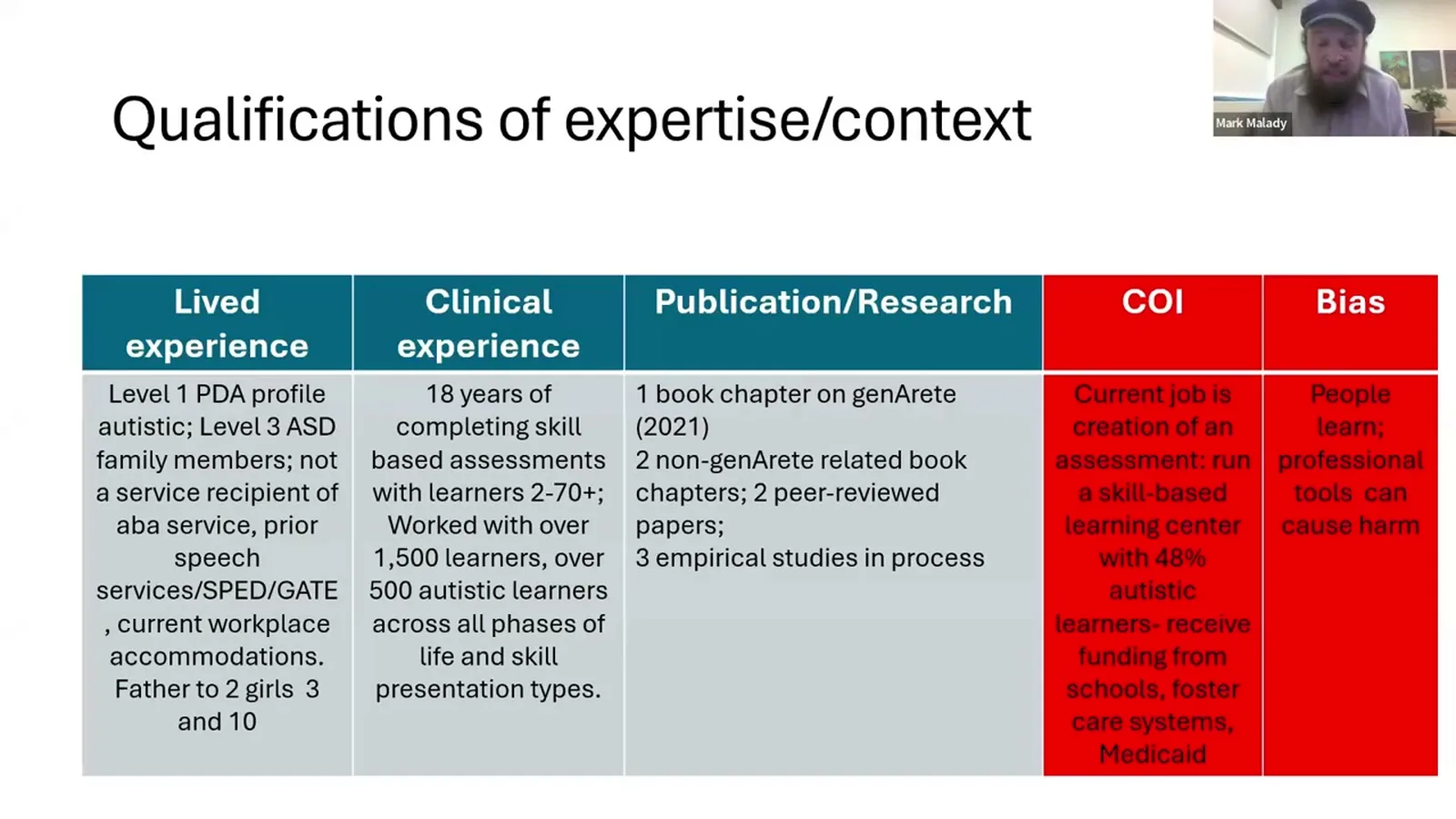
In this first talk of a three-part series, Mark Malady, BCBA, examines the state of skill-based assessment for autistic learners and other people with disabilities. He reviews recent literature showing an inverse relationship between utilization and evidence: widely used behavior-analytic instruments such as the VB-MAPP and ABLLS-R have only emerging empirical support, while less-used tools like the ABLA carry stronger validation, with funder requirements driving much of the imbalance. Drawing on CASP/APBA assessment guidelines, he unpacks key distinctions practitioners should know before selecting a tool: direct versus indirect, standardized versus non-standardized, norm-referenced versus criterion-referenced, and single-modal versus multimodal approaches, with attention to how norm-referenced comparisons can embed normalization agendas. Using the genArete assessment as a working example, he presents design features that support learner-centered practice: eliminating cold probes in favor of measurement systems that distinguish acquisition from mastery states, top-down and bottom-up entry points that respect the learner's time, varied measurement systems matched to targets, built-in assent and accommodations, and milestone-based comparison criteria benchmarked against competent performers rather than same-age norms. He closes with practical steps any clinician can apply to existing instruments, including semi-structured intake interviews to individualize assessment packages, auditing assessment selection for true differentiation across learners, separating instructional targets from ongoing environmental supports, and strategies for getting emerging instruments approved by funders.
Register free & watch nowCancel any time. Cert delivered to your inbox the moment you pass the quiz.
Learner ratings
from 42 learners
100% would recommend this CEU to other professionals in their field (13 responses)
“Very good”
— Aliaa A.“Great CEU! Thank you!!”
— Alyssa C.“Thank you”
— Maysaa A.“thx”
— Selena J.“amazing”
— Ki C.“Can't wait to hear the next!”
— B. G.
About this CEU
In this first talk of a three-part series, Mark Malady, BCBA, examines the state of skill-based assessment for autistic learners and other people with disabilities. He reviews recent literature showing an inverse relationship between utilization and evidence: widely used behavior-analytic instruments such as the VB-MAPP and ABLLS-R have only emerging empirical support, while less-used tools like the ABLA carry stronger validation, with funder requirements driving much of the imbalance. Drawing on CASP/APBA assessment guidelines, he unpacks key distinctions practitioners should know before selecting a tool: direct versus indirect, standardized versus non-standardized, norm-referenced versus criterion-referenced, and single-modal versus multimodal approaches, with attention to how norm-referenced comparisons can embed normalization agendas. Using the genArete assessment as a working example, he presents design features that support learner-centered practice: eliminating cold probes in favor of measurement systems that distinguish acquisition from mastery states, top-down and bottom-up entry points that respect the learner's time, varied measurement systems matched to targets, built-in assent and accommodations, and milestone-based comparison criteria benchmarked against competent performers rather than same-age norms. He closes with practical steps any clinician can apply to existing instruments, including semi-structured intake interviews to individualize assessment packages, auditing assessment selection for true differentiation across learners, separating instructional targets from ongoing environmental supports, and strategies for getting emerging instruments approved by funders.
What you'll learn
- 1Learning Objectives
- 2By the end of this CEU, participants will be able to:
- 3Describe the current state of empirical support for common skill-based assessments and the disconnect between evidence and field utilization
- 4Identify features of skill-based assessment instruments, such as norm-referenced comparison criteria and mastery-of-all-items graphical displays, where normalization agendas can appear
- 5Explain learner-informed assessment strategies, including semi-structured intake interviews, flexible entry points, and milestone-based comparison criteria, that individualize assessment without compromising instrument fidelity
Concepts in this CEU
Related talks
Talks that cover the same concepts
Generate: Learner Centered Skill Assessments
The Behaviorist Bookclub

genArete: Milestone based comparison criteria in Skill Assessment
The Behaviorist Bookclub
Assent: Don't just say Yes!-
The Behaviorist Bookclub

Delegating with Confidence: Training and Supervising RBTs to Support Assessments
Copper Consulting Group
Getting the Right Answer Isn’t Enough: Establishing Speaker–Listener Repertoires for Complex Learning
The Behaviorist Bookclub

Beyond Compliance: What Assent-Based ABA Looks Like in Real Life
Dani Elle Mentorship and Consulting
More from The Behaviorist Bookclub

Empowering Autonomy and Self-Management in ADHD Learners
The Behaviorist Bookclub
Shaping Behavior Change when ADHD is in the Picture
The Behaviorist Bookclub
From Hours to Competence: Assessing and Developing Supervisee Skills
The Behaviorist Bookclub
OpenCEU is supported by advertising from third-party sponsors. Sponsors are clearly labeled, have no influence over course content, instructors, or CEU decisions, and never appear on certificates. The BACB does not sponsor, approve, or endorse OpenCEU sponsors or their products.