ABLLS-R: A Language and Learning Assessment in ABA
The ABLLS-R maps language and learning skills for ABA programs. Learn what it covers, how strong the evidence is, and how to use it well.
Key takeaway
The ABLLS-R is a common tool in ABA programs. Its full name is the Assessment of Basic Language and Learning Skills, Revised. It maps a learner's skills across many areas.

genArete: Learner-Centered Skill Assessment
Free learning path on this topic
Child Development for Behavior Analysts
Typical development for behavior analysts. Kristen Byra's overview, then Kelly Brzak's deep dives on ages 2 to 5, 6 to 8, and 9 to 11, with milestones, common problem behaviors, and programming tips for each band.
Experts who cover this
2 recordings on openceu cover ablls-r.
- Featured talk1 CEU
genArete: Learner-Centered Skill Assessment
Mark MaladyThe Behaviorist Bookclub
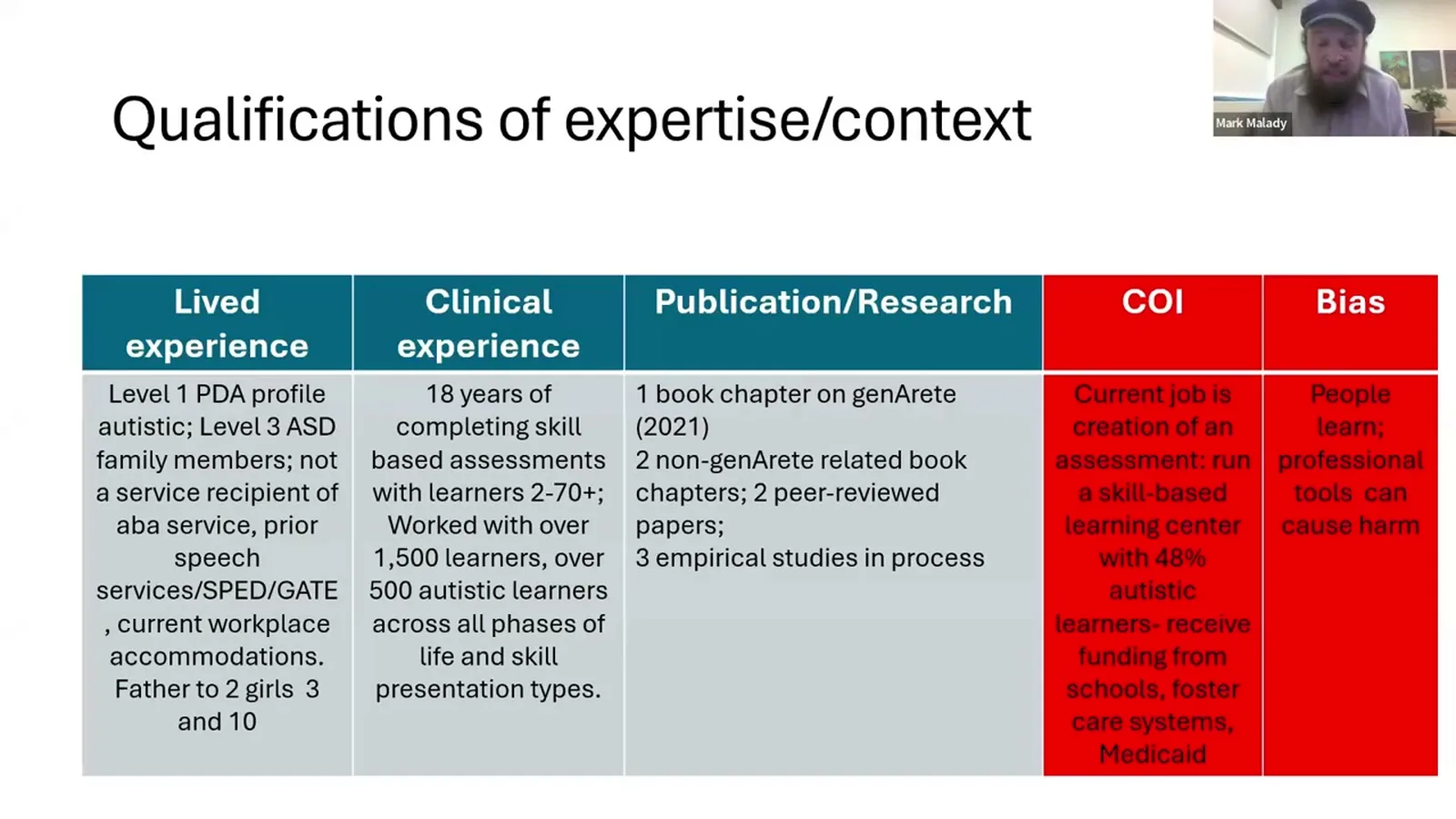
Grouped with the VB-MAPP as a widely-used but weakly-validated legacy tool; Mark notes a 2025 psychometric study drew on over 41,000 individuals' CentralReach…
- 1 CEU
Generate: Learner Centered Skill Assessments
Mark MaladyThe Behaviorist Bookclub
A recent psychometric evaluation used over 41,000 individuals' Central Reach data to formally validate the ABLLS-R and AFLS, illustrating that legacy…

On this page · 7 sections▾
The ABLLS-R is a common tool in ABA programs. Its full name is the Assessment of Basic Language and Learning Skills, Revised. It maps a learner's skills across many areas. These include language, play, self-help, and academic tasks. The results guide what to teach next.
For BCBAs, RBTs, teachers, and parents, the appeal is clear. The ABLLS-R breaks big goals into small, trackable steps. You can see where a learner is strong and where they need help. But a popular tool still deserves a careful look at its evidence.
What the ABLLS-R covers#
The ABLLS-R is a skills inventory. It sorts skills into many groups, from simple requests to complex language. Each item describes a specific behavior to check. You score whether the learner can do it, sometimes, or not yet.
This gives you a wide picture of a learner's repertoire. You can spot gaps that block progress. You can also pick clear, teachable targets. That is why so many teams reach for it early in programming.
A legacy tool getting fresh scrutiny#
Mark Malady groups the ABLLS-R with other older, widely used tools. He notes that the research behind them lagged their popularity for years. The tools spread because teams needed something to use.
our practice just overextended from our empirical analysis and validation because of the time that they were created, we didn't have anything readily available and we needed tools right now. From the talk — Mark Malady
That gap is finally closing. Malady describes a 2025 study that put the ABLLS-R under a real psychometric lens. It drew on CentralReach data from more than 41,000 individuals. The same study also covered the AFLS, a related living-skills assessment.
we have a comprehensive psychometric evaluation of the assessment basic language and learning skills revised and the assessment of functional living skills that was published From the talk — Mark Malady
So the tool many teams trusted on faith is now getting tested with data. That is good news for the field.
Using the ABLLS-R without checking boxes#
 Advertisement
The biggest risk with any inventory is going on autopilot. It is easy to treat items as a checklist. But a checklist is not a plan. The goal is meaningful skills, not filled-in boxes.
Use the ABLLS-R to understand the learner, then choose targets that matter to their life. Ask which skills open new doors for them. A skill that helps a learner ask for help beats one that only fills a grid.
Malady's point about legacy tools applies here too. A tool can be popular and still be used poorly. The value comes from how you read the results, not from the form itself.
Pairing it with other assessments#
The ABLLS-R does not have to work alone. Many teams run it with a language measure and an adaptive scale. Each tool adds a different view of the learner. Together they paint a fuller picture.
Malady offers a simple record-keeping tip for this. Give each combination of tools its own code.
If you use the VB map and the Ables and the Vineland, you just make a unique code for whatever package of assessments you do. From the talk — Mark Malady
That keeps your data clean when you compare results over time. For a deeper walkthrough of these tools, see Generate: Learner Centered Skill Assessments.
What the research says#
Research on ABA-based language assessment is still thin. A scoping review searched four major databases, including Medline/PubMed and Web of Science. It looked for ABA-based language protocols used in speech therapy. The search found 6,859 articles. Only five made it to full review. And only two protocols showed up: the VB-MAPP and the ABLLS-R (Almeida et al., 2025, CoDAS).
The same review flagged a real limit. Neither tool had validation studies for Brazilian Portuguese at the time (Almeida et al., 2025). That points to a common problem. Popular tools are often not validated for every language or culture that uses them.
The takeaway is not that the ABLLS-R is bad. It is that translation and local validation still matter. Use the tool with eyes open about where its evidence does and does not reach.
Getting real value from the results#
Good use of the ABLLS-R starts after scoring. Sit with the profile and ask what it means for this learner. Look for patterns, not just single gaps. Then set goals that connect to daily life at home and school.
Revisit the assessment on a regular schedule. Skills change, and so should your targets. When you treat the ABLLS-R as a living map, it guides real growth rather than paperwork.
Malady walks through this learner-first mindset in his course genArete: Learner-Centered Skill Assessment. It covers how to pick assessments and turn results into goals that matter.
FAQ#
What is the ABLLS-R used for?
It maps a learner's language and learning skills across many areas. Teams use the profile to find gaps and pick teaching targets. It is common in early ABA programs for children.
Is the ABLLS-R evidence-based?
It is widely used, and its research base is now growing. For years it spread faster than its validation. Recent large studies have started to test its reliability and validity more formally.
How often should you redo the ABLLS-R?
Most teams update it on a regular cycle, often every few months. Skills change over time, so the profile should too. Regular updates keep goals current and show progress clearly.
 Advertisement
Turn this topic into a CEU
You just studied this. Now get credit for it.
Watch genArete: Learner-Centered Skill Assessment with Mark Malady, BCBA and earn 1 free BCBA CEU. Detailed certificate, delivered the moment you finish.
Keep going with a free learning path
Child Development for Behavior Analysts
Typical development for behavior analysts. Kristen Byra's overview, then Kelly Brzak's deep dives on ages 2 to 5, 6 to 8, and 9 to 11, with milestones, common problem behaviors, and programming tips for each band.