Practical RFT
Presented by Stu Law, Ph.D.
One of ABA’s ‘dirty little secrets’ is that, from a philosophical standpoint, we tend to view events from an interactionally deterministic point of view. It’s a scary thing to believe at times, but it’s also one of the things I hold dearest as a student of behavior science. “What you’re doing now, and who you are now, is the only thing you could be and do given who you are and the environments that have shaped you” can be a remarkably compassionate way of viewing people. It allows us to be successful in places where few others can or perhaps even want to be. It is a difficult thing to understand and keep consistent though, particularly when verbal behavior enters the picture. With the slow removal of insurance age caps, and the colloquial use of behavior as roughly meaning “naughty behaviors,” ABA increasingly finds itself interacting with complex problems rooted in language and cognition, armed primarily with programs built around direct-acting contingencies and maybe some Skinnerian Verbal Behavior. More precise and sophisticated approaches to language and cognition are out there, but they are often disseminated in ways that are difficult to approach and feel impractical. In short, things like RFT can feel scary and difficult to apply, start, and understand. (If a ZOP is a MOL and a GIQ is a SHUG…) But if we are going to advance important discussions about things like assent, person-centered planning, and the weighing of dignity and risk, we should do so armed with approaches that allow us to more precisely, deliberately, and effectively navigate those complex issues from a behavioral view. We don’t necessarily need to make things that much more complicated to do that. We may just need better ways of talking about that complexity. For now, here’s the problem as I see it, and the path toward a potential solution, in plain language.
Register free & watch nowCancel any time. Cert delivered to your inbox the moment you pass the quiz.
Learner ratings
from 6 learners
83% would recommend this CEU to other professionals in their field (6 responses)
“Intertesting perspective”
— Michelle A.“na”
— Leah L.“10/10 Stu is absolutely phenomenal esp. with his choice of words! Worth viewing multiple times!”
— Reagan P.
About this CEU
One of ABA’s ‘dirty little secrets’ is that, from a philosophical standpoint, we tend to view events from an interactionally deterministic point of view. It’s a scary thing to believe at times, but it’s also one of the things I hold dearest as a student of behavior science. “What you’re doing now, and who you are now, is the only thing you could be and do given who you are and the environments that have shaped you” can be a remarkably compassionate way of viewing people. It allows us to be successful in places where few others can or perhaps even want to be. It is a difficult thing to understand and keep consistent though, particularly when verbal behavior enters the picture. With the slow removal of insurance age caps, and the colloquial use of behavior as roughly meaning “naughty behaviors,” ABA increasingly finds itself interacting with complex problems rooted in language and cognition, armed primarily with programs built around direct-acting contingencies and maybe some Skinnerian Verbal Behavior. More precise and sophisticated approaches to language and cognition are out there, but they are often disseminated in ways that are difficult to approach and feel impractical. In short, things like RFT can feel scary and difficult to apply, start, and understand. (If a ZOP is a MOL and a GIQ is a SHUG…) But if we are going to advance important discussions about things like assent, person-centered planning, and the weighing of dignity and risk, we should do so armed with approaches that allow us to more precisely, deliberately, and effectively navigate those complex issues from a behavioral view. We don’t necessarily need to make things that much more complicated to do that. We may just need better ways of talking about that complexity. For now, here’s the problem as I see it, and the path toward a potential solution, in plain language.
Credits
1 CEU · 59 min
From the talk
What was covered
Stu Law on practical RFT: where direct contingencies stop, how language changes what things do, and the one question to ask first.
- Treat RFT as a tool, not a truth claim: ask whether it helps you do work you could not do without it.
- Stop letting your role shrink to problem behavior. Claim language and learning targets as part of your work.
- When a client talks, check whether your preference and reinforcer methods still fit the person in front of you.
- Before you honor a stated goal, ask what is controlling that request and whether that is what you want controlling it.
- Warn families that new language skills cut both ways, and plan for the harder side.
- Expect praise to miss sometimes, because the same network holds both the proud side and the painful side.
Why RFT Feels Scary, and Why Fear Is Not a Reason to Skip It
Stu Law opened with a warning. This talk would not turn anyone into an expert. It was built to get people started. The topic is RFT, or relational frame theory (how language links ideas together). He said most RFT training jumps too fast into lab terms and study design. That loses the people who need it most. The daily work of a behavior analyst is hard and often thankless. Asking busy staff to learn one more framework is a big ask, and he does not treat it lightly.
There is a second reason RFT feels out of reach. Language work can feel like someone else's job. If you touch a person's sense of self, or how they take another point of view, it feels risky. Stu agreed that it is risky. Then he made his main point. Many BCBAs already work on these problems. They just do it with no training in them. He would rather we knew how delicate this work is than leave it to chance.
He also noted how fast people now enter the field. BCBAs are becoming BCBAs very quickly. He spent about ten years in grad school. Many of his peers trained for six years or more before taking on tangled human problems. So his ask is simple. Do not let your learning stop at the degree.
One thing that we have to let in the room is that learning RFT, I think, feels scary to a lot of people because working with language skills feels very quickly like something that should be or could be outside the scope of a behavior analyst.
From the talk — Stu Law, Ph.D.
"Behavior" Has Come to Mean Naughty Things Kids Do
Stu's first reason to learn RFT is scope. He said the word behavior has drifted. Search for it online and you get photos of kids in a meltdown. People then slide into a simple split. The speech path teaches language. The behavior analyst handles behaviors. He pushes back on that hard. If you worked under him, he would not let you say you were headed to the behavior classroom.
His worry is about turf. We work next to other fields in a tight market. Some of them will gladly hand us the parts they dislike. Then they keep the learning work for themselves. Stu said he teaches things. He does not just make bad behavior go away. In fact, with no control over learning targets, he would not know how to reduce it. So he argues for a seat at the table on language and skill building.
A wider scope also opens doors. He said this kind of work raises IQ scores and builds reading comprehension. That can get you into regular school settings. Some of his colleagues now use RFT in AI work, trying to make machines learn more like people. He is blunt about why this matters. He pointed to Florida, insurance companies, and Medicaid as signs that early intensive work may not be safe forever.
So behavior, despite my best efforts, has basically come to mean naughty things that kids do, right?
From the talk — Stu Law, Ph.D.
The Age Cap Moved, and the Caseload Moved With It
Insurance used to cap ABA at age five. A child might get a diagnosis at three. Two years later, funding stopped. States later asked why five, and the caps moved into adulthood. Stu thinks that was the right call. It also changed who sits across from us.
The field got very good with kids aged three to five. Now a client might be twelve, or twenty-two. Stu described pulling a student out of geometry class to teach contingency management (setting up rewards and limits). His own work has run the full span. In one session he teaches a first mand (a request that gets you stuff). In the next he helps a college student keep up in calculus. His team has worked with kids in foster care and with twice exceptional teens.
Two forces drive this, in his view. The age caps went away. And behavior kept meaning naughty things kids do. So analysts become experts in naughty behavior. Then they run the same playbook whether the person talks or not. Stu finds that last part concerning.
And what that's meant is that behavior analysts are finding themselves working with adults more often than they were back when ABA was kind of formulated.
From the talk — Stu Law, Ph.D.
The Bridge From ABA as a Technology to ABA as a Worldview
Stu drew a line between ABA as a set of tools and ABA as a way of seeing people. Training time is short, so programs teach the tools. You learn to run an FA, or functional analysis (a test of why behavior happens). You learn preference assessments (checks of what someone likes) and what the research says. The deeper questions get skipped. What is science? Why do I get to call myself a scientist when the palm reader does not?
He showed a simple ladder of how behavior analysis runs through his life. It starts with direct-acting contingencies (rewards and escape right now). Next comes Skinnerian verbal behavior. Then come what he calls contingencies of meaning (how language shapes what we do). He said the talk itself lived up there. He was not speaking for attention. The payoffs were tied to his values.
RFT is the bridge to that top rung. It links ABA to work like ACT, or acceptance and commitment therapy (a talk based behavior therapy). It also links to CBT, or cognitive behavior therapy (therapy that targets thoughts and actions). It links to DBT, or dialectical behavior therapy (skills therapy for strong emotions). It links to process based therapy (therapy built around core change processes) too. His own lab was full of behavioral clinical psychologists. Many now work in VAs and health systems. He still goes to ACBS (a contextual behavior science group) each year.
Stu treats RFT as a pragmatist (judging ideas by what they do). He does not ask if relational frames are real. He asks if they help him work. He made the same point about our history. Behavior analysts once did marriage and family work, exposure, and behavioral activation. Some even took an operant approach to seizures, with years of success.
The question is always, like, is it useful?
From the talk — Stu Law, Ph.D.
Where Skinner's Verbal Behavior Runs Out
Stu gave Skinner's verbal behavior real credit. It lets you see that a picture card for the toilet may not mean toilet at all. It can work as escape from something else. It also shows why the toilet makes an odd first word. That word serves adults more than the child. Tie first words to what the learner wants and you get further.
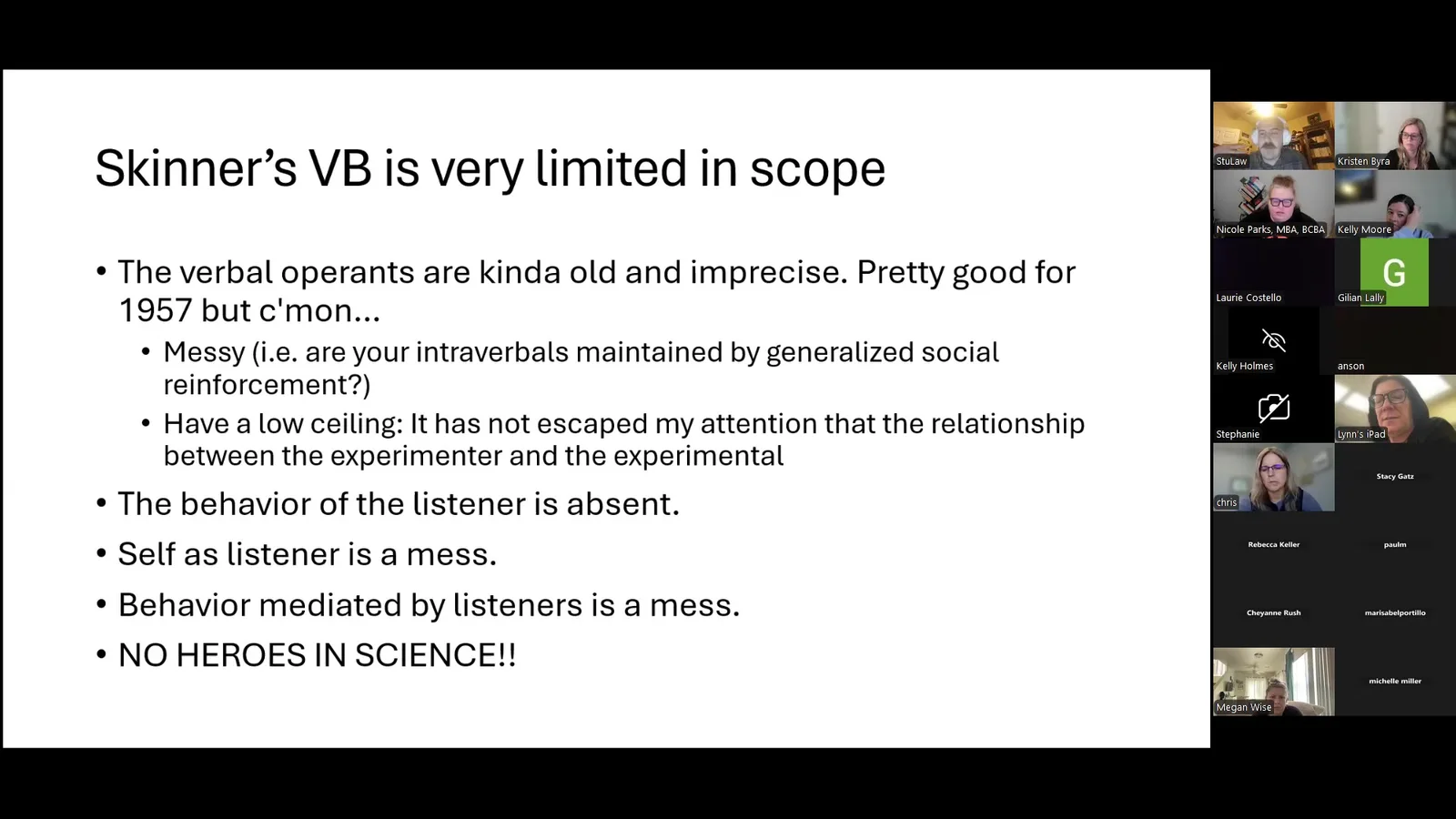
Then he named the limits. Verbal behavior mostly explains why speakers speak. A mand gets you things. A tact (naming something you notice) gets you praise. That system came out in 1957 as a first pass. Some of it was great and we still use it. Some of it never held up. Stu thinks the field should be able to say that out loud.
His dog example makes the gap plain. She bangs the door stopper when she wants out. Under Skinner's rules, that is a mand. The listener does not have to be verbal. He raised the same puzzle with a rat. If the pellet hopper breaks and you hand the pellets over, the lever press becomes a mand. Nothing changed in the rat.
Echoics carry the same problem. Stu quotes a movie line almost every time someone says my wife. Nobody praises him for it. He keeps doing it because it is fun and it sticks. Calling that an echoic (repeating what you just heard) hides the real function, since echoics are tied to praise. A catchy song gets stuck the same way, with no praise at all.
So my dog in Skinner system, my dog is verbal and I'm not because the behavior of the listener need not be verbal.
From the talk — Stu Law, Ph.D.
What RFT Adds: Why Listeners Listen
RFT asks a different question. Why do listeners listen? Why do we follow rules? What does language do to what we do? Stu said a relational frame (a learned link between ideas) depends on the setting and can apply to brand new things. Then he broke that idea into three plain parts.
Start with arbitrarily applicable relations (links we agree on socially). A parrot can learn which thing is bigger or darker. It cannot tell you that one friend is more of a dirt bag than another. People build those rankings with ease. Then we act on them. Stu ran through a joke list of dirt bags and asked who he would pick for the movies.
Next is contextual control (the setting picks the meaning). A friend of his said she wants to date a dirt bag. She meant someone outdoorsy who climbs mountains and might live in a van. Same two words. Very different function. That shift is the thing RFT was built to track.
He flagged mutual entailment (one link implies its reverse) as the piece that matters most. Once a child has it, function gets messy. They can start ranking people in ways nobody taught them. His shorthand is that we get stuff for free. New relations show up with no training at all.
one thing that humans are good at that non-human animals aren't good at is arbitrary relations
From the talk — Stu Law, Ph.D.
Transformation of Stimulus Function: When Praise Lands as a Punisher
This is the term Stu asked people to hold onto. Transformation of stimulus function (language changes what things do) is the core idea. Language can turn a word into a reward. It can turn a word into a warning. His test case is fear. You do not lie awake scared that a lion will eat you. You lie awake scared about tomorrow. What scares you is language.
Here is his picture of why praise can backfire. Think of a quarter. One side holds the good things you think about yourself. The other side holds the shame and the fear. It is one coin. That is part of why ACT leans on defusion (stepping back from your own thoughts). Saying nice things in the mirror can pull the painful side forward.
He gave a live example. His team was working on SMART goals with a young man. The word smart was a sore spot. To him, working on smart meant someone thought he was dumb. Even kind words landed as a punisher. A happy network can sit right next to a sad one. Stu used a restaurant you loved before a breakup. The joy and the loss arrive together.
Good teaching can also open new problems. He pointed to Fit Learning, which teaches relational operants (trained links between ideas) for reading comprehension. In one case, staff taught a child to compare and contrast. The child then compared himself to his siblings and did not like what he saw. Stu now preps families for this. Stronger language skills also make a kid better at hiding things.
when you reinforce the head side of the quarter you're also reinforcing the tail side of the quarter
From the talk — Stu Law, Ph.D.
Assent, Determinism, and the Limits of Direct-Acting Contingencies
Assent (saying yes to taking part), dignity of risk (the right to take chances), and person-centered planning are everywhere now. Stu thinks that is right. He also thinks it gets hard fast. He has seen rat models of assent, and he grants they help a bit. Then he points at how adults really do consent. There are safety words, accountability buddies, and friends who ask to be reminded. All of that runs on language.
Determinism (every act has a cause) is the other half. Stu recalled a conference talk on assent based teaching. It sounded like you teach a few mands and tacts and then step back. Linda Hayes raised her hand and said that sounds like giving them words and then free will. The speaker agreed. Stu's point is that we never let go of the steering wheel. A yes is still caused.
So what do you do instead? Ask what is controlling that. Then ask if that is what you want controlling it. A student says on graduation day that he will be an astronaut. Taking that at face value is not kindness. Ask what part of it appeals to him, then work from there.
This is also where direct-acting contingencies run short. You would not run a pairwise preference assessment with a teenage boy. You would ask him, then probe and follow up. Language shifts your schedules, your reinforcers, and the shape of the whole plan. Stu's closing claim was simple. Language changes the game, and the field will have to deal with it.
And I'm here to tell you that eventually that turns into a verbal problem.
From the talk — Stu Law, Ph.D.
Common questions
What is transformation of stimulus function in plain terms?▾
It means language changes what things do to us. A word can start working as a reward, a warning, or a punisher, with no direct training. Stu's example is fear: you do not lie awake worried about a lion, you lie awake worried about tomorrow. The thing acting on you is language.
Does RFT replace Skinner's verbal behavior?▾
No. Stu said Skinner's work is still useful, and he uses it. His complaint is that it mostly answers why speakers speak. RFT adds why listeners listen, why we follow rules, and how words change what we do.
Why don't positive affirmations work very well?▾
Because the proud side and the painful side sit on the same coin. When you reinforce one side, you touch the other. Stu said that is part of why ACT uses defusion instead of just stacking up nice statements. Praise can even punish, as it did for the young man who heard "smart" as proof that people thought he was dumb.
Is RFT work outside a BCBA's scope of practice?▾
Stu takes the risk seriously and does not brush it off. His argument is that many BCBAs already work on these repertoires without the training. He would rather people learn how delicate the work is than leave it to chance.
When should I stop relying on direct-acting contingencies alone?▾
When the problem is tied to language. Assent, dignity of risk, person-centered planning, and self-comparison all show up as verbal problems. Stu's practical cue is simple: if the person talks, check whether your usual tools still fit, starting with how you assess preference.
About the speaker
Stu Law, Ph.D., earned his doctorate at UNR, studied under Steve Hayes, and has authored over 20 publications. He is a co-creator of Generate, a skill-based assessment, and attends ACBS each year alongside behavioral clinical psychologists. In this talk he covered why RFT matters for everyday ABA, where Skinner's verbal behavior runs out, and how language reshapes assent and treatment planning.
This summary was generated from the recording’s transcript. Quotes are taken word for word from the talk.
What you'll learn
- 11) Attendees will be able to define Transformation of Stimulus Function, in a functional sense, and will be able to speak to how it alters direct-acting contingencies 2) Attendees will be able to define the bridge between ABA as a technology, and ABA as a philosophical approach to human complexity 3) Attendees will be able to identify the boundaries of direct-acting contingency approaches and where considerations for language-informed interventions may be advisable.
Related talks
Talks that cover the same concepts
A Panel on Collaboration in Practice: SLP, OT & ABA Services
Upskill ABA
From Peer to Professional: Becoming & Supporting Early Career Behavior Analysts
Upskill ABA
From Idea to IRB: Conducting Research in Your ABA Practice
Upskill ABA
Quality Without Measurement is Just Marketing: A Critical Analysis of Quality Service Delivery
Upskill ABA
Assent and Compassionate Care: Ethical Issues and Considerations for Practice
Upskill ABA
Language Changes the Game (Part 2)
Upskill ABA
More from Upskill ABA
OpenCEU is supported by advertising from third-party sponsors. Sponsors are clearly labeled, have no influence over course content, instructors, or CEU decisions, and never appear on certificates. The BACB does not sponsor, approve, or endorse OpenCEU sponsors or their products.