Skill-Based Assessment in ABA: A Plain Guide
What skill-based assessment means in ABA, why the most-used tools may be the least validated, and what a good assessment should do.
Key takeaway
Skill-based assessment is how we measure what a learner can and cannot do. It maps out skills so a team can plan good goals. Many ABA tools try to do this job.

genArete: Learner-Centered Skill Assessment
Free learning path on this topic
Master PFA and SBT
Matt Harrington's 12-article walk through practical functional assessment and skill-based treatment, from Hanley's 2014 study to the enhanced choice model. Then assent, since SBT depends on it, and the ethical guardrails that keep behavior reduction defensible. Five CEUs, one of them ethics.
Experts who cover this
2 recordings on openceu cover skill-based assessment aba.
- Featured talk1 CEU
genArete: Learner-Centered Skill Assessment
Mark MaladyThe Behaviorist Bookclub
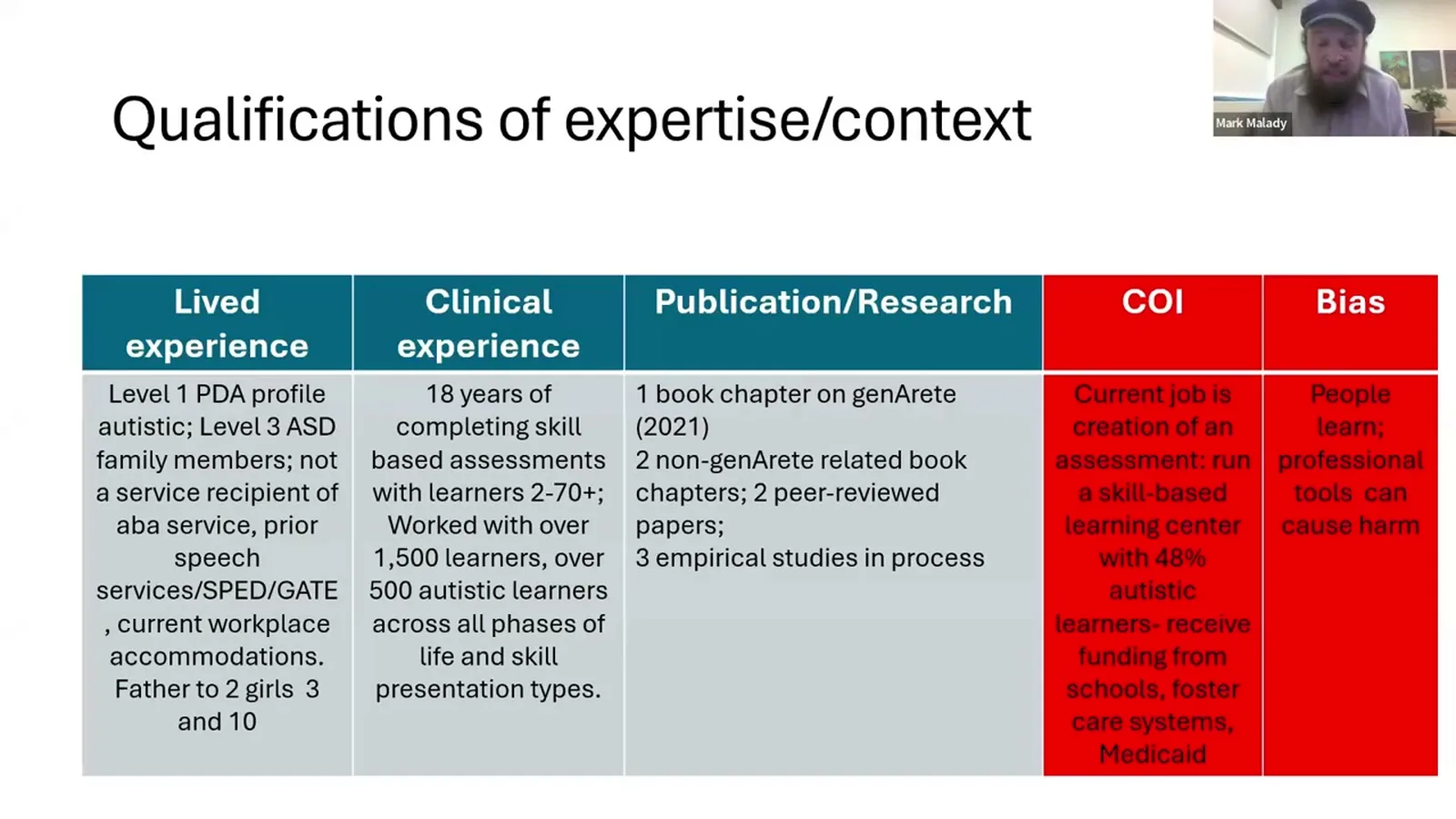
The core topic of the talk: Mark argues the field lacks assessments that capture the full breadth of skills in context across a learner's lifespan, and that…
- 1 CEU
Generate: Learner Centered Skill Assessments
Mark MaladyThe Behaviorist Bookclub
This is the core topic: Mark traces his motivation for co-creating the Generate assessment to running a day habilitation program where 110 learners across a…

On this page · 7 sections▾
Skill-based assessment is how we measure what a learner can and cannot do. It maps out skills so a team can plan good goals. Many ABA tools try to do this job.
The idea sounds simple, but the tools have real problems. Some of the most popular ones lack strong research behind them. A good assessment should do more than list skills. This page explains what skill-based assessment is and what it should really deliver.
What it is meant to do#
At its core, a skill-based assessment builds an accurate picture of a learner. It should cover a wide range of skills in real settings. And it should track skills across a person's whole life, not just early years.
Mark Malady argues the field falls short of this goal. Many tools do not capture the full breadth of skills in context. That gap leaves clinicians without a complete view. A partial picture leads to partial plans.
The best assessments also point toward a meaningful life. They should help a learner move toward the future they want. That is a higher bar than checking off isolated skills.
The popularity problem#
Here is the hard part. The most-used tools are often the least backed by evidence. Popularity and proof do not line up. Malady names this gap head-on.
there is a very clear disconnection between utilization and the current evidence base. We are not in alignment on our current tools for skill-based assessment being empirically validated as instruments in and of themselves. From the talk — Mark Malady
He backs this with market data. The most widely used tools lead the pack by a wide margin.
the VBMAP has the largest market share at the time period in 2020, followed by the ABLA's R. From the talk — Mark Malady
The VB-MAPP and the ABLLS-R are common milestone tools in ABA. They map early skills against typical development. But wide use does not mean strong proof. Malady spells out the mismatch.
So we're emerging or weak instruments in the validity and reliability actually are getting utilized at a higher rate than the instruments that have strong or very strong support. From the talk — Mark Malady
Validity means the tool measures what it claims to. Reliability means it gives steady results. When weak tools win on use, clients may get weak plans. That is the core worry.
When plans go stale#
 Advertisement
Malady's concern is not just about test scores. It is about real lives. He saw the cost firsthand in a day program. The plans there had gone stale for years.
It was really clear that people were working on these habilitation plans that were really skill focused and skill oriented, but they weren't making any progress on them. And when we kind of did a deep dive, we found that the average person had that same skill development plan for a five-year period. From the talk — Mark Malady
A habilitation plan is a plan to build daily-life skills. Five years with no change is a serious failure. It shows what happens when tools do not fit a wide range of needs. People stall because the assessment cannot see them clearly.
What a better assessment does#
So what should a strong skill-based assessment do differently? Malady lays out a few clear jobs. First, it should give an accurate account of real skills. Second, it should empower a meaningful life, not just fill a checklist.
Third, it should separate two different things. Some targets are skills to build. Others are supports or accommodations a person may always need. Mixing these up leads to poor goals. Pulling them apart makes plans more honest and more useful.
The assessment should also serve the learner directly. It is not just paperwork for the clinician. Malady frames the learner as a real user of the results.
we should be able to use this information to help the learner just in the alignment of how they see their future. From the talk — Mark Malady
This flips the usual view. The learner is not only the subject of the test. They are a partner who uses it to shape their own path.
Why this matters for practice#
Assessment choices shape everything that follows. A weak assessment leads to weak goals. Weak goals lead to slow or no progress. The five-year stall shows the stakes.
BCBAs and teams can act on this. Look at the evidence behind your tools, not just their popularity. Ask whether an assessment covers skills across the lifespan. Check that it tells build-the-skill targets apart from support needs. These habits protect the people you serve.
The lesson is not that all common tools are useless. It is that use should not be your only guide. Match the tool to the learner and to the evidence. That is how assessment starts to drive real progress again.
Choosing a tool with care#
Picking an assessment should be a thoughtful choice, not a default. Many teams reach for the tool they already know. But familiarity is not the same as fit. The goal is to match the tool to the learner.
Start by asking what the learner actually needs. A young child and an adult have very different goals. A tool built for early milestones may miss adult skills. The assessment should span the range of the person's life.
Next, look at the evidence behind the tool. Ask whether it has been tested for validity and reliability. Weigh that against how well it fits your client. Popularity alone should not decide the matter.
Finally, check what the results will drive. A good assessment should lead to clear, useful goals. It should tell skills to build apart from supports to provide. If a tool cannot do that, it may not be the right one.
FAQ#
What is a skill-based assessment in ABA? It is a way to measure a learner's current skills to guide goal-setting. It maps what a person can and cannot do across areas. The results shape the treatment plan and the goals a team chooses.
Why does the choice of assessment tool matter so much? The assessment sets the direction for the whole plan. A tool that misses key skills leads to poor or stagnant goals. Some experts warn that the most popular tools may not have the strongest research support.
What should a good skill-based assessment do? It should give an accurate picture of real skills in context. It should point toward a meaningful life for the learner. And it should separate skills to build from supports a person may always need.
Mark Malady expands on this learner-centered approach in Generate: Learner Centered Skill Assessments.
 Advertisement
Turn this topic into a CEU
You just studied this. Now get credit for it.
Watch genArete: Learner-Centered Skill Assessment with Mark Malady, BCBA and earn 1 free BCBA CEU. Detailed certificate, delivered the moment you finish.
Keep going with a free learning path
Master PFA and SBT
Matt Harrington's 12-article walk through practical functional assessment and skill-based treatment, from Hanley's 2014 study to the enhanced choice model. Then assent, since SBT depends on it, and the ethical guardrails that keep behavior reduction defensible. Five CEUs, one of them ethics.