Indistinguishability in ABA: A Goal Worth Questioning
What indistinguishability means in ABA, why norm-referenced tools can push it, and how to keep assessments centered on the learner.
Key takeaway
Indistinguishability is the idea that treatment should make an autistic learner look like non-autistic peers. In plain words, it means blending in. The goal becomes seeming "normal" rather than living well.

genArete: Learner-Centered Skill Assessment
Free learning path on this topic
ADHD for Behavior Analysts
Nicole Stewart's three-part series on ADHD for behavior analysts. Reframe what you are seeing, shape behavior change in a way that fits how ADHD learners learn, then hand over autonomy and self-management. Three hours, three CEUs.
Experts who cover this
3 recordings on openceu cover indistinguishability aba.
- Featured talk1 CEU
genArete: Learner-Centered Skill Assessment
Mark MaladyThe Behaviorist Bookclub
Mark frames indistinguishability, the idea that intervention should make autistic learners resemble non-autistic peers, as a risk baked into norm-referenced…
- 1 CEU
Generate: Learner Centered Skill Assessments
Mark MaladyThe Behaviorist Bookclub
A recurring critique throughout the talk: heavy reliance on norm-referenced tools can push behavior analysis toward a normalization/indistinguishability…
- 1 CEU
genArete: Milestone based comparison criteria in Skill Assessment
Mark MaladyThe Behaviorist Bookclub
Framed as the risk baked into norm-referenced tools: clinicians can accidentally fall into using assessments as indistinguishability-based platforms unless a…


On this page · 7 sections▾
Indistinguishability is the idea that treatment should make an autistic learner look like non-autistic peers. In plain words, it means blending in. The goal becomes seeming "normal" rather than living well. That shift can pull our work in the wrong direction.
This concept matters for every BCBA, RBT, teacher, and parent. It shapes the goals we pick and how we judge progress. It can slip into our work without us noticing. This page explains what it is, where it hides, and how to guard against it.
The stakes are real. Autistic self-advocates have named this goal as harmful. When we chase sameness, we may miss what the learner truly needs. Understanding the risk helps us do better work.
What indistinguishability means#
The term comes from older ideas about normalization. It treats the peer average as the target. If a learner acts like the group, the work is seen as done.
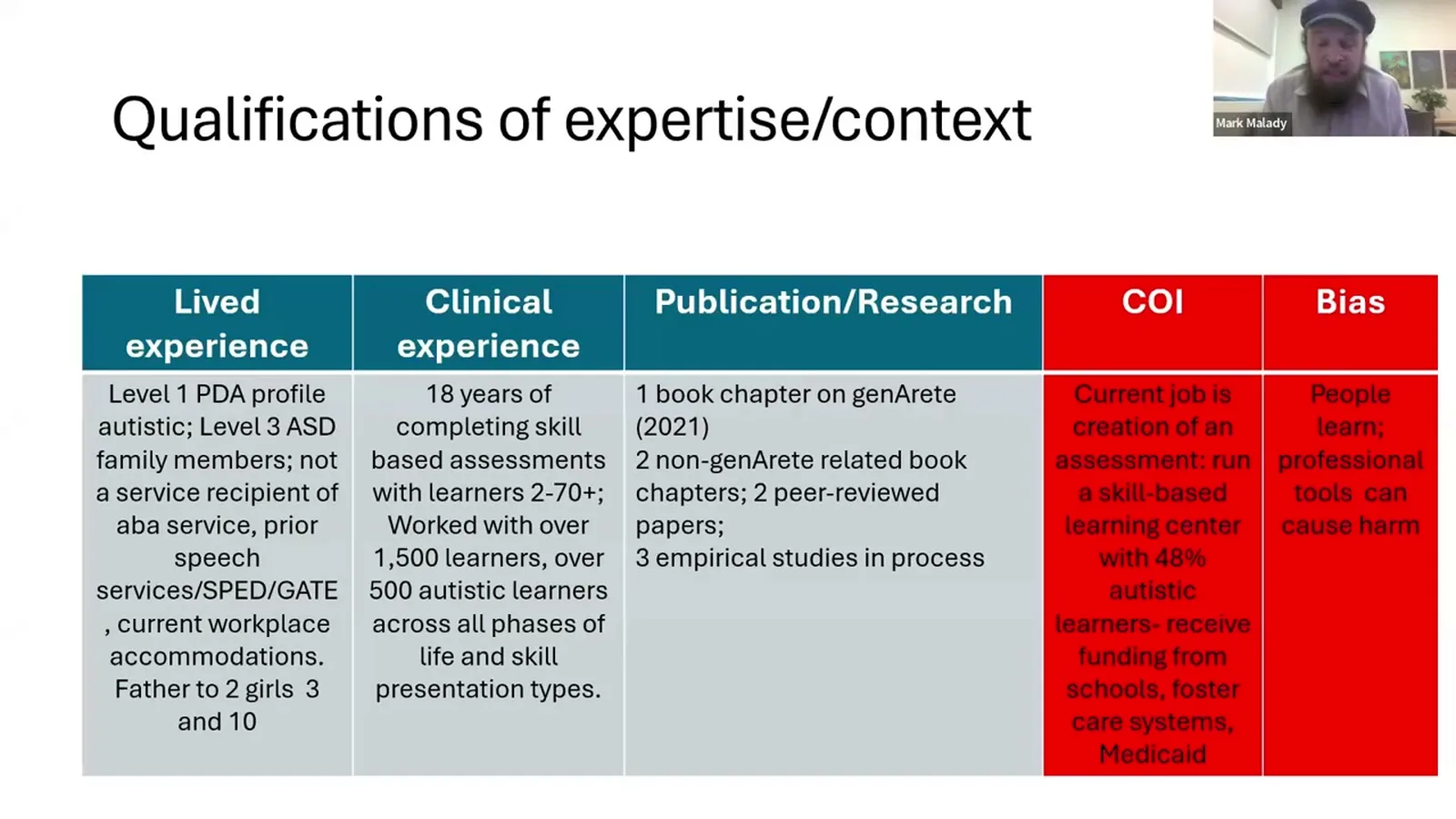
Mark Malady names this history openly in his skill assessment talks. He does not soften it. He asks us to consider that behavior analysis itself was built on an agenda of indistinguishability and normalization.
He is not saying every practitioner wants this. He is saying the pull exists. It can shape our field even when we mean well.
Where it hides in our tools#
The main risk lives in norm-referenced tools. These tools compare a learner to a typical peer group. That comparison quietly sets the peer as the standard.
Malady connects this pressure straight to the tools we use. The more we lean on them, the stronger the pull.
let's say that behavior analysis is built on an agenda of indistinguishability and normalization. If we're using tons of norm reference tools, this definitely can be an accurate description of some of the influences coming into our practice. From the talk — Mark Malady
The same risk shows up in how we display data. "Fill every box" graphs push learners toward one shared pattern. Malady warns about this drift with autistic learners in particular.
When we're thinking about unique differentiation across a population like autistic learners that quickly can lead us to those ideas of normalization and standardization and distinguishability. From the talk — Mark Malady
So the danger is not one bad clinician. It is baked into common measures and charts.
Why this still matters today#
 Advertisement
Some people say indistinguishability is old news. They argue the field has moved past it. Malady pushes back on that claim directly.
some claims that indistinguishability no longer exist in our field are just not accurate. From the talk — Mark Malady
His point is that the pull is still here. It hides in tools we use every day. Pretending it is gone makes it easier to fall into. Naming it is the first step to avoiding it.
This is why he keeps returning to the topic. He treats it as an ongoing risk, not a settled debate. Honest reflection helps the field grow. Denial only lets old patterns continue.
How to guard against it#
The fix is not to throw out all assessment. It is to keep the learner at the center. Malady offers a concrete safeguard for practitioners.
if we can add in the learner's current milestone or something that's really important to them, it can protect us from accidentally falling into a pattern in distinguishability. From the talk — Mark Malady
The key word is accidentally. Most clinicians do not choose this goal on purpose. They drift into it through the tools. A person-relevant milestone pulls the focus back to what this learner actually needs.
Malady frames the whole task as learning to spot the link and break it.
describe the relationship between indistinguishability and norm-reference criteria, and the things that we can do to guard ourselves from accidentally falling into indistinguishability-based platforms. From the talk — Mark Malady
So the goal is awareness plus a better anchor. Know the risk, then layer in what matters to the person.
Keeping goals meaningful#
Assessment is still useful when done with care. The problem is not measuring skills. The problem is treating "like everyone else" as the finish line. A better question is what this learner wants to do.
Start each goal with the person, not the norm. Ask what would make daily life better for them. Ask what they and their family care about most. Then use tools to support that direction, not to erase differences.
This shift changes how progress looks. Success is not scoring like the average peer. Success is moving toward a life the learner values. That framing keeps autistic traits from being treated as problems to fix.
It also respects the family and the learner as partners. Their input sets the target. The data then tracks progress toward that shared goal. This keeps the work honest and person-centered.
None of this means dropping high standards. It means aiming them at the right target. A skill is worth teaching when it helps the learner live better. That test keeps our goals grounded in real value.
What the research says#
The concern is not only from inside the field. Autistic self-advocates have raised it for years. One paper examined indistinguishability in behavior-analytic terms and looked at how it appeared in early, well-known studies (Veneziano, J., & Shea, S. (2022). They have a Voice; are we Listening?. Behavior Analysis in Practice, 16(1), 127-144. https://doi.org/10.1007/s40617-022-00690-z).
That paper argues the self-advocate community's concerns carry real weight. It calls on the field to take these criticisms seriously and to weigh stakeholder values. It also suggests changes to ABA training and research so goals reflect what learners actually want. This lines up with Malady's push toward learner-centered assessment.
FAQ#
What does indistinguishability mean in ABA? It is the idea that treatment should make an autistic person look like non-autistic peers. The goal becomes blending in rather than living a good life. Many advocates see this as a harmful target.
Why is indistinguishability controversial? It can treat autistic traits as problems to erase. Critics say this ignores what the learner values. It can also come from tools rather than from a clear choice by the clinician.
How can BCBAs avoid this trap? Keep the learner at the center of every goal. Add a person-relevant milestone or something that truly matters to them. Use norm-referenced tools with care, not as the only standard.
Mark Malady expands on these ideas across two related talks. He covers the assessment approach in Generate: Learner Centered Skill Assessments. He digs into comparison criteria in genArete: Milestone based comparison criteria in Skill Assessment.
 Advertisement
Turn this topic into a CEU
You just studied this. Now get credit for it.
Watch genArete: Learner-Centered Skill Assessment with Mark Malady, BCBA and earn 1 free BCBA CEU. Detailed certificate, delivered the moment you finish.
Keep going with a free learning path
ADHD for Behavior Analysts
Nicole Stewart's three-part series on ADHD for behavior analysts. Reframe what you are seeing, shape behavior change in a way that fits how ADHD learners learn, then hand over autonomy and self-management. Three hours, three CEUs.