ABLA-R: The Basic Learning Abilities Test in ABA
The ABLA-R tests basic discrimination skills and predicts what a learner can learn next. Here is what BCBAs should know about this well-supported tool.
Key takeaway
The ABLA-R is a short, hands-on test used in ABA. Its full name is the Assessment of Basic Learning Abilities, Revised. It checks whether a learner can tell simple things apart.

genArete: Learner-Centered Skill Assessment
Free learning path on this topic
Child Development for Behavior Analysts
Typical development for behavior analysts. Kristen Byra's overview, then Kelly Brzak's deep dives on ages 2 to 5, 6 to 8, and 9 to 11, with milestones, common problem behaviors, and programming tips for each band.
Experts who cover this
2 recordings on openceu cover abla-r.
- Featured talk1 CEU
genArete: Learner-Centered Skill Assessment
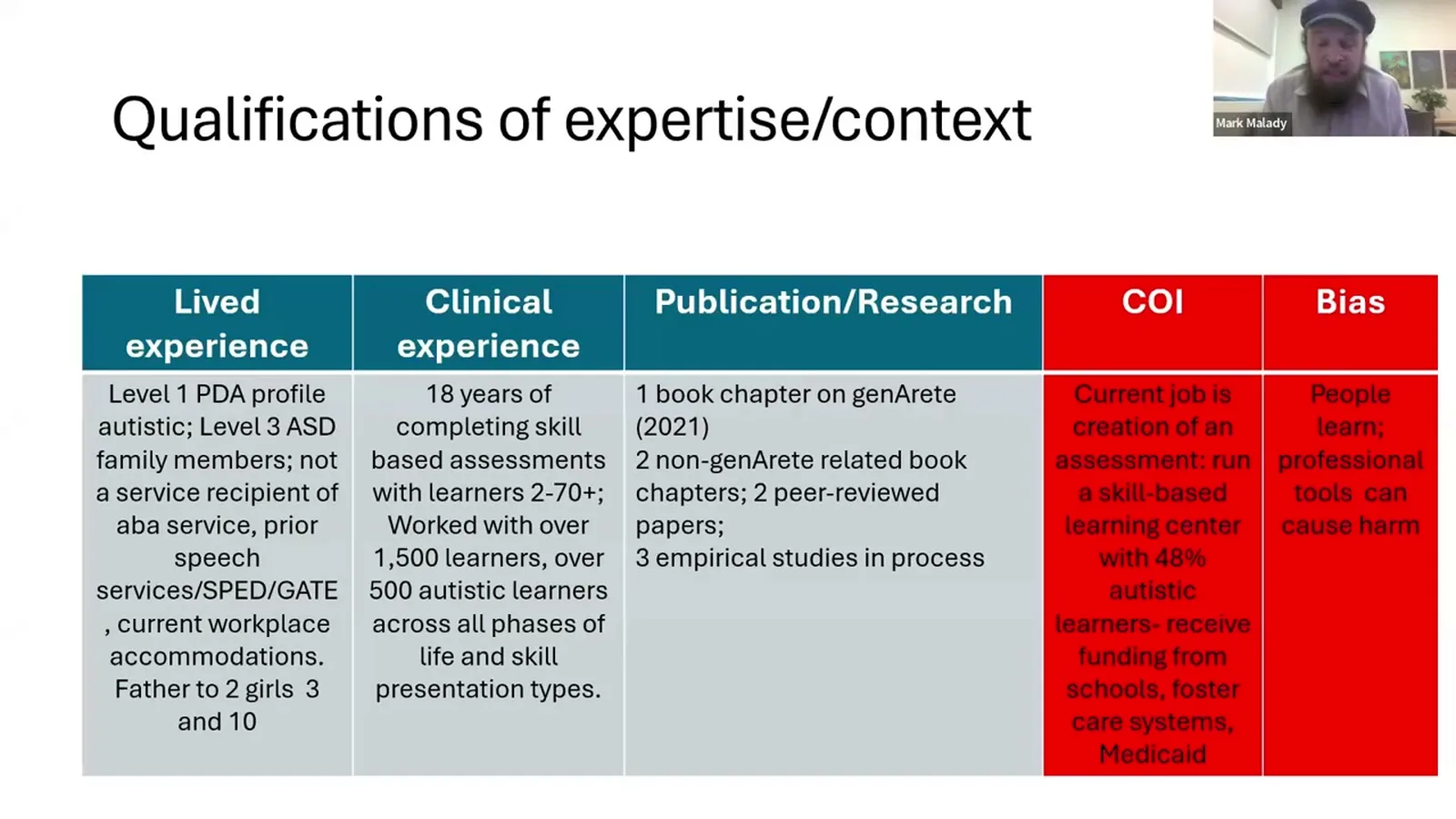
Mark MaladyThe Behaviorist Bookclub
Mark highlights the ABLA (Kerr et al., 1977), a basic discrimination-skills assessment, as one of the few instruments with genuinely strong empirical support…
- 1 CEU
Generate: Learner Centered Skill Assessments
Mark MaladyThe Behaviorist Bookclub
Highlighted as a rare example of a skill assessment (for discrimination skills) with genuinely strong reliability and validity support, yet it is used far less…

On this page · 7 sections▾
The ABLA-R is a short, hands-on test used in ABA. Its full name is the Assessment of Basic Learning Abilities, Revised. It checks whether a learner can tell simple things apart. These are called discrimination skills. The test gives the learner a few small tasks and watches how they respond.
For BCBAs, RBTs, teachers, and parents, this matters more than it sounds. Basic discrimination is the floor that many bigger skills stand on. If a learner cannot yet match a sound to a picture, harder language goals will stall. The ABLA-R helps you find that floor before you build on it.
What the ABLA-R actually measures#
The test comes from Kerr and colleagues in 1977. It sorts skills into levels, from very simple to more complex. Each level asks the learner to make a slightly harder distinction. Some levels use where an object is. Higher levels use what an object looks like or sounds like.
The top levels test auditory-visual discrimination. That means matching a spoken word to the right picture. This is a key building block for understanding language. A learner who passes it is ready for more. A learner who fails it may need earlier goals first.
Why experts trust the evidence behind it#
Mark Malady points to the ABLA-R as a rare bright spot among ABA assessments. Many popular tools have thin research support. This one does not.
the ABLA from Kerr et al. in 1977. And we see that the ABLA has really strong support. It's a very basic assessment that's used for discrimination skills. From the talk — Mark Malady
He also warns that the field often ignores the strongest tools. Weak tests get used a lot. Strong tests get used less. That gap is worth noticing.
when we look at utilization in the field, we almost have an inverse relationship happening. We're emerging or weak instruments in the validity and reliability actually are getting utilized at a higher rate than the instruments that have strong or very strong support. From the talk — Mark Malady
The lesson is simple. Pick tools that have earned your trust with data, not just habit.
Where the ABLA-R fits in your assessment plan#
 Advertisement
The ABLA-R is not a full curriculum. It is a quick screen of learning readiness. Use it early, before you set language or academic goals. It tells you which foundation skills are already in place.
Think of it as a starting map. It shows the level a learner has reached. From there you can aim your teaching at the right next step. You skip goals that are too hard and skip time-wasting drills that are too easy.
Reading the levels with care#
Mark adds one honest caution. The published levels are not perfectly clean. People do not always sort neatly across all of them.
Although the ABLA's claims go up to 12, there's a lot of disagreement on how that differentiation actually plays out across people. From the talk — Mark Malady
So treat the levels as a useful guide, not a fixed rule. Use them to plan, then watch the learner's real progress. Let the data in front of you have the final say.
What the research says#
Research supports the ABLA-R as a predictor, not just a snapshot. One study followed nine adults with developmental disabilities. Researchers first found each person's high and low preferred work tasks. Then they offered choices in three ways: the real tasks, pictures of the tasks, and spoken descriptions. For five of the nine adults, their ABLA discrimination scores predicted which choice format worked best.
Another study looked at equivalence class formation in learners with autism. Six individuals took part, testing at ABLA-R Levels 4, 5, and 6. Only the learners who reached Level 6 showed equivalence class formation. Those at Levels 4 or 5 did not. This lines up with the idea that Level 6 marks a real jump in ability.
A third study connected ABLA Level 6 to receptive language. Learners pointed to pictures of common objects after hearing their names. All five learners who passed Level 6 passed the picture name recognition tasks. Four of five who failed Level 6 failed those tasks. Together these findings show the test can flag who is ready for language work.
How it compares to popular tools#
Many teams reach for the VB-MAPP or similar tools first. Those are useful, but their research base is thinner than the ABLA-R's. Mark's point is not that you must drop your favorites. It is that you should weigh the evidence.
You can also combine tools. The ABLA-R can sit alongside a broader language assessment. It adds readiness data the other tools miss. If you want the deeper walkthrough, see Generate: Learner Centered Skill Assessments.
FAQ#
What does the ABLA-R test?
It tests basic discrimination skills. The learner completes simple tasks that show whether they can tell objects apart by place, look, or sound. The top level checks matching a spoken word to a picture.
Is the ABLA-R better than the VB-MAPP?
They do different jobs. The ABLA-R screens learning readiness with strong research support. The VB-MAPP maps a broad curriculum. Many teams use the ABLA-R to check readiness before setting VB-MAPP goals.
Who can give the ABLA-R?
Trained providers give it, often BCBAs or their supervised staff. The tasks are short and hands-on. Proper training matters so scoring stays consistent across people and settings.
 Advertisement
Turn this topic into a CEU
You just studied this. Now get credit for it.
Watch genArete: Learner-Centered Skill Assessment with Mark Malady, BCBA and earn 1 free BCBA CEU. Detailed certificate, delivered the moment you finish.
Keep going with a free learning path
Child Development for Behavior Analysts
Typical development for behavior analysts. Kristen Byra's overview, then Kelly Brzak's deep dives on ages 2 to 5, 6 to 8, and 9 to 11, with milestones, common problem behaviors, and programming tips for each band.