genArete: Milestone based comparison criteria in Skill Assessment
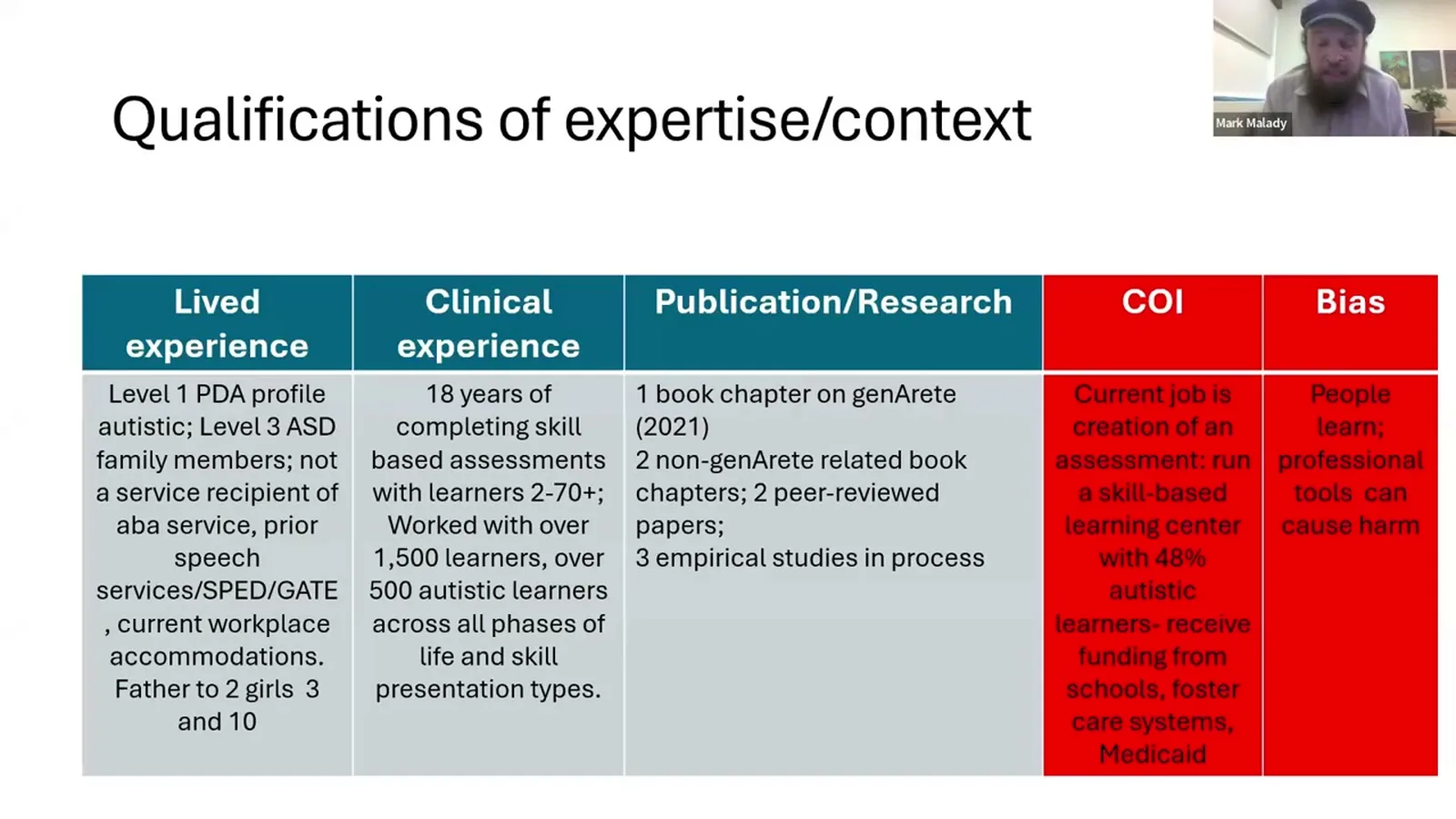
Presented by Mark Malady, BCBA

In this second talk of his three-part series on skill-based assessment, Mark Malady, BCBA, examines the comparison criteria embedded in the assessments most commonly used with autistic learners and argues that many still steer clinicians toward normalization even as the field claims to have moved past that agenda. He shows how visual design choices, such as center-to-outer layouts, preset axes, and blank scoring space, evoke predictable clinician behavior like teaching to the test, where assessment scores rise while global measures such as the Vineland show no meaningful change. He frames assessment tools as products of clinical work that acquire evocative and abative functions over clinical decision-making. Malady contrasts the two dominant criterion types, age-based norm-referenced benchmarks and professionally developed criteria, and proposes a third alternative: flexible, person-selected, outcome-based milestones benchmarked from competent performers. Using the genArete Learning System's skill-gram displays, he demonstrates how overlaying a milestone as a second data path redirects clinical attention and changes the meaning of blank space, illustrated by an adult in 24-hour care whose data far exceeded a benchmarked stay-home-alone milestone, reframing a skill-building conversation as a dignity-of-risk conversation. He reviews benchmarked milestones such as entry-level employment, living with a roommate, and kindergarten readiness, then outlines practical steps: identify competent performers, set item criteria, test with novel performers, build cross-learner data flow, and use quality-of-life surveys to repeatedly orient to milestone achievement. The Q&A covers selling the approach to leadership, selecting five focus targets, and reconciling learner and caregiver milestone mismatches.
Register free & watch nowCancel any time. Cert delivered to your inbox the moment you pass the quiz.
Learner ratings
from 22 learners
100% would recommend this CEU to other professionals in their field (7 responses)
“Thank you! As a transition coordinator, it is so important to think about how these skills generalize and relate to the real world.”
— Lee D.“very nice”
— Sarana S.“Always amazing”
— Arlene T.“thanks”
— Antonina G.“A huge thank you to Mark and Matthew today!”
— Imani P.“I loved this topic! It was incredible to reframe these assessments and make them more meaningful.”
— Brianna H.
About this CEU
In this second talk of his three-part series on skill-based assessment, Mark Malady, BCBA, examines the comparison criteria embedded in the assessments most commonly used with autistic learners and argues that many still steer clinicians toward normalization even as the field claims to have moved past that agenda. He shows how visual design choices, such as center-to-outer layouts, preset axes, and blank scoring space, evoke predictable clinician behavior like teaching to the test, where assessment scores rise while global measures such as the Vineland show no meaningful change. He frames assessment tools as products of clinical work that acquire evocative and abative functions over clinical decision-making. Malady contrasts the two dominant criterion types, age-based norm-referenced benchmarks and professionally developed criteria, and proposes a third alternative: flexible, person-selected, outcome-based milestones benchmarked from competent performers. Using the genArete Learning System's skill-gram displays, he demonstrates how overlaying a milestone as a second data path redirects clinical attention and changes the meaning of blank space, illustrated by an adult in 24-hour care whose data far exceeded a benchmarked stay-home-alone milestone, reframing a skill-building conversation as a dignity-of-risk conversation. He reviews benchmarked milestones such as entry-level employment, living with a roommate, and kindergarten readiness, then outlines practical steps: identify competent performers, set item criteria, test with novel performers, build cross-learner data flow, and use quality-of-life surveys to repeatedly orient to milestone achievement. The Q&A covers selling the approach to leadership, selecting five focus targets, and reconciling learner and caregiver milestone mismatches.
What you'll learn
- 1Learning Objectives
- 2Participants will be able to label some common comparison criteria used by primary skill-based assessments within ABA based services for autistic learners.
- 3Participants will be able to identify the benefits of milestone-based comparison criteria and the risk of using the criteria.
- 4Participants will be able to describe the relationship between indistinguishability and norm-referenced criterion and strategies that can be employed to decrease this risk.
Concepts in this CEU
Related talks
Talks that cover the same concepts

genArete: Learner-Centered Skill Assessment
The Behaviorist Bookclub
Generate: Learner Centered Skill Assessments
The Behaviorist Bookclub

Delegating with Confidence: Training and Supervising RBTs to Support Assessments
Copper Consulting Group
Getting the Right Answer Isn’t Enough: Establishing Speaker–Listener Repertoires for Complex Learning
The Behaviorist Bookclub

Child Development for BCBAs- Age 9-11
The Behaviorist Bookclub

Child Development Deep Dive: Middle Childhood (6-8 year olds)
The Behaviorist Bookclub
More from The Behaviorist Bookclub

Empowering Autonomy and Self-Management in ADHD Learners
The Behaviorist Bookclub
Shaping Behavior Change when ADHD is in the Picture
The Behaviorist Bookclub
From Hours to Competence: Assessing and Developing Supervisee Skills
The Behaviorist Bookclub
OpenCEU is supported by advertising from third-party sponsors. Sponsors are clearly labeled, have no influence over course content, instructors, or CEU decisions, and never appear on certificates. The BACB does not sponsor, approve, or endorse OpenCEU sponsors or their products.