Typical Child Development Milestones Every BCBA Should Know
The 9-month to 5-year milestones BCBAs miss most, why the VB-MAPP alone is not enough, and what to do instead from a BCBA-led CEU.
Key takeaway
If you are a BCBA looking for typical child development milestones, the honest version of the story is that the field walks you from 9 months to about 5 years old in good detail, and then the resources fall off a cliff.
Child Development for Behavior Analysts
On this page · 9 sections▾
If you are a BCBA looking for typical child development milestones, the honest version of the story is that the field walks you from 9 months to about 5 years old in good detail, and then the resources fall off a cliff. Between 9 months and 5 years, you can watch a child move from the cheerio game (picking up a cheerio between thumb and index finger) to babble samples like "ma ma ma ma" and "ba ba ba ba," then to a 3-year-old whose talking is clear enough that strangers can understand them most of the time, then to a 5-year-old who can tell you a full story with future tense. After 5, the trackers thin out fast, and most of what you find is either school-readiness checklists or generic CDC paraphrases. That gap is where a lot of treatment plans go sideways, because the VB-MAPP, which most BCBAs (Board Certified Behavior Analysts) reach for first, only covers ages 0 to 4.
This page walks the 9-month to 5-year milestones using examples from a BCBA-led CEU, then points you to which assessment to actually use when your client is older than 5.
Why BCBAs Need a Milestone Map (and Why the VB-MAPP Is Not One)#
The VB-MAPP is a verbal behavior assessment. It is great for what it was built to do, which is help you sequence early language goals for kids ages 0 to 4. It is not a child development map. A child development map covers motor skills, communication, play, social skills, and adaptive skills together. The VB-MAPP only covers part of that grid.
The trouble starts when a BCBA keeps using the VB-MAPP on a 10-year-old or a 12-year-old because the score still has open boxes. The open boxes feel like goals. They are not goals. They are a sign that you have outgrown the tool. If you are writing nursery-rhyme intraverbals for a 12-year-old because the box was empty, the tool is driving the plan, and the plan is no longer about the child.
A real milestone map answers a different question. It tells you what a typical kid does at this age in every area of life, so you can sequence goals that match the child in front of you instead of the grid on your desk.
The Real Cliff at Age Five: What Resources Stop Covering#
If you have ever searched for milestone trackers past kindergarten, you have hit the cliff already. Here is the honest version from the talk.
I will say most of the resources available in terms of child development, in terms of milestone trackers, and things like that really is looking at birth to five. I have found some few and far between of like up to age eight, but most of it is in that first five years of development. From the talk — Kristen Byra
This matters in two ways. First, if your client is older than 5, you cannot just keep scrolling the CDC site and expect to find a clean grid. Second, when the resources stop, a lot of BCBAs default back to the VB-MAPP because it is the tool they own. That is how you end up teaching a 10-year-old the same skill set you would teach a 3-year-old.
The fix is to know which assessment actually covers your client's age, not which one you happen to have on the shelf.
9 Months: The Cheerio Game and What It Tells You#
Nine months is a busy month. Motor skills, social skills, and communication all move at once. Here is the motor list in plain language.
We can move things smoothly from one hand to the other. And that's when we start doing the cheerio game where we can pick up the cheerios between our thumb and index figure. We can stand holding on to things. We can get into a sitting position all by ourself. We can pull ourself to stand. From the talk — Kristen Byra
The cheerio game is a real clinical signal. A child who is using a pincer grasp on a single cheerio is showing fine motor control that you can map to early tact and mand work. A child who is still raking food with a full hand at 12 or 13 months is telling you something different.
On the social and emotional side at 9 months, the typical picture is stranger fear, clinginess with familiar adults, favorite toys, understanding the word "no," and babble samples with repeated consonant-vowel sounds like "ma ma ma" and "ba ba ba." Stranger fear at this age is typical, not a red flag for social withdrawal. The babble pattern is what you want to hear. If a 9-month-old is silent across a 20-minute play observation, that is a flag worth writing down.
12 to 18 Months: First Words, First Steps, First Tantrums#
By 12 months you are looking for the child to stand alone, shake their head no, wave bye-bye, point at things, and say things like "mama," "dada," and "uh-oh." Following simple directions like "pick up the toy" should be in range.
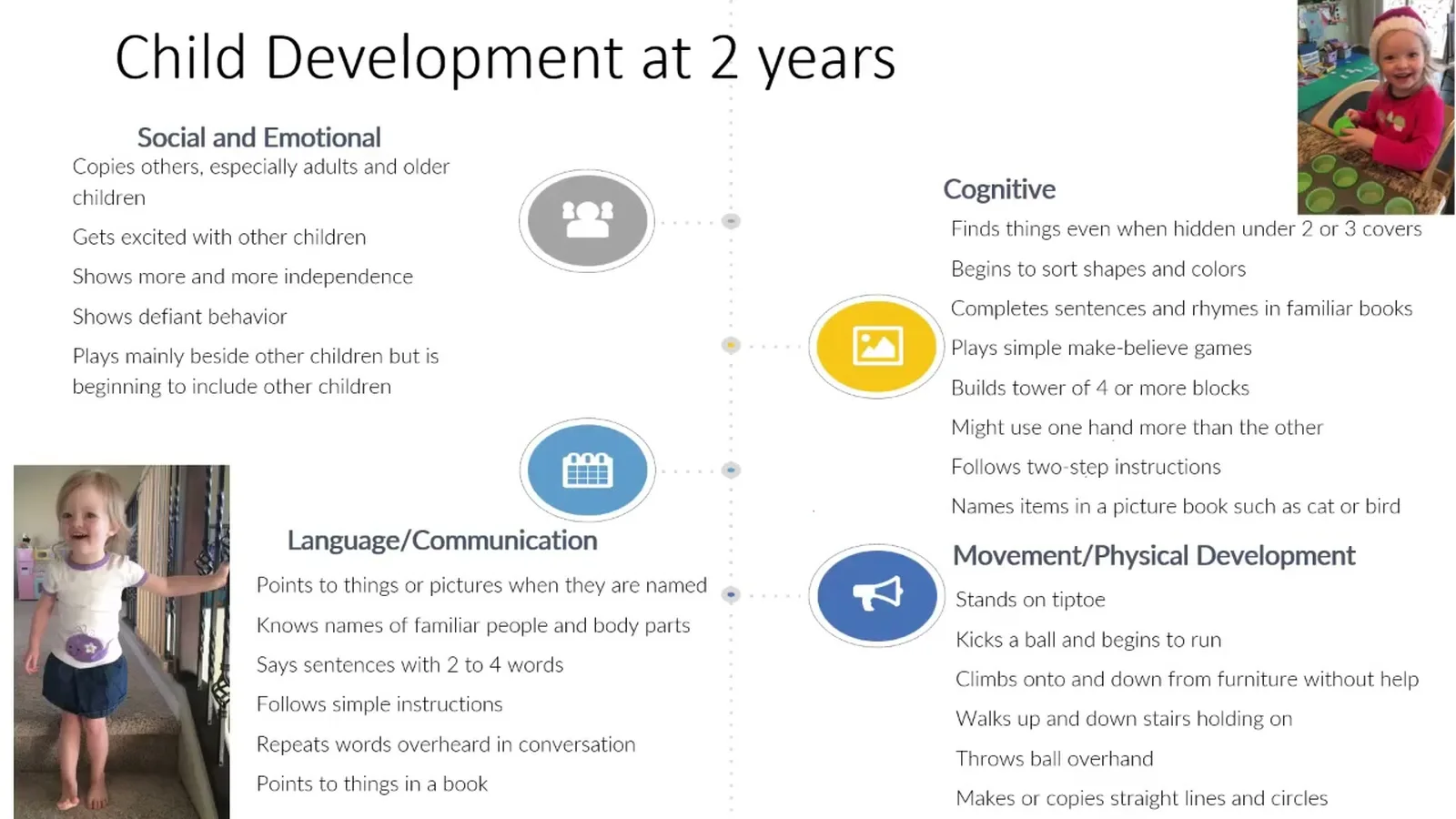
By 18 months the picture fills in fast. The child should be walking on their own, drinking from a cup, eating with a spoon, scribbling, pointing to one body part on request, and starting simple pretend play. Single words turn into a handful of single words. Familiar people get hugged. Unfamiliar people get a careful look.
This is also the band where the first real tantrums show up. A 2-year-old having a tantrum every other day is typical. A 5-year-old still having multiple long tantrums a day is a different conversation. If you are writing mastery criteria that say "zero tantrums for four weeks" for a 3-year-old, you are not setting a goal, you are setting up the plan to fail.
2 to 3 Years: The Year Strangers Can Finally Understand Them#
The jump from 2 to 3 is the biggest communication jump in early childhood. A 2-year-old is putting two to four words together and copying things they have overheard. A 3-year-old is doing this.
At three years old we start having friends now. We start understanding mine versus someone else's. We can do two or three step instructions. We understand kind of preposition stuff like that. We start, we can talk well enough for strangers to understand most of the time. We can do conversations at two to three sentences. From the talk — Kristen Byra
The "strangers can understand them most of the time" line is the most useful heuristic on this page. You can run it as a quick clinical check without any standardized tool. Take the child to a neutral adult who does not know them well. If that adult catches most of what the child says without asking the parent to translate, the child is tracking. If the parent has to translate every sentence, articulation work belongs in the conversation with speech.
On the play side, 3-year-olds start moving from parallel play to actual friendship. The phrase "mine versus someone else's" is a real cognitive step, not just a sharing problem. Goals around turn-taking should respect that the child is still building the underlying concept.
4 to 5 Years: Friends, Stories, and the Pre-K Bar#
By 4 the child is cooperating with other kids more than playing next to them. They can sing a song or a poem from memory (think wheels on the bus, itsy bitsy spider). They can tell you their first and last name. They can draw a person with two to four body parts. They can use scissors.
By 5 the bar moves to kindergarten readiness. They can speak clearly. They can tell a simple story in full sentences. They can use future tense ("I am going to feed the dog"). They can count to 10 or more. They can print some letters and numbers. They should be fully toilet trained, with rare exceptions.
If a 5-year-old on your caseload is missing three or four of these in a way that is not explained by their diagnosis or their support level, that is when you start looking for what the assessment grid does not show you. Self-care, narrative language, and motor planning are the three places most often underweighted in ABA (Applied Behavior Analysis) plans for this age band.
The One-Page Cross-Reference Every BCBA Should Print#
This is the routing piece. When your client is older than 5, the VB-MAPP is no longer enough. Use the right tool for the right age.
Most people are familiar with the VB map and that's zero to four. And then we have the Vineland. That's the acronym of the VABS and that's zero to 90 years old. Keeping in mind too, the Vineland will also give you that really handy dandy age equivalency score. From the talk — Kristen Byra
A simple rule of thumb. Use the VB-MAPP for clients ages 0 to 4 to map verbal behavior. Use the Vineland (VABS) when the client is older than 4 or when you need an age equivalency score to compare developmental age to chronological age. Use the ABLLS when you need a broader skill grid for early learners. Use the AFLS when adaptive and life skills are the priority. The CDC milestone tracker, the ASHA communication milestones, and the VB-MAPP self-care checklist are all free.
The bottom line. Do not pick a tool because it is the one you own. Pick a tool because it covers the age and the domain of the goal you are about to write.
Frequently asked questions#
Where do typical child development milestones come from for BCBAs? Most usable milestone data comes from the CDC milestone tracker, the Ages and Stages Questionnaire, and ASHA's communication and feeding milestones. These are free. The VB-MAPP also publishes a self-care checklist that is free to download from their site. Each source uses slightly different age bands, so when you build your own internal reference, pick one source per domain and stay with it.
Why are there no good milestone trackers past age five? Most population-level milestone research targeted the birth-to-five window because that is where pediatric screening dollars and early intervention policy focused. After kindergarten entry, the school system absorbs most developmental tracking through IEPs (Individualized Education Programs) and grade-level academic standards, not month-by-month developmental rows. There are a handful of trackers up to age 8, but the texture and quality drops fast. For BCBAs, this is the moment to switch from milestone trackers to the Vineland age equivalency, the ABLLS or AFLS skill grid, and direct conversations with the school team.
Do I need to be a diagnostician to share milestones with parents? No. You can hand a parent a CDC milestone tracker, walk through what you are seeing in session, and say "this would be a good thing to bring to your pediatrician." You are not diagnosing. You are giving them data so they can have a better conversation at the next wellness visit. Just be careful not to imply that a missed milestone equals a diagnosis. The screening tools do not replace a diagnostic evaluation, and the talk is explicit on that.
Where to Take This Next#
If your client is older than 5 and you are still trying to make the VB-MAPP work, the next step is honest: pull the Vineland, look at the age equivalency score, and write goals against the gap between developmental age and chronological age, not against an open box on the wrong grid. The full talk walks through how to do that without writing nursery-rhyme intraverbals for a 12-year-old.
Turn this topic into a CEU
You just studied this. Now get credit for it.
Watch Child Development for Behavior Analysts with Kristen Byra and earn 1 free BCBA CEU. Detailed certificate, delivered the moment you finish.