How to Collaborate With Your Client's Teacher Outside the IEP
The IEP is not the only place to coordinate with school. How a BCBA builds a real working relationship with the classroom teacher, from a BCBA-led CEU.
Key takeaway
The real work of school collaboration usually happens outside the IEP room, in a fifteen minute teacher meeting that you bring coffee to. The IEP is for aligning goals on paper.
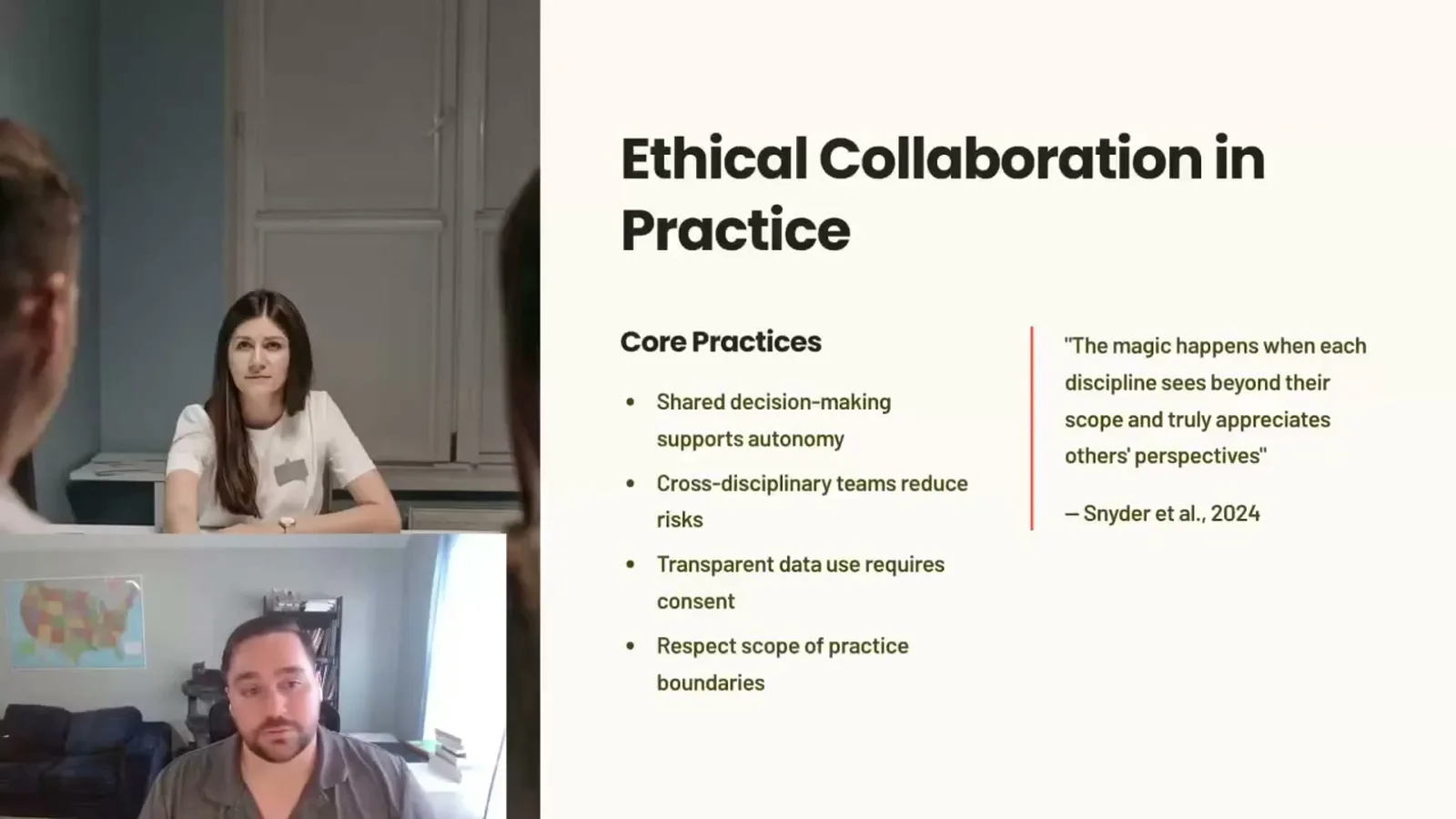
New Year, New Care Collab Goals
On this page · 8 sections▾
The real work of school collaboration usually happens outside the IEP room, in a fifteen minute teacher meeting that you bring coffee to. The IEP is for aligning goals on paper. The hallway, the email after dismissal, and the quick check-in by the classroom door are where you find out what is actually happening with your client at 10:45 AM on a Tuesday. If you are a BCBA (Board Certified Behavior Analyst) and you only ever talk to the teacher inside the IEP (Individualized Education Program) meeting, you are missing the part of the relationship that drives real change. School is the messy generalization setting your plan needs. The teacher is the person inside that setting all day. The IEP confirms the plan. The non-IEP relationship is how the plan actually gets used.
Why the IEP is not where the real collaboration happens#
The IEP meeting has a job. You walk in, you align goals, you get context on what the school team is seeing, and you sign your name. That is good and that work matters. But the IEP is a formal room. There are eight people on the call. The clock is running. The teacher is also thinking about the next student on her list, the lunch duty she has in twenty minutes, and the parent who is sitting two seats away. That is not the room where someone is going to brainstorm with you about why your client is melting down right after recess.
The non-IEP relationship is the one that lets you actually problem solve. It is the email you send the Wednesday after the IEP. It is the fifteen minute meeting before the bell. It is the quick text that says "hey, the visual schedule we talked about, did it land?" The IEP is one event a year. Real collaboration is a habit you build the other fifty-one weeks.
The classroom as your messiest, best generalization setting#
Most BCBAs treat the school like a problem. The data looks worse there. The behavior plan does not run as cleanly. The reinforcement schedule slips. There are twenty-two other kids in the room. The teacher cannot give your client a token every thirty seconds.
That is the point. That is the feature, not the bug.
School is the best generalization setting because it is completely uncontrollable. Every classroom I've ever been in, we don't have an ounce of the control that I would like. So it's the perfect generalization setting. School supplies you with a beautiful testing ground to see what is a resistant to change intervention and what only works when everything goes perfectly.
From the talk — Matt Harrington
If your plan only works in a quiet clinic room with one-to-one staffing, you do not have a plan. You have a demo. The classroom shows you the truth. A skill that holds up in a noisy room with one teacher and twenty-one peers is a skill the learner actually has. A skill that falls apart the second the reinforcement schedule changes was never strong in the first place. That is why teacher collaboration is worth the time it takes, even when control is low. Especially when control is low.
The teacher's playbook. and where you can actually add value#
Teachers are skilled. They are also tired, and they are running a classroom with limited tools. Most school teams default to a PBIS (Positive Behavior Interventions and Supports) playbook because that is what the building runs on. That is not a knock on teachers.
In most cases, teachers use the same playbook. School staff use the same PBIS playbook. Of course, there are folks who innovate, and I'm not trying to say that teachers are not skilled at what they do, but typically there's a few different strategies that they know has worked well. And if those don't work, they have to improvise.
From the talk — Matt Harrington
This is where you add value. Not by telling the teacher she is doing it wrong. Not by walking in with a sixty page behavior plan. You add value by saying "here is one strategy that worked for this kid in clinic last week, can we try a version of it in your room on Friday?" One strategy. One trial. Specific to her room. That is the bar. You are not there to replace the playbook. You are there to add one more page to it for this one student.
The coffee rule (and why it's not a gimmick)#
This sounds like a joke. It is not.
You should 100% bring coffee to the teacher. This is like my biggest hack with school collaboration. Bring Starbucks for the teacher. It's like the best way to get on their good side. It respects their time. It respects what they do. It is just an instant win. I've never had a teacher turn me down either.
From the talk — Matt Harrington
The coffee is not a bribe. The coffee is a signal. It says you know her day started at 6 AM, you know she has not sat down since the first bell, and you know the fifteen minutes she is about to give you is fifteen minutes she does not actually have. The coffee acknowledges all of that without you having to say a word. It also slows the meeting down for the first thirty seconds, which is exactly what you want. You want her to breathe. You want her to feel respected before you ask her to think.
Bring it. Ask her order ahead of time so you do not guess wrong. If you do not know her order, bring a black coffee and two sugars and an oat milk on the side. The point is the gesture, and the gesture should be specific.
What a 15-minute teacher meeting should cover#
Fifteen minutes. Not thirty. The teacher does not have thirty. Walk in with an agenda, hand her the coffee, and run the meeting tight.
Here is the split that matters. The IEP is for goals. The teacher meeting is for interventions.
When you're in the IEP, you're really looking to align goals and get a lot of context. When you're having those one-on-ones with the teachers, you're primarily looking to brainstorm interventions.
From the talk — Matt Harrington
So the agenda is short. Minute one to three is the coffee handoff and the human stuff. How is your week. How is the class. Real questions, short answers. Minute four to nine is one specific behavior or skill you want to brainstorm. Bring data, but bring one chart, not ten. Show her the pattern. Ask her what she sees in the room that matches or does not match. Minute ten to thirteen is the joint plan. Pick one thing to try. Pick when she will try it. Pick how you will both know if it worked. Minute fourteen to fifteen is the wrap. Thank her by name. Confirm the next check-in. Leave.
If you cannot do it in fifteen, you brought too much.
What to send the teacher afterward (and what to never send)#
Within twenty-four hours, send a one-page summary of the meeting. Not the behavior plan. Not the assessment. One page.
The one-pager has the learner's name at the top. Then three things. The one intervention you both agreed to try. The data point or behavior pattern that prompted it. The date you will check in next. That is it. No appendix. No graphs unless she asked for one. No fidelity checklist on the first send.
Never send a full behavior plan to a teacher cold. She will not read it. She will feel bad about not reading it. The next time you ask for fifteen minutes she will be slower to say yes. The one-pager is the deliverable. The full plan stays in your records and on the IEP. The teacher gets the one page she can actually use.
If the teacher emails back with a specific question, that is the moment to send more. Not before. Match the response effort to the relationship. The relationship is new. Keep your sends small.
When to loop the school psychologist in#
The school psychologist is usually one step removed from the day to day classroom but one step closer to the diagnostic and assessment side. You loop her in when the conversation moves past behavior management and into assessment. New testing on the table. A re-eval coming up. A question about whether the learner needs a different educational classification. Anything that touches the formal record of what this student needs from the building.
You do not loop the school psych in for every fifteen minute teacher meeting. You will burn her time and she will stop showing up. You loop her in when the decision the team is about to make is bigger than one classroom. The teacher knows what is happening Tuesday at 10:45. The school psych knows what the district will and will not approve. Use both. Use them at different moments.
Frequently asked questions#
Do I need administration's permission to meet with my client's teacher one-on-one?
Not usually, but you should give the school a heads up. The release of information has to be in place between your agency and the family. A short email to the teacher copying the principal or the case manager covers you. It says you are coming, it says when, and it says why. Most schools say yes. The schools that say no usually want the meeting to run through the case manager, and that is fine too.
What do I do if the teacher and the BIP disagree on consequences?
Treat it as a brainstorm, not a fight. You wrote the BIP (Behavior Intervention Plan) based on data you have. The teacher is responding based on what works in her room with twenty-one other kids. Both can be true. Ask her what she is seeing that is driving her approach. Share the data that is driving yours. Pick one piece of the consequence sequence to align on first. Get a small win. Build from there. If you walk in trying to win the meeting, you will lose the relationship.
Can I observe the classroom without being on the IEP team?
Sometimes. It depends on the school, the district, and the language in the release of information. Ask the case manager first. If yes, keep the first observation short, sit in the back, and do not take notes on other students. Send a thank you the same day with one specific thing you noticed that the teacher is doing well. That email is the start of the next conversation.
Closing the loop on school collaboration is the same as closing the loop on any care partner. Make it a habit. Bring the coffee. Keep the meeting short. Send the one-pager. Pick the next date before you leave the room. The relationship is the deliverable. Watch the full CEU above for the full care collaboration framework across all six partner types, plus the email templates Matt sends to teachers, SLPs, OTs, pediatricians, mental health providers, and psychiatrists.
Turn this topic into a CEU
You just studied this. Now get credit for it.
Watch New Year, New Care Collab Goals with Matt Harrington and earn 1 free BCBA CEU. Detailed certificate, delivered the moment you finish.