Reduced Psychological Safety on ABA Teams
What reduced psychological safety looks like on ABA teams, how punitive supervision teaches silence, and what leaders can do to rebuild trust.
Key takeaway
Reduced psychological safety is when team members stop feeling safe to speak up, ask questions, or admit mistakes. On an ABA team, that often means an RBT (registered behavior technician, the person who delivers most direct therapy) hides a data error.

Developing Team Culture Through Psychological Safety
Free learning path on this topic
Supervision, Done Right
Four supervision CEUs that build on each other. What reflective supervision is, how to build a supervision system, how to assess supervisee competence instead of counting hours, and how supervision affects provider outcomes. The BACB asks supervisors for three supervision CEUs per cycle. This covers it.
Experts who cover this
7 recordings on openceu cover reduced psychological safety.
- Featured talk1 Supervision CEU
Developing Team Culture Through Psychological Safety
Dr. Jessica OsosCopper Consulting Group
The core topic of the talk: psychological safety is defined via Amy Edmondson's research as a shared team belief that it is safe to take interpersonal risks…
- 1 Supervision CEU
Building a Supervision System That Actually Works
Lauren DonovanThe Behaviorist Bookclub
Framed as the foundation of the whole framework, psychological safety means a supervisee can bring questions and mistakes to a supervisor without fear of…
- 1 Supervision CEU
Teaching RBTs to Think Clinically: Training In-the-Moment Decision Making
Dr. Jessica Osos & Tauren KeelsCopper Consulting Group
Presenters tie compliance-based supervision to reduced psychological safety, where RBTs learn not to report problems because doing so is effectively punished…
- 1 Supervision CEU
So You Think You Can Lead, Ten Self Reflection Questions for Leaders in ABA
Sean YocumHickory Learning Group
Framed as the foundation of clinical quality: without psychological safety, teams can't speak up or grow. Yocum credits Kristen Byra (Upskill ABA) for pushing…
- 1 Supervision CEU
Reflective Supervision and Provider Outcomes in ABA
B. Kuereine GrayThe Behaviorist Bookclub
Gray links reflective supervision to an increased perception of psychological safety for supervisees, which she connects to professional identity development…
- 1 Supervision CEU
Foundations of Reflective Supervision in Behavior Analysis
B. Kuereine GrayThe Behaviorist Bookclub
Psychological safety, as it relates to clients, caregivers, stakeholders, and providers themselves, is named as one of the core elements distinguishing…
- 1 Ethics CEU
Cultural Considerations Across Teams, Systems & Practice
Makenzie SandlerThe Behaviorist Bookclub
Names reduced psychological safety, ineffective feedback loops, and misattributed performance issues as downstream harms when teams fail to recognize that…




On this page · 11 sections▾
Reduced psychological safety is when team members stop feeling safe to speak up, ask questions, or admit mistakes. On an ABA team, that often means an RBT (registered behavior technician, the person who delivers most direct therapy) hides a data error. Or they stay quiet about a plan that is not working.
This matters because ABA runs on honest information. Supervisors make treatment calls from the data and reports that staff bring them. When people feel it is risky to talk, that flow of information dries up. Clinical quality, staff morale, and retention all take the hit.
What reduced psychological safety looks like#
Dr. Jessica Osos starts with the basic definition. She draws on the work of Amy Edmondson, a Harvard Business School professor who named the idea in the late 1990s.
psychological safety is a shared belief that a team is safe for interpersonal risk-taking.
From the talk — Dr. Jessica Osos
An "interpersonal risk" is anything that could make you look bad in front of others. Asking a basic question is a risk. So is admitting you made an error, or saying you disagree with your supervisor. When safety is reduced, people stop taking those risks.
Osos gives a clear example from daily ABA work. An RBT realizes they took data wrong on a program. Maybe it comes up during a team meeting about how to take that data. If the RBT does not feel safe, they say nothing. The supervisor then analyzes that client's data without knowing part of it is wrong. A small silence turns into a bad treatment decision. That is what reduced safety looks like in practice. It is rarely loud. It is usually quiet people and missing information.
Why it puts clinical quality at risk#
Sean Yocum ties safety directly to the quality of care. He argues that true leadership in ABA is not about clinic size or caseload numbers. It is about building a place where RBTs feel safe to speak up and feel valued. He credits Kristen Byra of Upskill ABA for pushing this point hard in ABA leadership circles.
if your team isn't psychologically safe, your clinical quality is a house of cards.
From the talk — Sean Yocum
The image fits. A clinic can look strong from the outside. It can have polished programs and good-looking graphs. But if the people running sessions will not report problems, the whole structure rests on weak ground. Yocum is also clear that surface perks do not fix this. He says a quarterly pizza party is not the same as genuine psychological safety.
Osos makes the same point in her own words. She says safety is not a bonus feature for a team.
Psychological safety is not just nice. To have, it's really essential for team success.
From the talk — Dr. Jessica Osos
She explains that client needs in ABA are complex and change day to day. Teams need people who share ideas and admit mistakes so they can adapt. Without that openness, even talented teams struggle to reach their potential.
How punitive supervision teaches silence#
The talk "Teaching RBTs to Think Clinically," presented by Dr. Jessica Osos and Tauren Keels, shows how reduced safety is learned. The presenters compare two supervision styles. One is compliance based, where the rule is "what I say goes." The other is empowerment based, where staff are encouraged to notice and report.
They walk through the story of an RBT named Jordan. In the compliance-based setup, Jordan notices that something in the plan is not working. He brings it up. But the BCBA (Board Certified Behavior Analyst, the supervising clinician) does not reinforce that report. Over time, Jordan learns a lesson. The safe move is to follow the plan as written and say as little as possible. In the presenters' words, whenever he brings something up, that behavior is punished.
This is a behavioral view of reduced safety. Silence is not a personality flaw. It is learned behavior shaped by what happens after someone speaks. The presenters note that this kind of technician will not escalate issues. They will just "buckle in" and do what they were told, even when it is not working.
it all goes kind of back to psychological safety and creating this environment where decisions are reinforced
From the talk — Dr. Jessica Osos & Tauren Keels
In the empowerment model, Jordan gets reinforced for noticing patterns and reporting them clearly. He is also reinforced for in-the-moment decisions within his scope, even imperfect ones. Corrective feedback still happens, but it is delivered in a way that is not punishing. The goal is also to avoid people freezing in the moment.
Trust has to come before systems#
 Advertisement
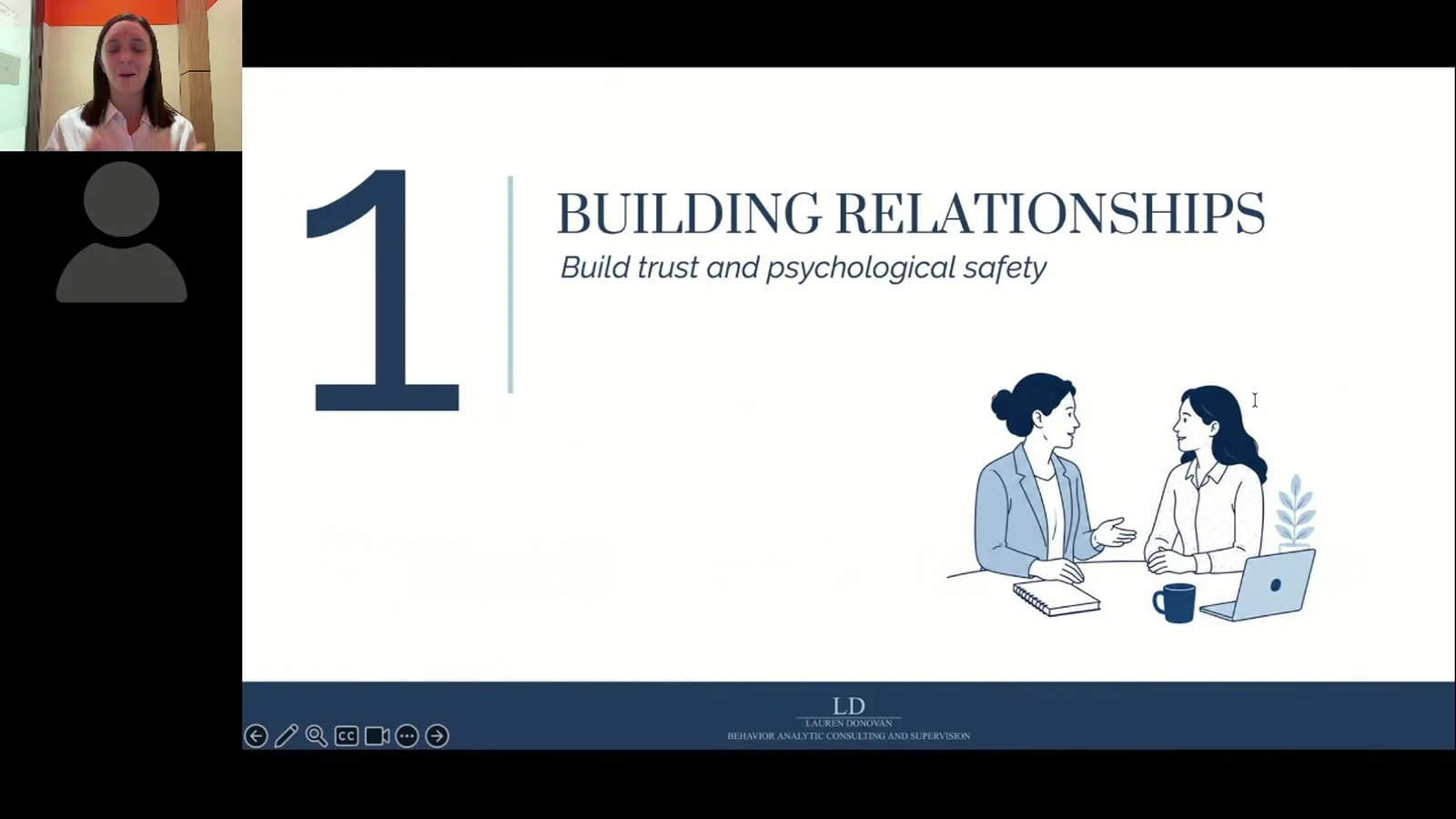
Lauren Donovan builds her entire supervision framework on this point. Before any tool or tracker, she says, the relationship has to be in place.
Before we talk about trackers and systems, or feedback, we have to build trust.
From the talk — Lauren Donovan
She defines the safety she wants in plain terms.
Psychological safety or the sense that a supervisor can come to you with questions and make mistakes.
From the talk — Lauren Donovan
Donovan adds that supervisees should be able to receive feedback without fear of being embarrassed or punished. She is honest that this is hard. Supervisors also need to hold staff to high integrity (doing the procedures the way they were written). Holding a high bar while keeping people safe takes effort.
Her answer is rapport building. That means checking in on people inside and outside of sessions. It means asking how they are and whether they have questions. She also suggests asking staff to point out things they want her to observe. Even small gestures count. She recalls offering staff a quick bathroom break during long stretches with students. These moments show staff that the supervisor is on their side. That makes later feedback easier to hear.
When culture differences get read as disrespect#
Makenzie Sandler adds an angle the other speakers do not focus on. She shows how reduced safety can grow from cultural misreadings, not just from harsh supervision.
Her example is a supervisor with a very direct style. A staff member from a different background, such as the rural South, might hear that same message as abrupt or even hostile. Sandler stresses that neither view is unethical or wrong. The same behavior is simply being perceived through different cultural expectations.
When teams miss this, the damage spreads.
now we can end up with... results maybe that are damaging supervision relationships or employee relationships, or maybe system wide relationships... Reduced psychological safety, ineffective feedback loops or feedback delivery, and just misattribution of performance issues.
From the talk — Makenzie Sandler
"Misattribution" here means blaming the wrong cause. Sandler describes a performance review where a self-rating and a supervisor rating differ on the same behavior. The gap may come from cultural variables, not poor performance. She warns that this can turn into "BCBAs against techs" or a loss of faith in leadership. Her fix is to recognize cultural influence behind perceptions and adjust accordingly.
Supervisors feel it too#
B. Kuereine Gray reminds listeners that safety is not only a staff issue. In her talk on reflective supervision, she lists understanding psychological safety as a core element. She applies it to clients, caregivers, other stakeholders, and providers themselves.
Gray shares a personal example. When a client is not responding well, she looks at her own behavior first. She asks whether she is avoiding something because of her own need to feel safe.
like oh it's been a hard day so I'm going to avoid this behavior.
From the talk — B. Kuereine Gray
She names fear as one of the behaviors she personally struggles with most. This matters for the topic. Reduced safety can shape a clinician's own choices, not only the choices of their staff. A tired supervisor who avoids a hard conversation may leave a stuck program in place. Gray connects these decisions to treatment outcomes, including how long treatment lasts. She also says she tries to model the behaviors she expects from others. Doing otherwise, she says, would be hypocritical.
The cost in burnout and turnover#
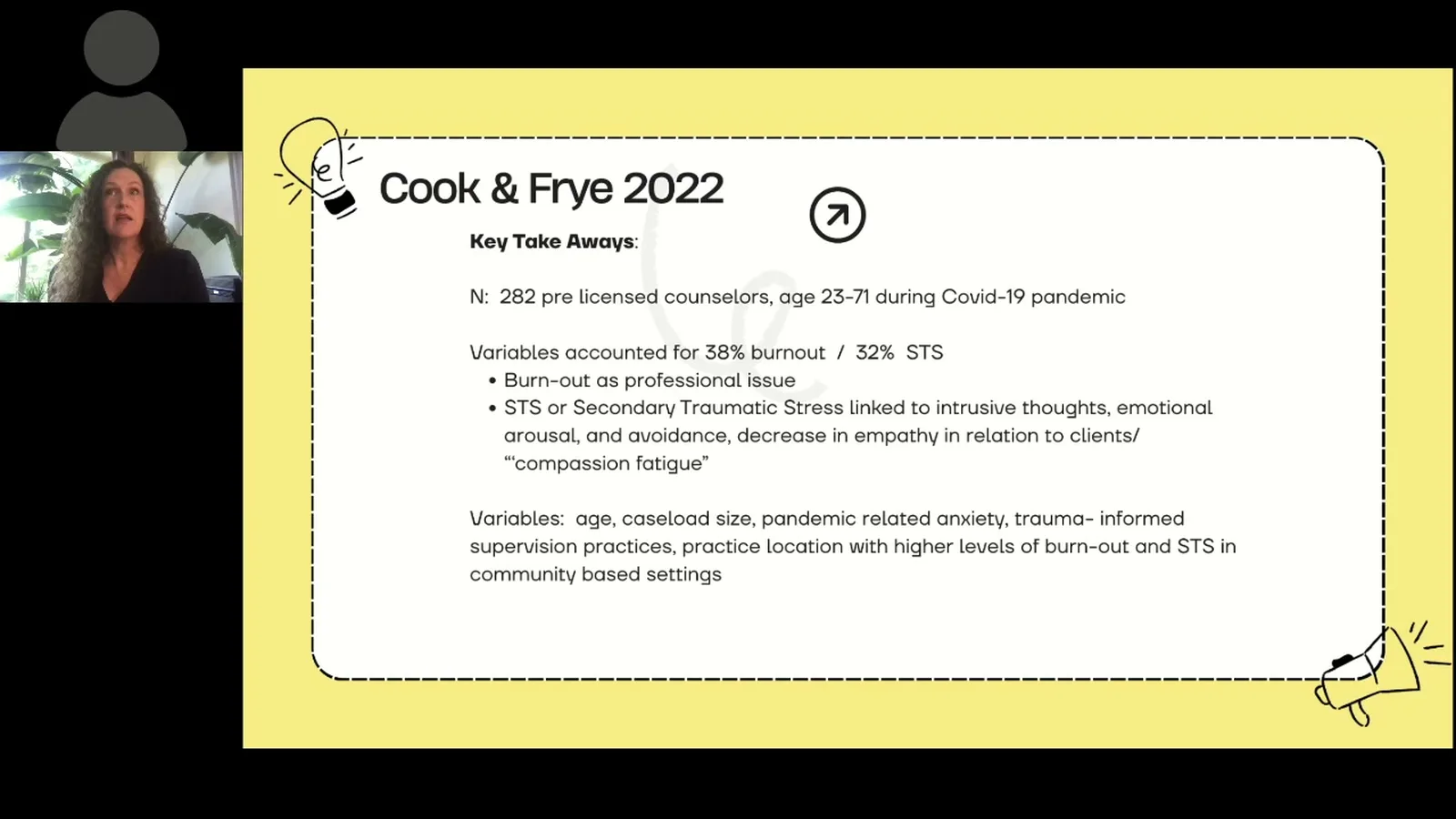
Several speakers link low safety to people leaving. Osos describes a model with four zones built from two factors. One is psychological safety. The other is motivation and accountability. When both are low, a team lands in the "apathy zone." People feel neither safe nor motivated. Engagement and performance drop, and this often leads to burnout or turnover.
Osos also says that teams with high safety tend to outperform teams without it. She notes it improves job satisfaction and reduces burnout, which helps keep skilled staff.
Gray makes the retention link from the other direction. She connects reflective supervision to how safe supervisees feel.
If reflective supervision Increases the perception of psychological safety, it increases the probability of developing professional identity, it increases your ability to engage both with your organization and your caseload.
From the talk — B. Kuereine Gray
"Professional identity" means seeing yourself as a real clinician with skills and judgment. Gray says these gains snowball into retention for an organization. Read in reverse, the message is clear. When safety drops, identity, engagement, and retention tend to drop with it.
Why the least safe person sets the level#
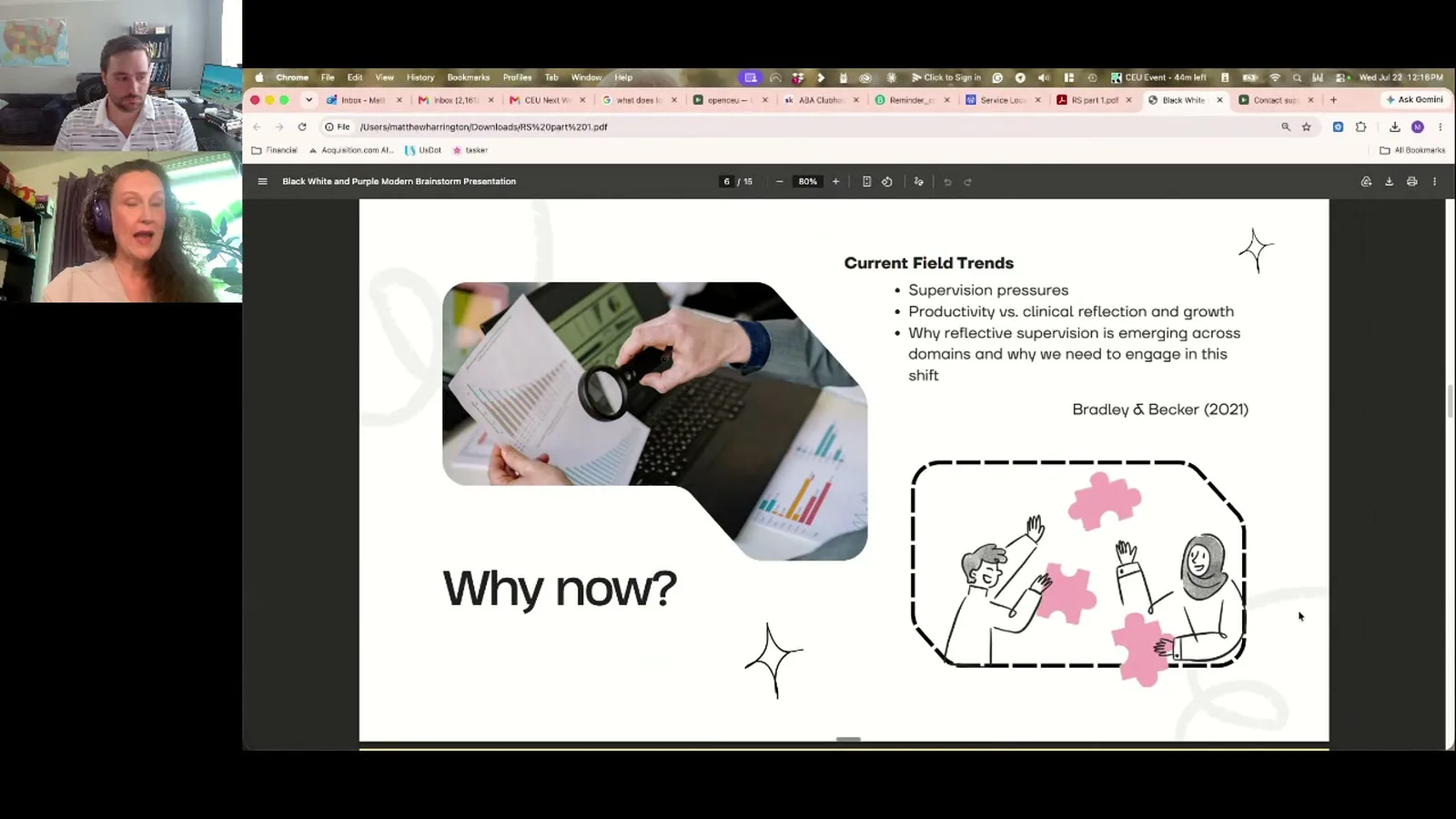
Osos makes a point that changes how leaders should measure this. Safety is not one number for the whole company. Each person has their own level of safety within a team.
a team is only as psychologically safe as its least safe.
From the talk — Dr. Jessica Osos
This means averages can hide real problems. A team with mostly comfortable veterans can still have new hires who are afraid to speak. Osos notes that new team members often feel less safe than people with longer tenure. She describes a path where a new hire starts out just hoping to feel included. With time, and with mistakes treated as learning instead of shame, they can build toward feeling safe to challenge ideas.
Osos recommends surveying teams and then closing the biggest gaps first. She adds a warning. Running a safety survey and then ignoring the results can actually harm psychological safety. It can also make future improvements harder. Leaders should review the written comments for issues that need attention right away, then take visible action.
How teams can rebuild safety#
Across these talks, a practical pattern appears. None of the speakers suggest a single quick fix. Instead, they point to steady changes in how supervisors respond.
First, build the relationship before the system. Donovan's rapport building comes before trackers and feedback plans. Second, reinforce reporting. The empowerment model in the RBT training talk rewards staff for noticing and sharing, even when their call was not perfect. Third, deliver correction without punishment. Explaining the "why" behind a different strategy keeps the door open.
Fourth, check for cultural misreadings. Sandler's advice is to ask whether a conflict comes from different expectations rather than bad intent. Fifth, supervisors should look at their own avoidance, as Gray describes. Finally, measure safety at the person level and act on what you learn, as Osos recommends.
For a step-by-step look at supervision structure, see Building a Supervision System That Actually Works.
What the research says#
The speakers here lean on a small set of research anchors. Dr. Osos traces the concept to Amy Edmondson, the Harvard Business School professor who introduced the term in a 1999 paper. Edmondson defined it as a shared belief among team members that the team is safe for interpersonal risk-taking. Osos reports that research finds teams with high psychological safety outperform those without it.
Gray points to a supervision framework from Wilkins. It holds that supervision must be reliable, supportive, available, and knowledgeable. It must also be trusted and respected. Gray adds that including social and emotional support requires supervision to be well structured. It should also focus on the provider as a human being with their own history of punishment and reinforcement.
Both frameworks point the same way. Safety is built by how supervisors respond, and it drops when that response feels like punishment. Readers who want the primary source should start with Edmondson's original work.
FAQ#
What causes reduced psychological safety on an ABA team? A common cause is supervision that punishes speaking up. When staff raise concerns and get ignored or corrected harshly, they learn to stay quiet. Cultural misreadings between supervisors and staff can also erode trust, as Makenzie Sandler describes.
How can you tell if an RBT does not feel psychologically safe? Watch for staff who say as little as possible and follow plans without comment. Other signs include hidden data errors, few questions, and no reports when programs stall. New hires are often the least safe people on a team.
How do supervisors rebuild psychological safety? Start with rapport before feedback systems. Reinforce staff for noticing and reporting problems. Give correction in a way that is not punishing. If you survey your team, act on the results so people see their input matters.
 Advertisement
Turn this topic into a CEU
You just studied this. Now get credit for it.
Watch Developing Team Culture Through Psychological Safety with Dr. Jessica Osos and earn 1 free BCBA CEU. Detailed certificate, delivered the moment you finish.
Keep going with a free learning path
Supervision, Done Right
Four supervision CEUs that build on each other. What reflective supervision is, how to build a supervision system, how to assess supervisee competence instead of counting hours, and how supervision affects provider outcomes. The BACB asks supervisors for three supervision CEUs per cycle. This covers it.