Foundations of Reflective Supervision in Behavior Analysis
Presented by B. Kuereine Gray
Cancel any time. Cert delivered to your inbox the moment you pass the quiz.
Learner ratings
from 87 learners
89% would recommend this CEU to other professionals in their field (56 responses)
“The presentation was informative and practical. It highlighted the importance of building supportive supervisory relationships, using reflective listening, and understanding how personal learning histories can influence supervision and clinical practice.”
— Yostena H.“Great talk!”
— Ashely B.“This unit was a little more dry than some of the others, but it was still helpful.”
— Amaria B.“good content”
— Dina G.“Good topic, hard to stay engaged.”
— Michelle K.
About this CEU
This foundational session defines reflective supervision and distinguishes it from administrative supervision in behavior analytic practice. Attendees will examine its core components and the research-supported benefits for provider functioning. The session connects reflective supervision to ABA supervision standards and ethical practice.
From the talk
What was covered
Reflective supervision in ABA: how it differs from admin supervision, its core skills, and what research says about provider burnout.
- Build rapport with the person you supervise before working through the task list. Trust drives growth in supervision the same way it drives progress in client care.
- Do not add supervision hours to fix burnout. The research Gray cited tied burnout to how good the support was, not how much of it there was.
- Name what you hear in tone, pitch, and body language, then ask the supervisee what sits under it.
- When a case stalls, ask the supervisee to picture the session from the learner's side before you change the program.
- Check your own avoidance when a program stalls: your past experience shapes your clinical choices too.
- Pick one repeated supervision conversation this week and shift it into a curious question.
What Reflective Supervision Is in Behavior Analysis
Reflective supervision (supervision that thinks about the work) is not a new form to fill out. It is a way of working with the people you supervise. The relationship comes first. Gray framed it as a partnership with a supervisee (the person you supervise). It is not a boss handing down jobs to an employee.
Gray made the case with a simple parallel. We know rapport (a trusting working relationship) matters before we place hard demands on a client. Good care starts with trust. That rule does not stop at the client. If rapport is the evidence based start of client work, it should also start supervision. The person being supervised needs the same footing.
The other mark of this model is curiosity. Instead of handing over the answer, you ask a question. Gray gives new clinical candidates one early task. They study their own patterns of behavior. They link those patterns to the functions of behavior (why a behavior keeps happening). The point is not theory. The point is to know your own barriers before a hard case finds them. Some candidates push back and ask for the answer. Gray holds the line, because a new analyst will soon walk into a home or a school alone.
It is collaborative in nature.
From the talk — B. Kuereine Gray
Reflective Supervision vs. Administrative Supervision
Administrative supervision (supervision aimed at tasks and paperwork) is the model most of us know. Gray listed what it sounds like. Are your billables done. Are the treatment plans in. Are the behavior plans on time. Are the safety plans current. Are staff assigned well. Are you supervising your own staff. The pressure points at productivity, money, and client outcomes.
None of that is wrong. Bills get paid so the work can happen. But Gray's point is what gets crowded out. Clinical growth drops off the agenda. So does social validity (does the result matter to people). So does the process of getting to the outcome, not just the outcome itself.
Gray tested this live with the room. Attendees wrote one word for their own supervision history. Supportive, helpful, and collaborative came up. So did rushed, limited, inconsistent, unfocused, and intimidating. One person described a chunk of their fieldwork hours as forgettable and sporadic. The mix says a lot. Plenty of us were trained by people with no time to think out loud with us.
Did you do all your things? Great, you're great employee
From the talk — B. Kuereine Gray
What the Research Says About Supervision and Burnout
Gray was direct about the evidence. Most of it does not come from ABA. Our field is young and has not studied supervision models much. We know behavior skills training (tell, show, practice, then give feedback) teaches skills well. We know far less about how to supervise the people who do the teaching. So Gray went to fields that have studied it longer.
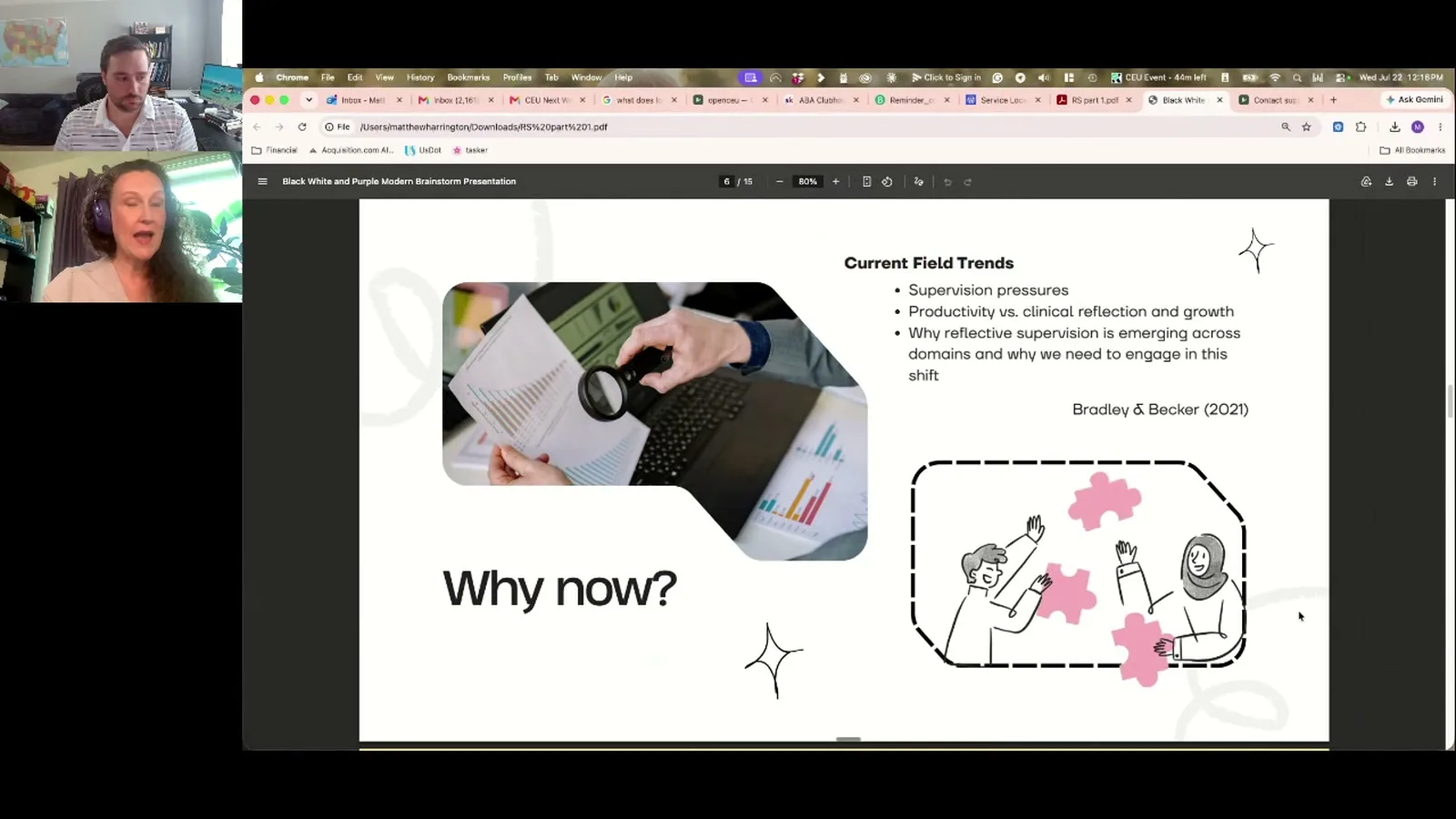
Bradley and Becker ran a meta analysis (a study that pools many studies) in 2021. They started with 119 peer reviewed studies of supervisory characteristics. They used PRISMA guidelines (a standard method for review work). They coded each study by the strategies used, then weighted it by research strength. Reversal designs (pull the treatment, then restore it) scored highest. Studies with comparison groups but no control scored lower. Single subject and uncontrolled work scored lowest.
The coded strategies read like a supervision menu. Acknowledging competency. Action planning. Agenda setting. Case conceptualization (how you frame the whole case). Case management. Collaboration. Corrective feedback. Empathy. Goal setting. Modeling. Praise. Relationship building. Reviewing provider data. Role play. Strengths identification. Values clarification. The highest frequency wins clustered around a few strategies. They were discussing the intervention, role play, corrective feedback, having an agenda, and case conceptualization.
The takeaway Gray stressed was counterintuitive. Time did not matter much. The amount and frequency of supervision was not tied to burnout, well being, or job satisfaction. Quality was. Perceived emotional support and instrumental support (hands on help with the work) buffered emotional exhaustion.
The supervisory relationship. is critical for provider well-being.
From the talk — B. Kuereine Gray
Who Actually Practices Reflective Supervision Today
Gray also walked through a 2022 report from the Office of Planning, Research and Evaluation. It found reflective supervision in use by a small slice of providers. Most of them sit in early intervention and mental health. Some work in home visiting. Some work in infant and early childhood programs. Some are in child welfare and social work. It is not in broad use, even though the research supports it. Bradley and Becker looked at mental health practitioners for the same reason.
The reported gains land on provider functioning. Providers feel more effective. They act with more independence. They make their own clinical calls. They understand complex interventions and run them without a hand on their shoulder. They take on a wider range of clients and outcomes.
Gray also framed the payoff in three time frames: immediate, intermediate, and distal outcomes (results that show up later). Providers start to see programming as a whole. They stop fixing one problem at a time. They start asking what the plan means for a learner across a lifetime. That is the work behavior analysis says it wants.
Reflective Listening Is Not Just Active Listening
Reflective supervision is hard to pin down. Gray said so plainly. But the parts can be taught. The first part is reflective listening (listening that names what you hear). Gray asked the room to split plain listening from the real thing. The answers were sharp. Listen to understand, not to reply. Pause and paraphrase. Ask curious follow up questions. Ask for details. Say how you read what was said. Listen without judgment. Look at the person, not a phone or a screen. Nod, and use your own nonverbals.
Gray added the layer on top. Track the pattern, not just the sentence. Notice when the same issue comes up for the third time. Notice prosody (the rise and fall of speech). Notice a change in tone or pitch. Notice the body language shift that shows up on one topic only. Then say it out loud and ask what is underneath.
The trap Gray sees most in supervisors is common and human. We summarize well, which is good. But we wait for our turn to talk. Reflective listening asks you to give that turn up for a while.
I see that this is having an impact on you.
From the talk — B. Kuereine Gray
Perspective Taking and Curious Questions in Case Review
Every supervisor knows the stuck case script. The client is not responding. I tried this. I tried that. Nothing works. Gray described the loop that follows. The provider runs another change, it fails, and frustration builds. Nobody breaks the cycle, because nobody steps outside it.
Perspective taking (seeing it from their side) is how Gray breaks it. Name the frustration first. Then ask the supervisee to picture the setting. What does this look like in that home. What does it look like around that caregiver, or that staff member, or that room. What might the learner be reading in the moment.
There is a technical reason this works, not just a warm one. We can build false histories of punishment or reinforcement that we never planned for. Those histories live in the setting, not in the plan. A curious question surfaces them. The third core part works the same way. Do not stop at what to try next. Ask why that option, and what reasoning led there.
Let's be curious about this.
From the talk — B. Kuereine Gray
Parallel Process: Your Learning History Comes to Session
The last core part is parallel process (one relationship mirrors the other). Providers keep growing while learners keep growing. Things come up for us during a course of care. Left unnamed, those things shape the service we give.
Gray built the argument from our own science. We would never expect a learner to handle a setting event (something earlier that changes behavior) with no support. We plan buffers. We look at learning history (past events that shape behavior). We adjust. Then we walk into supervision and expect ourselves to have none of that. Gray put it simply: we are not bots. Criticism of the field sometimes calls us robotic. We are people with histories, and we cannot leave them at the door.
Gray gave a personal example. When a program stalls, look at your own behavior first. Ask what you are doing. Ask what barriers are yours. Ask if you are avoiding a hard conversation on a hard day. That is escape maintained behavior (behavior that avoids a hard thing) in a supervisor's chair. Psychological safety (feeling safe to speak up) applies to you, the supervisee, the caregiver, and the client. Name the past events that make you flinch. Then build a buffer, so the flinch does not set the clinical course.
Is it that I am looking at my psychological safety like oh it's been a hard day so I'm going to avoid this behavior.
From the talk — B. Kuereine Gray
Using Reflective Supervision with RBTs, Peers, and Caregivers
Someone asked if this only works with clinical candidates. It does not. Gray uses these tools with RBTs (registered behavior technicians). She uses them with colleagues and in team meetings. She also uses them in caregiver training, which surprises people.
Caregiver training is a good fit for a plain reason. In the moment, a caregiver cannot take a small learner's perspective. The moment is too loud. But training time is calm. In a supportive and nonjudgmental space, you can walk through what may be happening. You let the caregiver arrive at the change instead of assigning it. Gray links that to buy in, and buy in to higher treatment fidelity (how closely the plan is followed).
Gray closed with homework worth doing. If you supervise, pick one conversation this week and shift it toward reflection. If you are supervised, name one repeated conversation you want changed, and ask for it. Either way, pick one reflective question to try on your own caseload. One attendee offered a strong one. What barriers came up this week, and how can I support you through a similar one next week? Skills fade without practice. That is as true for supervisors as it is for learners.
It's really difficult to never have exposure.
From the talk — B. Kuereine Gray
Common questions
What is reflective supervision in ABA?▾
It is a supervision model built on the relationship between supervisor and supervisee rather than on a task list. The core parts are reflective listening, perspective taking, exploring the reasoning behind clinical decisions, psychological safety, and parallel process. The supervisor asks curious questions instead of handing over answers. Gray calls it hard to define but possible to teach through those specific behaviors.
How is reflective supervision different from administrative supervision?▾
Administrative supervision checks billables, treatment plans, behavior plans, safety plans, and staffing. It is the traditional model and it is built around productivity and deadlines. Reflective supervision keeps that work but adds space for clinical growth and the process behind the outcome. One asks if you finished the list. The other asks what you are thinking and why.
Does more supervision time reduce burnout?▾
According to the meta analysis Gray presented, no. The amount and frequency of supervision was not related to burnout, well being, or job satisfaction. What mattered was the quality of the relationship and the emotional and hands on support the provider felt they had. That support is what buffered emotional exhaustion.
Is reflective supervision evidence based in behavior analysis?▾
Most of the research comes from outside ABA, which Gray addressed head on. Our field is young and has done little research on supervision models. The evidence she cited comes from two sources. One is a 2021 meta analysis by Bradley and Becker, which focused on mental health practitioners. The other is a 2022 report from the Office of Planning, Research and Evaluation. Applying it to ABA means operationally defining the practices for our own work.
Can you use reflective supervision with RBTs and caregivers?▾
Yes. Gray uses these tools with RBTs, with colleagues in team meetings, and during caregiver training. Caregiver training works well for a simple reason. Training time is calm, which makes it easier to take the learner's perspective. That is hard to do in the moment itself. She links that approach to stronger buy in and better treatment fidelity.
About the speaker
B. Kuereine Gray has worked in the field of disabilities since 1997. She became certified in 2007 and is the first licensed behavior analyst in the state. Gray is a clinician and a small business owner. She works as an infant and early childhood and family mental health specialist, and as a reflective supervisor. Gray is also a parent of children with special needs. Her background includes clinical work, advocacy, expert testimony, supervision, and consulting. This session is part one of a three part series on reflective supervision in behavior analysis.
This summary was generated from the recording’s transcript. Quotes are taken word for word from the talk.
What you'll learn
- 1-Define reflective supervision and differentiate it from administrative supervision -Describe the core components of reflective supervision -Identify research-supported benefits for provider functioning -Explain relevance to ABA supervision standards and ethical practice
Concepts in this CEU
Related talks
Talks that cover the same concepts
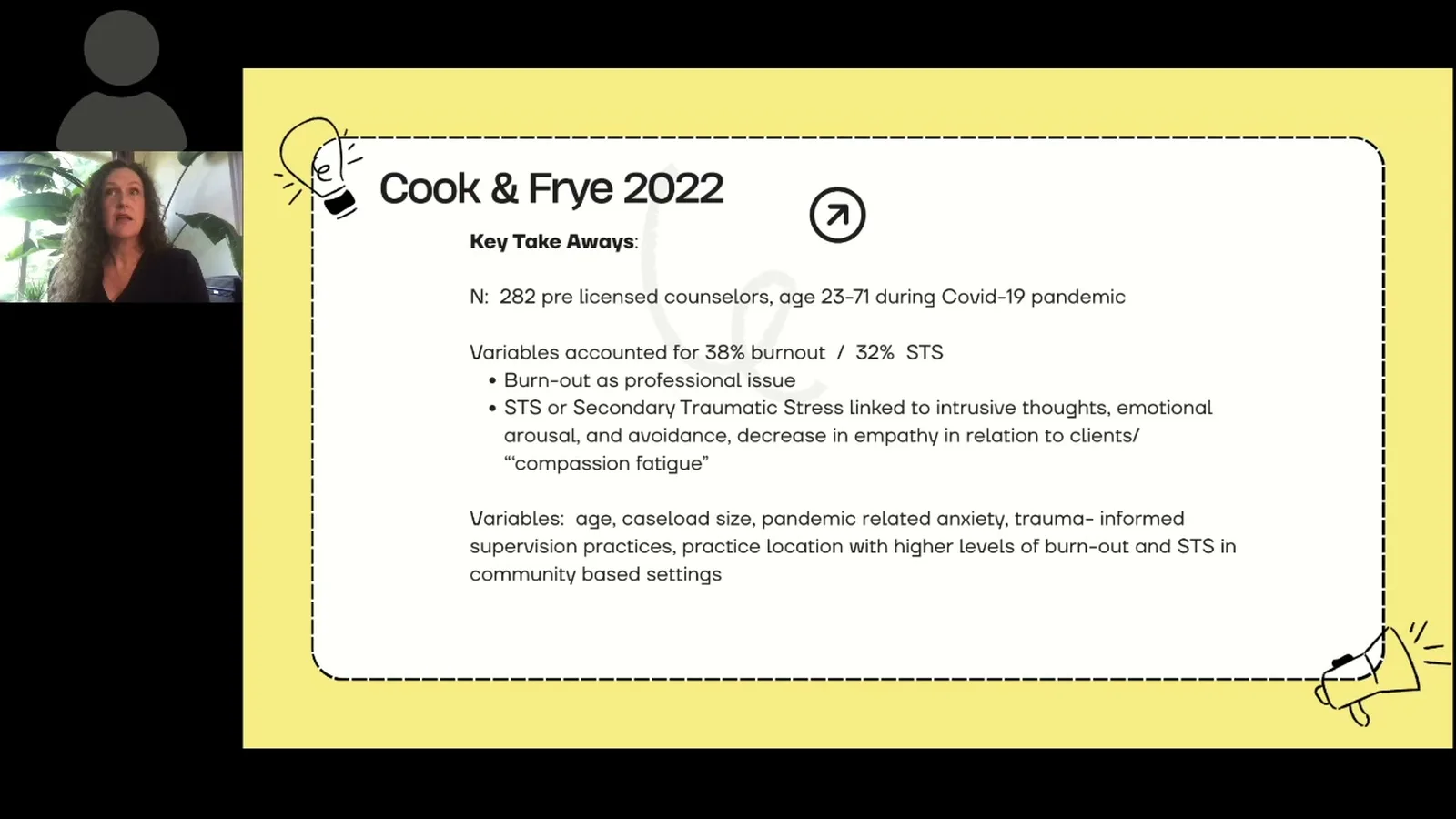
Reflective Supervision and Provider Outcomes in ABA
The Behaviorist Bookclub

Reflective Supervision and Client Outcomes
The Behaviorist Bookclub

So You Think You Can Lead, Ten Self Reflection Questions for Leaders in ABA
Hickory Learning Group
Leadership Alignment in Supervision
Behavioral Wellness Coaching, LLC

Developing Team Culture Through Psychological Safety
Copper Consulting Group

Teaching RBTs to Think Clinically: Training In-the-Moment Decision Making
Copper Consulting Group
More from The Behaviorist Bookclub
Harm Reduction Within ABA Practice
The Behaviorist Bookclub
Supervising Beyond Technical Skills: Professionalism, Communication, and Clinical Judgment
The Behaviorist Bookclub
When the Foundations Are Right: Unlocking Advanced Verbal Repertoires
The Behaviorist Bookclub
OpenCEU is supported by advertising from third-party sponsors. Sponsors are clearly labeled, have no influence over course content, instructors, or CEU decisions, and never appear on certificates. The BACB does not sponsor, approve, or endorse OpenCEU sponsors or their products.